Toby Young

Toby Young

Toby Young is associate editor of The Spectator.

David Cameron is more authentic than Boris Johnson

From our UK edition

I don’t recall exactly when I first met David Cameron, but it must have been in Oxford in 1985 shortly after the beginning of Michaelmas term. I was a third year at Brasenose studying PPE and he was a first year, also doing PPE. I remember him being friendly and down to earth and canny enough to keep his political views to himself. At the time, Brasenose was dominated by a group calling itself the ‘left caucus’ and while it wasn’t social suicide to be identified as a Tory, it was a bit infra dig. After Cameron twigged that we were both ‘in the closet’, so to speak, he confessed to me that he was a Thatcherite. ‘Dry as dust,’ he whispered.

Two faces of a single calamity: how the war against inequality backfired dramatically

From our UK edition

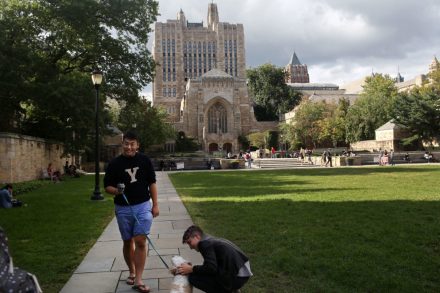
In 2015, Daniel Markovits, a professor at Yale Law School, delivered a commencement address to that year’s graduating class in which he attacked the idea of meritocracy. It was, he said, a gilded cage that imprisons the elite and leaves the rest feeling excluded and undervalued. For Markovits to make these remarks at one of the cathedrals of the meritocratic church — students at Yale typically score above the 99th percentile in the nationwide Law School Admissions Test — was a kind of heresy and it attracted enough attention for him to secure a book deal. Four years later, The Meritocracy Trap is the result.

How John Bercow saved me from Short Man Syndrome

From our UK edition

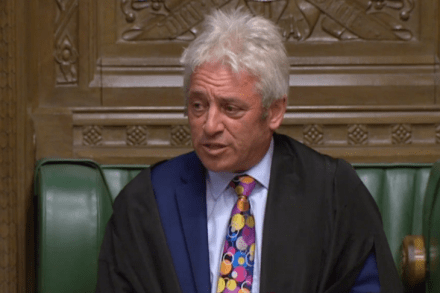
I think my colleagues on the pro-Brexit side of the aisle have been a little unkind in their response to John Bercow’s announcement that he’ll be standing down as chief referee in the House of Commons. Yes, he’s clearly done everything in his power to make life as difficult as possible for those MPs who want to implement the result of the 2016 referendum. Yes, his attitude to parliamentary precedent has been completely inconsistent, citing obscure, supposedly binding conventions to obstruct Brexiters one minute, then casually disregarding longstanding constitutional conventions the next. And, yes, the language he uses to express his contempt for any Conservative MP who so much as grimaces at one of his nakedly partisan rulings is unparliamentary, to put it mildly.

John Bercow’s nauseating farewell

From our UK edition

I didn’t think the smug triumphalism of the Remainer Alliance could get any more nauseating, but this afternoon it did. I’m thinking of John Bercow’s announcement that he’s stepping down as Speaker of the House of Commons and the 90+ minutes of sycophantic tributes from all those MPs who think the electorate made a grave mistake in voting to leave the European Union. Honestly, the Conservatives should produce a highlight reel and release it as a Party Political Broadcast during the next General Election campaign. Here was the political class in Westminster at its worst – lavishing praise on the Speaker because they’re so appreciative of his efforts to obstruct the will of the British people.

The political pact that could save Brexit

From our UK edition

If there is to be an election before we leave the European Union, some kind of non-aggression pact between the Tories and the Brexit party is essential. Without it, the risk is all too obvious: that pro-Brexit voters will be divided, allowing pro-Remain candidates to win, even in some constituencies where a clear majority are in favour of leaving. A case in point is Boris Johnson’s constituency. Uxbridge and South Ruislip is in the London borough of Hillingdon, where 56.37 per cent of votes cast in the 2016 referendum were for Leave. But his majority in 2017 was only 5,034, and if the Brexit party fields a candidate against him — particularly if some of the pro-Remain parties decide to stand down in favour of Labour — there’s a chance he’ll lose.

Corbyn, not Boris, was the real loser on Tuesday

From our UK edition

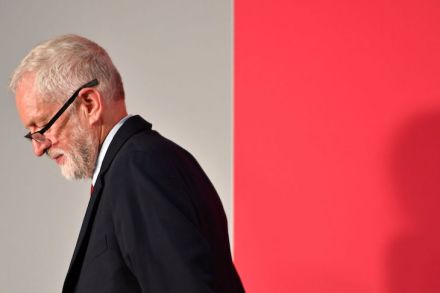
The Remainers are celebrating after Tuesday night's defeat of the government and writing Boris off as a busted flush. ‘Johnson’s Brexit strategy in ruins as anti-no deal MPs inflict defeat,’ says the headline on this morning’s FT. But I’m not convinced this was such a bad night for the Prime Minister. Boris’s response to Tuesday's loss has been to table a motion calling for a general election. Corbyn’s position, as I understand it, is that he will only agree to an election after the ‘anti-no deal bill’ forcing Boris to ask for an extension of the Brexit deadline on 19 October has been approved by both Houses of Parliament. (Boris refers to it as ‘Jeremy Corbyn’s surrender bill’.

Must try harder: education is still a vote loser for the Tories

From our UK edition

The reluctance of the Conservative party to take credit for the success of its education reforms is a source of increasing bewilderment to me. With each passing year, the A-level and GCSE results of free schools and academies provide yet more evidence that liberating state schools from the dead hand of local authority control has had a transformational effect — and 2019 is no exception. Free schools such as the London Academy of Excellence in Stratford and Michaela Community School in Wembley have chalked up some of the best results in the country, while academy chains such as the Harris Federation and the City of London Academies Trust have cemented their places at the top of the league table. Yet, incredibly, education is still a vote loser for the Tories.

The Royal Mint’s transphobic decision to snub Enid Blyton

From our UK edition

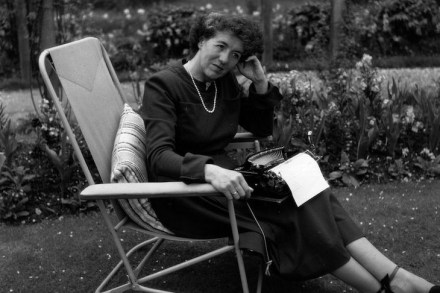
Who knew the Royal Mint, of all places, had been captured by the cult of political correctness? According to the Mail, the Mint’s Advisory Committee decided not to put Enid Blyton on a 50p coin to commemorate the 50th anniversary of her death because she is 'a racist, sexist, homophobe and not a very well-regarded writer'. That’s an odd statement, since it suggests that had she been a better-regarded writer, her racism, sexism and homophobia would have been overlooked. Perhaps that’s the Mint’s rationale for not removing Charles Dickens and William Shakespeare from the £10 note and £20 note respectively, in spite of their liberal use of anti-Semitic caricatures.

I’m back on the ‘public humiliation diet’ – thanks to my kids | 26 August 2019

From our UK edition

I’m on holiday with my family in Turks and Caicos, and maintaining my current weight is proving difficult. Regular readers will recall that I lost about half a stone at the beginning of 2018, after an army of offence archeologists started sifting through everything I’d written, dating back more than 30 years, looking for evidence that I was an unsuitable person to be involved in education. Since then, this type of inquisition has become much more common — scarcely a day passes without someone being defenestrated from public life on account of having said or done something imprudent in the past — but 18 months ago it was sufficiently distressing to cause rapid weight loss.

I’m back on the ‘public humiliation diet’ – thanks to my kids

From our UK edition

I’m on holiday with my family in Turks and Caicos, and maintaining my current weight is proving difficult. Regular readers will recall that I lost about half a stone at the beginning of 2018, after an army of offence archeologists started sifting through everything I’d written, dating back more than 30 years, looking for evidence that I was an unsuitable person to be involved in education. Since then, this type of inquisition has become much more common — scarcely a day passes without someone being defenestrated from public life on account of having said or done something imprudent in the past — but 18 months ago it was sufficiently distressing to cause rapid weight loss.

Labour is shooting itself in the foot

From our UK edition

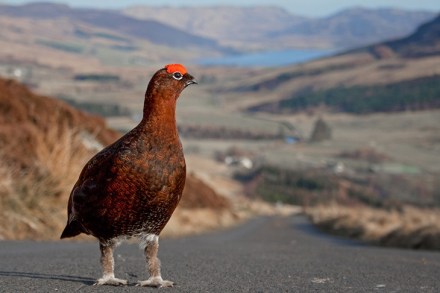
The Glorious Twelfth this year, signalling the start of the grouse-shooting season, was overshadowed by a Labour party press release demanding a ‘review’ into driven shooting. Labour’s shadow environment secretary Sue Hayman left people in little doubt as to what she expected this review to conclude. ‘The costs of grouse shooting on our environment and wildlife need to be properly weighed up against the benefit of landowners profiting from shooting parties,’ she said. ‘For too long the Tories have bent the knee to landowners, and it’s our environment and our people who pay the price.’ Needless to say, this is all virtue-signalling nonsense. For a start, the shooting industry imposes no ‘costs’ on the environment.

Donald Trump isn’t to blame for America’s mass shootings

From our UK edition

The BBC’s flagship news and current affairs programme wasn’t in any doubt about who to blame for America’s latest bout of mass shootings. Newsnight’s report began with footage of Donald Trump addressing the faithful at a rally. ‘This is an invasion,’ he warned, referring to the refugees massing on the Mexican border. ‘When you see these caravans starting out with 20,000 people, that’s an invasion.’ It then cut to Emily Maitlis in the studio. ‘That was in May,’ she said. ‘Today, Donald Trump called on Americans to condemn racism, bigotry and white supremacy.

America’s shootings aren’t Trump’s fault

From our UK edition

The BBC’s flagship news and current affairs programme wasn’t in any doubt about who to blame for America’s latest bout of mass shootings. Newsnight’s report began with footage of Donald Trump addressing the faithful at a rally. ‘This is an invasion,’ he warned, referring to the refugees massing on the Mexican border. ‘When you see these caravans starting out with 20,000 people, that’s an invasion.’ It then cut to Emily Maitlis in the studio. ‘That was in May,’ she said. ‘Today, Donald Trump called on Americans to condemn racism, bigotry and white supremacy.

Should the Brexiteers try and form an electoral pact?

From our UK edition

In the wake of the Lib Dems’ victory in last week’s Brecon and Radnorshire by-election, there’s been a lot of talk on the Remain side about the need for an electoral pact between the anti-Brexit parties. After all, the Lib Dem candidate only beat the Conservative incumbent by a margin of 1,425 votes, so wouldn’t have won if the Greens and Plaid Cymru hadn’t agreed to stand down.

The arresting truth about snowflakes

From our UK edition

I was driving to Gunnersbury Park last Sunday for my weekly 10K run when I caught the tail end of Broadcasting House on Radio 4. The presenter Paddy O’Connell was interviewing George King, the 19-year-old who scampered up the Shard at the beginning of July without the aid of ropes or suction cups. As you’d expect, he was impressive. He first set eyes on Britain’s tallest building as a 13-year-old on a school trip and decided then and there that he wanted to climb it. He embarked on years of rigorous training, taking up boxing and running a 62-mile ultramarathon.

If you want a Boris backer, book me

From our UK edition

The changing of the guard at 10 Downing Street always creates opportunities for the commentariat. I don’t just mean it gives them something to talk about for the next week or two; it also provides a chance for reinvention and renewal. Suppose you have been a relentless critic of Brexit for the past three years, convinced the British public made a catastrophic mistake. You’ve been pushing that line day in, day out, whether reviewing the papers for Marr or as a panellist on Politics Live. And let’s face it, you’re a little bit bored of hearing these same arguments coming out of your mouth. Well, the good news is, you can now change tack. You can join the Boris bandwagon and become a born-again Brexiteer.

I’m starting a trade union for intellectuals

From our UK edition

I have just returned from Minneapolis after attending the annual conference of the International Society for Intelligence Research. That’s ‘intelligence’ in the sense of general cognitive ability rather than spooks. It’s the third time I’ve gone, having been asked by the society to give a lecture in 2017 (a different journalist is invited each year to talk about how to improve the public understanding of the field). There are a lot of myths floating around about intelligence, such as the belief that IQ isn’t real.

Why has Gary Lineker been appointed a visiting fellow at Oxford?

From our UK edition

Congratulations to Gary Lineker OBE, who has just been appointed a visiting fellow to Lady Margaret Hall, an Oxford college. This coup was announced on Twitter earlier today by Alan Rusbridger, principal of LMH and ex-editor of the Guardian: Lineker is among nine new fellows appointed by LMH, with Emma Watson becoming an associate fellow, having served as a visiting fellow from 2016-19 “with particular emphasis on promoting gender equality and women’s rights”, according to the college’s press release. That’s Watson, not Lineker, who might have struggled to reconcile that with his refusal to take a pay cut as the BBC’s highest-paid star – he earns £1.75 million a year – to redress the corporation’s gender pay gap.

Boris and The Sextator farce

From our UK edition

Fourteen years ago, almost to the day, Lloyd Evans and I received a note from Boris. It was the press night of Who’s The Daddy?, our play about the various sex scandals that had engulfed The Spectator in the previous 12 months, and we were terrified about how he’d react. As the editor of the magazine, he would have been within his rights to sack us, given how disloyal we’d been. We had portrayed him as a sex-mad buffoon with a portrait of Margaret Thatcher on his office wall that turned into a pull-down bed — in constant use throughout, needless to say. Not only that, but we’d sent up numerous other members of staff, including Kimberly Fortier, the publisher, Petronella Wyatt, the deputy editor, and Rod Liddle, the magazine’s star columnist.

The disastrous decline of Scottish and Welsh education

From our UK edition

I’ve contributed a chapter to an education book published this week by the Institute of Economic Affairs. I was asked by the editors, Pauline Dixon and Steve Humble, to assess the impact of Britain’s education reforms, beginning with the introduction of the National Curriculum in 1988, extending through the creation of league tables in 1992 and culminating with the opening of academies and free schools from 2002. The first challenge was finding a reliable way to measure the effect of these initiatives. The introduction of the National Curriculum coincided with the replacement of O-levels and CSEs with GCSEs, making it difficult to compare before and after.