Tobias Grey

Brief encounter | 22 June 2017

From our UK edition

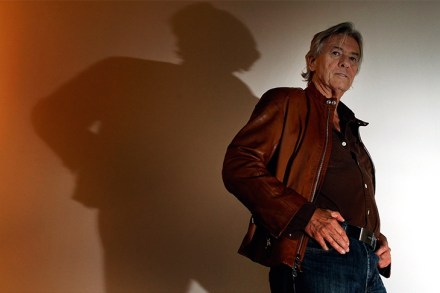
How do you follow a film like Shoah? The nine-hour Holocaust documentary, released in 1985 after 11 years of work and 350 hours of interviews — with survivors and perpetrators, saviours and collaborators, historians and bystanders — is considered one of the greatest films ever made. For decades, director Claude Lanzmann kept returning to the subject, raking over the same material, finding it impossible, maybe indecent, to move on. Of the five documentaries he has made since Shoah, four were substantial footnotes to the original, extended — and often extraordinary — out-takes from the acres of unused footage. But Lanzmann did have an answer to the question of what to do next — even though it sounded like a joke.
Impeccable filmmaking from Michael Haneke: Happy End reviewed

From our UK edition

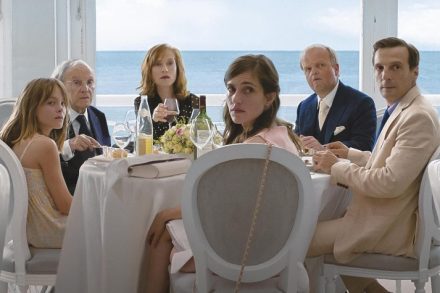
The title is ironic. The end is not happy for Michael Haneke's bourgeois French family, whose hamper of festering secrets the Austrian director unpacks with glee. His twelfth feature, which is vying for an unprecedented third Palme d’Or at this year’s Cannes Film Festival, features an acting masterclass from French veteran Jean-Louis Trintignant as Georges Laurent, a dotty patriarch who has lost the will to live. For added piquancy Haneke has set his latest tale in the northern French city of Calais where po-faced immigrants stroll silently about the streets - their lack of menace no doubt intended as a counterpoint to the dastardly doings of the Laurent family.

Amusing, waspish take-down of Jean-Luc Godard: Redoubtable reviewed

From our UK edition

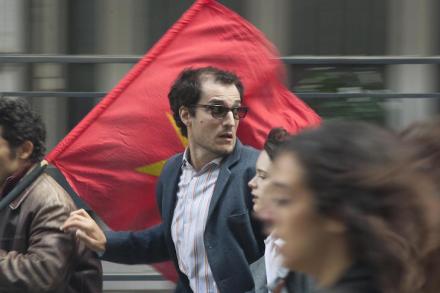
Jean-Luc Godard’s famous dictum was: 'all you need for a movie is a girl and a gun'. In Redoubtable, French director Michel Hazanavicius’s jaunty biopic of Godard, set during the student insurrection of 1968, which premièred yesterday at Cannes Film Festival, there is plenty of the first and none of the latter. The girl is Anne Wiazemsky, Godard’s teenage bride and one-time muse, who wrote an elegant memoir of their time together, Un an après, which is the basis for Hazanavicius’s film. Wiazemsky’s role is taken by French-English actress Stacy Martin who reveals almost as much flesh here as she did in Lars von Trier’s Nymphomaniac.

Revolutionary road

From our UK edition

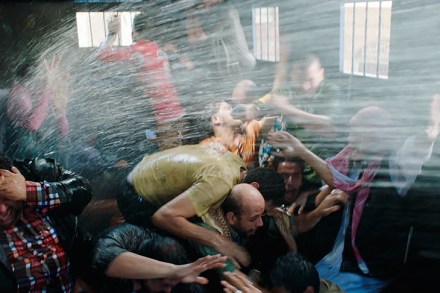
Cairo is deceptively calm, says Egyptian film-maker Mohamed Diab. ‘People were so scared from the fighting in the streets that now all they want is stability at any price,’ he explains. ‘But if you look closely at the situation, it’s worse than it was with Mubarak in charge when it comes to freedom of speech, freedom of the press and human rights.’ It’s not turned out quite how Diab had hoped. In 2010 he directed Cairo 678, a riveting film that in hindsight seemed like a premonition of what was to come.

His dark materials | 16 March 2017

From our UK edition

The enticingly subversive films of Paul Verhoeven were very tempting to me as a schoolboy. When I hit 14, the Dutch director released RoboCop and the excitement among me and my friends at catching two hours of unmitigated ultra-violence reached fever pitch. He did not disappoint. That was in 1988 and it was interesting later on to read several newspaper articles accusing Verhoeven of having made a fascistic screed in favour of zero-tolerance law enforcement. This was not something any of us had considered up to that point, but satire, yes, even back then we had an inkling of what that was and RoboCop seemed to fit the bill nicely. Verhoeven’s latest movie Elle (reviewed by Deborah Ross last week) shows the old powers haven’t waned.

In defence of the Jacobins

From our UK edition

The French Revolution ushered in not only a revolution of rolling heads but of talking ones too. ‘Speech-making was a new political instrument,’ writes Eric Hazan. ‘The King of France never gave speeches and neither did his ministers.’ Indeed Louis XVI’s lack of eloquence, or more specifically his egregious line of sentimental claptrap, had fatal repercussions for him in the court of public opinion. He was certainly no Mirabeau, whose speeches, printed in their thousands, were heard right across the country.

‘A dandy aesthete with visions of sacrificial violence’

From our UK edition

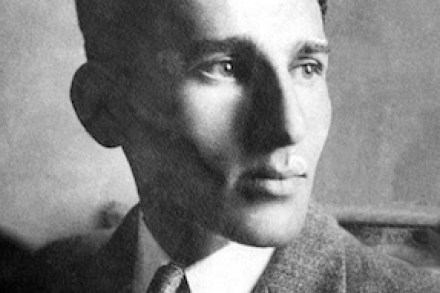
Eschewing the biblical advertising of ‘the promised land’ or indeed ‘a land of milk and honey’, the Conservative colonial secretary William Ormsby-Gore presented a far grislier picture of Palestine on the eve of the second world war when he described it as ‘full of arms and bitterness, and there are few who do good and many that do evil’. That précis is proved sadly accurate many times over in Patrick Bishop’s gripping The Reckoning, about the fatal shooting and subsequent martyrdom of the Zionist freedom fighter (or terrorist — take your pick), Avraham Stern. As characters go Stern is compelling in a car-crash kind of way.

What took Francis Mitterrand to the top?

From our UK edition

Of a dashing political rival, François Mitterrand once remarked: He was more intelligent than I was, he thought faster than I did, he was more seductive to women. In some ways, he gave me a complex. But he lacked perseverance. The man of whom Mitterrand spoke was a certain Félix Gaillard, whose claim to fame during the Fourth Republic was to become France’s youngest ever prime minister at the age of 38. He lasted barely five months in the job (1957–58) and was never heard of again. As Philip Short — who has previously written works on Mao and Pol Pot — makes mordantly clear in his well-rounded, albeit meandering biography, Mitterrand’s career path to the summit of French politics was an altogether more tortuous and drawn out affair.

Hitler didn’t start indiscriminate bombings — Churchill did 

From our UK edition

‘I cannot describe to you what a curious note of brutality a bomb has,’ said one woman who lived through the initial German raids on London during the second world war. This woman’s ambivalent reaction to having a bomb rip through her bedroom typified the shocking reality of a different type of war to any that had ever been fought before. For as Richard Overy makes eminently clear in his extraordinary and far-reaching history of Europe’s bombing war, this was the first time civilians actually became a part of the front line. The cause of this was the advent of aerial bombardment, which, Overy says, exposed ‘the democratic nature of total war, which insisted that all citizens had a part to play.

They Eat Horses, Don’t They?, by Piu Marie Eatwell – review

From our UK edition

Oh the French! Where would the Anglo publishing industry be without them? Ever since Peter Mayle first made goo-goo eyes at sun dappled Provence in 1990 and pocketed a pile of dough in the process, many a self- respecting hack with a smidgeon of French culture has followed in his train. Most have been purveyors of what the tastily named Piu Marie Eatwell dismissively terms ‘Froglit’: A highly commercialised and formulaic genre of lightly humorous fiction or non-fiction, generally written by Anglo-American expats living in France and usually with an autobiographical bias, dedicated to eulogising, elucidating, satirising or otherwise promulgating stereotypical ideas about the French. With They Eat Horses, Don’t They?

Tales of Two Cities, by Jonathan Conlin – review

From our UK edition

In Jonathan Conlin’s Tales of Two Cities the little acknowledged but hugely significant histoire croisée of two rival metropoles gets a long overdue airing. For, like it or not, London and Paris would be much duller places if neither had deemed fit to discover the other. Oddly, up until now no historian has ever explored this fecund, though sometimes grudging, exchange of ideas and cultural mores. Perhaps it required an outsider such as Conlin (though resident in London, he originates from New York) to martial the necessary objectivity.