Theo Hobson

Theo Hobson

Theo Hobson is co-editor of Created for Love: Towards a New Teaching on Sex and Marriage.

Muddled souls – Britain is a non-religious, Christian-ish country

From our UK edition

[audioplayer src="http://traffic.libsyn.com/spectator/TheViewFrom22_30_Oct_2014_v4.mp3" title="Ruby Wax and Andy Puddicombe join Mary Wakefield to discuss the quasi-religion of 'mindfulness'."] Listen [/audioplayer] A new survey of British religious attitudes is out. It reveals a surprising degree of hostility to religion, and an unsurprising degree of muddle. David Cameron's claim that Britain is a Christian country looks refuted, for more than 60 per cent of respondents said they are ‘not religious at all’. Presumably this must mean that less than 40 per cent call themselves Christian? Er, no – 56 per cent say they are Christian. It seems that Britain has a strong contingent of nonreligious Christians, like secular Jews.

Anglicanism keeps muddling on — thank God

From our UK edition

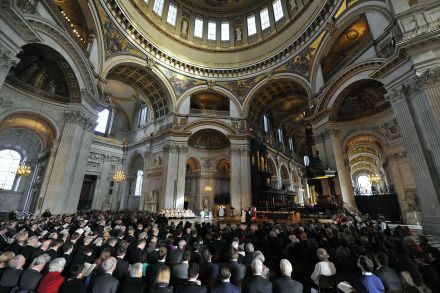
A new survey of Anglican clergy has been published. Its findings are reassuringly unsurprising. For example, almost one-third of the clergy identify as evangelical; exactly one-third as Catholic; and just over one-third as something in the middle. In a different question, a quarter identify as conservative. Just over half want to keep the established Church in its current form; the rest want some sort of reform. Most call for the Anglican Communion to be more accepting of diversity, rather than seek stricter uniformity. Same in relation to the national Church. Sensible middle-way muddling-through remains the dominant approach: half the clergy think that Christians are discriminated against in some way by our secular society; half oppose same-sex marriage.

Rowan Williams has been reading too much Wittgenstein

From our UK edition

It used to seem rather obvious that the world was full of evidence for God. These days, theologians no longer beat this drum — but some of them still give it soft little taps from time to time. Such tapping is what Rowan Williams is drawn to, now that he’s free of the obligation to dance around homosexuals and Muslims, so to speak. In this book, adapted from his recent Gifford lectures (a famous lecture series devoted to ‘natural theology’), he ponders the philosophy of language, and suggests that there is a deep affinity between how humans make meaning and how religious language makes sense. It’s a meticulously restrained and complex performance, as you’d expect — but worth straining to hear.

A gangster called Capitalism and its vanquisher The Common Good

From our UK edition

Once upon a time, a powerful unkillable beast menaced the nation. It had to be tamed. It could only be tamed by a robust ethos of the common good. This gradually emerged: a new democratic spirit was born! But soon critics popped up, complaining about aspects of the new order, calling it stifling, limiting, pompous and dated. They gained power: the fools uncaged the beast! For three decades it has trampled all over public life, declaring the profit motive to be the only realism; it has unbalanced industry, empowered reckless bankers, and forced public services to dance to its commercial tunes; it has utterly subverted the left, which dared not challenge it, but rather trusted that it would bring universal benefits.

The Times’ shocking revelations about ‘dark deeds’ at St Paul’s School are anything but

From our UK edition

Shocking revelations in the Times about St Paul’s and Colet Court, the schools that George Osborne attended (along with me). Someone called Adam Barnard has exposed the terrible goings-on behind the façade of educational excellence in leafy Barnes. Perhaps his most serious allegation is that, after sport, boys were made to shower naked, and there was some sick freak of an adult lurking in the changing room, ostensibly checking that this happened, but in reality perhaps harbouring dark, dark thoughts. Also, Barnard reveals that some of his teachers were a bit scary, and that he sometimes felt a bit uneasy – these were the sort of teachers who probably would have caned boys a lot, had there been corporal punishment.

The return of God: atheism’s crisis of faith

From our UK edition

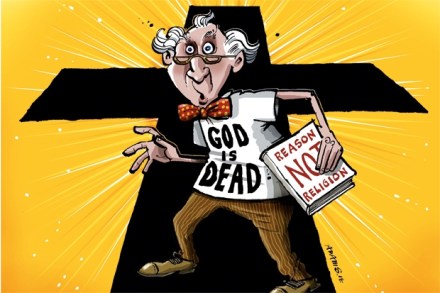
[audioplayer src="http://traffic.libsyn.com/spectator/TheViewFrom22_16_April_2014_v4.mp3" title="Douglas Murray and Freddy Gray discuss the return of God" startat=37] Listen [/audioplayer]Like any movement or religion, atheism has ambitions. Over the years it has grown and developed until it has become about far more than just not believing in God: today atheism aspires to a moral system too. It comes with an idea of how to behave that’s really very close to traditional secular humanism, and offers a sense of community and values. Atheism has crept so close to religion these days that it’s de rigueur for political atheists like Ed Miliband to boast about a dual identity: a secular allegiance to a religions tradition, in his case Judaism.

Ladies of the Guardian: please stop writing about sex

From our UK edition

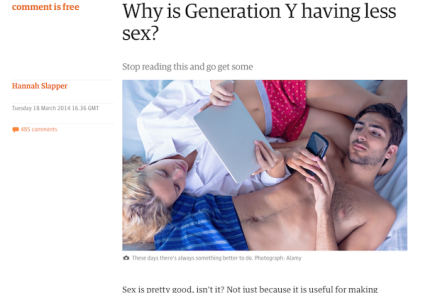
I’m generally a fan of the Guardian’s website, and sometimes write for it, but I’m sick of how much space it gives to ladettes banging on about sex. It’s a firm rule that, to write on matters sexual, you have to be a young female with a jaunty prose style and a strong belief that (fully consensual) sex is GREAT! It’s good dirty fun – if you’re doing it right! Articles that take a more nuanced line are as rare as non-Etonian cabinet ministers. A visiting Martian might be curious to know why this puffing of sex has to come from female writers – don’t men enjoy the bliss of sex too?

The Guardian’s latest crush: Justin Welby

From our UK edition

The Church of England has had some surprisingly good press recently. Who knows how these things happen, but the media seems to have decided to stop attacking its homophobia, and to start praising its social vision. The change at Lambeth Palace seems to have prompted this shift, which is a bit ironic, as Justin Welby is far more involved in the sexually illiberal side of Anglicanism than Rowan Williams was, but never mind. It has also been prompted by persistently hard economic times: the Church’s involvement in deprived communities gradually wins it more attention. Maybe it has insights that normal political bodies lack. Would you believe it?

The Church of England needs a compromise on gay marriage. Here it is

From our UK edition

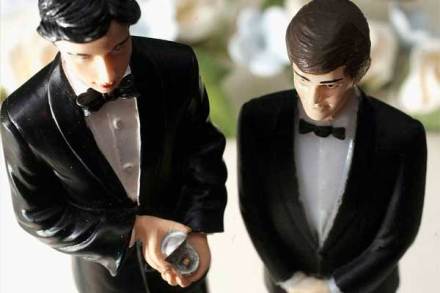
It is a wearyingly obvious observation, but the Church of England remains crippled by the gay crisis. It is locked in disastrous self-opposition, alienated from its largely liberal nature. Maybe the new Archbishop of Canterbury, Justin Welby, has a secret plan that will break the deadlock: there is no sign of it yet. The advent of gay marriage has made the situation look even more hopeless. It entrenches the church in its official conservatism, and it further radicalises the liberals. A few weeks ago the church issued a report clarifying its opposition to gay marriage, in which it ruled out the blessing of gay partnerships. This was not a hopeful move: it ought to be keeping these issues separate.

Richard Dawkins has lost: meet the new new atheists

From our UK edition

The atheist spring that began just over a decade ago is over, thank God. Richard Dawkins is now seen by many, even many non-believers, as a joke figure, shaking his fist at sky fairies. He’s the Mary Whitehouse of our day. So what was all that about, then? We can see it a bit more clearly now. It was an outpouring of frustration at the fact that religion is maddeningly complicated and stubbornly irritating, even in largely secular Britain. This frustration had been building for decades: the secular intellectual is likely to feel somewhat bothered by religion, even if it is culturally weak. Oh, she finds it charming and interesting to a large extent, and loves a cosy carol service, but religion really ought to know its place.

False idols | 6 September 2012

From our UK edition

It is widely agreed that 9/11 had a silver lining: that frightening day prodded us into thinking about religion, into taking it seriously. It nudged us away from our embarrassed evasion and forced us to admit that religion is a huge cultural and political force, even in Britain. It helped to bury the myth that gradual secularisation was making religion less important each year, something that sophisticated people could safely ignore or sneer at. It led us to begin a loud, boisterous, but also serious and nuanced, debate on the place of religion in public life. But did it? Is it true that we began to think more clearly about our complex religious inheritance? That we now honestly and intelligently grapple with the fundamental issues around religion’s relationship to politics?

False idols

From our UK edition

It is widely agreed that 9/11 had a silver lining: that frightening day prodded us into thinking about religion, into taking it seriously. It nudged us away from our embarrassed evasion and forced us to admit that religion is a huge cultural and political force, even in Britain. It helped to bury the myth that gradual secularisation was making religion less important each year, something that sophisticated people could safely ignore or sneer at. It led us to begin a loud, boisterous, but also serious and nuanced, debate on the place of religion in public life. But did it? Is it true that we began to think more clearly about our complex religious inheritance? That we now honestly and intelligently grapple with the fundamental issues around religion’s relationship to politics?

The Church of England’s power struggle

From our UK edition

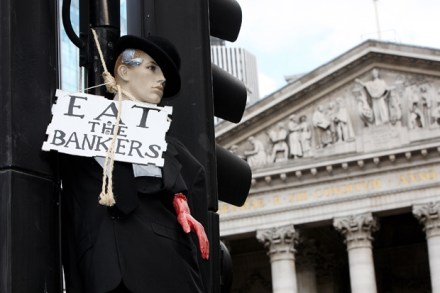
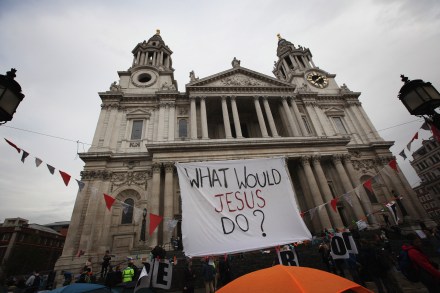
Blimey, who’s going to resign next? Chartres? Williams? The Queen? God maybe? What’s going on here? A high-profile branch of the C of E has been put in the media spotlight in a way that it cannot cope with. It is being cast as stooge of the System, bankers’ poodle. It wants desperately to communicate its sympathy with liberal opinion, with the concerns of the protesters. It feels that it is being cornered into looking like their antagonist, even like some sort of tyrannical regime, hiding in a big domed palace. No C of E cleric wants to be the focus of this. Giles Fraser sensed that the episode might result in violent scenes — such scenes must not be risked at any cost, he implied; it would be too disastrous for the Church.

Time to take the Church more seriously

From our UK edition

It is one of the most important religion stories for a decade or so. The Church of England seems to have changed its mind on church schools. A few days ago, the Bishop of Oxford, the Right Reverend John Pritchard, who is also chairman of the Church’s board of education, said he wanted just 10 percent of places reserved for church attenders. It’s a total turn-around. For a decade the Church has bullishly defended the system, and dismissed dissenters as traitors to the cause. What happened? The C of E has realized that the popularity of its schools is bad for its image. How can this be? The popularity of church schools is due to their success, and why should success be a cause for shame?

‘Jesus hung out with freaks’

From our UK edition

Why does the American religious right get all the attention: is there not also a religious left? Why is it always on the back foot? Why, though such a basic part of the nation’s history, does it seem un-American? It suffers from the same problem as its political cousin: most Americans think of the left as something for metropolitan elites or angry black radicals. (President Obama is associated with both.) But liberal Christian voices are breaking out. A few young preachers have edged away from conservative evangelicalism, but their criticism of the dominant religious culture tends to remain cautious (why lose the chance of a massive congregation?). A notable exception is Jay Bakker, 35-year-old pastor of a church for the young hipsters of Brooklyn, called Revolution NYC.

The religious right’s historical fraud

From our UK edition

It’s very telling that, in a debate earlier this week, Christine O’Donnell seemed not to know that the separation of church was in the Constitution. The wider point is that the religious right, which underlies the Tea Party movement (as a recent study shows), is built on a skewed version of American history. It depends on the pretence that the nation was originally, and is naturally, a theocracy. It claims that, as in ancient Israel, or a Muslim state, religious law is the rightful basis of politics. This was the ideology of the Calvinists who came over in the Mayflower. But this vision was rejected by the nation’s founders, who were various sorts of liberal Protestant. They daringly created a more-or-less new phenomenon: secular political space.

Liberalism is good, beautiful and true

From our UK edition

Most of the media responses to Griffin have been a bit complacent. He was exposed as a dodgy idiot, the vast majority say. I thought he came across pretty well, considering the wrongness of his views. I was uncomfortably reminded that the message of an extreme reactionary is always surprisingly seductive, tempting. The essential appeal is the promise that life can be radically simpler. This strikes a chord in the vast majority of us. We are burdened by complexity, anxiety, a sense that the contemporary world is alienating, chaotic. A vision of our culture being purged of its cultural complexity and working more effectively and more simply is, alas, beguiling. There's something in our dodgy DNA that responds to the dark logic.

Sex by sat-nav

From our UK edition

Theo Hobson is depressed by the media’s rapturous welcome for Grindr, a new software device that helps gay men locate each other for impromptu sex I am not a homophobe. But I suppose I might be a pinkophobe. I do not think that homosexuality is wrong, bad, inferior, hateful in the eyes of God. And yet I find male homosexual culture objectionable. I think, especially in the last decade or so, that it has come to have a corrupting influence on sexual culture generally. The heart of the matter is the fact that male homosexuality has a special relationship with promiscuity, and gay culture fails to be ashamed of this. Instead it glories in it.

In search of disorganised religion

From our UK edition

Theo Hobson attends Grace, an alternative Christian service in west London, and finds it arty, irreverent, postmodern — and full of people seeking a new way to worship I went to church last weekend. Sort of. It was a Saturday evening service run by a group of laypeople in an Anglican church in Ealing. It’s a monthly event called Grace. What sort of people attend? Quite trendy ones. People who are a bit too trendy for normal church. The sort who know how to link a computer up to sound and visual equipment. No grannies, no kids. Soft club music pulsed as I entered, and a big screen showed an art installation: furniture made of neon strips. In the middle of the pewless nave were a couple of sofas, a table and chairs, and a fridge; round the edges were some beanbags.

A careful believer

From our UK edition

Is David Cameron religious? In the course of his interview with the Evening Standard he provides a clear glimpse of his attitude to religion. He sees it as something that should be advocated with the utmost care, if votes are not to be squandered. He is asked if faith in God is important to him. "If you are asking, do I drop to my knees and pray for guidance, no. But do I have faith and is it important, yes. My own faith is there, it's not always the rock that perhaps it should be.” Hmmm. Surely praying for God’s guidance is a basic part of Christian faith, and nothing to be ashamed of. He is trying hard to sound pro-God but not in a Blair-like way.