The Spectator

What’s on today at Conservative conference: Saturday

From our UK edition

This year's party conference won't be quite the same. Gone is the warm white wine at ugly hotel bars, instead replaced by ministers desperately trying to unmute themselves on Zoom. That being said, Michael Gove's 'fireside chat' will certainly be one to watch, as will Matt Hancock's talk on the future of the NHS. Here are the main highlights:  Main Auditorium highlights 11:30 Welcome from Andrew Colborne-Baber and the Rt Hon Amanda Milling MP Opening of Conservative Party Conference Rt Hon Amanda Milling MP, Co-Chairman of The Conservative Party and Minister Without Portfolio; Andrew Colborne-Baber, President, National Conservative Convention.

Who started America’s presidential debates?

From our UK edition

Word for word US presidential debates are often traced back to the first televised debate, between Richard Nixon and John F. Kennedy in 1960. But they were inspired by a series of seven debates held between Abraham Lincoln and Stephen Douglas while contesting an Illinois senatorial seat in 1858. The debates would have stretched a modern audience — they were each three hours long. It is hard to imagine, too, how modern candidates would have coped with the format: the first speaker was invited to speak for an hour, the second for 90 minutes, and then the first candidate was allowed a further half-hour. Douglas won the seat and, two years later, found himself again facing Lincoln for the presidency. This time, Lincoln declined to debate — and went on to win the top job.

Letters: Lessons for Boris from the classroom

From our UK edition

Lessons for the government Sir: James Forsyth suggests that the Prime Minister wishes to avoid sounding as if he is blaming voters for the rise in coronavirus infections (‘Lockdown breakdown’, 26 September). Mr Johnson appears to have already crossed that line. In education we recognise that a teacher has lost control of their class and of their own good judgment when they become exasperated with their pupils for not learning anything. Fortunately, we know a great deal about how to help someone stuck in this negative cycle. Good teachers are predictable and consistent; they know that it is futile to claim that a rule is vitally important if it comes with a list of options and exemptions.

The lockdown battle of Marseilles is a warning for Boris

From our UK edition

From the vantage point of Downing Street, Boris Johnson may feel reassured that the further measures against Covid-19 he imposed this week, along with the extraordinary fines with which he has decided to enforce restrictions across the country, appear to have public support. Indeed, one poll suggested that upwards of 60 per cent of the population believe the government did not go far enough last week when it ordered pubs to close at 10 p.m. But the Prime Minister should not be fooled by that apparent backing. Before he commits himself to any further action he needs to look to Marseilles, where President Emmanuel Macron has come unstuck after trying to impose similar measures.

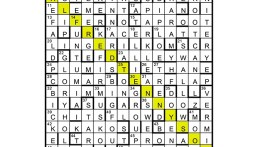
2474: Love Me Do solution

From our UK edition

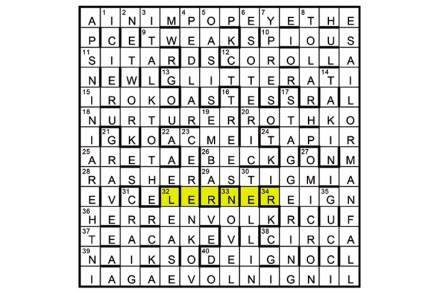
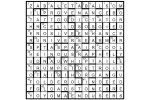
In George Orwell’s 1984 WINSTON SMITH (31/3) worked for the MINISTRY of TRUTH (43/21). The MINISTRY of LOVE (43/34) got him for THOUGHT CRIME (24/35) and sent him to ROOM 101 (28). He finally gave in to BIG BROTHER (15).

The first 2020 presidential debate — live blog

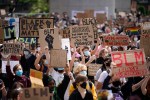
7:25 p.m. ET — Matt McDonald: Hello and welcome to The Spectator’s live blog for tonight’s tête-à-tête between President Donald Trump and former vice president Joe Biden. Along with eight other Spectator contributors and editors, I’ll be guiding you through the evening’s shenanigans in Cleveland. Hopefully we can offer a better quality of debate... 7:30 p.m. ET — Matt McDonald: Here’s a lovely picture of some anti-Trump protesters gathering in Cleveland’s Wade Park to whet your appetite. Next up, what our writers are most looking for tonight. [caption id="attachment_10426806" align="alignnone" width="1024"] Protesters in Wade Park, Cleveland (Getty)[/caption] 7:35 p.m.

debate live blog

Covid-19 update: Counting lives lost by the lockdown effect

From our UK edition

The Spectator brings you the latest insight, news and research from the front line. Sign up here to receive this briefing daily by email, and stay abreast of developments both at home and abroad. News and analysis Stockport and Wigan are expected to be put under stricter lockdown measures due to the rising number of Covid-19 cases, which would include no longer being able to mix with other households, apart from support bubbles.The UK is now on track for a £400 billion deficit in 2020-21. The government borrowed £35.9 billion in August – the highest amount borrowed in August since records began. UK debt has hit £2.024 trillion, surpassing the £2 trillion mark for the first time in history.

Whose bright idea was the circuit-breaker?

From our UK edition

It’s electrifying! Who invented the circuit-breaker? Thomas Edison patented it in 1879, realising what damage could be caused to electrical equipment in the event of a surge in current created by short-circuit. However, his early electrical installations did not use them, opting instead for fuses — thin wires designed to burn out when the current flowing through them reached a critical level. The first circuit-breaker — with spring-loaded contacts designed to open when the current became too much — was not installed until 1898, at L Street Station by the Boston Electric Light Company. Vehicle recovery Has the recovery in car sales been maintained?

Iran hasn’t earned the right to bear arms

From our UK edition

Hard though it is to remember now, 2020 began with a very different dark cloud on the horizon. For a week or so it looked as if the West’s cold war with Iran would burst into full-scale conflict. The assassination by US forces of Iran’s revolutionary guard leader Qassem Soleimani on 3 January sent oil prices soaring and raised fears that President Trump’s reputation as a war-monger was finally to be deserved. As we now know, the crisis fizzled into nothing. In retaliation, Iran halfheartedlyfired missiles at a couple of air bases in Iraq where US forces were stationed, killing no one. Donald Trump announced ‘all is well’ and, as he had already done with North Korea, succeeded in de-escalating a crisis which he was widely believed to be escalating.

Portrait of the week: New Covid restrictions, a Supreme Court vacancy and an earthquake in Leighton Buzzard

From our UK edition

Home Pubs and restaurants would have to close at ten o’clock, under new coronavirus restrictions announced by Boris Johnson, the Prime Minister, in the Commons. Shop staff and passengers in taxis would have to wear face masks and weddings be limited to 15 people. ‘We’ve reached a perilous turning-point,’ he said. The new laws could be in force for six months. Official advice was changed back to: ‘If you can work from home, you should.’ Police would be able to impose £10,000 fixed-penalty notices on people caught outside their house who had been ordered to stay in quarantine. People in Scotland would not be able to visit each other’s homes. Wales and Northern Ireland made up their own laws.

Full text: Keir Starmer’s conference speech

From our UK edition

I’m delighted that we’re here in Doncaster. My wife’s mum was born and grew up here – just next to the racecourse. We’re regulars here. Visiting family friends but also to go to the Ledger. Though of course sadly not this year. I’m also told that this is the first Labour leaders’ speech in Yorkshire since Harold Wilson in 1967. The circumstances were a bit different then. For one thing, Wilson was able to update conference about Labour’s achievements after three years in government. So I look forward to coming back one day in the same circumstances that brought Wilson here! I want to say a heartfelt thanks to the Labour party staff and volunteers who have moved a virtual heaven and earth this week.

Full text: Chris Whitty on the second wave

From our UK edition

What we've seen is a progression where — after the remarkable efforts which got the rates right down across the country — we first saw very small outbreaks, then we've seen more localised outbreaks which have got larger over time, particularly in the cities. Now what we're seeing is a rate of increase across the great majority of the country.  It's going at different rates, but it is now increasing. And what we found is anywhere that was falling is now beginning to rise and then the rate of that rise continues in an upward direction.  This is not someone else's problem, this is all of our a problem.  This graph is a simple one. It simply shows the number of inpatient cases in England over the period from 1 August.

Who will have more informants: the Stasi or Covid marshals?

From our UK edition

Information overload The government’s plan to put ‘Covid wardens’ on the streets to enforce the new rule against more than six people meeting in public has been likened to the practice of the East German Stasi relying on mass informants. How many East Germans worked on behalf of the Stasi? — According to historian Helmut Mueller-Enbergs, 620,000 Germans acted as informers during the 51-year history of East Germany, including 12,000 West Germans. — When the Berlin Wall fell in 1989, 189,000 East Germans were Stasi informants, just over 1 per cent of its 16 million population, and one in 20 Communist party members. Back in business? In which sectors is the jobs market recovering most strongly?

Letters: In defence of seagulls

From our UK edition

China’s covered Sir: If Charles Moore had contacted the BBC, rather than conducting a fruitless Google search, we would have told him we run three China bureaux — in Beijing, Shanghai and Hong Kong — and that our three mainland correspondents are backed up by production and administrative staff locally. In Hong Kong, we have a team for the BBC’s online Chinese language service. We would have outlined our agenda-setting, and award-winning, reporting on the Uighurs over the last two years, as well as other major issues such as Covid and the situation in Hong Kong. We would have highlighted our BBC2 three-part series on President Xi. And we would have pointed out the audience growth for our Chinese language service, despite our site being officially blocked in China.

Portrait of the week: new laws, illegal mingling and bungled tests

From our UK edition

Home At one minute past midnight on Monday, new laws came into force prohibiting households in England increasing their numbers to more than six either at home or in the open air, not passed by parliament but imposed by statutory instrument by the Home Secretary under the Public Health Act 1984. The laws had been given the name ‘Rule of Six’ by Boris Johnson, the Prime Minister. Mingling was singled out for censure. Wales and Scotland had their own variants, principally exempting children from the count. People in Birmingham, Sandwell and Solihull were banned from meeting anyone not part of their household; parents complained that this prevented grandparents looking after their children.

Labour’s identity crisis

From our UK edition

On the face of it, there could scarcely be better conditions for a revival of the Labour party. Even before the Covid crisis, a generation of young people were struggling to earn as much as their parents did at their age. The housing crisis remains unresolved, prices are higher than before the pandemic. The Tories are borrowing far more than they can afford and there will soon be a reckoning — with tax hikes, austerity or both. Unemployment will soar as the furlough scheme is unwound. But much of the left’s energy is being wasted in marching down the cul-de-sac of identity politics. For activists, the summer has been spent in an unseemly competition over who can find offence at the most unlikely people and inanimate objects. This week, they began to turn on their own icons.