The Spectator

Portrait of the week: A Covid Budget, a Cotswold meteor and Angelina Jolie sells Churchill’s painting

From our UK edition

Home First-dose coronavirus vaccinations totalled more than 20 million. A study suggested that in the over-eighties, a single dose of either the Pfizer or Oxford-AstraZeneca vaccine was more than 80 per cent effective at preventing hospitalisation. Hospital admissions of 8,452 in the week ending 27 February were 22 per cent down on the week before that. At dawn on 28 February, total UK deaths (within 28 days of testing positive for coronavirus) had stood at 122,705, including 2,340 in the past week, down by 32.3 per cent on the week before that. Six people with the Brazilian variant of coronavirus were detected in Britain, but one could not be traced. In the Budget, Rishi Sunak, the Chancellor of the Exchequer, said borrowing would rise to a peak of 93 per cent of GDP.

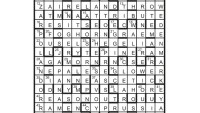
2493: Opposites – solution

From our UK edition

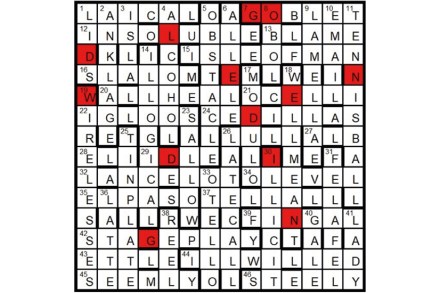
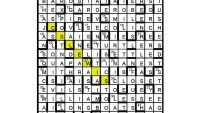
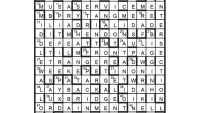
‘I WANT TO BE ALONE’ (1A) and ‘COME UP AND SEE ME SOMETIME’ (49/27) were supposedly said by Greta GARBO (17A) and Mae WEST (45) respectively. Garbo was born in STOCKHOLM (13) and West died in LOS ANGELES (10/29). Garbo starred in MATA HARI (23/38) and West in I’M NO ANGEL (19). GARBO and WEST were to be shaded. First prize A.

Letters: Immunity passports are nothing to fear

From our UK edition

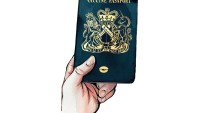
Nothing to fear Sir: Many of us await the day when we can travel abroad for much-anticipated holidays — but surely there is a distinction between immunisation passports and Tony Blair-type IDs (‘Papers, please’, 13 February)? If a country requires you to be immunised to travel there in order to protect its citizens against Covid, then I would be happy to have that ‘passport’ requirement. It is quite different from carrying ID with you in your own country. Let’s face it, the danger from Covid will fade in time, and the ‘passport’ requirement along with it. After all we happily travel with a passport in our pockets to show who we are when we go abroad. Didn’t people have the same worries when passports were introduced?

Which Covid vaccine is really the most effective?

From our UK edition

State of the art Graffiti on Edvard Munch’s first version of ‘The Scream’ was revealed to be the work of the artist himself. There is a tradition of artists damaging their own work: — In 2018, a Banksy, ‘Girl With Balloon’, was partially shredded moments after being sold for $1.4 million at Sotheby’s by a device fixed inside the frame. — In 1920, Dadaist Francis Picabia arranged for his friend André Breton to rub out his chalk drawing, ‘Riz au Nez’, shortly after it went on display in Paris. — In 1960, ‘Homage to New York’, a sculpture by Jean Tinguely, auto-combusted after going on display in the city’s Museum of Modern Art.

Portrait of the week: A lockdown exit plan, Duke of Edinburgh in hospital and Texas in deep freeze

From our UK edition

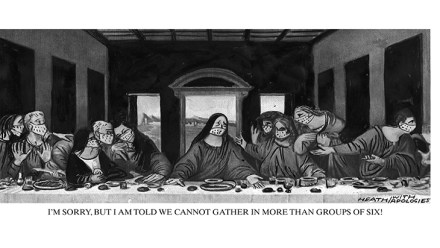
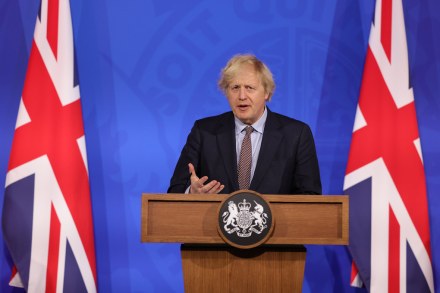
Home The much-anticipated decriminalisation of two consenting people meeting over coffee on a park bench was declared for 8 March under a loosening of coronavirus restrictions announced by Boris Johnson, the Prime Minister. On that day all schools in England will open. No earlier than 29 March, groups of six would be able to meet outdoors, including in private gardens, and tennis courts would reopen. No earlier than 12 April, all shops, hairdressers and libraries would open, and pubs and restaurants could serve customers outdoors. No earlier than 17 May, groups of six could meet indoors and foreign travel would be allowed. No earlier than the summer solstice, social meetings would be legalised, even wedding receptions.

Vaccines are working – so why isn’t society reopening?

From our UK edition

When the Prime Minister sets out his ‘roadmap’ for easing Covid restrictions on Monday, it will be against a backdrop that is both better and worse than could have been imagined six months ago. Worse because we have gone on to suffer a second wave of the disease that has seen almost as much excess death as the first wave. But better in the sense that we have vaccines that are in use and more effective than many hoped, with first doses given to 15 million people — almost a third of the adult population. On several occasions last year, Boris Johnson referred to vaccines as the cavalry coming over the hill. The cavalry is here, and most of those at serious risk of dying from Covid are being inoculated.

Do gender studies departments have a gender problem?

From our UK edition

Target practice The government hit its target of giving a first Covid vaccine to 15 million of the most vulnerable people by the middle of February. Some other government targets which have been met (sort of): — 100,000 Covid tests a day by the end of April. The government did claim to have achieved this — but did so by counting testing kits which had been posted out and not necessarily returned. — There was a rise of 7,600 people applying for teacher training courses last year, which meant that the government hit its target for secondary school teachers to the tune of 106% and primary school teachers by 130%. — The target of spending 0.7% of GDP on aid has been achieved every year since 2013. The target has now been temporarily reduced to 0.5%.

Portrait of the week: Hotel quarantine starts, Ribblehead Viaduct cracks and a royal guest for Oprah

From our UK edition

Home The target was achieved of vaccinating, by the middle of February, about 15 million people of 70 or over, together with care home residents and workers, and the clinically extremely vulnerable. But there was concern that a substantial proportion of care home workers declined the vaccine. By 16 February, more than 20 per cent of the population had been given their first dose. At dawn on 14 February, total UK deaths (within 28 days of testing positive for the coronavirus) had stood at 116,908, including 4,861 in the past week. Over the previous week, the seven-day moving average of deaths had fallen to 688 a day from 932 a day. An extra 1.7 million people were added to the 2.3 million advised to shield, entitling them to earlier vaccination.

The Spectator’s response to Lady Dorrian’s judgment

From our UK edition

Last week, The Spectator went to the High Court in Edinburgh to seek clarification on the publication of Alex Salmond's written testimony to the Parliamentary Inquiry into how the Scottish Government handled complaints against him (nothing to do with the criminal trial). We published his evidence on our website in January as a public service.  By contrast, and to our surprise, the Inquiry decided that it was unable to consider this evidence, apparently due to a court order protecting the anonymity of complainers.  We welcome Lady Dorrian’s written judgment today which confirms that - as we always believed - the court had no intention of obstructing a legitimate parliamentary inquiry established to investigate government behaviour and hold it to account.

Universal Credit and the future of the welfare state

From our UK edition

Amid the many failures of public policy during the Covid crisis, one success has gone largely unnoticed. The Universal Credit system coped with a huge uplift in applications without breaking down. In February last year 2.6 million households were signed up; six months later that had swelled to 4.6 million. Some 554,000 people made new claims in the first week of lockdown, ten times the normal levels. For a benefit which not so long ago was being damned for the poor execution of its rollout, it is remarkable that the system coped. Its unexpected success offers plenty of lessons for the future of the welfare state. The digitisation of the system, controversial at the time, enabled the service to be delivered to those in urgent need of help.

Portrait of the week: A royal baby, Boohoo buyouts and France legalises lunch al desko

From our UK edition

Home On Sunday 7 February, as the week began, 11,465,210 people in the United Kingdom had received a first vaccination against Covid-19 and 510,057 a second. Those aged 70 or over were invited to book a vaccination online or by telephone if they had not received one. Illegal immigrants were advised to register with a GP without risking deportation. South Africa, possessing a million doses of the Oxford-AstraZeneca vaccine, decided to suspend its use after a trial of 2,000 people (42 of whom developed Covid) seemed to indicate that it offered ‘minimal protection’ against mild and moderate cases; no one in the trial was old.

Letters: How to repair the Church of England

From our UK edition

Save on bishops Sir: The Church of England is once again missing the point if its financial crisis will result in the closure of parish churches and redundancy of clergy (‘Holy relic’, 6 February). Radical action is required, but the focus should be elsewhere. A starting point would be to amalgamate the vast majority of dioceses. Why is East Anglia served by the C of E dioceses of Ely, Norwich, St Edmundsbury and part of Peterborough when the Roman Catholics manage more than adequately with a diocese for East Anglia? Time to unite and benefit from economies of scale. But it should go much further: halve the number of bishops, diocesan and suffragan, and axe some of the non-jobs with fancy names which seem to proliferate in and around the centre.

How often do tempers flare at parish meetings?

From our UK edition

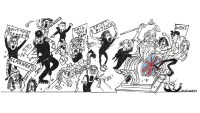
Temper, temper A Zoom video of a disruptive parish council meeting in Handforth, Cheshire, went viral. It is not the first such incident. — In December 2014 a fight broke out at a meeting of the allotments committee of Brierfcliffe parish council near Burnley, over a former parish councillor’s claim for a right to graze her sheep on council land. — In October 2015 police were called to a parish council meeting in Long Melford, Suffolk, after members of the public in attendance became an ‘angry mob’. — In November, police were called to a meeting at Hindolveston parish council in Norfolk following reports of verbal and physical abuse over a planning application.