The Spectator

Portrait of the week: Duke of Edinburgh dies, Covid retreats and questions for Cameron

From our UK edition

Home The Duke of Edinburgh, who was married to the Queen for 73 years, died at Windsor Castle, aged 99. The Queen was said to feel ‘a huge void’. Union flags flew at half mast; gun salutes were fired. For a day the BBC cancelled television schedules and broadcast the same programmes on all its channels. Parliament was recalled a day early. No laws would be passed until after the funeral on 17 April at Windsor, to be attended by no more than 30, in compliance with coronavirus legislation. As a mark of respect, the Prime Minister thought better of being photographed drinking beer in a newly liberated pub garden, though he did have his hair cut. The nation learnt from endless newspaper pages and broadcast media what a difficult and dutiful life the Duke had led.

Letters: There’s nothing libertarian about vaccine passports

From our UK edition

Taking liberties Sir: I feel that Matthew Parris is absolutely wrong about liberty (‘The libertarian case for vaccine passports’, 10 April). True liberty is that each individual has the possibility to live their life how they desire (within the law), taking full responsibility for any and all the risks they incur. I am not responsible for anyone else’s health. To say that we have to stay indoors, wear masks, observe social distancing or have vaccinations because we would be killing others if we did not is blackmail. If you use the logic that the individual is responsible for the health of all other people then everyone who owns a car is directly responsible for every injury on the roads.

How often does it snow in April?

From our UK edition

D of E awards A few of the late Duke of Edinburgh’s lesser-known titles and honours: — Royal Chief of the Order of Logohu (Papua New Guinea); Grand Commander of the Order of Maritime Merit of the San Francisco Port Authority; Grand Cross in Brilliants of the Order of the Sun of Peru; Grand Cross of the Order of the Falcon (Iceland); Member First Class of the Order of the Supreme Sun (Afghanistan); Grand Cordon of the Supreme Order of the Chrysanthemum (Japan); Grand Cross with Chain in the Order of the Queen of Sheba (Ethiopia). Paying their respects The Duke of Edinburgh will have only 30 mourners at his funeral, thanks to Covid restrictions. How many people have attended or watched royal funerals?

2499: Entitled trio – solution

From our UK edition

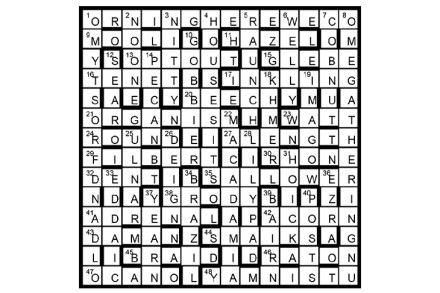
The theme was C.S. Lewis’s The Lion, the Witch and the Wardrobe. 38A (of Scotland), 43A and 22D were all called ‘The Lion’ (see Brewer’s entry for lion); 11A, 41A and 9D are all witches; 12A, 34A and 6D are wardrobes.

Joe Biden has dropped ‘vaccine passports’. Will Boris?

From our UK edition

‘The government would love to put issues such as these beyond the bounds of debate by creating an air of national emergency.’ So this magazine declared on 27 November 2004 in response to Tony Blair’s proposal for national identity cards, which had just been announced in the Queen’s speech. Our editor then, Boris Johnson, argued that their very existence would threaten the character and liberty of the country. If you buckle in an emergency, he argued, the principle will be lost for ever. He urged Tory MPs to rebel and crush identity cards which, he later said, he’d abolish if he ever ended up in government. History now repeats itself. Blair is back, advocating identity cards in the form of vaccine passports or ‘Covid status certificates’.

Portrait of the week: Vaccine passports, Northern Ireland riots and a cocaine-smuggling kayaker

From our UK edition

Home The government sketched a scheme for a coronavirus passport, or ‘Covid status certification’, to be tried out at the FA Cup Final on 15 May. It would record vaccination, a recent negative test or natural immunity after recovering from Covid and might admit the bearer to public places, such as pubs or soup kitchens. Dozens of MPs opposed the passport, including Jeremy Corbyn, the former Labour leader, who sits as an independent, and Iain Duncan Smith, the former Conservative leader. In the meantime everyone could have two lateral flow tests a week at pharmacies or at home, and would have to self-isolate if the result was positive.

How likely is a false positive from a Covid test?

From our UK edition

Positive thinking The government wants us to test ourselves for Covid-19 twice a week, using lateral flow kits which will be freely distributed. What is the risk of being ordered to self-isolate as a result of a false negative? — While the NHS claims that these tests produce false positives in 0.1% or fewer cases, an evaluation by Porton Down and Oxford University last year found a false positive rate of 0.3% in a hospital setting, rising to 0.39% in the community — in other words, about one in every 256 tests. — According to the Office for National Statistics infection survey, in the week to 27 March one in every 370 people were infected (not necessarily showing symptoms) — 0.27% of the population.

Full text: First Roadmap Review

From our UK edition

Introduction 1. The Government's overriding goal is to protect the lives and livelihoods of citizens across Scotland, Wales, Northern Ireland and England. The COVID-19 Response - Spring 2021 (the roadmap) set out how the Government would continue to protect and support citizens across the UK and provided a roadmap out of the restrictions in place across England. 2. The Government committed to taking a cautious approach to easing those restrictions, guided by data instead of dates, to avoid another surge in infections that could put unsustainable pressure on the NHS. The roadmap set out “no earlier than” dates for these steps, which are five weeks apart.

The false narrative of white vs BAME

From our UK edition

Almost 20 years ago, Michael Howard spoke about the ‘British dream’: that immigrant families like his could come to this country and find every door open for their children. The same was true for Priti Patel’s parents, both refugees from Idi Amin’s Uganda. Dominic Raab, the Foreign Secretary, has spoken movingly about his father, who was a refugee from the Nazis. Our islands are and have always been a beacon of light for those fleeing darkness, or simply seeking a better life for their families. Over the years, our country’s reputation has drawn millions of people who have settled here in search of the British dream. They have faced headwinds of racism and bigotry, as migrants and their families invariably do.

Portrait of the week: Alex Salmond’s party, China’s H&M ban and protests in Bristol and Batley

From our UK edition

Home More than 30 million had received their first dose vaccination. The government remained confident of supplying second doses and of vaccinating all the adult population by July, despite a delay in supplies from India and threats from the EU to stop exports. In response to EU hostility, Boris Johnson, the Prime Minister, said: ‘Companies may look at such actions and draw conclusions about whether or not it is sensible to make future investments.’ The Novavax vaccine, more than 50 million doses of which would be available if approved by the MHRA, would be made and packaged entirely in Britain. The Moderna vaccine was also expected to be available from the end of April.

Letters: Britain should hang on to its vaccines

From our UK edition

Ticket to freedom Sir: While I sympathise immensely with the spirit of last week’s lead article (‘Friends in need’, 27 March), we cannot justify asking Britons to wait any longer than necessary while their ticket out of lockdown is exported to the EU bloc, whose level of freedom is on average significantly higher than the UK’s. How can we justify exporting vaccines to Finland and Sweden, for example, where there has always been the freedom to meet family and friends in groups, while we are still enforcing draconian measures here?

The false narrative of BAME vs white

From our UK edition

Almost 20 years ago, Michael Howard spoke about the ‘British dream’: that immigrant families like his could come to this country and find every door open for their children. The same was true for Priti Patel’s parents, both refugees from Idi Amin’s Uganda. Dominic Raab, the Foreign Secretary, has spoken movingly about his father, who was a refugee from the Nazis. Our islands are and have always been a beacon of light for those fleeing darkness, or simply seeking a better life for their families. Over the years, our country’s reputation has drawn millions of people who have settled here in search of the British dream. They have faced headwinds of racism and bigotry, as migrants and their families invariably do.

Letters: Keir Starmer has failed the country

From our UK edition

The word of God Sir: Douglas Murray complains that the C of E has embraced the ‘new religion’ of anti-racism (‘The C of E’s new religion’, 20 March). But the truth, which neither he nor the church seems to have realised, is that the ‘anti-racist’ agenda is a secular attempt to plug a long-standing gap in western Christianity. The answer is to recover the full message, not to bolt on new ideologies. The earliest Christian writings insist that in the Messiah ‘there is neither Jew nor Greek’. The book of Revelation envisages Jesus’s followers as an uncountable family from every nation, tribe, people and language.

Britain must help Europe fight a third wave

From our UK edition

During the referendum campaign five years ago, the pro-Brexit side argued that by freeing ourselves from the EU’s native protectionism and over-application of the precautionary principle, Britain could revitalise its economy and democracy. The EU wanted to seize more power, they argued, by taking control of ever greater areas of public life. Remainers thought these fears were exaggerated. They saw in the Leave vote an eruption of nativism. The EU’s vaccine war, however, could not have better demonstrated the problem of Brussels overreach. While the vaccine programme rolls on in Britain, with more than half of all adults now inoculated, the EU is being drawn ever further down a blind alley of its own making.

Portrait of the week: Europe’s vaccine wars, a beached walrus and Sturgeon survives

From our UK edition

Home The nation was surprised to learn that from 29 March there would be a dearth of vaccine for a month. More than half the adult population had been vaccinated once, and more than 4 per cent twice. In one day 589,675 people received their first vaccine, including Boris Johnson, the Prime Minister, and the next day 752,308 first doses were given. But five million doses of the AstraZeneca vaccine from India were delayed and the EU was making hostile noises about banning exports to Britain. The government considered making vaccination compulsory for people working in care homes, a quarter of whom had not been vaccinated.