The Spectator

Has Elon Musk picked up a turkey in Twitter?

From our UK edition

Talking gobblers Has Elon Musk picked up a turkey in Twitter? – Musk paid $54.2 per share. The share price reached $41.57 on its first day of trading in 2013. It slumped to $14.62 in April 2016 and peaked at $77.06 in February 2021. In the first quarter of 2022, it claimed 229 million active daily users, a rise of 15.9% year on year. There were 39.6 million users in the US. – In Q1 2022 the company raised $1.2 billion in revenue: $1.11 billion from advertising and £94 million from subscriptions. However, in the same quarter the company ran up $1.33 billion in costs. Dirty Cop How are Cop conferences doing at cutting their own carbon emissions?

Portrait of the week: A migrant crisis in Manston, elections for Northern Ireland and Matt Hancock heads for the jungle

From our UK edition

Home Suella Braverman, the Home Secretary, spoke in the Commons of an ‘invasion on our southern coast’ by migrants in small boats. ‘Let’s stop pretending that they are all refugees in distress,’ she said. ‘The whole country knows that is not true.’ She was reacting to a crisis at a migrant processing centre in Manston, Kent, built for 1,600 but housing 4,000. David Neal, the independent chief inspector of borders and immigration, called it ‘really dangerous’. He said an Afghan family had lived in a marquee there for 32 days. It was made more crowded after migrants were moved following an attack with three petrol bombs on a Border Force migrant centre in Dover by a man in a car who then killed himself. On Saturday alone, 990 migrants crossed the Channel.

The Non-Discovery of San Francisco Bay

From our UK edition

Drake, the clot, missed it by a mile. That hook of rock failed to snag  his sails into the only gap for a  thousand miles and the Ohlone breathed  easy in their skins unaware of the  Great Inevitable whilst the dew  on the antelope’s nose lay undisturbed.  Salmon knew the river  would not deepen. The eagle’s shadow rippled like a whisper over desert ridges. Grassland rolled a parody of Atlantic waves. Crow and Lakota  were still safe behind the Appalachians  which dipped to the farms of the Puritans  and the graves of the Seminole.  One curious soul raised his head,  wondered what lay beyond the forest and the valleys. To the west.

The short-lived bloom of Monica Rose

From our UK edition

In her, oily tongued Hughie found his perfect foil: a cockney sparrow, whose pixie cut and skinny frame won the hearts of millions in the age of monochrome. Her money more than doubling as she made the ratings soar, bringing with it a rags-to-riches change. The sky seemed the limit, yet something in her ached for her lost world of nine-to-five, round the corner local, down-to-earth mates. Until finding herself broken on the wheel of flashbulb fame, she threw in the towel, hoping to return to her old, ordinary ways. Instead, uprooted for too long, she withered, took to God and pills, deadheading herself with an overdose on one light-starved, February day.

Who was Britain’s youngest prime minister?

From our UK edition

Prime numbers At 42, Rishi Sunak is Britain’s youngest PM since Lord Liverpool took office the day after his 42nd birthday in June 1812. He replaced Spencer Perceval, the only British prime minister to be assassinated. Much is made of Sunak’s wealth, but he hasn’t enjoyed the privilege Lord Liverpool did (his father was an adviser to George III). Thanks in part to his connections, Lord Liverpool was elected to the Commons as member for Rye at the age of just 20. As he had to be 21 to sit in the Commons, he went on a Grand Tour of Europe until he came of age. He was PM for 15 uninterrupted years. Asian heritage How large is the Asian British population? – According to the ONS, there are 4.2m people in England and Wales – 7.

The economic storm ahead is losing some of its power

From our UK edition

When Russia invaded Ukraine in February, German protesters lined the streets holding placards saying ‘Better a cold shower than Putin’s gas’. Their resolve was soon to be tested: energy costs surged and Berlin’s longstanding policy of relying on Russian gas started to cost the country dear. Germany set itself the hugely ambitious target of having its gas stores 95 per cent full by November, a policy that remained even after Moscow turned off the Nord Stream pipeline. It seemed a near-impossible target. But this target has now been met ahead of schedule. German gas usage is down by about a third after major changes to industry. With the panic over, the price of commercial gas contracts – in Germany and Britain – has now fallen to levels last seen in the spring.

Portrait of the week: Sunak in No. 10, pasta gets pricier and Russia hits Ukraine’s energy grid

From our UK edition

Home Rishi Sunak, aged 42, became Prime Minister. At the weekend Boris Johnson had flown back from a holiday in the Dominican Republic in response to the resignation of Liz Truss. She said she could not ‘deliver the mandate on which I was elected by the Conservative party’. The 1922 Committee devised a hurdle of 100 nominations for any MP to be considered as leader, with secret ballots of MPs and, if two candidates remained, an online vote by party members. It was thought that if Mr Johnson secured 100 votes, the membership would elect him. At 9 p.m. on Sunday, the day before nominations closed, he withdrew from the contest. Next day, a minute before nominations closed, Penny Mordaunt withdrew. So Mr Sunak won.

Rishi’s reshuffle: the appointments

From our UK edition

Rishi Sunak is Britain's third prime minister this year. On Tuesday, Sunak assembled a new top team with the hope of unifying the fractured party. The cabinet departures included Jacob Rees-Mogg among those heading to the back benches. As for the arrivals, Suella Braverman is back in the role of Home Secretary just under a week after being forced to resign over a security breach. Here are the key developments: Jeremy Hunt has been reappointed as Chancellor. Suella Braverman is back as Home Secretary. Ben Wallace remains Defence Secretary and James Cleverly stays as Foreign Secretary. Dominic Raab is deputy PM and Justice Secretary.  Nadhim Zahawi is party chairman. Grant Shapps becomes Business Secretary.

Divided they fall: can the Tories save themselves?

From our UK edition

Seldom has support for a government fallen so far, so fast. Polls show that 24 per cent of the public would vote for the Conservatives if there was an election now, vs 52 per cent for Labour: figures that make 1997 look like a good result for the Tories. This is not just a one-off rogue poll, but the sustained average of six. It reflects what Tory MPs hear from voters appalled at the disgraceful shambles of the past few weeks. It won’t be forgotten in a hurry. This magazine gave its verdict on the Liz Truss agenda in August: ‘To attempt reform without a proper plan is to guarantee failure,’ we argued. She lost no time in proving this point. But others are drawing wider and deeper – and rather dangerous – conclusions.

Letters: The case for legalising cannabis

From our UK edition

Paying the price Sir: Lionel Shriver’s piece about university standards rang true to me (‘University is supposed to be hard’, 15 October). When I, then working for a distinctly moth-eaten British university, visited a very famous private college in Massachusetts in 1985, I expressed my envy of his luxurious surroundings to a professor of English. His reply was: ‘Don’t envy us. You have something we don’t have. It’s called standards.

Portrait of the week: Truss says sorry, Hunt reverses mini-Budget and Kanye West buys Parler

From our UK edition

Home Liz Truss said in a BBC interview as Prime Minister that she wanted to ‘say sorry for the mistakes that have been made’. Declaring that she would lead the Conservatives into the next election, she addressed blocs of MPs: the One Nation group one day, the European Research Group the next. She watched Jeremy Hunt, the Chancellor of the Exchequer whom she had just appointed to replace Kwasi Kwarteng, deliver a statement to the Commons reversing most of the provisions of the ‘fiscal event’ of 23 September. The new Chancellor announced the end of current subsidies for domestic energy bills in April, preferring something that ‘will cost the taxpayer significantly less than planned while ensuring enough support for those in need’.

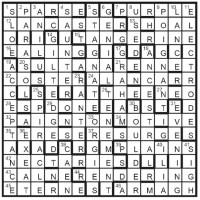
2575: Problem XIII – solution

From our UK edition

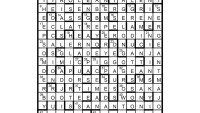
5 (the number of GOLD RINGS, from ‘The Twelve Days of Christmas’: 34/22A) x 103 (the number of the PSALM (7D) BENEDIC ANIMA MEA: 41/30/1D) x 5 (the number of SYMBOLS AT YOUR DOOR, from ‘Green Grow the Rushes,O’: 3/8/38) = 2575 (the number of the PUZZLE (14)). First prize O.F.G. Phillips, Oxford Runners-up Clive West, Old Windsor, Berks; M.D.

2574: A Chinese – solution

From our UK edition

Each unclued Across light (including the pair at 16/7) is a SWEET and the unclued Down lights can be preceded by SOUR. First prize Steven Lodge, Bridgwater, Somerset Runners-up Diana King, Leeds; A.

What does Nicola Sturgeon want for Christmas?

From our UK edition

Dying of heat The former government chief scientific adviser Sir David King predicted that the heatwave in mid-July could cause up to 10,000 excess deaths. Was he right? — The ONS says there were 2,227 excess deaths from 10 to 25 July: that is compared with the five-year average (which excludes the Covid year of 2020). This amounted to a 10.4% rise in excess deaths. The ONS recorded 3,271 excess deaths during the five ‘heat periods’ of the summer months (when the mean Central England Temperature exceeds 20˚C). There were nearly twice as many excess deaths among females (2,159) as among men (1,115), a reversal of previous heatwaves. There were 5,017 excess deaths among the over-seventies.

Letters: red kites are a menace

From our UK edition

Free Kaliningrad Sir: Mark Galeotti was right to identify the exclave of Kaliningrad as a target for a strong western response to any use by Putin of a nuclear weapon against Ukraine (‘Nuclear options’, 8 October). Perhaps it should be offered the chance of secession from Russia, not only to avoid destruction, but to secure a better future than Putin or any successor could offer. It was subject to terrible ethnic cleansing after its conquest in the second world war, which rules out its return to Germany. But it could lose its dismal association with Kalinin. Under its historic name of Königsberg, it could revert to its previous status as a Free City – within the EU and as part of Nato’s territory.