The Spectator

Livestream: BBC – defund or defend?

From our UK edition

Editorial errors, ideological bias and partisan presenters – what has happened to the BBC? Watch The Spectator’s Charles Moore, who was fined after refusing to pay his licence fee, and the Telegraph’s Allison Pearson go up against Spectator editor and former BBC journalist Michael Gove and former BBC America editor Jon Sopel to debate whether we should defund – or defend – this once great institution. The event took place on Tuesday 24 March and you can watch the full live recording here.

2741: Unsurpassable – solution

From our UK edition

The unclued lights reveal ‘It is a far, far better thing that I do, than I have ever done,’ said by Sydney CARTON towards the end of A Tale of Two Cities by Charles DICKENS. First prize Jane Hudson, Eye, Suffolk Runners-up Gordon Hobbs, Woodford Green, Essex; D.P.

Portrait of the week: Growth slows to zero, Scotland rejects assisted dying and Trump sends Marines to the Gulf 

From our UK edition

Home Sir Keir Starmer, the Prime Minister, spoke to President Donald Trump of America about the importance of reopening the Strait of Hormuz, but resisted his call for Britain’s ships to be sent there. The government considered sending British-made Octopus drone-interceptors to the Middle East. Sir Keir said £53 million would help a million households reliant on heating oil – £53 a household; ‘It’s moments like this that tell you what a government is about,’ he said. The economy showed zero growth in January, according to the Office for National Statistics. The ONS added alcohol-free beer to the basket of goods used to calculate inflation. John Lewis awarded staff a bonus for the first time in four years.

Which age group is most at risk of meningitis?

From our UK edition

Churchill insurance There was outrage that Winston Churchill is to be dumped from the £5 note in favour of wildlife. But was Churchill actually a good example with money? Shortly after he became prime minister in May 1940, he was faced with two crises: the capitulation of France to the invading German forces and the prospect of personal bankruptcy. He had an overdraft of £5,602 (£274,000 in today’s money), while his income from writing was to diminish as a result of his taking high office. The situation was only resolved when businessman Sir Henry Strakosch made an anonymous donation of £5,000, paid via his business partner – and Churchill’s friend – Brendan Bracken. It was one of several occasions when Churchill had to be bailed out by friends.

Letters: Litter is a sign of Britain’s low self-esteem

From our UK edition

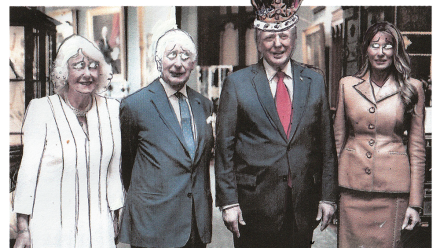
State of the nations Sir: My spirits were raised by your stirring defence of the forthcoming royal visit to America (‘Britain’s Trump card’, 14 March). Its contemporary importance can be viewed in the light of Charles Moore’s Note (same issue) that the remaining hereditary peers have just been removed from the House of Lords. The monarch has thereby become the only person with a part in our legislature by virtue of inheritance, a situation bound to encourage those with republican instincts. Their tired old question will be resurrected: why can we not elect our head of state? The answer will be evident in pictures from the White House.

Spectator Schools: spring 2026

From our UK edition

In this week’s Spectator Schools supplement, the Revd Fergus Butler-Gallie writes about the undervalued beauty of school chapels. ‘They are so often architectural gems,’ he says, ‘masterpieces that stand alongside some of the nation’s finest buildings.’ You can judge a private school by how it cares for its chapel – those that still do should be commended and celebrated. Philip Womack would no doubt agree. He writes that his time as a school chorister was the making of him.

School portraits: Snapshots of four notable schools

From our UK edition

Hurtwood House, Surrey Set in the Surrey Hills, Hurtwood House is England’s only independent boarding school exclusively for sixth-formers. Renowned for its performing arts, the school’s annual Christmas musical is no ordinary affair. The ten-night production is staged with a full West End orchestra and professional directors, choreographers and lighting designers. It is no surprise that alumni include Emily Blunt and Hans Zimmer. Hurtwood can also boast a high level of academic achievement: last year 54 per cent of A-level results were graded A*-A.

Livestream: The Tory Dilemma – deal or no deal?

From our UK edition

As Reform chips away at the Tory vote, the Conservatives face a stark choice – join forces with Nigel Farage or fight alone. James Heale, The Spectator’s deputy political editor, will be joined by Conservative peer Daniel Hannan, journalist and politician Paul Goodman, shadow cabinet member Victoria Atkins and former Brexit secretary David Davis to discuss what a Conservative-Reform pact might look like – and whether it should happen at all. You can watch the event via livestream here at 7pm GMT on Monday 16 March.

The King is still our Trump card

From our UK edition

George III has not been well remembered on either side of the Atlantic. Despite reigning for almost 60 years, in Britain he is known, if at all, for losing the Thirteen Colonies and his madness in his later life. But in America, he is the villain of the national story; in Thomas Jefferson’s phrasing, the ‘Prince, whose character is thus marked by every act which may define a Tyrant’. The Declaration of Independence is a lurid list of his alleged crimes against his American subjects. But 250 years after that document was signed by the Founding Fathers, George III has been going through a renaissance. In recent biographies, Andrew Roberts and Jeremy Black have argued that he was a much-misunderstood monarch.

Where exactly is the Middle East?

From our UK edition

Less near Where exactly is the Middle East?  – The term was first popularised in an article by Alfred Thayer Mahan, a US academic on naval strategy, published in the National Review in 1902, proposing that western powers would need outposts like Gibraltar to serve their interests in the region, which he defined as the countries bordering the Persian Gulf. This distinguished it from the Near East, a now largely defunct term for the countries surrounding the eastern Mediterranean, including Turkey and the Balkans. Over the first half of the 20th century, the Middle East gradually consumed the Near East.

Letters: We interfere in the Middle East at our peril

From our UK edition

The West’s track record Sir: I read with much sadness Matthew Parris’s reservations about western attempts at regime change in Iran (‘Is this Starmer’s finest hour?’, 7 March). Sadness because he is quite correct, given the West’s track record in Iraq, Afghanistan, Libya and Syria. He rightly alludes to Benjamin Netanyahu’s ‘Greater Israel’ plans amid destabilised, chaotic neighbours. In Syria in late 2010, I spoke with resident Sunni, Shia, Alawi, Christian and even Jewish residents from Homs and Hama to As-Suweida and Aleppo: well over 90 per cent pointed to their freedom of association and of worship, the women to the secondary and tertiary education they could enjoy, and all because the Assads could guarantee these things.

Portrait of the week: Iran attacked, Iran attacks and Starmer fumbles

From our UK edition

Home Britain was not involved in the attack on Iran, Sir Keir Starmer, the Prime Minister, said, but a day later he gave America permission to use British bases (including Diego Garcia) ‘to prevent Iran firing missiles across the region’. He told the Commons, ‘This country does not believe in regime change from the skies,’ and ‘the only way forward is a negotiated outcome’. ‘This is not Winston Churchill that we’re dealing with,’ said President Donald Trump of America. A drone hit RAF Akrotiri in Cyprus; the destroyer HMS Dragon was dispatched there. At least 300,000 British citizens were said to be in the Gulf.

Ed Miliband must go

From our UK edition

Economic forecasting was created, J.K. Galbraith said, to make astrology look respectable. It is not difficult to imagine what the great Keynesian economist would have thought of Rachel Reeves’s Spring Statement this week. It was pure -crystal balls. The statement was redundant on delivery – redundancy being one of the few areas of growth in our economy, as the bleak unemployment figures amply attest. The developing conflict in the Middle East, which has unleashed precipitous oil and gas price rises, has rendered the Chancellor’s promises of future growth more unlikely than ever.

2739: Off Drive – solution

From our UK edition

The eight unclued entries are the names of Verdi operas: FALSTAFF, AIDA, NABUCCO, ERNANI, IL TROVATORE, LA TRAVIATA, RIGOLETTO, OTELLO. The puzzle’s title suggests an anagram of the composer’s name, Verdi.

Letters: There’s no defending Robert Maxwell

From our UK edition

Bring back wisdom Sir: Douglas Murray is right that reducing the educational attainment of politicians is not the answer to people’s demand for change (‘The perils of idiocracy’, 28 February). But we do have an educational divide driven by disrespect, which graduates have caused and need to fix. Historically, non-graduates associated those of higher education with values like wisdom, curiosity and insight, thereby qualifying educated people to fix complex problems and make big decisions affecting everyone else. Now, people see insufficient evidence of such qualities among those in charge. The less that higher education imparts genuine wisdom and expertise, the more it relies on looking down on ‘respectable’ people and opinions.

Watch: Spring statement live

From our UK edition

Before the first missiles landed in Tehran, Rachel Reeves had been looking forward to today’s spring ‘forecast’ statement, which was designed to be the lightest-touch intervention by a Chancellor since Philip Hammond in 2018: no Office for Budget Responsibility scoring of her fiscal rules, no tax announcements, no major policy changes and, crucially, no months of damaging speculation about black holes or gilt yields in Britain’s fragile economy. The strategy worked, with barely any debate ahead of time and the only real question being how small her measures would be. That is, until turmoil in the Middle East sent oil and gas prices surging, markets tumbling and bond yields climbing, threatening to render parts of her forecasts outdated.