The Spectator

Continental drift | 2 June 2016

From our UK edition

It is a long time since the term ‘sick man of Europe’ could be applied to Britain. France is now a worthier candidate for the accolade — it -increasingly resembles a tribute act to 1970s Britain. A package of modest labour-market reforms presented by a socialist president has provoked national strikes on the railways and Air France. This week, the streets of Paris resembled one big Grunwick or Saltley Gate — the trials of strength between employer and union in which so many of Britain’s most bolshy trade unionists cut their teeth. This week is not a one-off: in recent years France has had a strike rate more than twice that of Denmark, its nearest European competitor. Britain now looks a paradigm of -industrial virtue by comparison.

Against armistice

From our UK edition

From ‘President Wilson and the Lessons of History’, 2 June 1916: Emphatically it is not a war of what we may call the old eighteenth-century pattern, where any one could step in and say, as if speaking to a couple of duellists: ‘You have had a good honest fight. Honour is satisfied. Now don’t you think the sensible and the humane plan would be to shake hands and try to forget all about your unfortunate quarrel?’ There is nothing whatever of that nature about the present struggle. The peoples of Europe are not arrayed upon what used to be called the field of honour, but engaged in a death-struggle in which one side is fighting for domination, and the other for security that peace, justice, and national independence shall continue on the earth.

The Spectator poll: Are You In or Out? Bob Geldof, Tim Rice & Joey Essex have their say

From our UK edition

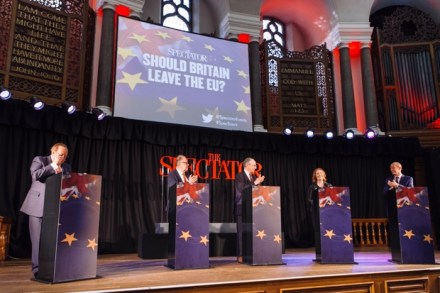
The Spectator's EU Poll asked a fairly random group of well-known people how they’d vote in the EU referendum, and this is what they said: Sir Tim Rice, lyricist: 'In 1975 I voted to stay in the Common Market from a standpoint of ignorance. In 2016 I shall vote to leave the EU, as a rebel without a clue. This is a gut reaction which I trust far more than the barrage of misinformation churned out by both sides of the campaign but overwhelmingly by the Remain camp. At least this time round I know I don't know anything which is more than can be said for most of the campaigners. It would be good to spend one's final years as part of a truly independent nation once more. I am intrigued that Mr.

Letters | 26 May 2016

From our UK edition

Leave’s grumpy grassroots Sir: James Delingpole should join us at a Remain street stall. He would soon be disabused of his idea that Remainers are ‘shrill, prickly and bitter’ and Leavers are ‘sunny, relaxed and optimistic’ (‘What’s making Remain campaigners so tetchy?’, 21 May). We can often spot a likely Leaver by their angry expression. As we offer a leaflet with facts about the EU to counter the lies and distortions our acquaintance has imbibed from the Leave campaign, we are lucky to escape with anything less offensive than ‘Piss off’. If a leaflet is taken, we often see it torn up. At the grassroots, Leave is certainly grumpy.

Losing faith

From our UK edition

A landmark in national life has just been passed. For the first time in recorded history, those declaring themselves to have no religion have exceeded the number of Christians in Britain. Some 44 per cent of us regard ourselves as Christian, 8 per cent follow another religion and 48 per cent follow none. The decline of Christianity is perhaps the biggest single change in Britain over the past century. For some time, it has been a stretch to describe Britain as a Christian country. We can more accurately be described now as a secular nation with fading Christian institutions. There is nothing new in the decline of the church, but until recently it had been a slow decline.

Portrait of the week | 26 May 2016

From our UK edition

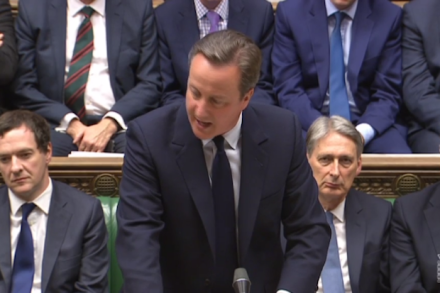
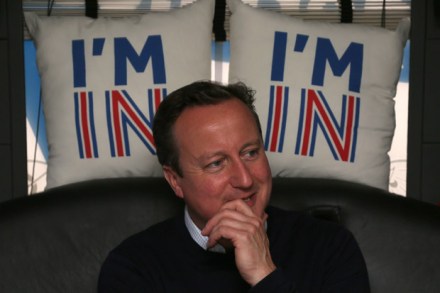
Home The government published a Treasury analysis warning that an exit from the EU would plunge Britain into a year-long recession and could cost 820,000 jobs. David Cameron, the Prime Minister, speaking with George Osborne, the Chancellor of the Exchequer, at B&Q’s head office in Hampshire, said that leaving ‘would be like surviving a fall then running straight back to the cliff edge. It is the self-destruct option.’ Downing Street said that leaving the EU would make an average holiday for four people to the EU £230 more expensive. Gillian Duffy of Rochdale, the nemesis of Gordon Brown, the former Labour leader, spoke in favour of the Leave campaign.

The dogs of peace

From our UK edition

From ‘Food dictatorship’, The Spectator, 27 May 1916: Nobody would like to see the whole race of dogs exterminated, but there are undoubtedly more dogs maintained in this country than can reasonably be justified, and a substantial addition to the Dog Tax would diminish the number, and pro tanto economise the consumption of food.

Barometer | 19 May 2016

From our UK edition

Name check 306 business people signed a letter to the Daily Telegraph saying that Britain would be better off outside the EU. Some notable collections of signatures: — 364 economists signed a Times letter about the dangers of monetarism in 1981. — 5,154 physicists signed a paper in Physical Review Letters last year reporting a more accurate recording of the mass of the Higgs boson particle. — 75,000 people signed a petition protesting against the government’s leaflet on why we should vote to stay in the EU. — 540,000 signed a petition demanding a stay of execution for Beau, a Missouri dog accused of killing a duck. — 1m Spaniards signed a petition in 2013 demanding that their government resign. — 2.

Lies, damned lies and…

From our UK edition

A Ryanair plane in a Stansted hangar was not the best backdrop for George Osborne’s claim that the economic argument about the European Union is now over and that his ‘consensus’ has prevailed. In recent years, Ryanair has lost its status as the fastest-growing budget airline in Europe: that honour goes to Norwegian Air, which has thrived outside the EU. And on the day of the Chancellor’s speech, a group of Ryanair passengers had announced their intention to take out a lawsuit against the company for what they see as unfair tricks to disguise the true cost of tickets. The Chancellor does the reverse of Ryanair: he tries to frighten us about the imaginary costs and charges of a ticket to Brexit.

Letters | 19 May 2016

From our UK edition

Republican party schisms Sir: Jacob Heilbrunn astutely analyses the predicament Donald Trump creates for America’s neoconservatives (‘Lumped with Trump’, 14 May). But the ideological schisms within the Republican party are even more profound than he indicates. In fact, Trump not only divides the populist right from movement conservatives — and neoconservatives — based in Washington, DC, he also divides neoconservatives against themselves. William Kristol, the neoconservative kingpin in Washington, has lately found himself under intense attack by David Horowitz, a California-based ex-radical-turned-rightist in the classic neoconservative mould. Horowitz has excoriated Kristol for dividing Republicans and effectively helping Hillary Clinton.

Bus battles

From our UK edition

From ‘The softening of street manners’, The Spectator, 20 May 1916: Generally the public opinion of the ’bus entirely upholds the conductor. The influence of the tyrant is too strong to allow of protest, but now and then cases of rebellion occur, and bold females who consider themselves slighted vow that they will write to the company. But an ordinary ’bus-load contains no such heroines…. Sometimes, however, the will of the passengers prevails by reason of unanimity. A few nights ago a drunken soldier got, late at night, into a West End ’bus. The conductor civilly asked him to get out. The man began to argue, and a number of elderly women took his part. ‘Let him stop,’ they begged, one after another.

Letters | 12 May 2016

From our UK edition

Europe is already divided Sir: The Archbishop Emeritus of Westminster writes eloquently about the historical purpose of a ‘union’ in Europe as being primarily to eliminate the wars that for centuries had characterised Europe (‘Let’s renew the EU’, 7 May). He, and Pope Emeritus Benedict, both point to the shared Christian beliefs that defined all nations of Europe. But the EU, as it has evolved, is now no expression of such an underlying faith — in fact, the opposite. As he points out, it has removed any official reference to Europe’s common heritage, and is increasingly set on a shallow, utilitarian course. Europe is now more divided than ever, and it will become more so under its present policies.

What Brexit won’t fix

From our UK edition

The Leave campaign was right to pour scorn on David Cameron’s warning this week that Brexit could threaten Europe’s military stability and lead to war. Boris Johnson mocks the Prime Minister about his prophecy on page 14. If Cameron really believed that Britain leaving the EU could lead to war in Europe, why on earth did he risk having a referendum at all? Why was he suggesting until a few weeks before his negotiations with EU leaders that he would consider voting for Brexit if he didn’t get his way? It’s easy to tease the increasingly shrill alarmism of the Remain campaign. But it is harder to say how exactly leaving the EU would make things better.

Portrait of the week | 12 May 2016

From our UK edition

Home David Cameron, the Prime Minister, made a speech in the British Museum warning of war if Britain left the European Union: ‘And if things go wrong in Europe, let’s not pretend we can be immune from the consequences.’ George Osborne, the Chancellor of the Exchequer, said that if Britain left, house prices would go down. The government changed its policy, announced during the budget, of turning all schools into academies. The government changed its policy of denying admission from Europe of unaccompanied children originating in countries such as Afghanistan and Syria. Mr Cameron was heard on television to say to the Queen at Buckingham Palace: ‘We’ve got some leaders of some fantastically corrupt countries coming to Britain.

Churchill’s return

From our UK edition

From ‘Colonel Winston Churchill’, The Spectator, 13 May 1916: The return of Colonel Churchill to the House of Commons, which we are told is to be permanent, has set going a number of rumours as to the future of the most audacious and brilliant figure in our public life. Colonel Churchill, it is alleged, is to come back into the Cabinet, and to come back as Irish Secretary… What is wanted in the Ministry just now is a man who can he trusted. But who dare say that Colonel Churchill has the quality of political trustworthiness? Be his political genius what it may, he is above all things a mauvais coucheur.