2705: Thirty sevens – solution
From our UK edition
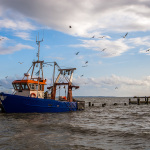
The unclued lights have all won the Pier of the Year award. First prize John Liddicoat, Swanage, Dorset Runners-up Rosamund Campbell, Woodstock, Oxon; C.J.

From our UK edition
The unclued lights have all won the Pier of the Year award. First prize John Liddicoat, Swanage, Dorset Runners-up Rosamund Campbell, Woodstock, Oxon; C.J.
From our UK edition
Home Sir Keir Starmer, the Prime Minister, announced a full national statutory inquiry into grooming gangs (which he had previously opposed) on the recommendation of Baroness Casey of Blackstock, who had been asked to audit the matter. His announcement came after four men born in Pakistan and three Rochdale-born taxi drivers of Asian descent were convicted of offences against two teenage girls who were repeatedly raped and assaulted in Rochdale from 2001 to 2006. The Casey report said that Greater Manchester, South Yorkshire and West Yorkshire had ‘disproportionate numbers of men from Asian ethnic backgrounds amongst suspects for group-based child sexual exploitation’.
From our UK edition
Sole survivors A 40-year-old British man, Vishwash Kumar Ramesh, was the sole survivor of the crash of an Air India jet shortly after takeoff from Ahmedabad en route to Gatwick. A surprising number of aircraft disasters have had a sole survivor – at least five others where more than 100 were killed. — On 16 August 1987 a four-year-old girl, Cecilia Cichan, survived the crash of North West Airlines flight 255 shortly after takeoff from Detroit; it killed 156. The plane’s wing flaps had not been extended (a suggested cause of the Air India disaster). — On 6 March 2003, a 28-year-old soldier, Youcef Djillali, survived the crash of Air Algerie flight 6289 shortly after takeoff from Tamanrasset; 102 died.

From our UK edition
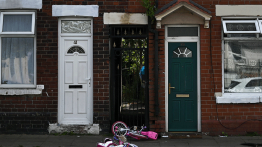
Some crimes are so horrific that our instinct is to look away. And there can be few as appalling as those perpetrated by the rape gangs whose activities Dame Louise Casey reported on this week. Girls as young as ten were beaten and sexually abused. They were tortured with baseball bats, knives and meat cleavers. They were urinated on, had cigarettes stubbed out on them, were burned by lighters and branded on their buttocks. Some contracted venereal diseases. One 12-year-old was compelled to undergo an abortion. These crimes weren’t rare, but sustained and widespread, carried out in up to 50 towns and cities across Britain over decades. The perpetrators were overwhelmingly Muslim men from Pakistani diaspora communities.
From our UK edition
Patricia – Pat – was dumpy, with a curling lip, Pat was in fact the Office Bitch. Every night she walked (stridently) home along our beautiful meaningless beach. I sometimes saw her from the car, an umbral figure with an itch for grey skies, pavements and — she told us this — ‘some decent human misery’, which of course was never to be: the sun was unstoppable, relentless the rapture of the sea. So Pat went ‘home’ to London and lived alone, unhappily.
From our UK edition
Dying wish Sir: As a 99-year-old with, presently, no intention of requesting assistance to die, I am struck by the articles of Dan Hitchens and Tom Tugendhat (‘Bitter end’ and ‘Killing me softly’, 7 June), which base their strong opposition on the opinions of everyone other than the person supposed to be requesting such assistance. He or she, poor soul, is expected to just lie there and listen to whether they are to be allowed to have any opinion at all on the matter. It’s my life they are writing about. At present I have the ability to end it whenever I might wish. What Messers Hitchens and Tugendhat are arguing is that, if I change my mind, no one is to be allowed to help me at a moment of my choosing. That’s wrong.

From our UK edition
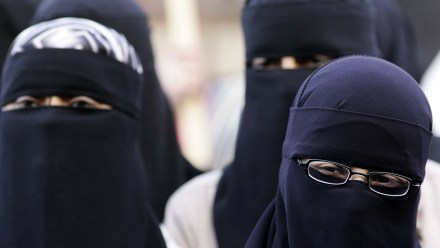
Behind the veil How many countries have banned the burqa? At least 24 have placed some restrictions around the wearing of full-face coverings in public, although in most cases it applies only in public buildings. Interestingly, they encompass liberal democracies and dictatorships, Muslim-dominated and non Muslim-dominated countries. They are: Algeria, Austria, Azerbaijan, Belgium, Bulgaria, Canada, Chad, China, Denmark, France (general ban in public), Gabon, Kosovo, Kyrgyzstan, Latvia, Luxembourg, Netherlands, Norway, Sri Lanka, Switzerland, Tajikistan, Tunisia, Turkmenistan, Turkey and Uzbekistan. In Afghanistan, the wearing of a burqa or niqab (which has a slit for the eyes) is compulsory for women. Degrees of separation Is it still worth going to university?

From our UK edition
The words are ‘bomb’ (suggested by BLOCKBUSTER (1A) and EGG (7A)), ‘comb’ (SLADE (18A) and DISENTANGLE (41A)) and ‘tomb’ (SHRINE (20A) and SPEOS (10D)). Together they form EYE-RHYMES (40A-25D) only. OMBRE (31D) is to be shaded.

From our UK edition
This week’s spending review confirms that where there should be conviction, there is only confusion; where there should be vision, only a vacuum. The country is on the road to higher taxes, poorer services and a decaying public realm, with the bandits of the bond market lying in wait to extract their growing take from our declining share of global wealth. When every warning light is flashing red, the government is driving further and faster towards danger The Chancellor approached this spending review with her credibility already undermined. Promises not to raise taxes on working people translated into a tax on work itself which has driven up unemployment.
From our UK edition
Home Yvette Cooper, the Home Secretary, was the last minister to agree funding in the government spending review. Once the NHS and defence were settled there wasn’t enough to go round. The police wanted more. Everyone over the state pension age in England and Wales with an income of £35,000 or less will receive the winter fuel payment after all, at a cost of £1.25 billion, Rachel Reeves, the Chancellor of the Exchequer, announced. Capital spending included £39 billion on social housing over the next ten years. The government also committed £14.2 billion for the new Sizewell C nuclear power station, but did not say where the money was coming from. Rolls-Royce was selected as the preferred bidder to build the country’s first small modular reactors. Unemployment rose to 4.
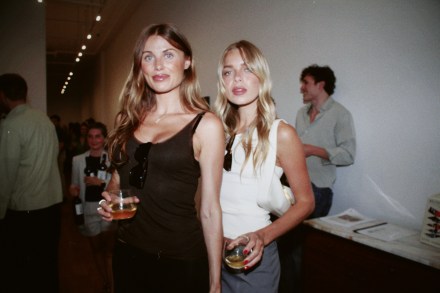
Strong cocktails and sparkling conversation were the order of the evening at The Spectator's first event in New York City at Palo Gallery. Author Rachel Cockerell spoke about her fascinating book, Melting Point: Family, Memory, and the Search for a Promised Land. Cockerell’s radical debut tells the story of the Galveston Plan: a forgotten episode in US history in which ten thousand Jews fleeing the persecution and brutality of the Russian Empire set sail for Galveston, Texas.It was standing room only for Speccie subscribers for the conversation between New York editor Orson Fry and Cockerell. Afterwards, the author mingled with guests and answered their questions. The evening nicely lubricated with white wine, beer and sake, graciously provided by the event sponsor SOTO SAKE.
From our UK edition
Lionel is right Sir: Gareth Roberts’s piece (‘End of the rainbow’, 31 May) gave me pause to reflect. It’s not that Pride has become irrelevant; after all, same-gender relationships are still criminalised in 64 countries – and in eight of those the death penalty is applicable. Rather, since the pandemic, it seems to have taken a rather nasty and unpleasant turn, with those dissenting from whatever ludicrous party line happens to be in vogue routinely heckled and vilified. Placards emblazoned with slogans such as ‘If you see a Terf [trans-exclusionary radical feminist] then smash them in the face’ are often to be spotted on Pride marches.

From our UK edition
Under control UK air space is to be reorganised – the first wholesale change since the 1950s – to improve flight times and reduce delays. It was Britain that pioneered air traffic control with the world’s first control tower – a timber shed on a platform 15ft above the ground – at Croydon Aerodrome in 1920. The tower was given responsibility for all aircraft airborne, with which it had basic radio connections. From 1928, control centres in Norfolk and Kent allowed radio signals to be ‘triangulated’ for the first time, allowing the position of an aircraft to be determined even if the pilot was lost. Battle ready The government seemed to downgrade its target to spend 3 per cent of GDP on defence to an ‘aspiration’.

From our UK edition
The unclued lights each contain E as their only vowel four times. Down solutions at 4, 5 and 36 include three Es and those at 6, 10 and 38 include two Es. First prize Alison Howard, Tunbridge Wells Runners-up A.C.R.
From our UK edition
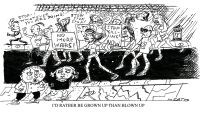
Home The government said that the armed forces had to move to ‘warfighting readiness’ and accepted the 62 recommendations of the Strategic Defence Review headed by the former defence secretary and head of Nato, Lord Robertson of Port Ellen. But the funding of the plans remained in doubt as the government insisted that a rise in defence spending to3 per cent by 2034 remained an ‘aspiration’; yet Nato was expected at this month’s summit to insist on a level of 3.5 per cent. The government committed £15 billion to its nuclear warhead programme; £1.5 billion to build six new munitions factories; an extra £1.5 billion for repairs to military housing; and the building of up to 12 conventionally armed nuclear-powered submarines.

From our UK edition
Britain without blasphemy laws is a surprisingly recent development. Blasphemy was abolished as a common law offence in England and Wales only in 2008 and in Scotland in 2021. But that was the final burial of a law dead for much longer. The last execution for the crime was in 1697; the last imprisonment in 1921; and the last successful trial in 1977 – Mary Whitehouse’s prosecution of Gay News for publishing a poem about a centurion’s rape of Christ’s corpse. Even if 11 local councils banned Monty Python’s Life of Brian two years later, the trend since has been towards trusting that the Almighty is big enough to fend for himself. Yet this week the clock seemed to have been turned back to around ad 650.
From our UK edition
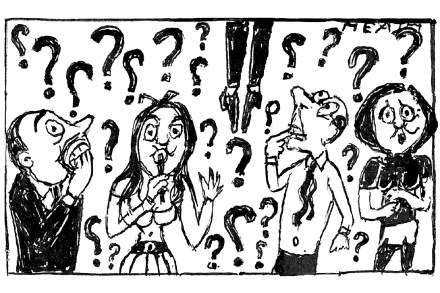
This week, the Spectator Club hosted a quiz night for subscribers – with the ‘Charles Moore’s red corduroys’ team the eventual winners.* The night was such a success we thought other readers would enjoy doing the quiz as well. There are four rounds of questions below. We’d like to think the questions are fun to work out, and pass the ‘even if you don’t get them, you’ll kick yourself when you hear the answer’ test. If you can beat the winning team’s score we'll enter you into a draw for a bottle of Pol Roger champagne. Enter your answers here by Friday 6 June.Round one 1. Which type of pasta was banned from menus for those attending the 2025 papal conclave, because of ancient fears that it could be used to smuggle in notes from the outside world? 2.
From our UK edition
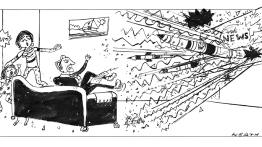
Domestics policy Brigitte Macron, wife of Emmanuel Macron, was seen to push him in the face as the doors to their plane opened on arrival for a visit to Vietnam. The French President claimed they were just joking. It will kindle memories of awkward moments between Donald Trump and his wife Melania, as well as the incident in June 2019 when police were called to the south London home of Boris Johnson’s then-girlfriend Carrie Symonds after reports of a heated argument, apparently about wine being spilled on a sofa. – It is increasingly hard for politicians to keep their domestic disputes private.

From our UK edition
Hard reset Sir: Once again we must debate Brexit (‘Starmer vs the workers’, 24 May). The ‘reset’ agreement does give more control over UK domestic policy to the EU, if the points outlined in it are followed through. I assume they will be, as that’s what Labour’s front bench wants. (The prospect of us rushing through EU passport control, as Michael Gove and others suggest, is still unlikely, though – the document states only that there will be the ‘potential use of e-gates where appropriate’.) Britain must pay for many of the extra ‘benefits’. Apparently the boost to the UK amounts to £9 billion by 2040, but I’m unable to identify any government research that supports this – only an assertion in a press release.

From our UK edition
Meet Nick. He is 30 years old, has a good job and lives in London. He keeps himself to himself. He isn’t political. At least he never used to be. And yet the struggle of Nick has become the struggle of our age. For Nick, the social contract has broken down. Nick embodies a generation for whom achieving the same life quality as their parents is a distant dream After he has paid his taxes, student loan and the rent for his Zone 4 shoebox, Nick’s take-home pay is meagre. He knows where his money goes: on the benefits, social housing and remittances of one Karim, 25, an aspiring grime artist; and on Simon and Linda, 70, a retired couple spending the fruits of their final-salary pensions and property portfolio on cruises.