Books & Arts – 26 October 2017
From our UK edition
From our UK edition
From our UK edition
The poem ‘The Red Wheelbarrow’ (originally ‘XXII’) by William Carlos Williams is considered perhaps the foremost example of IMAGISM. First prize M. & M.
From our UK edition
The routing of Isis in northern Iraq ought to be a time of international celebration, but as ever in the Middle East, there is no such thing as a straightforward victory. No sooner had Isis been driven away — though not quite vanquished — than the next great struggle commenced, this time between the Iraqi government and the Kurdish forces who for the past three years have been holding back Isis from the city of Kirkuk and its surrounding oilfields. This week, Iraqi forces stormed into Kirkuk and raised the country’s official flag, removing the Kurdish flag which was raised there in 2014.

From our UK edition
The great divider Sir: Niall Ferguson (‘Tech vs Trump’, 14 October) draws a parallel between the Reformation — powered by the printing press — and today’s social networks — powered by the internet — in their influence on the established hierarchy. Ferguson astutely observes that the consequence of the Reformation was not a hoped-for harmony but ‘polarisation and conflict’. The difference was then, and is now, between collectivism and individualism. Collectivists always saw the internet as a vehicle for the universal consciousness: the blending of minds. Individualists always saw the internet as an integrator: establishing facts using the principle of non-contradiction. The first is mystical.
From our UK edition
Home Theresa May, the Prime Minister, and David Davis, the Brexit Secretary, went to Brussels and had dinner with Jean-Claude Juncker, the president of the European Commission and the EU’s chief negotiator Michel Barnier. They came up with a joint statement that ‘efforts should accelerate over the months to come’. But by this week’s meeting of the European Council, Britain was deemed not to have done enough about the price it would pay to allow the EU to discuss trade matters. No great hope was held out that it would be any better by the next meeting in December. Keir Starmer, Labour’s Brexit spokesman, said: ‘There is no way we would vote for a no deal.


From our UK edition
The routing of Isis in northern Iraq ought to be a time of international celebration, but as ever in the Middle East, there is no such thing as a straightforward victory. No sooner had Isis been driven away — though not quite vanquished — than the next great struggle commenced, this time between the Iraqi government and the Kurdish forces who for the past three years have been holding back Isis from the city of Kirkuk and its surrounding oilfields. This week, Iraqi forces stormed into Kirkuk and raised the country’s official flag, removing the Kurdish flag which was raised there in 2014.

From our UK edition

From our UK edition
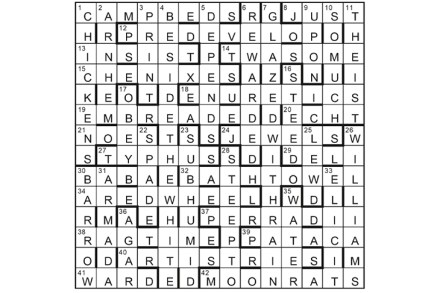
The paired unclued lights are food items which include a place-name. BATH and BUNS do double duty, BUNS is the plural and BRIGHTON ROCK is the literary reference. The pairs are 1A/22, 8/12, 8/14, 11/14, 13/33, 31A/25D, 38/37 and 39/30.
From our UK edition
Cheat sheets The Quality Assurance Agency for Higher Education wants universities to catch out more students who buy essays online. How much do cheats pay for this service? — 1,000 words in seven days to 1st standard £103. Also offers 2:1 standard for £74 and 2:2 standard for £57. This website offers a refund if you don’t get the promised grade. —A rival site offers a 1st standard essay in seven days from just £18.99, with £13.99 for a 2.1 and £11.99 for a 2.2. — From £16.18 per page on a site which says ‘compare our prices with those set by solicitors, barristers, doctors or accountants’. Falling short Where would an early exit leave Theresa May in the prime ministerial ranks?
From our UK edition
Let’s talk about guns Sir: I was surprised that the cover stories on the recent shootings in Las Vegas (‘Say nothing’, 7 October) did not address the issue of gun control. The point surely is that if weapons are readily available, and not universally disapproved of, sooner or later someone will use them. There doesn’t have to be a specific motive, religious or otherwise, and often there is no point in looking for one. There is no question that for some people, using guns and explosives gives a thrill which they probably do not find elsewhere — and the more powerful and rapid-firing the weapon, the greater the thrill.

From our UK edition
Home Theresa May, the Prime Minister, when asked by Iain Dale in an interview on LBC: ‘If there was a Brexit vote now, would you vote Brexit?’ repeatedly refused to say. Earlier, briefing the House of Commons on Brexit, she said that the country must prepare for ‘every eventuality’. The government published two papers on trade and customs arrangements that envisaged ways by which Britain could thrive as an ‘independent trading nation’ even if no trade deal were reached with Brussels. Mrs May admitted that during a transitional period, the European Court of Justice would retain jurisdiction.

From our UK edition
The giants of the internet have long said that they are not publishers but mere platforms — or couriers — of the new information age. Companies such as Google and Facebook insist that they’re the digital equivalent of the vans, newsagents and paperboys who distribute what other people publish. So they ought not to be held responsible for it. In the early years of the internet, their argument made sense. Most news and comment came from newspapers and magazines (like this one). But then social media arrived and restraint vanished. Military-grade email encryption has emerged as standard, giving security to those who don’t want their email hacked, but also cover to criminal networks.

From our UK edition

From our UK edition
The suggested title is Brideshead Revisited, HEEDS/RABID (6A/42) being an anagram of BRIDESHEAD. The six characters, all members of the Flyte family, are ALEXANDER (Lord Marchmain) (21D), TERESA (Lady Marchmain) (37), and their children, BRIDEY (17), SEBASTIAN (8), JULIA (33) and CORDELIA (19). FLYTE (diagonally from the eighth row) was to be shaded. First prize Daisy Jestico, London SE23 Runners-up Mrs J. Sohn, Gorleston-on-Sea, Norfolk; E.
From our UK edition

From our UK edition
What do the Tories offer? Sir: I have been hoping that someone more eloquent than me would respond to your contributors’ rants about Jeremy Corbyn, but as they have not, I thought I’d chip in (‘Corbyn’s big chance’, 30 September). As someone who is reasonably financially secure, the Tories would probably consider me a shoo-in voter. But what do they offer? Tax cuts, while paying for them by cutting services and benefits to those less fortunate, and in effect, pulling up the ladder behind me. ‘Capitalism’ to many in this country is really only a description of how Thatcher sold, or destroyed, the country’s wealth-creation industries, and a few years later the government of the day gave the proceeds to the banks as a bailout.
From our UK edition
Bunny beginnings Hugh Hefner, creator of Playboy, died. How did he get the idea for bunny girls? — Hefner said he had been inspired by Bunny’s Tavern, a bar in Urbana, Illinois, named after its owner Bernard ‘Bunny’ Fitzsimmons, who opened it in 1936. — A closer match for Hefner’s clubs was the Gaslight Club opened in Chicago in 1953, where customers were served by ‘gaslight girls’ dressed in corsets and fishnets. — Originally, Hefner proposed dressing up his hostesses as baby dolls, then toyed with the idea of ‘stag girls’ wearing antlers, to match the name he wanted to give Playboy magazine, Stag Party. He had to drop that name when Stag magazine (men’s adventure stories) threatened to sue.
From our UK edition
Home Theresa May, the Prime Minister, told her audience at the Conservative party conference that she wanted to continue, like them, to ‘do our duty by Britain’. She said the government planned to make it easier for local authorities to build council houses. On the eve of the conference, Boris Johnson, the Foreign Secretary, in an interview with the Sun sketched out four ‘red lines’ that he said should apply to Brexit. These included a transition period that must not last ‘a second more’ than two years. His stipulations went beyond anything agreed by the government, but Mrs May sidestepped questions about whether he was ‘unsackable’.

From our UK edition
Theresa May’s conference speech — interrupted by coughing fits and with part of the set falling apart behind her — served as an unfortunate metaphor for her premiership and party. She is carrying on and in doing so, she demonstrates her resilience, but also her frailty. The horrified faces of cabinet members watching as her voice dried up on stage seemed to sum up their wider concerns about whether their party is in a fit state to see off Labour, so recently dismissed by them as a joke. Now, they are left wondering if their party is falling apart. The Prime Minister spoke about taking the fight to Jeremy Corbyn, but her announcements suggest that she is suing for peace — accepting his argument, and seeking to copy some of his solutions.

From our UK edition