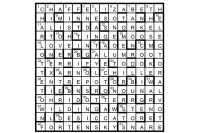
to 2413: Sign here please
From our UK edition
The unclued lights are EPISCOPAL SIGNATURES First prize Jason James, Cambridge Runners-up K.M.
From our UK edition
The unclued lights are EPISCOPAL SIGNATURES First prize Jason James, Cambridge Runners-up K.M.
From our UK edition
From ‘Keeping fat’ by Geoffrey Wheatcroft, 7 October 1978: The running craze is a symptom of our deplorable age, in particular of our obsession with health, slimness, fitness and, above all, longevity. Jogging is not only undignified but absurd. It is a confession that people feel that they lead displeasingly unhealthy lives, but are not prepared to do anything preventative, rather than remedial, about it. The answer for someone who thinks that he is overweight is to eat less for a while, not to leap around at unseemly exercises. And the way to eat less is, simply, to eat less.
From our UK edition
Support for stop and search Sir: Mary Wakefield is rightly exasperated by fatuous comments over police use of stop and search (‘Stop posturing over stop and search’, 29 June). Perhaps this year there will be 200 murders of children by other children. Swamping areas with police is obviously a visible response to the problem, but gangs know there is a reluctance to stop and search and this is part of the reason for their arrogant attitude. Stop and search is street policing in the raw. It often leads to arrest, and it can be a messy, frustrating, confrontational business, even when done with tact and patience. As a Met PC for 31 years — Lewisham, then Islington — I went through hundreds of pockets. Nearly all the searches were resented: who wants to be frisked?
From our UK edition
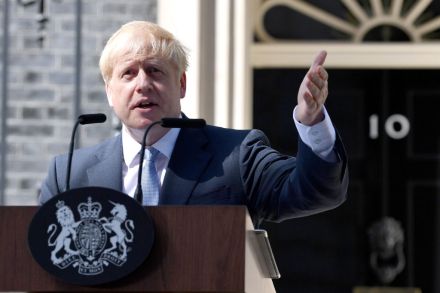
Model hobbies Asked what he did to relax, Boris Johnson claimed that he liked to make model buses. Some others who share his hobby: — Rod Stewart is a keen railway-modeller who claims to have a set the size of a tennis court at his Beverly Hills home. — Jools Holland, Roger Daltrey and Pete Waterman are all into model railways. — Model buses are a more rarefied taste. But if he isn’t already, Boris could consider joining the Model Bus Federation, which has represented the hobby since 1968. Its national show and AGM will be held in Tewkesbury on Saturday 5 October, just after the Conservative party conference. Who pays? Boris Johnson wants to raise the threshold for the 40 per cent rate of tax from £50,000 to £80,000. How many people pay tax?
From our UK edition
Home Boris Johnson, the bookies’ favourite for the leadership of the Conservative party, would, if he became prime minister, ‘show the public sector some love’ said his supporter Matt Hancock. Jeremy Hunt, his rival for the leadership, said: ‘If you’re a sheep farmer in Shropshire or a fisherman in Peterhead… I will mitigate the impact of no-deal Brexit on you.’ The 160,000 members of the Conservative party, few of them public-sector workers, and even fewer sheep farmers or fisherfolk, were sent postal ballots from 6 July to vote for the new leader.
From our UK edition
When the tanks were rolling into Tiananmen Square and the Cold War hadn’t yet formally come to an end, it seemed obvious: freedom and democracy were prerequisites for economic success. Yet over the past three decades, China has challenged that notion by creating a model previously unknown to the world: consumer capitalism combined with autocratic government. Under Xi Jinping’s rule, China’s new middle class now enjoys near-western living standards. So long, that is, as it does not question the legitimacy of its leaders. The success of the Chinese model has presented a conundrum for western governments: how to deal with a country that continues to have little regard for human rights and yet nevertheless offers lucrative opportunities for investors.
From our UK edition
From our UK edition
On 15th June 1919 John ALCOCK (34) and Arthur BROWN (37) completed the first non-stop transatlantic flight when they crash-landed near CLIFDEN, COUNTY GALWAY (46/9) in a VICKERS VIMY (23/25), having taken off from ST JOHN’S, NEWFOUNDLAND (10/13) the previous day.
From our UK edition
Appeasement? Sir: Your editorial (‘Plan B’, 22 June) refers to the need for Boris Johnson, as prospective PM, to have ‘warm words for our European allies — even if we end up without a deal’. The use of the word ‘allies’ troubles me. The dictionary defines the word in context: ‘Any time there’s a disagreement or conflict, it helps to have allies: if you don’t, you’re all alone.’ Being ‘alone’ is not the same as being wrong. Britain has been very much ‘alone’ in the past. And while it has sometimes been wrong, it has often been alone and right in its cause. One of the most extraordinary aspects of the whole Brexit debate has been the vituperative conduct of the EU.
From our UK edition
Crises in the Gulf and Conservative leadership elections come around with unnerving regularity. It is not unknown for both to coincide — that happened in 1990, when Margaret Thatcher was overthrown in the lead-up to the first Gulf War. On that occasion, drama on the domestic front did not smother Britain’s response to the international crisis — unlike now. It is bizarre to have a US president threatening to ‘obliterate’ Iran while our Foreign Secretary hardly bothers to respond, preferring to pose with fish and chips and Irn Bru on the campaign trail.
From our UK edition
Home A neighbour of Boris Johnson, 55 (a candidate for the leadership of the Conservative party and hence for the prime ministership), recorded a loud argument Boris was having one night with Carrie Symonds, 31, in the flat in Camberwell they shared. The neighbour called the police (who later said ‘There were no offences or concerns apparent to the officers’) and then gave the recording to the Guardian. Other newspapers immediately ran front-page reports of the incident. Mr Johnson and Miss Symonds had to leave the flat because of protesters in the street. Mr Johnson refused to answer press requests for an explanation. Three days later, a photograph of the couple holding hands in a garden was published by Mail Online.
From our UK edition
To debate or not to debate Is Boris Johnson wise to shun TV debates? — Prior to the 2015 Labour leadership election, TV debates had not been part of party leadership debates, and have only been part of general elections since 2010. — The first election to feature a TV debate was the 1960 US presidential election, when JFK and Nixon met for four debates. The first, staged by CBS, went out on TV and radio, when radio audiences favoured Nixon and TV audiences favoured Kennedy. Nixon had just left hospital, and had applied a product to cover up his five o’clock shadow. Under the TV lights it began to melt, making it look as if he was dribbling. Six per cent of the electorate said the TV debates had played a role in making up their mind, and Nixon went on to lose by 0.
From our UK edition
From our UK edition
The unclued lights are famous LEFT-HANDED people.
From our UK edition
Eco opportunity Sir: As a North Sea oil engineer now working on the UK’s ‘green’ energy transition, I believe Ross Clark (‘Greener than thou’, 15 June) raised many valid points but missed out on the major opportunities for the UK economy. Irrespective of what we believe to be the extent of climate change, other key factors are changing rapidly. Who will want to drive their own petrol car when they can summon an autonomous vehicle at the click of an app? And with the global population rising, the total energy demand continues to soar. In the UK, leaps in technology have led to major investment and seen energy generation costs tumble in the past decade.
From our UK edition
History of hustings Why are hustings called by that name? — The word ‘hustings’ is derived from an old Norse word for ‘house of assembly’. In English it was applied to the court held by the Lord Mayor of London in Guildhall, and also to the wooden platform on which the court was held. It was later applied to the meetings at which election candidates used to be publicly nominated. — The process involved a show of hands which gave candidates an idea of the support they might expect were a poll to be held. Candidates with little visible support would often withdraw, with the result that a candidate would be elected unopposed, rather as some Conservatives have been hoping might happen in the case of Boris Johnson.
From our UK edition
Home Boris Johnson was well ahead in the parliamentary stage of the contest for the leadership of the Conservative party, gaining 126 of the 313 votes by MPs in the second ballot, with Jeremy Hunt second at 46 (and Dominic Raab knocked out). He had declined to take part in a Channel 4 debate, and was represented by an empty podium before an audience purporting to be floating voters. The most memorable metaphor of that debate concerned bin bags. Rory Stewart said: ‘I was trying to cram a whole series of rubbish bins into the rubbish bin.’ He had meant to say ‘a whole series of rubbish bags’, but the point was that unrealistic Brexit promises resembled his dustbin experience.
From our UK edition
When Boris Johnson was appointed editor of this magazine two decades ago, an unkind soul said it was like ‘entrusting a Ming vase in the hands of an ape’. The remark encapsulated many people’s worst fears about the man who will almost certainly be Britain’s prime minister in four weeks’ time, if not before: that Boris is an irresponsible joker. Similar warnings were made when he was elected London mayor. His refusal to conform to type encourages a constant expectation of imminent disaster. What if Boris flops in No. 10? Even his supporters can’t be sure he won’t fail: his election as leader is a gamble from a party that believes its very survival is at stake.
From our UK edition
First prize Susan Edouard, Bexhill-on-Sea Runners-up Joan Sutton, Canterbury, Kent; Harry Duff, Machen, Caerphilly.
From our UK edition
The benefits of indecision Sir: Belgium has often been without a government for months on end without suffering any economic collapse. In Britain in recent decades governments with large majorities and led by ideologically driven prime ministers have made disastrous decisions on welfare reform, foreign policy and selling off social housing. Isabel Hardman is correct to say that ‘decisions are needed to solve problems that have festered for years’ (‘The in-tray of horrors’, 8 June). However her analysis should also consider the benefits of government paralysis: the damage that has been avoided because superficial and ill-thought-out policies never saw the light of day.