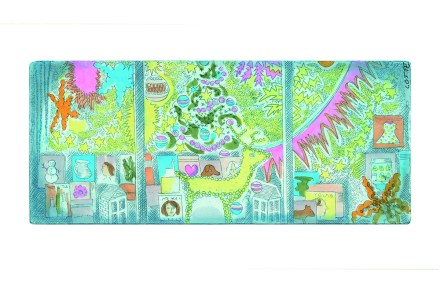
to 2435: A Little Puzzle
From our UK edition
Unclued lights are DWARFS.
From our UK edition
Unclued lights are DWARFS.
From our UK edition
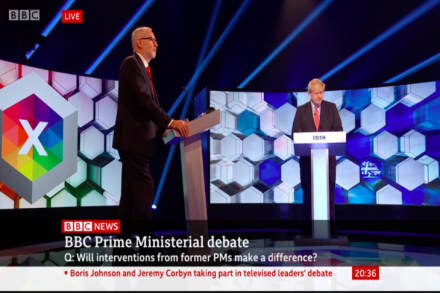
Boris Johnson and Jeremy Corbyn clashed in a head-to-head in tonight's live BBC debate. The two leaders faced off in front of a studio audience for their final clash before election day.
From our UK edition
Keeping it in the family A study by the Middle East Technical University claimed to prove that the pronounced chin of Charles II of Spain and many of his Habsburg relatives was the result of marriage between cousins. Some royals who went even further: — Tutankhamun’s wife Ankhesenamun is believed to have been his half-sister. She bore two daughters who both died in infancy. — King Rama V of Siam (1868-1910), also known as Chulalongkorn, is reputed to have had 77 children with 92 different consorts, four of whom were his half-sisters. — Princess Nahienaena of Hawaii (1815-1836) bore a daughter with her brother, Prince Kauikeaouli. The baby died.
From our UK edition
Look closer to home Sir: In your interview with Boris Johnson (‘Austerity was not the way forward’, 30 November) he attributes the EU referendum result to ‘regional inequality… parts of the UK were simply being ignored… leaving people behind’. Yet he says his remedy for this is ‘infrastructure and education and technology’. In other words, people voted Leave for reasons that had nothing to do with the EU: they were ‘left behind’ because of the austerity policies of the British government. The remedy he identifies is also entirely within the power of our own government.
From our UK edition
Next week, voters will decide the future of the government, of Brexit, and perhaps of the Union. Jeremy Corbyn has been admirably clear on what he offers: a radical experiment in far-left economics, going after the wealthy to fund the biggest expansion of government ever attempted in this country. Boris Johnson proposes to complete Brexit and restore much-needed stability to government. But given that about half of voters still oppose Brexit, the race is close. Corbyn offers a new referendum on Brexit. It is easy to snigger at his declaration that he would be neutral during this campaign. But his pledge to be an ‘honest broker’ conceals the deceit that his referendum represents.
From our UK edition
Home Usman Khan, aged 28, out of prison on licence after serving eight years of a 16-year sentence for preparing acts of terrorism, stabbed to death Jack Merritt, aged 25, and Saskia Jones, aged 23, at Fishmongers’ Hall and wounded three others before being stopped on London Bridge by members of the public and shot dead by police. A Polish kitchen worker called Lukasz Koczocik tried to disarm him with a pole; another man grabbed a narwhal tusk from the wall at the hall where Khan had been attending a conference on rehabilitation while a third let off a fire extinguisher to distract him from further bloodshed. One man who pursued the killer was said to be a murderer present at the conference.
From our UK edition
From our UK edition
The unclued lights, including the pair at 35/28, are CAKES.
From our UK edition
From our UK edition
Next week, voters will decide the future of the government, of Brexit, and perhaps of the Union. Jeremy Corbyn has been perfectly clear on what he offers: a radical experiment in far-left economics, going after the wealthy to fund the biggest expansion of government ever attempted in this country. Boris Johnson proposes to complete Brexit and restore much-needed stability to government. But given that about half of voters still oppose Brexit, the race is close. The prospect of Jeremy Corbyn in government - and all that this implies - is all too real. And it might become so if those who oppose him do not actively vote against him next week.
Andrew J. Bacevich I have reached the age when it seems important to give attention to the books I ought to have read long ago but skipped past. As an American born in the middle of the 20th century, I’m drawn to the literature of that era. Lately, I have been reading for the first time John Steinbeck’s The Grapes of Wrath (Penguin, $18), published during the Great Depression. Of course, I have seen John Ford’s gripping interpretation of the novel, starring Henry Fonda as Tom Joad. It’s a great movie. In my estimation, the novel itself is also a masterpiece. Of course, it is necessarily a product of its time, saturated with a sentimental depiction of those dispossessed by massive economic upheaval.
From our UK edition
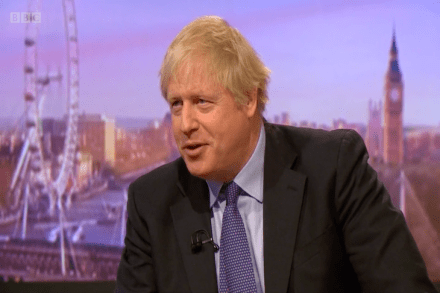
Boris Johnson appeared on the Andrew Marr Show this morning. Marr grilled the Prime Minister on everything from NHS spending to Andrew Neil. Read the full transcript here: Andrew Marr: Simple question to start with, how could such a man be released onto the streets of Britain after serving only eight years? My final guest this morning is the Prime Minister, Boris Johnson. How could it happen, Boris Johnson? Boris Johnson: Well, I'm afraid that when you look at the case, there are a number of conclusions that one can immediately draw. And that is, of course, first of all, Andrew, that I pay tribute to the emergency services, the reaction of the police, the public. Our sympathies, of course, are with the victims and their families.
From our UK edition
From our UK edition
Down to zero Sir: Paul Collier’s siren call to take advantage of near-zero interest rates to go on a massive government infrastructure splurge is one Jeremy Corbyn might welcome but Conservatives should resist (‘Back to Plan A+’, 16 November). Japan tried what he is proposing when its bubble burst in 1990. The result: $6.3 trillion debt and two wasted decades. As Harvard’s Edward Glaeser has noted: ‘No one can look at the Japanese numbers and conclude that the money has ramped up the growth rate.’ Apart from anything else, politicians are poor allocators of capital.
From our UK edition
Election counts Michael Bloomberg — the ninth richest person in America — entered the US presidential race by buying $34 million (£26 million) worth of advertising just to launch his campaign. How does that compare with what British political parties are allowed to spend in the general election? — In Britain, each party is allowed to spend, centrally, £30,000 for each constituency fought. With 650 constituencies, this amounts to a maximum of £19.5 million. — In addition, individual candidates can spend £8,700 plus 6p per voter (in urban boroughs) or 9p per voter (in county constituencies). — Put the two together and it means there is an effective maximum level of spending of just under £30 million per party.
From our UK edition
Home The Chief Rabbi, Ephraim Mirvis, intervened in the election campaign by declaring that anti-Semitism was a ‘poison — sanctioned from the very top’ of the Labour party, whose claim to have dealt with cases was a ‘mendacious fiction’.The Archbishop of Canterbury, the Most Rev Justin Welby, said: ‘That the Chief Rabbi should be compelled to make such an unprecedented statement at this time ought to alert us to the deep sense of insecurity and fear felt by many British Jews.’ Jeremy Corbyn, the Labour leader, insisted that ‘rapid and effective’ action had been taken against offenders, and refused to apologise. Chris Moncrieff, a longtime lobby correspondent of the Press Association, died aged 88.
From our UK edition
There is a large vacuum at the heart of this general election campaign. Aside from the topic of our relations with the EU, and Nicola Sturgeon’s statement that she would decline to press a nuclear button which is never going to be hers to press in any case, no leader has had anything of interest to say on foreign policy. This is not for want of matters to discuss. The elections in Hong Kong at the weekend presented an ideal opportunity to bring up foreign policy. A small political earthquake occurred in a former British colony, with reformers triumphing at the polls just as they had drawn huge support on the streets.
From our UK edition
The painters were Millais (suggested by BOXING MATCH/SLOTHS: 1A/9D), Constable (GYP/FIRM: 7A/35), Gainsborough (EARNS/BROOKLYN: 29/24) and Landseer (NATION/SOOTHSAYER: 30/19). The title suggested Hogarth. First prize R.J.
From our UK edition
From 16 October 1982: Prince Andrew’s Caribbean holiday with Miss Koo Stark (following, perhaps prompted by, months of all-male company in the Falklands) has reassured the nation that its royal family is ‘normal’.The Prince’s conduct is hallowed by tradition. Indeed, the difficulty is in finding a single heterosexual prince… who confined himself to the woman he married. Over the past centuries, only King George VI seems to qualify with anything approaching certainty. Like Andrew, King William IV was a sailor… he visited the West Indies, where he unluckily contracted venereal disease. Mrs Jordan, an actress, bore him ten children. Similar examples are too numerous, or too shameful, to mention. We have seen it all before.
From our UK edition
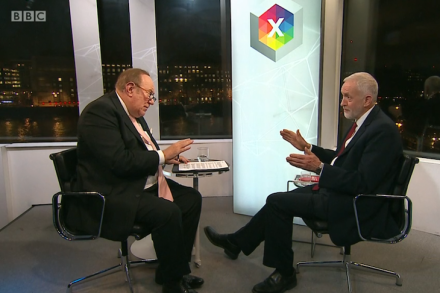
Jeremy Corbyn took part in The Andrew Neil Interviews on BBC One this evening. Neil grilled the Labour leader on everything from anti-Semitism to Vladimir Putin. You can read the full transcript from the interview here: AN: Jeremy Corbyn, the Chief Rabbi says a new poison of anti-Semitism, anti-Jewism, has taken root in the Labour Party and it’s sanctioned by you, he says. He questions you’re fit for office. What’s your response? JC: I’m looking forward to having a discussion with him because I want to hear why he would say such a thing. So far as I’m concerned anti-Semitism is not acceptable in any form anywhere in our society and obviously certainly not in my party, the Labour Party.