Tanya Gold

Tanya Gold

Tanya Gold is The Spectator's restaurant critic.

Half-baked Hollywood

From our UK edition

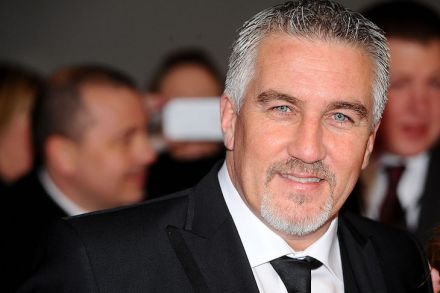
Knead is the first of Paul Hollywood’s new strain of bakeries that sell coffee, and which will encircle capitalism. This one is outside Euston station and I think the name — Knead, meaning squashed under fists, specifically Paul Hollywood’s fists — is designed solely to make you think of his big hands. Lots of people who watch The Great British Bake Off like Paul Hollywood’s big hands, and his PR team know it. He could knead Europe away; he could make Britain anything you want it to be. He and Mary Berry (now transformed into Prue Leith after the move from BBC1 to Channel 4) bridge the abyss in the British character. They are dignity and filth. There is much oblivious sex and politics in Bake Off, which is why it is a hit.
The queen of hotels

From our UK edition

Jean-Georges at the Connaught — formerly the Prince of Saxe-Coburg Hotel, but it was renamed during the first world war, at about the same time the Duke of Saxe-Coburg and Gotha was deprived of his British peerages, which was one of the funnier events in the war — is the informal restaurant at the Connaught Hotel, and it opened this summer on the curve of Carlos Place, Mayfair. The Connaught is an English hotel with a German heart. It is therefore the hotel equivalent of our Queen, and the best hotel in the world. It is better than its sister Claridge’s, from which Dwight Eisenhower ran away in 1944. He could face the Nazis, but not the ‘whorehouse pink’.

Elle Decoration meets pub food

From our UK edition

The Mandrake is a new ‘design hotel’ in London, which means it is for people who treat Elle Decoration magazine as their primary source of op-ed. It lives in a red-brick terrace in Fitzrovia and it feels very odd, like a corpse with the beating heart of a baby, perhaps even a Beckham baby: would it have preferred to demolish the crusty frontage and establish itself inside Heathrow Terminal 5, or a giant fridge? Who can say? And why is it named after a poisonous plant? The entrance is dark, and haunted by black-suited men. I do not know what they do, besides lurk charismatically and pretend they work for Karl Lagerfeld, and he is in danger, perhaps from cheap skirts, or his own plastic surgeon.

Venice all tarted up

From our UK edition

Veneta is a Venetian restaurant inside the St James’s Market development south of Piccadilly Circus. I do not like this development because it has no identity and great cities should have identities. It is not like St James’s, and it is nothing like a market either. It is a cold and glassy spot with a stupid name, and it is, with other developments from here to Hyde Park Corner, the reason that people now hate London or do not recognise it as London, because it is beginning to resemble a giant Nespresso capsule. Someone once told me that in a million years the only evidence of our civilisation will be nappies and Nespresso capsules and I think this may be true, and future alien visitors will think we invented caffeine and babies and then blew ourselves up by mistake.

Art of darkness | 14 September 2017

Stephen King, 69, has sold more than 350 million books, and tries not to apologise for being working-class, or imaginative, or rich. The snobbery has ebbed a little, though; in 2003 he won the National Book Foundation’s Medal for Distinguished Contribution to American Letters, and now the BFI is screening a series of adaptations of his novels, which show how versatile he is. Why can’t you write stories like Rita Hayworth and Shawshank Redemption, a woman asked him once. I did write it, he told her, but she did not believe him. King has published 59 novels, but he is a recovering addict and can’t remember writing them all. Most of Cujo (1981), a story about a rabid dog and adultery, is news to him.

In silent misremembrance

From our UK edition

Foxlow is near Golden Square in west Soho, where drunken hacks used to take long drunken lunches before having stupid drunken ideas. My favourite stupid drunken idea was from a Guardian hack and it involved renting an ice-cream van and asking Nick Cohen and A.A. Gill to drive around in it, selling ice creams, bickering and hopefully breaking down, before writing up the experience for a Silly Season special. But drunken hacks no longer take long drunken lunches in Soho. They get drunk at home, if there is one, or drink in the queue at Eat, if they can afford to eat. The piece was not commissioned, the years passed, and I am now a guest at the funeral of my own profession each day. A.A. Gill is dead, Nick Cohen is sober, and even Silly Season has gone.

A perfect feast with Roger Allam

From our UK edition

J Sheekey is one of Richard Caring’s older, and better, restaurants. Since he has dowsed the suburbs of London in multiple outposts of the Ivy (there is one in Wimbledon, another in Richmond and presumably one pending in Penge), J Sheekey increasingly feels like an island in a sea of pointlessly aspirational green. The rise of the Ivy — the original celebrity brasserie, which is code for an indifferent restaurant full of awful people eating shepherd’s pie — is an inevitable consequence of the rise of celebrity culture. This is anti--culture, and the Ivy is, therefore, an anti--restaurant. So many celebrities, and now so many Ivys to put them in. The age of narcissism has many tentacles.

Tapas but no phantom

From our UK edition

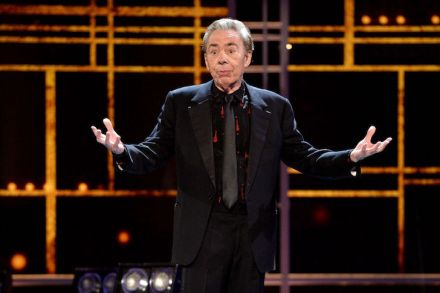
I am always surprised to remember that Andrew Lloyd Webber has taste; it must be remembrance of Cats. I was surprised, for instance, to learn that he once owned Pablo Picasso’s portrait of d’Angel Fernández de Soto, which I always thought of as my Picasso because it looks like my friend Hadrian Wise, who used to come to Merton College bar in his pyjamas. We once rolled a joint as long as The Spectator because he loved The Spectator. High as I was after the Spectator-length joint in 1994, I never thought I would write for it. Neither did he. Now Lloyd Webber, whose masterpiece is Phantom of the Opera, because it is all about him, has decided to host a tasteful restaurant in Victoria called the Other Naughty Piglet.

A menu for the emmets

From our UK edition

Tate St Ives is a pale 1980s block, with a fat rounded porte cochère and sea-stained walls. It is the kind of house Iron Man would build if he lived in New Malden, but St Ives has always welcomed money. It is an oddity in the land of cows, pilchards and tin, beloved of retirees, surfers and urban survivalists. You can, for instance, buy a £100 rucksack at a shop called the Common Wanderer, which also sells the book Wildside: The Enchanted Life of Hunters and Gatherers. I suspect this enchantment is news to the Cornish, and always has been. St Ives is a place of tribes then, with at least three different villages sitting above the beach where surfers frolic. Then there is the art gallery. It is very self-consciously an artistic ‘hub’.

Salt-beef delirium

From our UK edition

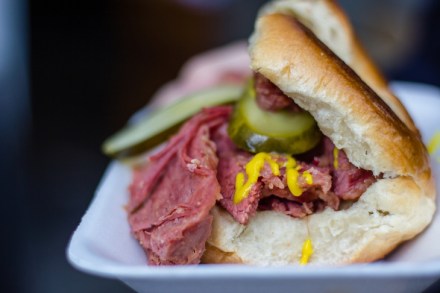
Katz’s Delicatessen, established 1888, is a theme park of Jewish-American food, with tribute gift shop, on the lower east side of Manhattan. There is nowhere more Jewish than Katz’s except Haredi Brooklyn, but if you go there you don’t come back. Katz’s offers a gentler Jewish experience, if you can conceive of such a thing, or it at least attempts it; it offers a kind of Judaism you can enjoy over lunch, which I find amazing because I have never managed it. (No one, for instance, talks about the Holocaust in Katz’s, not because they don’t want to but because they can’t. Try saying Treblinka with a dumpling in your mouth.

Cold foam and spindly legs

From our UK edition

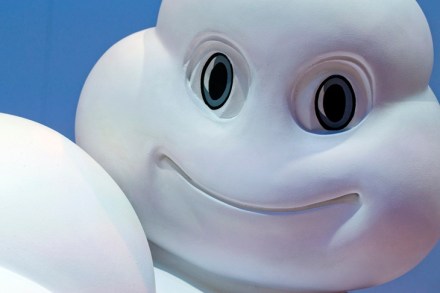
Bibendum is a hushed restaurant on the first floor of the Michelin House on the Fulham Road. (Bibendum is the name of the Michelin Man; as such, he is the only restaurant mascot I can think of who is a morbidly obese drunk, and here of all places. It is a noble gesture in a district full of Prada and control). The building is extraordinary — an art-deco whim standing on a corner like Cinema Paradiso without the dreams. It was once the headquarters of the Michelin tyre company; as such, I admire the ambition of placing a tyre company in what is essentially a Venetian palace, but perhaps tyres were considered special then. In the Congo, for instance, rubber took a lot of people with it.

Not my bag

From our UK edition

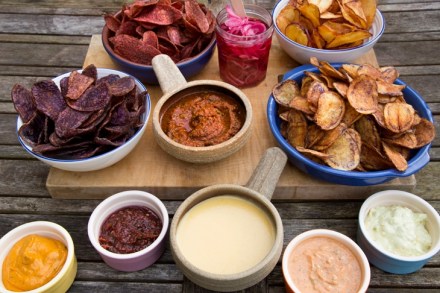
Hip Chips is a specialist crisp restaurant in Old Compton Street, Soho; no, it is stupider than that. It is a specialist posh crisp restaurant and it is a grave disappointment to the compulsive overeater. The Bacon Nik Nak Shack would surely be a better idea because crisps, like leisure wear and coaches, can never really be posh. They should not even, ideally, be fresh; the joy in eating a packet of Pickled Onion Monster Munch is in the mingling of the Monster Munch and your own blood as the skin on the roof of your mouth melts off, and there it is. But these are details: who am I to stand against the tide? Even so, the success of the Cereal Killer Café in Brick Lane shows exactly how much infantile adults will pay to have their infantilism sanctioned by consumer capitalism.

Vaulting ambition

From our UK edition

To the Ned, as diarists say when they can’t provide a rational reason for their voyage: the colossal banking hall transformed into ten restaurants, or one super-restaurant with ten menus, by the owners of Soho House, who are sucking up all the press coverage the age of churnalism can grant. I cannot yet decide what is more chilling: a Soho House open to all or a Soho House safely hidden behind its semi--weaponised membership criteria. I began to loathe the brand when I saw the table-tennis tables and selfie booths at Shoreditch House.

Food | 25 May 2017

From our UK edition

Pollen Street Social lives in a Georgian house on Pollen Street, Mayfair, a narrow curve between Hanover Street and Maddox Street. Vogue House, HQ of Condé Nast magazines, is nearby, and Pollen Street is very like it: almost nothing can get in or out. The Tatler in-house dachshund Alan TBH Plumptre tried leaving Vogue in 2013, and was murdered by the revolving doors. Did he want better — or fewer — things? We will never know. Pollen Street Social is a ‘modern urban meeting point’ according to the babble on the website, which is ever more deranged, and makes me think: as opposed to what? It is the flagship restaurant of Jason Atherton, who was named best restaurateur at the GQ Food and Drink Awards last year.

Character floors

From our UK edition

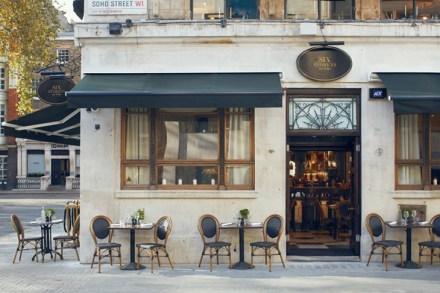
Six Storeys on Soho is in a slender grey townhouse on Soho Square: a bar, restaurant and club. It is technically art deco, but it feels much older; it grasps back for 18th-century Soho without the typhoid epidemic and the corpses. It used to be a gay bar called the Edge, but the gay bars are closing in London, victims of a new epidemic called Grindr. Now it feels like Mary Poppins’s house after she lost hope. I came to the Edge with my friend the artist Sebastian Horsley, who wore purple suits and a top hat, and made A.A. Gill look slovenly. He kept a gun by his bedside on Meard Street, but in the end he did not need it. He fell asleep on heroin and did not wake up, and he would love it here. He would match the furniture, and they have a lot of gin.

Fowl play

From our UK edition

Cafe Football is in the Westfield shopping centre in Stratford, east London, a shopping centre with a faulty name. It isn’t in the west, and it isn’t in a field. (The original Westfield is in Shepherd’s Bush. That is in the west, but not in a field. It is by the A40 and it is like America without the joy.) Westfield Stratford City sits in a puddle of chain cafés and restaurants and shops. It has been on my review list for three years, 2.9999999 of which I have spent cowering in north London. Stratford was — shall we call it renovated? — for the London Olympic Games in 2012, and it is now a windy building site full of air pollution and hipsters and thwarted hopes.

Acting up | 20 April 2017

From our UK edition

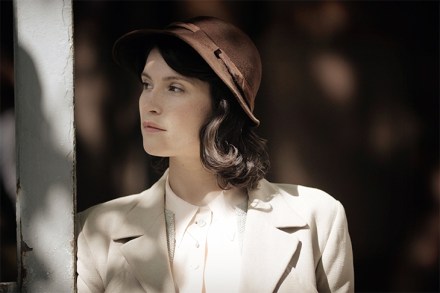
Gemma Arterton’s new film, Their Finest, is about second world war propaganda. Her character, who is bookish and sensitive, is allowed — because of war — to write film scripts. She discovers two girls — two ordinary, pale, unhappy girls — who steal their father’s boat and sail to Dunkirk for the rescue. She thinks this story will swell hearts: and so she, and her collaborator (Sam Claflin), make a British Casablanca about Dunkirk. They know there must be loss, or nothing has value. I marvelled over two things in Their Finest, even as I dislike the title. First, how the pale, unhappy girls are transformed, for the film inside the film, into beautiful actresses, all lipstick and ankles, with shadow brushed away.

Howard Jacobson on Trump: He has the emptiest mind of all

From our UK edition

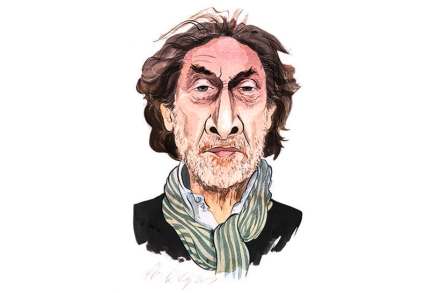
Howard Jacobson awoke to the news of Trump’s victory in November. He had no newspaper column so, what could he do? Write a novel, said his wife, and he did, in six weeks. It is called Pussy, and it is a short and horrifying hypothetical biography of Donald Trump, now an infant prince called Fracassus, born into a noble family of property developers. Fracassus hates words. He hates women. He tweets. Jacobson throws every weapon — every word — he has into Pussy. He is the voice of the metropolitan liberal elite emitting a death rattle, and that is a grave calling.

Jamie’s latest plank

From our UK edition

Barbecoa is Jamie Oliver’s new restaurant on Piccadilly, and no matter how many times I mutter the name, I do not know what it means, if it means anything; it may be a posh riff on barbecue, which does not need gentrifying, because barbecue is cuisine’s mass murder. The only other mention I can find is the original Barbecoa in St Paul’s. This is Barbecoa 2, then: the sequel. I used to like Jamie Oliver, or the idea of him. I liked his willingness to be a spokes-chef; to damn parents who feed their children Turkey Twizzlers and roof insulation; I liked that he is fat.

Trump, the emptiest mind

From our UK edition

Howard Jacobson awoke to the news of Trump’s victory in November. He had no newspaper column so, what could he do? Write a novel, said his wife, and he did, in six weeks. It is called Pussy, and it is a short and horrifying hypothetical biography of Donald Trump, now an infant prince called Fracassus, born into a noble family of property developers. Fracassus hates words. He hates women. He tweets. Jacobson throws every weapon — every word — he has into Pussy. He is the voice of the metropolitan liberal elite emitting a death rattle, and that is a grave calling.