Susanna Gross

Bridge | 4 February 2023

From our UK edition

If time and money were no object, I’d be jetting off to Vienna in a couple of weeks, then flying to Biarritz, then spending a week in New Orleans, back in time to catch a flight to Warsaw… and that would only take me up to April. Most people probably aren’t aware how many international bridge tournaments take place throughout the year, all of them packed with serious competitors and famous names. In fact, the life of a top professional is one of non-stop travel – they barely spend a month at home before they have to fly off again. I wish I could get away more often, but, like most people, there’s only so much I can do: this year it’ll be Strasbourg for the Transnationals and Lillehammer for the Marit Sveaas Pairs.
Bridge | 21 January 2023

From our UK edition

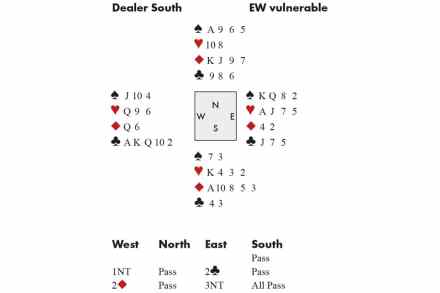
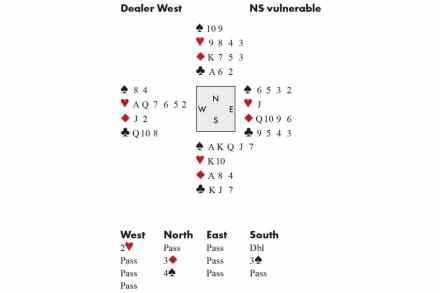
How often do you reach for the double card? Perhaps you’re a bit of a wimp like me. I’ve lost count of the times my inner voice has urged: ‘Double, Double!’ – a bit like the witches in Macbeth – only for me to ignore it and meekly pass. It’s pure fear of being wrong: there’s only one thing worse than seeing your opponents’ smug faces when they score up a doubled overtrick or two – and that’s seeing your partner’s face. But as Zia once said, if every contract you double goes down, you’re not doubling enough. Be brave – even if you’re only doubling on a hunch, or because the opponents seem unsure of their own bidding.

Bridge | 7 January 2023

From our UK edition

Did you make any new year’s resolutions? High on most people’s lists – along with shedding a few pounds – is to exercise more. But what about mental fitness? It’s a lot more fun than getting sweaty in the gym – and all it requires is taking up bridge. Bridge really is the best mental workout you can do; endless scientific studies have proved that it staves off dementia. But forget the studies – just ask anyone who plays, at any level. To quote the Irish novelist Colm Toibin: ‘Bridge saved me from becoming a lazy bastard.’ My own resolution isn’t to play more but to play better: to push myself harder, minimise the lapses of concentration, banish the brain fog. In other words, to try and be more like – well, any of the world-class players I so admire.

Bridge | 10 December 2022

From our UK edition

Like many people, I assumed that online bridge would fade away once people began playing face-to-face again. I’m so glad I was wrong. The social aspect of the game is, of course, largely lost online, but on the other hand, quite apart from the convenience, it’s a great way to improve; I always replay hands afterwards and compare what others did. Best of all – for me, at least – is getting the opportunity to play against legends of the game like Jacek Kalita and Simon de Wijs in the invitational online tournaments (I’m lucky enough to be on Jonathan Harris’s team). Name me another sport where that can happen! It’s the equivalent of a tennis enthusiast joining a local club and getting to play against the likes of Nadal or Federer.

Bridge | 26 November 2022

From our UK edition

Have you ever stopped to have a long think while playing bridge online, and seen an opponent type the word ‘TEST’ in the chat box? I have, several times, and I’d always assumed it was a sympathetic way of acknowledging that someone has a criticaI decision to make. But when I mentioned this to David Gold the other day, he told me I’d got it wrong – the opponent is checking his screen hasn’t frozen. And most of the time it’s euphemistic – a way of saying, ‘Get on with it!’ I’m sure no world-class player has ever received a chivvying ‘TEST’ – everyone is fully aware that when they take their time, there must be a good reason.

Bridge | 12 November 2022

From our UK edition

I was very sad to learn last week that Dinah Caplan has died. She was 90, and had been a hugely popular and respected player on the bridge circuit for as long as any of us can remember. But more than that, she was an inspiration to anyone who worries that they’ve left it too late to make their mark. Having joined her family’s clothing business at just 15, she juggled the demands of a job and motherhood for much of her life, and it wasn’t until 2011 that she decided to get more serious about bridge. She entered the England women’s trials (with Lizzie Godfrey), ended up winning, and at the age of 78 made her international debut – surely one for the record books.

Bridge | 29 October 2022

From our UK edition

I get very tense, not to say cranky, if I’m interrupted while playing bridge. But last week I decided it was time to chill out – as I’m sure anyone else would if they too had witnessed Gitte Hecht-Johansen’s extraordinary feat of multi-tasking. Gitte is originally from Denmark but has long been a fixture – an unusually elegant one – on London’s bridge scene, both as a player and a tournament director. Last Monday evening she was at TGR’s in Paddington, directing the weekly duplicate held there by the West London Gay Bridge Club. I was also at TGR’s for a league match. But one of our opponents was running late, so someone had the idea of asking Gitte whether she would mind standing in for a few boards. Quite unfazed, she agreed.

Bridge | 15 October 2022

From our UK edition

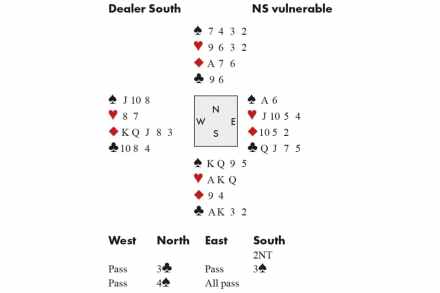
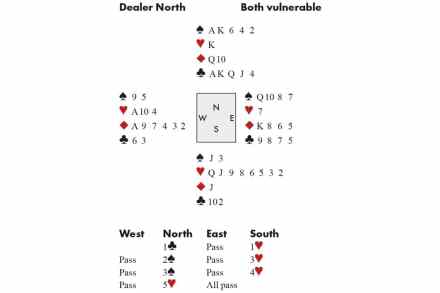
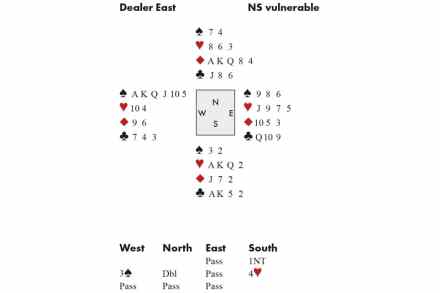
Did you know that a ‘heartbreaker’ is a real term in bridge? It’s described in The Bridge Player’s Encyclopedia as ‘a hand which fails to live up to one’s original expectations’.But that’s way too flat a definition. A heartbreaker causes emotional distress; it hurts. That might sound a bit dramatic to non-players, but bridge is a game which mimics the extreme highs and lows of a love affair – a hand which dashes your hopes can depress you out of all proportion. It’s not just bad luck which can turn a hand into a heartbreaker – sometimes it’s the opponents’ skill. I’ve never forgotten the time, many years ago, when the most beautiful hand I’ve ever picked up turned to ash.

Bridge | 1 October 2022

From our UK edition

A beautiful Greek island; a warm sea; delicious al fresco dinners; and bridge from morning till night with Andrew Robson. Pure fantasy? Actually, it pretty much sums up my past week. I was lucky enough to be invited by Charlie and Carol Skinner to Paxos for seven days of rubber bridge, in honour of our friend Stuart Wheeler, who died two years ago. There were 12 of us, and the stakes were high (£20 per hundred). It is, of course, a huge privilege to play with Andrew, and we all love it. But it’s not without stress. When we partner him, we’re desperate not to let him down. The pressure shows: poor Andrew often gets us at our worst. I doubt there has ever been a group of players who spent so much time apologising.

Bridge | 17 September 2022

From our UK edition

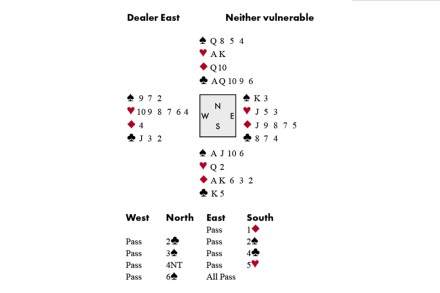
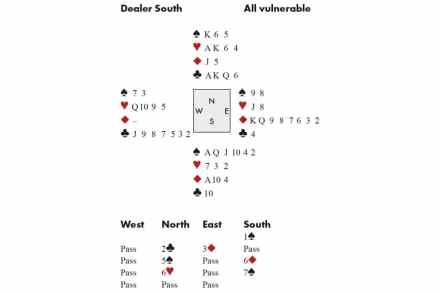
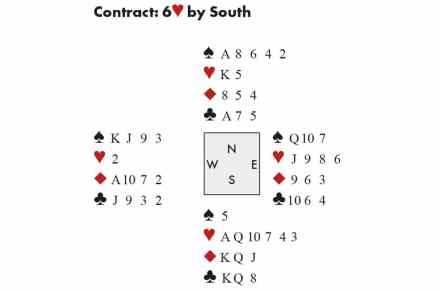
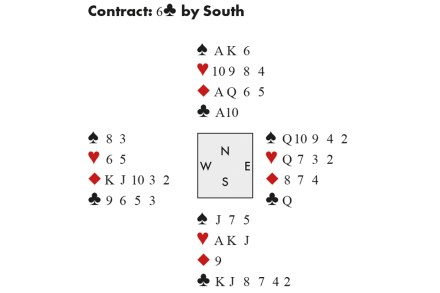
It’s tough trying to recall every card that the opponents have played when you’re in the middle of a tricky contract. It reminds me of that old game show hosted by Bruce Forsyth – The Generation Game – where the winning contestant sat at a conveyor belt and watched prizes go past. They then had 20 seconds to remember – and take home – as many as they could: ‘Fondue set!… Clock!… Cuddly toy!…’. No one managed them all. So too with cards: after a few have gone past, they can become a bit of a blur. Not at the highest level, of course; it’s one of the things that sets the experts apart from the rest. In the recent final of the World Mixed Teams, here’s how Daniela von Armin made 6◆(see diagram).

Bridge | 3 September 2022

From our UK edition

The beautiful city of Wroclaw in Poland is currently teeming with bridge players, all of them there for the 16th World Bridge Series. Anyone can play, but the standard is fiercely high: most of the world’s top players are taking part. This week it’s the Mixed and Seniors; last week was the Open and Women’s. One surprising thing was how few women’s teams came: just 10. At the last Series there were 17. It seems that women’s bridge is dwindling, due in part to the surging popularity of the Mixed (57 teams). That said, even with so few competitors there was some thrilling bridge on display from the very best women players.

Bridge | 20 August 2022

From our UK edition

My husband is a writer (John Preston), whose recent books were better received than he had ever dared hope. When our 15-year-old son came home from school recently, he told John excitedly that his English teacher turns out to be a fan: ‘He says he loves your books, and how well written they are, and asked whether you’d come and give a talk at the school.’ He then turned to me and said sweetly: ‘I did tell him my mother’s a bridge player.’ I lit up. ‘Really? And what did he say?’ I asked. ‘He said you’d get on well with his grandmother.’ I’m sure I would; but I did feel the urge to tell him that bridge is also very much a young person’s game.

Bridge | 6 August 2022

From our UK edition

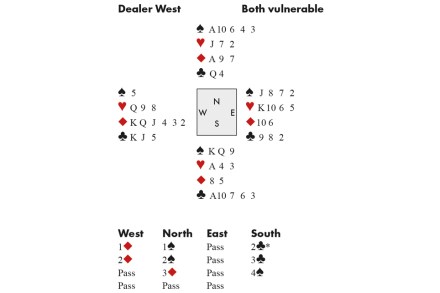
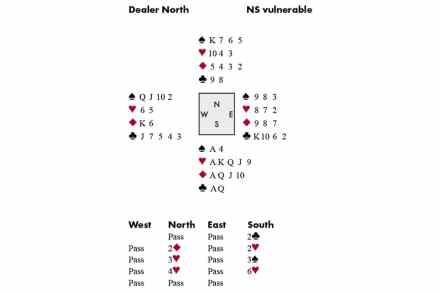
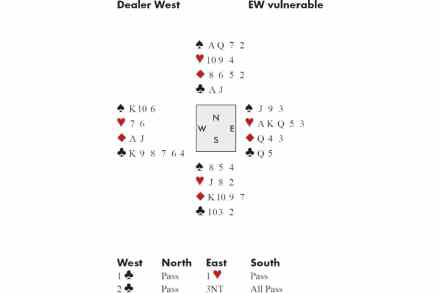
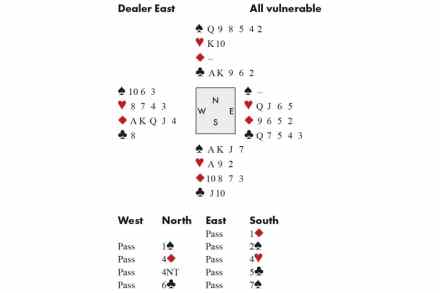
In the modern game, being green versus red (non-vul v. vul) is a licence to bid on tram tickets: passing is for wimps. The aim is to be as obstructive as possible – anything to stop the opponents having a clear run at game. Hence the huge array of pre--emptive and two-suited overcalls that have been devised to make life difficult. But although aggressive bidding can work brilliantly, it can also be dangerous – especially against experts, who are primed to take full advantage of any information you give them. Take the following deal from the Yeh Bros Cup in China some years ago. Peter Bertheau and Fredrik Nyström of Sweden bid a grand slam they wouldn’t have considered without some help from Japan’s Kazuo Furuta and Kadashi Teramoto (see diagram).

Bridge | 23 July 2022

From our UK edition

I was very sorry to learn of the death of the legendary American player and author Eddie Kantar – he was still writing articles with such youthful vigour that I had no idea he was 89. Kantar was considered to be the greatest player-teacher-writer of all time. The clarity of his writing, combined with his self-deprecating humour, brought him legions of fans from across the world. I have an entire row of his books on my shelves – including classics like Complete Defensive Play and Bridge For Dummies – which I’ve been thumbing through for 20 years. As the English player John Cox put it: ‘To many of us, his death feels like losing a friend, albeit one we had never met.’ Kantar was an equally brilliant player, winning two world championships.

Bridge | 9 July 2022

From our UK edition

In one respect, it would be so much easier to play a game like poker or chess than bridge; if you play badly you only embarrass yourself – you don’t have partners or teammates to worry about. Mistakes at the bridge table are doubly painful when we imagine our partners rolling their eyes, or our teammates moaning behind our backs – and we’re not being paranoid, they probably are. But we shouldn’t be too thin-skinned; it’s important to remember that even the best players screw up. If you want to feel better about yourself, all you need to do is go online and kibitz some of the major tournaments. During the recent European championships in Madeira, I saw several mishaps by international champions which were positively comical.

Bridge | 25 June 2022

From our UK edition

At a bridge tournament about 15 years ago, I started chatting to a friendly, eccentric woman in her mid-sixties, wearing a sequined baseball cap. I had no idea who she was, but when she told me her name, I knew at once: the well-regarded bridge columnist of the Independent. What I hadn’t realised was that Maureen Hiron, who died last week, led such a fascinating life outside of bridge. She started her career as a teacher at a London comprehensive, but was pensioned off at 32 when an air-conditioner fell on her head. The accident, she believed, somehow unshackled her creativity, and soon after, she invented Continuo, an abstract strategy game played with coloured tiles. It rapidly became the bestselling game in England.

Bridge | 11 June 2022

From our UK edition

I recently spent a long weekend in Lillehammer in Norway. Apparently it’s very charming, but frankly I have no idea: I only glimpsed it from the taxi to my hotel. It’s always like that when I play in tournaments abroad. Forget sightseeing – I rarely step outside. The Marit Sveaas Swiss Pairs is more intensive than most: 60 boards a day, from morning till evening. I was lucky enough to be partnering Jessica Larsson, the Swedish women’s European champion. A mutual friend had suggested we play, and we met the night before to discuss a system. As it happens, we got on rather too well, and ended up drinking in the bar till the early hours.

Bridge | 28 May 2022

From our UK edition

For those of us who are prone to anxiety before playing in big tournaments, there are plenty of self-help books to turn to. They don’t specifically address bridge, of course, but the lessons have universal application. Among my favourite authors is Martin Seligman, the celebrated ‘father of Positive Psychology’. Whenever I sit down to play, I try to remember his words on the importance of optimism and positive thinking. Yet there’s one piece of advice nowhere to be found in any of his books: what do I do when my opponent turns out to be… Martin Seligman? Let me tell you, the man shows no mercy at the bridge table. Not only is he very good, but he hires a team of world-class professionals to compete at the top level.

Bridge | 14 May 2022

From our UK edition

The Spring Fours is one of the great events in the English bridge calendar – a five-day knockout attracting many international stars. This year, it was won by Frances Hinden’s team. Superb bridge was played all round – not just by Team Hinden, but all the runners-up, too. As ever, luck played its role – and I couldn’t help feeling sorry for Janet de Botton’s team, who seemed sure of getting through to the semi-finals until a dollop of misfortune fell their way. Going into the final stanza of the quarter-finals, they were 30 points up against Richard Plackett’s team. When you’re that far ahead, with only eight boards to go, you try and play ‘safe’: you can afford some losses, but no big swings or heavy penalties.

Bridge | 30 April 2022

From our UK edition

Recently, a friend was browsing through the bridge books on my shelves, when suddenly she burst out laughing. ‘Here’s a funny one,’ she said. ‘It’s called Loser on Loser Play.’ Why would anyone want to read a book by a loser on how to lose? Given that she’s only recently learnt how to play – by recently, I mean two years ago, which is the blink of an eye for a bridge player – I explained that it’s a fairly common technique which involves substituting one loser for another. You might do it for a number of reasons, for instance to force a particular opponent to be on lead, or to reduce two losers to one by creating a trick.