Sam Leith

Sam Leith

Sam Leith is literary editor of The Spectator.

Eugenics will never work – thankfully

From our UK edition

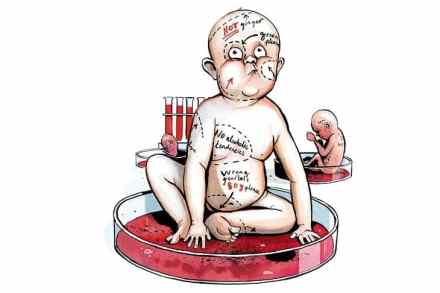
In his most recent book, How to Argue With a Racist, the geneticist Adam Rutherford set out a lucid account of how the basis for many widely held and apparently commonsensical ideas about race are pseudoscientific; and he lightly sketched, along the way, the historical context in which they arose and the ideological prejudices that nourished them. We might have some half-baked ideas about how evolution works — and have unthinkingly accepted racial categories invented by 18th-century imperialists — but, he assured us in perhaps the standout line of the book, the underlying genetics is ‘wickedly complicated’. Control is a companion piece to that one.

Philip Oltermann: The Stasi Poetry Circle

From our UK edition

39 min listen

My guest in this week's Book Club podcast is Philip Oltermann, whose new book The Stasi Poetry Circle: The Creative Writing Class that Tried to Win the Cold War, unearths one of the most unexpected corners of East German history. At the height of the Cold War, members of the GDR's notorious secret police got together regularly to workshop their poems. Was this a surveillance exercise, a training module for propagandists – or something stranger than either? And were their poems any good? Philip tells me about why poetry was such a big deal in the Eastern Bloc, how – had Petrarch but known – the sonnet was the perfect model for dialectical materialism, and where those poets are now...

You can’t really ‘cancel’ anything

From our UK edition

'When parents give Maus…to their little kids, I think it's child abuse. I wanna protect my kids!' Who do you imagine this quote is from? Some plaid-clad member of the moral majority at a town hall meeting in Tennessee – where the local board of education in McMinn County recently caused an outcry by removing Art Spiegelman's graphic novel about the Holocaust from the eighth-grade curriculum? Nope. It's a quote from, well, Art Spiegelman – in a 1997 comic he drew depicting a conversation he had with Maurice Sendak. This week he took a rather different view. Interviewed by CNN, he said that in contemplating the school board ruling he had 'moved past total bafflement to trying to be tolerant of people who may possibly not be Nazis… maybe?

Pre-crime has arrived in China

From our UK edition

The idea of ‘pre-crime’ was popularised by Philip K. Dick’s story ‘The Minority Report’ and the 2002 Steven Spielberg film based on it. Here was a vision of a shudderingly paranoiac technological dystopia in which you could be arrested for something you haven’t even done yet. Not so science-fictional as all that. ‘Pre-criminal’ is the phrase — apparently one in official currency — that’s used of the protagonist of the story with which Darren Byler begins his chilling short book. Vera Zhou was a student of Byler’s at the University of Washington.

Christopher Prendergast: Living and Dying With Marcel Proust

From our UK edition

34 min listen

In this week's Book Club podcast, I'm joined by Christopher Prendergast, Professor Emeritus of Modern French Literature at Cambridge and the author of the new book Living and Dying With Marcel Proust. In the centenary year of Proust's death (and the English publication of Swann's Way) he tells me (among other things) how the structure of A La Recherche is more straightforward than many think, why that madeleine was nearly a slice of toast, and about the great unsayable at the heart of Proust's great story.

Downflood: the Good Ship Boris is sinking

From our UK edition

In Sebastian Junger’s book The Perfect Storm, there’s a near-matchless description of how big boats go to the bottom. 'The crisis curve starts out gradually and quickly becomes exponential,' Junger writes of a boat wallowing and taking on water in a big sea: The more trouble she’s in, the more trouble she’s likely to get in, and the less capable she is of getting out of it, which is an acceleration of catastrophe that is almost impossible to reverse... If there’s enough damage, flooding may overwhelm the pumps and short out the engine or gag its air intakes. With the engine gone, the boat has no steerageway at all and turns broadside to the seas.

The collapse: how Red Wall MPs turned on Boris

From our UK edition

39 min listen

In this week’s episode: Will the Red Wall crush Boris Johnson? In this week’s Spectator, our political editor James Forsyth and our deputy political editor Katy Balls report on the plot to oust the Prime Minister by Red Wall MPs, and No.10’s battle to save Boris. They join the podcast to give their up to date diagnosis. (00:43)Also this week: How to save the BBC?This week Nadine Dorries announced that she is planning a licence fee freeze. In the Spectator this week Paul Wood, a veteran journalist of the BBC writes about his love-hate relationship with the broadcaster. He joins the podcast now along with Domonic Minghella, writer, producer and former showrunner of the BBC’s Robin Hood. (14:45) And finally: Is it moral to do good with bad money?

James Birch: Bacon in Moscow

From our UK edition

26 min listen

In this week's Book Club podcast, my guest is the gallerist James Birch - whose new book Bacon In Moscow describes how he achieved the seemingly impossible: taking an exhibition of Francis Bacon's work to Moscow in the late 1980s. James tells me how he negotiated between the volatile artist and the implacable Soviet bureaucracy with the help of a suave but menacing KGB middleman; and how, along the way, he nearly acquired an original Francis Bacon painting and nearly acquired a Russian wife.

What Meccano taught me

From our UK edition

Elsewhere in England this weekend, grimly sweating middle-aged men were planning Operation Save Big Dog, Operation Red Meat and Operation Decommission Shopping Trolley. In our house, though, the only game in town for grimly sweating middle-aged men was Operation Racing Car. My son Jonah had received his Covid-postponed eighth birthday present from his cousins and it was – retro! – a Meccano set.  'Dad, can you help me build it?' he asked, heteropatriarchonormatively. And of course I gladly forwent my planned afternoon doomscrolling Twitter to see how many new Downing Street parties would be unearthed.

Stuart Jeffries: Everything, All The Time, Everywhere

From our UK edition

41 min listen

This week's Book Club podcast addresses one of the most misunderstood and vilified concepts in the culture wars: postmodernism. How did this arcane theoretical position escape from academia to become a social media talking point? What the hell is it anyway? What does Jeff Koons have to do with Foucault? Is postmodernism out to destroy capitalism, or is it capitalism incarnate? And what comes after postmodernism? Stuart Jeffries - author of Everything, All The Time, Everywhere: How We Became Postmodern - puts it all in quotes for us.

We should be thankful for the Sackler family’s philanthropy

From our UK edition

When the whole opioid crisis blew up, the Sackler family — whose fortune was substantially built on getting thousands of Americans debilitatingly addicted to OxyContin — withdrew for a period from their charitable giving. It was reported yesterday, though, that they're back in the philanthropy business, and last year gave £3.5 million to various British causes — among them the Oxford Philharmonic Orchestra, the Watermill Theatre, King’s College, London, the homelessness charity Amber Foundation, various churches, academies and conservation projects. 'The return of the Sacklers to philanthropy in the UK,' the report stated confidently, 'will cause outrage'. Really?

Natalie Livingstone: The Women of Rothschild

From our UK edition

46 min listen

My guest in this week's Book Club podcast is Natalie Livingstone – whose new book The Women of Rothschild: The Untold Story of the World's Most Famous Dynasty gives the distaff dish on the banking family's long history. She discovers that the Rothschild women have been just as remarkable as the men – from early modern matriarchs to jazz-club butterflies.

Prince Andrew is fighting a PR battle – and losing

From our UK edition

My late grandfather, the editor and columnist John Junor, nurtured fondly throughout his career the conviction that nobody could be sued for asking a question. It was in this spirit that he approached in his weekly column the story of a schoolteacher who had been acquitted for the third time in his career of sexually molesting young boys in his care. He did not for a moment doubt the man’s innocence, JJ wrote, but he wondered: would it not be prudent for this man to take up a line of work ‘that carries a less high risk of false accusation’?

The modern economy is built on addiction

From our UK edition

Two stories, side-by-side in the Sunday paper I was looking at online. The first — 'Strip Dame Dopesick of her title' — was a report that the families of victims of opioid addiction were campaigning for Dame Theresa Sackler, whose family profited unimaginably from marketing addictive legal painkillers, to be stripped of her title. The second was the story of how the writer and TV presenter Richard Osman had spoken on BBC Radio Four of struggling with an addiction to crisps, chocolate and biscuits for four decades. He compared his relationship with food to an alcoholic’s with booze: ‘The addiction is identical.

Is Piers Corbyn really dangerous?

From our UK edition

I thought the police statement — bureaucratic, anonymised, bone-dry – got the tone just right. In confirming the arrest of Piers Corbyn on suspicion of encouragement to commit arson, a spokesman confirmed only that 'a man in his 70s' had been arrested in Southwark, south London on Sunday morning. This, for those who missed it, is understood to relate to Mr Corbyn’s fire-breathing (literally: he took his nylon-clad life in his hands with a stunt involving lighter-fluid) speech to an anti-vax rally in the capital.

My fight with Viagogo

From our UK edition

My wife had a brilliant idea for my 12-year-old daughter’s Christmas present: tickets to go and see Sigrid (a pop act, apparently, m’lud) at Wembley. She sent me a link. Quick, quick, I thought: get them while they’re hot. I clicked through and bought three old-fashioned physical tickets. I sucked up the delivery fee because I imagined, sentimentally, my daughter looking back years later on those yellowing stubs and remembering her first ever gig. First mistake: the site I’d clicked on was the resale site Viagogo. I should have checked the venue’s own ticketing site but I was on my phone, I’d clicked on the link my wife had sent me, it looked legit and I was worried these things would sell out instantly. So I was paying double the face price.

How Noddy and Big Ears conquered the world

From our UK edition

Perhaps the funniest of the many funny jokes in Sue Townsend’s The Secret Diary of Adrian Mole, Aged 13¾ is its protagonist’s struggle with Enid Blyton. Having turned the corner into adolescence, Adrian is mortified by the Blyton characters on the wallpaper in his childhood bedroom and sets about repainting the room in black, the better to represent his turbulent soul. And yet, though he slaps on coat after coat of black paint, the shiny yellow bells on Noddy’s cap continue to show through. He’s reduced to colouring them in one by one. (‘Went over hat bells with black felt-tip pen, did 69 tonight, only 124 to go.

Kevin Birmingham: The Sinner and The Saint

From our UK edition

39 min listen

My guest in this week's Book Club podcast is Kevin Birmingham, whose new book The Sinner and The Saint: Dostoevsky, A Crime and its Punishment, tells the extraordinary story of how Dostoevsky came to write Crime and Punishment – and the underexplored story of the real-life murderer whose case inspired it. Physical agony, Siberian exile, vicious state censorship, old-school nihilists – and the astonishing personal resilience of one of Russia's greatest writers... it's all here.

Meghan woz right

From our UK edition

The Duchess of Sussex’s legal ding-dong with the Mail on Sunday (which published her private correspondence with her father) has been one of those battles where you regret it’s not possible for both sides to lose. But one side did lose, and it deserved to. Meghan was in the right. I half wish she hadn’t been, if only so we didn’t have to read her statement after the court of appeal found in her favour. It managed the peculiar feat of crowing and simpering at the same time:  ‘This is a victory not just for me, but for anyone who has ever felt scared to stand up for what’s right.