Ross Clark

Ross Clark

Ross Clark is a leader writer and columnist who has written for The Spectator for three decades. He writes on Substack, at Ross on Why?

Brace yourselves for ‘Bidenomics’

Is there anyone left who still believes in sound government finances? After the 2008/09 financial crisis there was a lively debate between fiscal doves, who wanted government spend its way out of recession, and hawks, who thought it a good idea that governments at least attempt to live within their means, because nasty things would happen in the longer term if they did not. Such arguments seem almost quaint now. Where is the resistance now that Joe Biden is about to spray the US economy with a $1.9 trillion stimulus package, including helicopter money of $1,400 per household? In 2008/09, there was some justification in that economic activity was extremely weak and many households were in debt — you could argue that the economy needed a lift, at whatever price.

bidenomics

The class of Covid will pay the price for years to come

From our UK edition

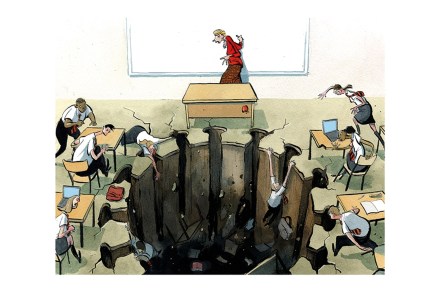
Schools in England, it seems, will reopen fully on 8 March at the earliest – a full two months after they closed. The Prime Minister has declined to bring this forward, in spite of new Covid cases falling at a rate of 25 per cent per week. The Scottish and Welsh governments have both said they will partially reopen schools in February. What was looking like being half-a-term's lost schooling is now looking to be closer to a full term's worth. That comes on top of over two months of school closures last year – and some interrupted education in the autumn terms as teachers and pupils were forced to self-isolate on many occasions. What will be the long-term cost of the lost months of education? The OECD has had a go at estimating it.

Can we boost immunity with the vaccines we have now?

From our UK edition

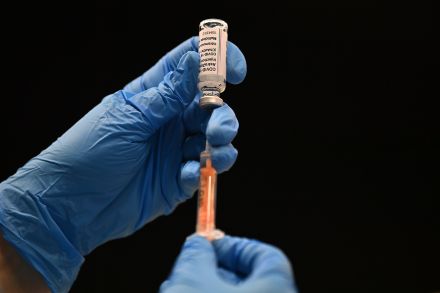
What to make of the news this morning that Oxford University is to ask for volunteers to take part in a trial to ‘mix and match’ the Pfizer and AstraZeneca vaccines? Researchers will ask for 820 volunteers, all over 50 years old, who will be given two shots of a vaccine, two weeks apart. Some will receive AstraZeneca followed by Pfizer, some the other way around and some — the control group — will be given two doses of the same vaccine. Britain has set itself apart from the EU, not just in the speed and extent of its vaccine procurement programme but also for its willingness to experiment.

How alcohol deaths hit a record high during lockdown

From our UK edition

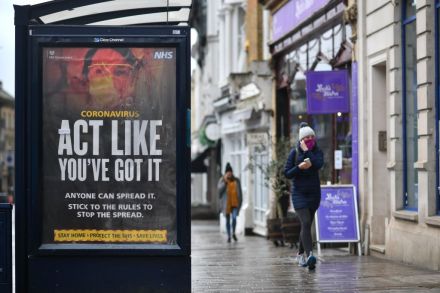
Almost a year after the statistics were first published, the country remains horrified by the daily total of Covid 19-related deaths. Meanwhile, we are rather less apt to notice other statistics related to harm and death, which may be an unintended by-product of the fight against Covid-19.  The Office of National Statistics' (ONS) latest figures for the number of deaths related to alcohol-specific causes, published yesterday, received little attention. But they make for dreadful reading. There were 5460 such deaths in the first three quarters of 2020, a shocking rise of 16.4 per cent compared with the same nine-month period in 2019.

Will Sturgeon admit to the cost of independence?

From our UK edition

I’m not a great fan of economic modelling. Remember, for example, the Treasury’s infamous claim that unemployment would rise by between 500,000 and 800,000 within two years of a vote for Brexit (i.e. before we had actually left). In the event, unemployment fell in 2018 to reach the lowest level since the mid-1970s. Yet having used economic models to rubbish the case for Brexit, it becomes very difficult then to ignore forecasts which claim there would be an even bigger negative economic impact from Scottish independence. So what, in other words, will Nicola Sturgeon and other SNP politicians do about a paper just published by the LSE that claims that independence would, in the long run, reduce Scottish income per capita by between 6.3 per cent and 8.

The problem with taxing the self-employed

From our UK edition

Last year, when Rishi Sunak, after some dithering, came up with a scheme to help the self-employed during the pandemic, he made clear that it would come with a quid pro ro: higher taxes for the self-employed in the longer run. With his second Budget coming up on 3 March will he take the initiative and do what governments have been threatening to do for years – and jack up national insurance to bring it in line with the rate paid by employees? The gap between NI contributions – employees generally pay 12 per cent and their employers a further 13.8 per cent, while the self-employed generally pay 9 per cent – is frequently raised as a possible source of extra revenue. Each time the self-employed fight back.

New Oxford data supports UK vaccine strategy

From our UK edition

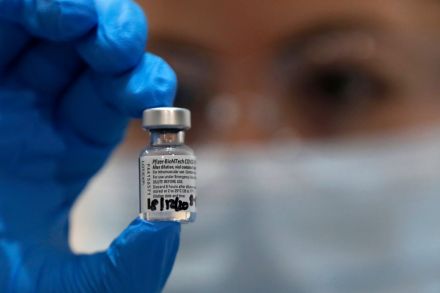
Ever since the Oxford-AstraZeneca team announced the results of its Phase 3 trials last November, there has been a suspicion among some that their vaccine is the poor relation of the messenger RNA vaccines developed by Pfizer and Moderna. It might be cheap compared with the others, it might be easy to store and transport, but the results published last November indicated that it had an efficacy of 70 per cent compared with over 90 per cent for Pfizer and Moderna. Even that was questioned when it was pointed out that the 70 per cent figure was arrived at by mixing different trials, involving different quantities of vaccine.

Can ‘surge testing’ get new variants under control?

From our UK edition

A year on, in one sense we’re pretty well back to where we started — with the government attempting to snuff out the South African variant of the SARS-CoV-2 virus in the same way as it did the original Wuhan version. It didn’t work then, and we rapidly moved to the second phase of the pandemic plan, where it was taken for granted that the virus had become widespread and it was a case of controlling rather than eliminating it. Do we have any better chance of eradicating the South African variant?

One year after Brexit, Britain is reaping the benefits

From our UK edition

A year ago today Britain awoke to a rather muted celebration – which seemed to consist largely of a bubble car driving around Parliament Square with a Union Jack in tow – ready to face up to a brave new future outside the EU. Who would have imagined then that the Observer would mark the first anniversary by running a leading article condemning the EU as 'shambolic' and instead praising Boris Johnson’s government for something Britain did all by itself? Of course, the Observer’s judgement is only in respect to one thing: the EU’s joint vaccination procurement programme. Nevertheless, it is something rather important, on which a great number of people’s lives are dependent.

Could this drug offer immediate protection from Covid-19?

From our UK edition

When Donald Trump returned to the White House after a brief spell in hospital with Covid-19 last October he made a video attributing his rapid recovery to a drug he called ‘Regeneron’. ‘They call it a therapeutic drug, but to me it wasn’t therapeutic – it made me better,’ he said. ‘I call that a cure.’ Naturally, given that Trump had on a previous occasion appeared to advocate injecting humans with disinfectant, there was an element of scepticism on the part of many viewers. However, the drug he was talking about went on the receive emergency use authorisation in November from the US Food and Drug Administration. We now have interim results from a Phase 3 trial in which the drug was used as a ‘passive vaccine’.

The GameStop surge is just another Ponzi scheme

From our UK edition

Who doesn’t wish they hadn’t tucked away a few GameStop shares at the beginning of this year? It’s not a great company – more a Blockbuster Video whose time has come and gone, another bricks and mortar retailer destroyed by a shift to online sales, in this case of video games. But what does that matter when you could have bought at $20 (£14.57) and now have a share worth $197 (£143)? And that is before Wall Street opens on Friday, when the pre-market suggests it may well be up another 150 per cent. It is mad — yet not mad. The mostly young retail investors pouring into the stock are doing it for a reason: they want to destroy the hedge funds whom they see as among the many bogeymen of global capitalism.

Is the virus retreating?

From our UK edition

Imperial College’s React study was in the news again this morning. The latest instalment swabbed 167,642 people between 6 and 22 January and found that 2,282 of them tested positive. A weighted average suggested that 1.57 per cent of the population had the virus between those dates. The study concluded: 'Prevalence remained high throughout, but with the suggestion of a decline at the end of the study period'. It led to reports this morning that the latest wave of the epidemic is declining only very slowly. The React study, however, seems to be increasingly out of line with government data on new infections, as picked up through the test and trace system. On 6 January, the seven day average of new infections across the UK stood at 594.6 per 100,000.

Will the new Help to Buy scheme help anyone?

From our UK edition

As Mark Twain didn’t quite say, there are only three certain things in life: death, taxes and yet another government-backed bung for the housing market. The latest instalment is the 2021 to 2023 Help to Buy scheme, which carries on the theme of offering subsidised loans to first-time buyers – and only first-time buyers. Here’s what is on offer—from April. Buyers can take out a loan of between five and 20 per cent of the purchase price of a new home (or up to 40 per cent in London). There is a cap on the property price on which the loans are available varies from region to region, ranging from £186,100 in the North East to £600,000 in London.

Is this the key to understanding Covid immunity?

From our UK edition

Just how strong an immunity do Covid patients develop after they have acquired the infection and how long does it last? The question is vital to the likely future passage of the pandemic, and to how well vaccines will protect us in the long term. Several studies have suggested there is a sharp decline in antibodies to SARS-CoV-2 over time – a paper from Imperial College’s React study in October, for example, revealed that the proportion of the population showing antibodies to the virus declined from 6 per cent in June to 4.4 per cent in September. The researchers were at pains to emphasise that the presence of antibodies does not indicate immunity to Covid-19, but many people have taken it as an indication that immunity to the disease quickly declines after infection.

What role do schools play in the spread of Covid-19?

From our UK edition

Schools were the last institutions to close and can be expected to be the first to reopen. But just how big a part do schools play in the spread of Covid-19? The European Centre for Disease Prevention and Control has published a review of the evidence from 17 countries and concluded that the reopening of schools cannot be blamed for a resurgence in the virus. Most countries closed their schools during the first wave of the epidemic in spring 2020. From 15 April, Denmark reopened schools – with social distancing – for 2 to 12 year olds. There was no increase in cases following this reopening, according to the ECDC.

Has the current wave peaked?

From our UK edition

Yesterday, the news was dominated by Imperial College’s React study which suggested – in contrast to the fall in recorded new infections – that the prevalence of Covid-19 in the general population was either static during the first ten days of lockdown (between 6 and 15 January), or could even have risen slightly. This morning, however, we have a second opinion in the form of the ONS infection survey, which like React is based on testing a randomised sample of the population. It suggests that the prevalence of Covid-19 did indeed fall in the first half of January – but not by all that much. Between 9 and 16 January, the ONS estimates, 1.024 million people in England and Wales were infected, the equivalent to 1 in 55 of the population.

Are infections rising?

From our UK edition

Not for the first time, people could be excused for feeling a bit confused by conflicting data on Covid-19. This morning, many news outlets reported claims from the latest React study that levels of Covid-19 infections are no longer falling and may, in fact, be rising. This is somewhat at odds with government data that shows cases have peaked since the beginning of the third English lockdown. For days, the figure for new infections, as detected by NHS Test and Trace, and published on the government’s Covid-19 dashboard, have been falling. In the past seven days, the number of new infections recorded across the UK was 294,172 — 21.5 per cent down on the previous seven day period. What's going on?

Rishi Sunak’s Singapore problem

From our UK edition

For those trying to argue that the evils of colonialism still hang over former lands of the British Empire, the legacy of racism suppressing their ambitions and achievements, the Republic of Singapore presents something of a challenge.  Just how did this particular colony manage to become not only one of the wealthiest countries in the world, but one of the highest-fliers in the United Nations' Human Development Index? Indeed, the Asian city state has once again this week been promoted as a model for its former colonial master to emulate.  It can’t just be the Guinness that has attracted investment to another former corner of British soil over the past couple of decades: the Republic of Ireland.

Is the one shot jab a game changer?

From our UK edition

The UK’s decision to lengthen the gap between first and second doses of the Pfizer and AstraZeneca vaccines has been criticised by some. But what if we had a vaccine which only needed one dose, and had been tested on that basis? A vaccination programme could progress far more quickly and without the complication of having to ask people to come back to a clinic a second time. In particular, it would simplify the distribution of vaccines in countries with less-well developed public health systems. That is the promise of the latest vaccine candidate for which results have been reported: the Johnson & Johnson vaccine, which is based on an existing Ebola jab.

Reforming workers’ rights is an upside of Brexit

From our UK edition

Of all the arguments put out against Brexit during the bitter referendum debate, one of the least convincing was that it would give a UK government the opportunity to repeal employment law, thereby impoverishing Britain and its people. Jeremy Corbyn once asserted that a Conservative government would turn the country into a 'low-wage tax haven'. That is an interesting concept, which like the chemical element Seaborgium might theoretically exist but which has yet to be discovered in the real world – most tax havens seem to be pretty wealthy, at least compared with similar countries which haven’t set the fiscal and regulatory conditions to attract businesses and wealthy individuals.