Ross Clark

Ross Clark

Ross Clark is a leader writer and columnist who has written for The Spectator for three decades. He writes on Substack, at Ross on Why?

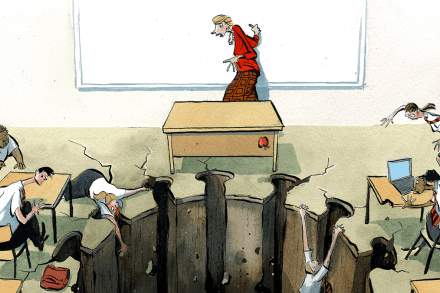
Can schools return without disruption?

From our UK edition

A lot of people won’t want to take much notice of Mary Bousted, joint-general secretary of the National Education Union (NEU), who warns today that schools face significant disruption by the end of September as Covid-prevention measures have to be reintroduced. It was the NEU, after all, which not only opposed the return of schools after the first lockdown, but simultaneously advised its members not to take part in online lessons either. The NEU has often given the impression of being motivated first and foremost by a desire to obstruct the government’s plans.

The NHS blood tube shortage should concern us

From our UK edition

One of the great lessons from the early stages of the pandemic was the need to shorten supply chains and make them more robust. This was especially true for medical supplies. Just-in-time supply chains have been developed over the years to increase efficiency, but had never been tested in a global crisis when demand for certain medical products is high and supply is weak. The government ended up paying huge sums for PPE which, in some cases, was not even suitable for use. The shortage raises eyebrows because a plastic tube is, after all, a plastic tube It seems the lesson has not entirely been learned. There is now a shortage of blood tubes – the small plastic tubes which are used for collecting samples of blood.

Natural immunity is stronger than vaccination, study suggests

From our UK edition

At times this summer, the government has been accused of fighting Covid-19 with an undeclared strategy that concentrates on vaccinating the old while allowing the young to build up herd immunity. The effort that the government has put into persuading young people to have the vaccine suggests this is more conspiracy theory than reality. Nevertheless, might it be a good strategy? The preprint of a yet-to-be-published Israeli study comparing the efficacy of the Pfizer vaccine with immunity gained through natural infection suggests that the latter may be more effective and longer-lasting.

Fact check: what caused the German floods?

From our UK edition

As a study in how hysteria develops, the reporting of World Weather Attribution study into last month’s floods in the Rhineland could hardly be bettered. You will no doubt have heard or seen headlines over the past couple of days claiming that climate change made the floods ‘up to nine times’ more likely. Some even ran without the ‘up to’ — such as the Times, which reported with apparent confidence: 'Deadly floods nine times likelier in warmer climate'. What ordinary readers are less likely to have done is to have read the study itself. Needless to say, it paints a very different picture of the event and any causal link with climate change.

Boris Johnson’s Macron-esque pettiness

From our UK edition

How we all hollered with outrage in May when Emmanuel Macron closed France’s borders to people arriving from Britain on the dubious basis that Britons, and Britons alone, were in danger of infecting France with the Indian variant. I believed, and I still believe, that Macron and his government were in part motivated by Brexit — it was part of our ongoing punishment for daring to vote to leave the EU. It certainly wasn’t justified on scientific grounds: if Briton had more recorded Indian variant (or Delta) cases than other European countries at the time it was largely thanks to more samples of Covid being sequenced here. Some countries, France included, were not analysing more than a tiny fraction of cases.

No. 10 is distorting the economy

From our UK edition

Job vacancies at a record high, a shortage of 90,000 lorry drivers, farmers complaining about a lack of seasonal workers, care homes complaining about difficulties in recruiting staff — and 1.9 million people still on furlough at the end of June. It shouldn’t be difficult to put these figures together and work out what is going on — even if Lord Adonis, with his usual tunnel vision, has been busily tweeting blaming everything on Brexit. When the furlough scheme was introduced it was intended as a short-term measure to tide over businesses that had been forced to close as a result of Covid restrictions. So why is it still in place when the economy has almost entirely reopened?

Greta Thunberg is right

From our UK edition

I am not usually on the same page as Greta Thunberg but she is absolutely right when she accuses the UK of lying about cutting its carbon emissions by 44 per cent since 1990. I have heard ministers repeatedly make this claim on radio and television while hardly ever being challenged on it — so I am thankful that Thurnberg has done what others have failed to do. The government’s 44 per cent claim is based on its official figures for territorial emissions — i.e. those physically spewed out within the UK. It excludes emissions from international shipping, aviation, the manufacture of goods elsewhere in the world for the benefit of UK consumers and the burning of biomass in UK power stations.

How are the vaccines affected by the Delta variant?

From our UK edition

Has the emergence of the Delta, or Indian, variant reduced the effectiveness of Covid vaccines and if so by how much? The fear that the Delta variant might be partially escaping our vaccines has often been expressed in recent weeks, especially given that highly-vaccinated countries such as Israel and parts of the US have suffered new peaks of infection since the Delta variant came to dominate. But there has been a lack of real-world data to prove whether or not there is any grounding to these fears. Today, however, the Oxford University Covid 19 Infection Survey published a study which seeks to answer this question.

It’s time to scrap the triple lock

From our UK edition

For a government to break a manifesto commitment is a serious matter which, quite rightly, is sure to rebound at the ballot box. But there is one commitment in the Conservatives’ 2019 manifesto which has simply got to go: the promise to maintain the ‘triple lock’ on pensions which sees the basic state pension increased each year by either inflation, average earnings or 2.5 per cent, whichever is the highest.  At the time the party made this promise it could not have foreseen the peculiar circumstances which would result in today’s remarkable ONS figures showing that average earnings are up over the past 12 months by 8.8 per cent.

Britain’s economic bounce back is less impressive than it seems

From our UK edition

The UK economy is rebounding at the fastest rate in Europe, and faster even than the United States: that is the general tone of reporting of today’s GDP figures, which show that the UK economy expanded by 4.8 per cent in the second quarter of 2021. That is compared with 0.9 per cent in France, 1.5 per cent in Germany and 1.6 per cent in the US. But hang on, dig a little deeper and there is something a little odd going on with the figures. Compare nominal and real changes in GDP during the second quarter and it produces the following: UK, nominal growth in second quarter: +3.6 per cent; real growth in second quarter: +4.8 per centFrance, nominal growth in second quarter: +1.0 per cent; real growth in second quarter: +0.

The cost of net zero

From our UK edition

35 min listen

In this week’s podcast: First up, to deny the man-made climate crisis we now find ourselves in would be an act of wilful delusion. But what is the right way for the UK to try and minimise this looming disaster? In our cover story this week Ross Clark looks at the financial viability of the government’s central proposal: getting to net zero. Lara Prendergast talks to him along with James Kirkup, chair of the Social Market Foundation, who writes in this week’s magazine saying that the cost for net zero is more than worth it. (00:48)‘Ten years ago, electric cars were a work of science fiction, now the best-selling car in the UK in June was the Tesla.

The true cost of net zero

From our UK edition

When Theresa May committed the government to achieving ‘net zero’ carbon emissions by 2050, Sir John Armitt, chair of the National Infrastructure Commission, likened it to President Kennedy’s 1961 promise to put a man on the moon by the end of the 1960s. How we would achieve net zero might not yet be clear, but a combination of ambition and ingenuity would somehow see us through. Still, at least JFK had some idea about the cost and he did not make it a legally binding obligation for the US to visit the moon, thus inviting activists to sue the government if it failed. Rishi Sunak is now understood to be in rebellion against the costs of net zero — whatever they might be.

What’s the truth about the UN’s ‘code red’ climate warning?

From our UK edition

Predictably enough, the UN's Intergovernmental Panel on Climate Change report has been greeted with hyperbole about fire, flood and tempest. It is 'code red for humanity,' according to UN general-secretary Antonio Guterres. 'This report must sound a death knell for coal and fossil fuels before they destroy our planet.' As ever with IPCC reports, the content doesn’t live up to the hysterical reviews. If the vision presented in it were the basis of a disaster movie you would want your money back.  No, it doesn’t say that the German floods were caused by man-made climate change – something implied by much of the press coverage, which used photos of the damage in Rhineland towns to illustrate the publication of the report.

In praise of Mike Ashley

From our UK edition

If you want to be thanked by a grateful nation, don’t ever buy a failing football club, especially not in a city where the local team has a tribal following. That is the moral of the tale of Mike Ashley, who has just stepped down as chief executive of Sports Direct's parent company.  Never mind creating, or saving, 20,000 jobs. Never mind fighting price-fixing by rivals determined to rip off impressionable young football fans desperate to own their club’s strip. Never mind being brave enough to invest in High Street stores which almost everyone else thinks are doomed. Ashley’s public reputation was always going to be dependent on the performances of Newcastle United’s footballers.

Why British firms keep getting bought out by foreign investors

From our UK edition

Sharks, vultures, asset-strippers: just a few of the names that have been applied to the likes of Parker Hannifin, the US company which is trying to take over UK aviation company Meggitt. It's the latest in a spate of takeover attempts of UK engineering firms by US competitors and private equity firms. An alternative name for them would be astute businesses which can see the value in companies that dopey British pension fund managers are unable to spot. If the takeover of UK firms is a problem or a scandal, British institutions are the real villains. They have bid down the values of these firms as they go chasing returns on US tech shares instead. Parker Hannifin has offered 800p a share for Meggitt.

Are booster shots necessary?

From our UK edition

Will Britain become the first country in the world to have a large section of its population immunised against Covid-19 three times over — and will that be a worthwhile achievement? The government is reportedly planning to give out booster shots — eventually to everyone over the age of 50 — starting as early as 6 September. This appears to be following the advice issued by the Joint Committee on Vaccination and Immunisation on 30 June. If the government tells us we all need an extra shot after so short an interval, might it undermine confidence in the vaccines?

A ‘no jab, no job’ policy would be a disaster

From our UK edition

Now that the government has announced that it will be compulsory to present a vaccine passport to enter a nightclub or other large venue from September, is it moving towards making double vaccination compulsory in the workplace too?  Yesterday foreign secretary Dominic Raab said that it would be 'smart policy' for companies to insist that employees working in the office are double-vaccinated. This morning, transport secretary Grant Shapps denied that the government had any plans to pass legislation to make vaccination compulsory among employees but described it as a 'good idea' if companies required it.

Britain, climate change and the reality of extreme weather events

From our UK edition

‘Extreme weather will be the norm,’ says the Guardian. Britain is gaining a more ‘violent’ climate according to Sir James Bevan, chief executive of the Environment Agency. ‘The UK is already undergoing disruptive climate change with increased rainfall, sunshine and temperatures, according to scientists,’ wites the BBC’s ‘environmental analyst’ Roger Harrabin. But how many people making these sorts of claims have actually read the Met Office’s report – the ‘State of the UK Climate 2020’ – as opposed to merely reading the press release? Not for the first time, the real data presents a very different world from the one depicted in the increasingly hysterical reporting on climate change.

How many Covid hospitalisations are caused by Covid?

From our UK edition

How many people have been taken into hospital and are dying with Covid, and how many have been admitted to hospital and died because of the virus has been one of the fundamental questions of the pandemic. We have been bombarded with daily statistics which have never attempted to put this into context. An overall Covid death toll of 129,000 – by the government’s count – means little without knowing who has been dying. Statistics relating to the age profiles of the dead and their medical histories have cropped up from time to time – showing that those who have died are, on average, over 80 and that many suffered from serious and often multiple pre-existing conditions. But these statistics have slipped out of the day-to-day conversation.

Can London’s floods be explained by climate change?

From our UK edition

It’s climate change again, innit. It didn’t take long for Sunday’s flooding in London to be put together with Canada’s recent heatwave and the floods in Germany and China to be used as ‘evidence’ of ever-accelerating climate change – giving us even less time to save the world than previously thought. ‘More rain as Londoners call out climate change,’ screamed a headline on City A.M., alongside pictures of water pouring through Stratford DLR station and cars stuck on the North Circular.