Ross Clark

Ross Clark

Ross Clark is a leader writer and columnist who has written for The Spectator for three decades. He writes on Substack, at Ross on Why?

It’s too late to break Europe’s gas reliance on Russia

From our UK edition

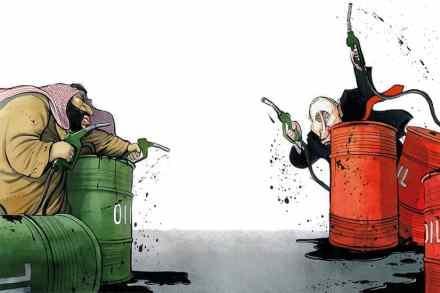
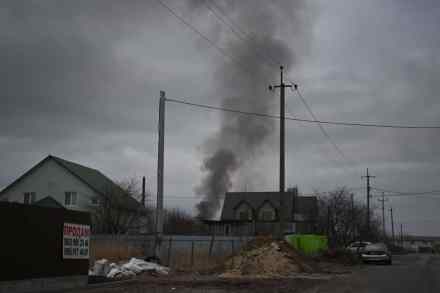
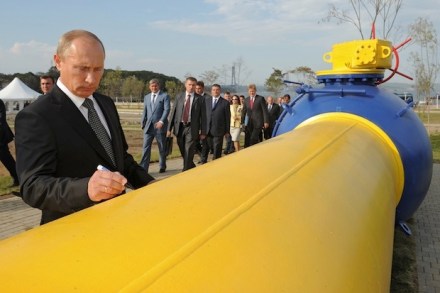
So, Nord Stream 2 will not be plugged into Germany’s gas grid. A little surprisingly, Chancellor Olaf Scholz has been first out of the blocks this morning in the western economic response to Putin’s recognition of breakaway states in eastern Ukraine. The block is not total: what Scholz says is that the certification process for the pipeline will be halted — leaving open the possibility that it might, after all, be connected if Putin starts to behave himself, or Germany becomes especially desperate for gas. Nevertheless, it is a significant move which will have an economic impact on Russia. But it is astonishing that the project was ever allowed to come this far in the first place.

Storm Eunice has nothing to do with climate change

From our UK edition

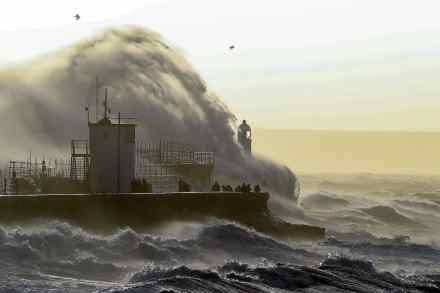
I sat tight and braced myself for the worst this morning — not high winds but for the Today programme to blame storm Eunice on climate change. Sure enough, at a quarter past eight, it didn’t disappoint. While a report acknowledged that it was not possible to blame specific weather events on climate change, Baroness Brown, who sits on the government’s climate change committee, was hauled on the show to explore the link between ‘extreme weather’ and climate change. She suggested that the Intergovernmental Panel on Climate Change (IPCC) would be producing a very frightening report on it soon. The use of the generalised term ‘extreme weather’ — i.e.

Should we vaccinate children against Covid?

From our UK edition

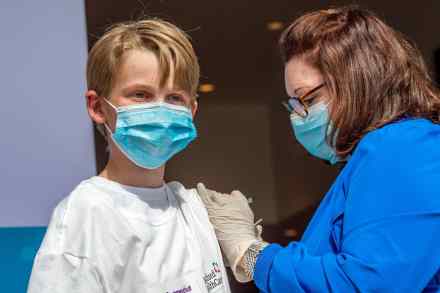
Is there any point in vaccinating five to 11-year-olds against Covid? For months the policy across the UK was not to do this, on the grounds that few children suffered anything other than mild symptoms — so the possible side effects were not worth the risk. The Pfizer jab, which has formed the mainstay of vaccinations among the under-forties in Britain, has been linked with cases of inflammation of the heart muscle. However, this was mostly mild in patients affected — while the risk of inflammation was found to be less than a quarter compared with the same condition following a Covid infection. The Joint Committee on Vaccination and Immunisation yesterday advised that children aged five to 11 should be offered two doses of the Pfizer vaccine, at least 12 weeks apart.

Are ethnic minorities still more likely to get Covid?

From our UK edition

Is there a genetic element to the risk of being infected with Covid — and are some disadvantaged ethnic groups more vulnerable to the virus? This was once one of the most controversial questions about Covid — asked often during the first and second waves of the pandemic when it became apparent that infection and death rates were higher among some ethnic groups than others (a government report was published at the time). Among the factors discussed were the tendency of black and Asian Britons to work in exposed, public-facing roles such as in transport, their greater presence in crowded, inner-city districts and the greater prevalence of multi-generational households among some groups.

How high could interest rates go?

From our UK edition

The last time that US inflation hit 7.5 per cent, Ronald Reagan was a recently-elected president. And he, older readers might recall, partly owed his election to inflation. He memorably said during his campaign: 'inflation is as violent as a mugger, as frightening as an armed robber and as deadly as a hitman.' But what of Britain? Bank of England chief economist Huw Pill gave a speech this morning in which he revealed that the Monetary Policy Committee (MPC) very nearly raised the bank’s base rate to 0.75 per cent this month rather than to 0.5 per cent — there was only one vote in it. Should this, along with the news from the US, make us suspect that rates are heading higher than we might previously have thought?

Is scrapping self-isolation safe?

From our UK edition

Is now the right time to lift all Covid restrictions, as the Prime Minister suggested he might do from 24 February? The news was met with howls of outrage from some quarters. For example, Zubaida Haque, who runs an equality think-tank and serves on the self-styled ‘Independent Sage’, last night tweeted:  One of the chief influences on the final decision about changing the rules will be Denmark ‘Ending the legal requirement to self-isolate if you test positive is a clear message to the clinically (extremely) vulnerable and immuno-compromised groups that their lives/health are no longer the concern of the govt or the public. It’s cruel, callous and not based on science.’ But others beg to differ.

A windfall tax on oil giants would harm – not help – pensioners

From our UK edition

Look up this year’s performance of the shares and bonds which make up your pension fund and you will see that BP and Shell are the rare chinks of light. BP is up 15 per cent and Shell up 20 per cent, with both enjoying bumper profits on the back of high oil and gas prices. Cue, then, for Labour and the Lib Dems to demand a windfall tax in order to confiscate some of these profits. The money ought to be used, Eds Miliband and Davey have said this morning, to help people pay their heating bills. In both their minds ‘dividends’ and ‘shareholders’ are rude words – whereas in reality the people with a stake in BP and Shell are in many cases exactly the same people who are struggling to pay their heating bills.

Make capitalism real again

From our UK edition

The emergence of Covid provoked a worldwide economic crash. That lasted a mere four weeks. By the time western countries were locking down, a bull market had begun afresh. Through months of lockdowns, soaring case rates and death rates, shares were not just rebounding but marking new highs – firstly involving tech shares and online retailers which had done well from social distancing, but then pretty much anything. The arrival of the first vaccine phase 3 trial results in November 2020 sent shares spinning upwards, yet the emergence of the Alpha and Delta strains didn’t seem to do any harm. And now that economies seem finally to be putting Covid behind them? In Britain, plan B has ended. Denmark has ditched its Covid restrictions entirely.

The Bank of England’s interest rate hike isn’t enough

From our UK edition

There would have been times when the news ‘Bank of England doubles interest rates’ would have been met with a shudder. But when the move takes rates merely from 0.25 per cent to 0.5 per cent it hardly ranks as a shock at all. The days when the base rate reached 15 per cent seem as far away as ever. Rates remain far lower than was considered normal before the banking crash of 2008/09. Prior to that, rates had not been below two per cent in 300 years. So, no, the Bank of England is not responding aggressively to rising inflation.

Two years on, what’s the evidence for lockdown?

From our UK edition

Did lockdowns save lives? We will never have a definitive answer to this vital question because it was impossible to conduct controlled experiments — we don’t have two identical countries, one where lockdown was imposed and one where it wasn’t. Nor is it easy to compare similar countries, for the simple reason that every country in the world — bar Comoros in the Indian Ocean — reacted to Covid by introducing at least one non-pharmaceutical intervention (NPI) by the end of March 2020. There was no clear link between lockdown stringency and fewer deaths in the spring of 2020, A team from Johns Hopkins University has, however, assessed the many (albeit flawed) studies into whether lockdown works — a ‘meta-analysis’.

Why should we listen to celebrities over Joe Rogan?

From our UK edition

I’m boycotting Spotify. I am doing this for the same reason as I don’t have a Netflix subscription: I refuse to subsidise the efforts by Harry and Meghan to monetise their royal fame. If either company terminates its relationship with the couple I will consider using its services, but for the moment I will stick to YouTube. But no, it wouldn’t be a problem for me that Spotify hosts the Joe Rogan podcast – something which I admit I have never listened to, but which seems to have upset Harry and Meghan, as well as Neil Young and Joni Mitchell. The day we banish people from spouting unpopular opinions, even nutty ideas, is the day that we submit to being ruled by a tyranny of officially-sanctioned experts.

The NHS vaccine mandate was bound to fail

From our UK edition

Health Secretary Sajid Javid now looks set to drop his plans to sack unvaccinated NHS staff. It was almost inevitable given the practical difficulties that come with sacking more than 70,000 workers who showed little sign of changing their minds — all while the NHS is desperately trying to catch up with missed treatments following the pandemic. Javid is expected to say that the far milder Omicron variant has changed his calculation: Covid is no longer a threat that would necessitate compulsory vaccination. In reality, his bluff was about to be called.

Why Denmark has called for the end of Covid restrictions

From our UK edition

England has been described by some as an outlier in that the government is lifting Plan B restrictions in spite of Covid infections remaining high – daily numbers are still higher than at any point prior to the emergence of the Omicron variant. Some have even accused the Prime Minister of lifting the restrictions in order to divert attention from his political troubles. Yet Boris Johnson’s government is not alone. The Danish government, too, has announced that all remaining restrictions will be lifted on 1 February and Covid-19 will no longer be classified as a ‘socially critical disease’ in the country.

The abandoned revolution: has the government given up on Brexit?

From our UK edition

There is a lesser-known Robert Redford film, The Candidate, in which he plays a no-hope Democrat taking on a popular and well-liked Republican in a Californian election. After engaging unexpectedly well with the public and winning an improbable victory, he turns to one of his aides and asks, bewildered: ‘What do we do now?’ The question is left hanging in the air like the back end of the bus in The Italian Job. The script might as well have been written about Boris Johnson and the Brexit referendum campaign. It is nearly six years on from that victory, and two years on from Brexit itself. And yet it is still far from clear what — if anything — the Prime Minister intends to do with his victory. We thought we knew what he wanted from Brexit.

Don’t bet on interest rates rising

From our UK edition

So is this really it: the end of the era of virtually zero interest rates? There was a marked pullback in US markets on Wednesday when Jay Powell, the chair of the Federal Reserve, indicated that yes, he really did mean it: interest rates are on the way up, if not quite yet. ‘The committee is of a mind to raise the federal funds rate at the March meeting assuming that conditions are appropriate for doing so.’ Share prices, which earlier in the day had risen in expectation of a doveish stance, fell back sharply. The very idea that a central bank might increase interest rates to tackle rising inflation seemed to catch investors unaware – so used have we all become to ultra-low borrowing rates.

Did Plan B work?

From our UK edition

Today is England’s last day under Plan B restrictions, brought in by the government at the beginning of last month to curb the spread of Omicron. Work-from-home guidance was scrapped last week, while mandatory face coverings in shops and on public transport — as well as the need to show vaccine passports at large venues — are to be lifted tomorrow. Was there any point in these restrictions in the first place? We will never know, of course, what would have happened had the government not brought them in — no one has conducted a controlled experiment on an identical England where Plan B was never introduced.

Entitled motorists have ruled the roads for far too long

From our UK edition

Last week it was ‘operation red meat’, designed to recapture wavering Tory voters. This week something very different: changes to the Highway Code are coming into effect, which threaten to upset the not-insignificant number of car owners. Sure enough, the Alliance of British Drivers, the trade union for Mr Toads, has complained bitterly. Responding to a new clause reminding that cyclists and pedestrians have the right to use any part of the road, the Alliance complains: 'This is a recipe for anarchy and accidents. It is unworkable. Greater clarification is needed as it appears to give pedestrians total control over the entire road network.

Ousting Boris Johnson now would be a mistake

From our UK edition

There must come a time when even Beth Rigby starts to ask whether she is too fixated on a small staff party which happened nearly two years ago and not quite enough on the highest inflation rate in 30 years and the prospect of a Russian invasion of Ukraine. But to be fair to Sky TV’s political editor – who herself was taken off air for three months last year for attending a party which broke Covid rules – she is hardly the only one. As well as every other media outlet pursuing the same story to the point of absurdity the story is being fed by a number of covens of Conservative MPs who are determined to use this opportunity to oust the Prime Minister.

Banning tomato ketchup sachets won’t save the planet

From our UK edition

Warning to the working classes: the government is coming after your pleasures again. It is you who are being blamed for environmental degradation and you who will be made to pay the price. The latest wheeze of environment secretary George Eustice is to ban plastic sachets of tomato ketchup, soy sauce and whatever else from takeaways. Evidence has shown, he says, that these little sachets 'can cause considerable harm to the marine and terrestrial environment when disposed of incorrectly'.  Fair enough, in that we would all be better off if food manufacturers could find biodegradable substitutes for their packaging. But why is it always what might be described as common pleasures which ministers fixate upon when trying to solve social and environmental problems?

Does Boris believe in Brexit?

From our UK edition

For once, yesterday’s Downing Street press conference included a worthwhile question, and not of the 'why aren’t you locking us down?' variety. In fact, it had nothing to do with Covid at all. Harry Cole of the Sun asked why, given that the Prime Minister had once cited the ability to remove VAT from fuel bills as a tangible benefit of leaving the EU, he was not now taking advantage of his new-found freedom, especially as bills are heading sharply upwards. Boris Johnson mumbled something about not wanting to help people who could easily afford their energy bills and that the government might consider more targeted help instead.