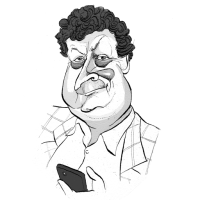
Rory Sutherland

Rory Sutherland

The myth of self-denial

From our UK edition

It’s a cheap joke, but it cheers me up. When Starbucks started that habit of asking your name and writing it on your cup, I began giving my name as ‘Chantelle’, ‘Monique’, ‘Desirée’ or ‘Pixie’. Then, when I’d collected four or five of these empty cups, I would leave them all lying around in the car to stop my wife getting too complacent. In the same way, I always use a false name when I book an executive car. It amuses me to see a black Mercedes S-Class parked somewhere prominent with a big white card in the passenger window with ‘Monbiot’ written on it.

New kinds of housing

From our UK edition

If the all-party Parliamentary Housing Sub-Committee were to embark on a week-long fact-finding tour of Barbados, it would create a tabloid scandal. Yet it might be a good idea all the same. For among the palm trees they will find remnants of a fascinating housing experiment which began almost 200 years ago, yet which affords a useful lesson for housing policy today. In 1838, when slavery was abolished on the island, plantation owners suddenly found themselves obliged to pay wages to their workers. In an effort to recoup this cost, they churlishly began charging those workers rent for houses they had previously occupied for free. Rents in some cases were so high that emancipated slaves were scarcely better off than before.

Complexity is too simple

From our UK edition

Pojoaque, near Santa Fe, New Mexico This is a magical part of the world — and it’s easy to see why D.H. Lawrence, Aldous Huxley and Douglas Adams were tempted to hang around for a while. When James Delingpole finally gets his act together and leads 10,000 Spectator subscribers into the desert to form a libertarian commune, northern New Mexico should be the first place he tries. He’ll have the blessing of a former two-term governor here, triathlete and Everest mountaineer Gary Johnson, now the Libertarian party’s presidential candidate. As Republican governor, Johnson spent part of his second term campaigning for the decriminalisation of marijuana: when asked of his past drug use, ‘Did you inhale?’, Johnson replied, ‘I barely exhaled.

Old habits make sense

From our UK edition

‘Develop your eccentricities while you are young,’ said David Ogilvy. ‘That way, when you get old, people won’t think you’re going gaga.’ I am 46. And I am happily beginning to discover that a lot of habits I once thought ‘geriatric’ are in fact common sense. I haven’t yet started wearing beige or buying shoes that close with Velcro, but I’m tempted. And last week I gave in to one urge and went around the house compulsively labelling things. I haven’t reached the point where my remote controls and radios have little torn shreds of sticky paper attached to them with hand-drawn arrows labelling buttons ‘video’, ‘Radio 4’ and ‘off’. But I have started labelling all our bloody chargers.

The price of a good reputation

From our UK edition

I have never practised tax avoidance myself. It’s not that I’m particularly virtuous: it’s just I’d rather pay a few thousand pounds to HMRC than spend an hour talking to an accountant. But I was fascinated by the Jimmy Carr affair for one reason. Why was Mr Carr, alone of the thousand or so participants, hounded to withdraw from the Jersey K2 scheme? Innate decency aside, Carr had to withdraw because he is famous and a comedian. A comedian’s career is ‘reputationally fragile’. People need to like you before they’ll laugh at you. (Fatty Arbuckle and Woody Allen are two people who, once tainted by scandal, found themselves ‘just not so funny any more’). The other thousand people using the K2 scheme are neither famous nor amusing.

The tangled truth

From our UK edition

There is a kind of mercantile speculation which ascribes every action to interest and considers interest as only another name for pecuniary advantage. But the boundless variety of human affections is not to be thus easily circumscribed. This is from a sermon by Samuel Johnson. I can’t find the date, but suspect he is having an early pop at Adam Smith, whom he met only once (they didn’t hit it off). Around a hundred years later, here’s Friedrich Hayek, accepting the Nobel prize for economics.

Slaves to the network

From our UK edition

It is a common lament that the British are bad at languages. At first glance, this is inarguably true. Few educated Brits can chat unselfconsciously in French. Yet ordinary Swedes or Dutchmen can tell jokes and explain complicated ideas in perfectly idiomatic English. It’s our fault, isn’t it? Well, not quite. Let’s leave the matter of individual competence behind and zoom outwards to look at the wider ‘network effects’ of learning a foreign language. Let’s assume you are Dutch. It is immediately obvious which foreign language to learn first — English. But for a native English speaker there’s a quandary. Mandarin, Spanish, Arabic, Portuguese or Malay could all make a competing case.

Pushing the envelope

From our UK edition

What’s so good about email? Well, it’s quick and easy for you to write an email, you can copy in lots of people, it’s immediate and it’s free. And the worst thing about email? Well, it’s very quick and easy for other people to send you an email, or to copy you in on an email, and their bloody senseless email arrives immediately. And for bloody free. This is one problem. Almost all the advantages of email accrue to the sender. The effort, obligation and responsibility all fall to the recipient. In that sense email creates what economists call ‘negative externalities’, rather like industrial pollution or aircraft noise. In several respects email is worse than conventional paper mail. Letters come in a batch, once a day.

Divided we stand

From our UK edition

Many Native American tribes would consult a shaman before embarking on a hunting expedition. In one tribe, a shaman would take a caribou bone, carve on it images of the kind of prey the tribe were keen to find (buffalo, deer, trailer-park video-poker addicts) and then place it on a fire. At some point the heat of the fire would cause the bone to split. The hunting party would then set out unquestioningly in the direction of the line of the crack. This is of course a completely insane practice; the kind of irrational, superstitious nonsense that would have Richard Dawkins foaming at the mouth. Except it isn’t. In fact, it’s rather brilliant. One hundred years ago there was no surefire way of predicting where to find a buffalo herd.

The cover-up instinct

From our UK edition

I believe that Lee Harvey Oswald shot JFK. I think the moon landings took place as billed. And Diana’s car crashed into a pillar in the Pont de l’Alma without the assistance of the Duke of Edinburgh. In the last case, I am particularly disinclined to believe in conspiracy theories since, prior to the accident, I had ridden through the tunnel in a taxi several times, the first when I was 11 years old. Each time I had the same thought: ‘God, this is a stupid design for a tunnel.’ It contains a long series of square concrete pillars along the central reservation, separated from the road only by a couple of feet and a feeble kerb. It is now 15 years since it saw the most famous car crash in history, yet no guard-rails have been installed.

More Canada!

From our UK edition

The more elderly among The Spectator’s readership, who still secretly mourn the loss of Nyasaland and the Aden protectorate, may be pleased to hear that a small step was taken last month towards reversing the Empire’s inexorable decline. More surprising still, the idea behind this expansion comes from an American economist and the flag raised will be not the red ensign but the maple leaf. But it’s a start. The original proposal (mentioned here three years ago) is to create ‘charter cities’ in the developing world where the institutions, infrastructure and government are not those of the surrounding nation but are imported wholesale from somewhere else.

The Wiki Man: Not-so-basic instinct

From our UK edition

As someone who has a panic attack when the Sky box fails to work, I am fascinated by people who stay calm in a major crisis. Hence I love listening to cockpit voice recordings on YouTube. Among the best are Apollo XIII and ‘US Airways Flight 1549’ — the ‘Miracle on the Hudson’. With both engines of an Airbus A320 knocked out by a birdstrike, captain Chesley B. Sullenberger III is offered an emergency landing at Teterboro. He pauses for a second. Then: ‘We can’t do it…. We’re going to be in the Hudson.’ At this point, it is worth noting a few facts about the pilot. He was 57 at the time, an age which would disqualify him from many airlines.

The Wiki Man: Double crossed

From our UK edition

There is no shortage of competitors for the strangest site on the internet. ‘The Britney Spears Guide to Semiconductor Physics’, for instance. Or gooseduds.com — an essential website (essential, that is, if you have ornamental garden geese and feel the urge to dress them in seasonal clothes). Or hatsofmeat.com, a website that shows exactly what its name suggests. But, after 18 years of surfing the web, last week I stumbled on a page more ridiculous than any of these. I live in Kent. Getting to Heathrow is a nuisance. The south-western stretch of the M25 is often congested, and the journey is made slower by Surrey’s habit of imposing random and gratuitous temporary speed limits on its section of the M25 to boost speed-camera revenues. Never mind, I thought.

The Wiki Man: Tailor-made television

From our UK edition

I could paint a Mona Lisa, I could be another Caesar; Compose an oratorio that is sublime. The door’s not shut on my genius – but I just don’t have the time. Like Flanders & Swann’s sloth, many people are secretly convinced that they could write a masterpiece. Almost everyone also believes that they could start an internet business — if they only had the time. I once considered starting a micro-swearing network called Touretter — an angrier version of Twitter. And a group of us recently debated starting Farmville: The European Union Edition. This was to be an online farming game where you own a tract of virtual land and then receive huge sums of imaginary money for doing absolutely nothing.

The Wiki Man: Tips from Kant on taxes and phone bills

From our UK edition

On tax policy I find I am now a Liberal Democrat. This is a bit of an identity crisis for me. A bit like coming out. Or waking up as a giant insect. But I just really like Gloria Gaynor — sorry, I meant not taxing earnings under £10,000 a year. And the musical theatre — sorry, mansion tax. It just feels instinctively right. It’s this fairness thing that works for me. The same for the tycoon tax. I like the principle. After all, it is not the only function of a tax system to increase revenue — you must also preserve the consensus that the system treats everyone equally. Sweetheart deals with multinational corporations or loopholes for billionaires violate this principle.

The Wiki Man: Let the road-train take the strain

From our UK edition

Only two things matter when choosing a car. What is it like to drive fast? And what is it like to drive very, very slowly? Forget about cornering and acceleration. Very little of our time in cars is spent negotiating hairpin bends or revving chavvishly at a junction. Most motoring falls into two distinct categories. 1) Superb driving conditions: driving at night, or best of all in France (whose admirable policy of motorway pricing leaves their best roads free for the enjoyment of British tourists — since paying to use a motorway twice a year is much less painful than paying twice a day).

The Wiki Man: In with the old

From our UK edition

I have noticed Britons in France or Italy cringe with embarrassment, and mutter apologies to waiters when ordering a cappuccino after dinner — or at any time after noon. ‘Look, you needn’t apologise,’ I say. ‘The reason foreigners drink their coffee black isn’t because they’re sophisticated: it’s because their milk tastes like crap.’ It has always surprised me that two countries which take great pride in food can produce such dismal milk. One theory is that many Mediterranean people have not evolved the ability to digest milk after childhood. So Brits should not feel ashamed at any lack of savoir-faire; if anything, our hosts should feel uncomfortable about their failure to make any genetic headway over the past 20,000 years.

The Wiki Man: The best thing since wheeled suitcases

From our UK edition

I had a Land Rover Discovery once. It was expensive to run, largely on account of the rear visibility. The blind spot was so large that, when reversing, you had to worry not only about lurking cats, shrubs and bollards but also bungalows. I felt proud whenever I went for six months without needing to replace one of the rear lights. My present car, when reversing, beeps if it detects any obstruction, the frequency of beeps increasing as the object gets closer. This is a godsend when parking. (The only problem is that I sometimes expect these beeps when driving cars not similarly equipped: when I borrow my wife’s car I park like a Neapolitan.) The parking sensor is a simple idea which should have been invented earlier than it was. Why so late?

The Wiki Man: Class system

From our UK edition

1) Imagine you have the choice of living in two worlds. In World A you have a five-bedroom house and everyone you know has a six-bedroom house. In World B you have a four-bedroom house and all your friends have three-bedroom houses. Which world would you prefer? 2) You can live in World C, where you get five weeks’ holiday a year and your friends get six. Or you can choose World D where you get four weeks’ holiday a year and everyone else gets three. Which do you choose? ••• Most people, when asked these questions, chose worlds B and C. In other words, with property (at least above a certain size), it is the relative size of a house that matters more: with holiday time, it is the absolute amount that appeals.

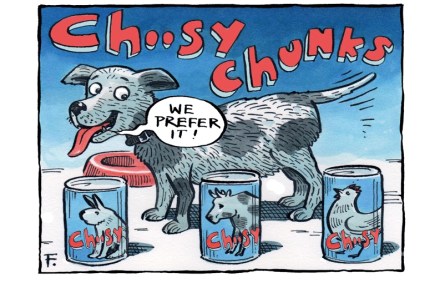
Even dogs prefer democracy

From our UK edition

Recent research has shown a robust and positive correlation between the amount of democracy we enjoy and how happy we are. This is true for the Swiss, at any rate, for it was among the cantons of Switzerland that the research was conducted. If you believe the Swiss are a peculiarly unrepresentative group, you may be interested to know that the same rule holds true not only for melted-cheese-­eating neutrality monkeys, but also for dogs. Dogs prefer democracy? How can we possibly know?