Rory Sutherland

Rory Sutherland

Gastropolitics give us food for thought

From our UK edition

An Iranian friend of mine recently brought me some gaz from Isfahan. Commonly known as Persian nougat, gaz is perhaps the most delicious thing I have ever eaten. The only thing to avoid is learning how it is made. Pistachio nuts are mixed with ‘honeydew’ collected from the angebin plant of the Zagros mountains, a sticky white substance often believed to be the manna of the Bible. It sounds glorious. That is until my friend told me that honeydew is not the sap of the plant — but is exuded from the anus of an insect which feeds on it. So one of the tastiest things on the planet turns out to be louse crap. What we know of something strangely affects how it tastes.


Does a tax rise make you work less? Or does it spur you to work harder?

From our UK edition

History records many well conceived and apparently logical grand plans for the betterment of mankind. Sadly such ideas almost always fail. Why is this? One possibility is that they fail precisely because they are logical. The dictates of logic require the existence of universally applicable laws. But humans, unlike atoms, are not consistent enough in their affinities for such laws to hold very broadly. For example we are not remotely logical in whom we choose to help. Will wealthy Germans help poorer Germans? Yup. Greeks, however? No chance. Utilitarianism makes perfect sense — right up to the point you try to apply it. As Orwell said, ‘To an ordinary human being, love means nothing if it does not mean loving some people more than others.

Why most economic models are doomed from the outset

From our UK edition

History records many well conceived and apparently logical grand plans for the betterment of mankind. Sadly such ideas almost always fail. Why is this? One possibility is that they fail precisely because they are logical. The dictates of logic require the existence of universally applicable laws. But humans, unlike atoms, are not consistent enough in their affinities for such laws to hold very broadly. For example we are not remotely logical in whom we choose to help. Will wealthy Germans help poorer Germans? Yup. Greeks, however? No chance. Utilitarianism makes perfect sense — right up to the point you try to apply it. As Orwell said, ‘To an ordinary human being, love means nothing if it does not mean loving some people more than others.

Netwór Krail has outdone himself yet again

From our UK edition

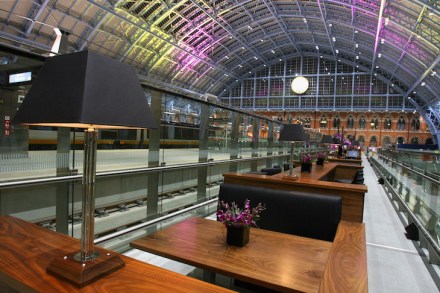
In the shadow of the Shard, not far from Borough Market, is a £1 billion public artwork, an allegorical sculpture entitled ‘What is wrong with the world today’ by the reclusive wunderkind Netwór Krail. It was officially unveiled by the Duke of Cambridge earlier this month. The reason you may not have read about this monumental piece is that most of the press coverage failed to notice this structure was a landmark in experiential art. They mostly used its banal official name: the new London Bridge station. Next time you visit this ‘station’, I urge you to appreciate this installation for what it really is — a brilliant, scathing commentary on the modern age.

Keep your DNA to yourself

From our UK edition

Nearly ten years ago, a lorry driver known only as ‘Michael Harry K’ adopted an extreme response to combating what he saw as declining standards on the autobahns: he started shooting at other vehicles. In a four-year spree he fired around 700 rounds at cars and trucks before his arrest in June 2013. What helped him evade justice for so long was the same thing that prevents us learning his full name: German privacy laws. Trucks pay tolls on autobahns, and so CCTV records the number plates of vehicles passing through toll booths. After the first 30 shootings, it could have been a routine procedure to identify the one vehicle in the right places at the right times. But the police were not allowed to see the data. It’s hard to imagine this happening in Britain.

Could an owl make video conferencing finally take off?

From our UK edition

When I was ten, the two things we all expected to enjoy by 2020 were flying cars and videotelephony. What never occurred to us was that we might successfully invent one of these things and then fail to use it. Yet that has largely been the case with video conferencing. Is its day still to come? Will there be some tipping point when we start to hold virtual meetings routinely? Or will video conferencing turn out to be one of those technologies whose promise is never fulfilled: something which ‘has a great future — and always will’. I don’t know. Certainly it suffered from being oversold too soon.

We’re still waiting for the internet revolution

From our UK edition

At the risk of sounding like Jean Baudrillard, I would like to suggest that the internet revolution has not yet taken place. So far, lots of very clever people have performed amazing feats of technical ingenuity. But for the most part our collective behaviour has so far failed to change enough to truly benefit us. Rather than making us freer, more relaxed and more efficient, in general everyone seems busier, more distracted and more tense. Unfortunately, technology is a bit like Hitler: it doesn’t know when to stop. No sooner has it annexed the Sudetenland than it starts invading Czechoslovakia. The world might be happier if Silicon Valley were put on a two-day week, to give us — and our social norms — time to catch up.

The long and the short of political advertising

From our UK edition

Nine years ago, before Cambridge Analytica existed, I caught wind of a research project at Cambridge involving the online measurement of the ‘big five’ personality dimensions. These are usually listed by the acronym OCEAN or CANOE: Conscientiousness, Agreeableness, Neuroticism, Openness and Extraversion. I made a note to go to Cambridge to learn more but, being low on conscientiousness, I never got around to it. Perhaps I dodged a bullet by not getting involved. When people say ‘It’s the early bird that catches the worm’, I always reply, ‘Yes, but what about the early worm?’ Besides, does personality alone predict behaviour? Perhaps not as much as Cambridge Analytica promised.

You can no longer reduce wealth inequality by taxing income

From our UK edition

This piece first appeared in The Spectator The maximum amount you can save in an ISA for the tax year 2017-2018 is now £20,000. The maximum annual pension contribution is £40,000. Counterintuitively, these huge allowances are actually a disincentive for ordinary people to save. With a £5,000 ISA maximum, a modest saver had an impetus to save each year for fear of missing out; with an ISA ceiling of £20,000, anyone can postpone saving until next year. But you don’t have to be a Marxist to wonder why a household which can save £60,000-120,000 a year is in need of extra help from the state. Figures released this year by HM Revenue & Customs forecast that tax relief on pensions will cost £24.1 billion, with a further £16.

ISA limits discourage ordinary people from saving

From our UK edition

The maximum amount you can save in an ISA for the tax year 2017-2018 is now £20,000. The maximum annual pension contribution is £40,000. Counterintuitively, these huge allowances are actually a disincentive for ordinary people to save. With a £5,000 ISA maximum, a modest saver had an impetus to save each year for fear of missing out; with an ISA ceiling of £20,000, anyone can postpone saving until next year. But you don’t have to be a Marxist to wonder why a household which can save £60,000-120,000 a year is in need of extra help from the state. Figures released this year by HM Revenue & Customs forecast that tax relief on pensions will cost £24.1 billion, with a further £16.

Why I’m not on board with quiet carriages

From our UK edition

Every now and then I try to invent a new scientific unit. I’ll never come up with anything as good as the millihelen — a unit of beauty sufficient to launch one ship — or the Sheppey, which is a distance of approximately seven-eighths of a mile defined as ‘the minimum distance at which sheep remain picturesque’. But I do have hopes for the tedion, which measures the half-life of boredom: it denotes the time you must spend in a location to enjoy a 50 per cent chance of overhearing someone say something interesting or funny. On a train to Cardiff or Manchester, a tedion is probably around five to ten minutes. On a Home Counties commuter train it runs into days — or in London, the conversational nadir of the UK, weeks.

Reducing activities to their core misses the point

From our UK edition

There may be a very simple evolutionary reason why water does not really taste of anything, as I learned from the psychophysicist Mark Changizi. Pure water has no taste because our taste buds have been calibrated, very sensibly, not to notice it. For a few million years, the most important contribution taste buds made to survival were to detect things in water that weren’t water: the very things, in short, which might indicate that the water wasn’t safe to drink. If we had evolved perception so that water tasted like Rioja or Dr Pepper, the sensory overload might have overpowered that hint of dead sheep from a rotting carcass 100 yards upstream: our taste buds are calibrated with water as the base line, the better to notice things which shouldn’t be in it.

The Presidents Club was on to something

From our UK edition

There exist in the annals of salesmanship certain ideas that are both highly immoral and wickedly clever. Before P. T. Barnum attached his name to circuses, he ran Barnum’s American Museum in Manhattan. From 1841 until its destruction by fire in 1865, this received more than 38 million visitors, each paying 25c. The entry fee entitled visitors to stay all day; congestion often prevented new paying visitors from being admitted, so to hasten traffic to the exits, Barnum placed signs throughout reading ‘To The Egress’ or, according to some reports, ‘The Great Egress’. Enticed by the prospect of seeing what they imagined was some exotic bird, less literate guests followed these signs through a door and promptly found themselves locked out on the street.

We can have an efficient health service or one no one complains about. We can’t have both

From our UK edition

This piece first appeared in this week's Spectator magazine.  Recently the NHS postponed a large number of non-urgent operations to cope with what is known as the ‘annual winter crisis’. Naturally, this outcome was treated as a scandal in the press, and there were predictable calls for Jeremy Hunt to resign. But the fact that non-urgent operations are postponed is not by definition bad. It might be evidence that the NHS is working well. Or at least that it is doing what it is supposed to do, which is to deploy necessarily finite resources on the basis of patient need, rather than some other criterion — such as profitability or ability to pay. Making people wait for less urgent operations isn’t a bug of the NHS; it’s a feature.

A nice, cuddly NHS would be bad for us

From our UK edition

Recently the NHS postponed a large number of non-urgent operations to cope with what is known as the ‘annual winter crisis’. Naturally, this outcome was treated as a scandal in the press, and there were predictable calls for Jeremy Hunt to resign. But the fact that non-urgent operations are postponed is not by definition bad. It might be evidence that the NHS is working well. Or at least that it is doing what it is supposed to do, which is to deploy necessarily finite resources on the basis of patient need, rather than some other criterion — such as profitability or ability to pay. Making people wait for less urgent operations isn’t a bug of the NHS; it’s a feature.

How to make economists fight like ferrets in a sack

From our UK edition

One of the funniest passages of writing I have read in the past few years appears within the pages of Richard Thaler’s memoir Misbehaving. He describes what happens when the University of Chicago economics faculty moves to a new location. The economists simply have to agree among themselves who will occupy each office in the new building. Now in theory, at any rate, this should be a breeze. You have a group of people who should be among the most rational in the world; their discipline, economics, defines itself as dedicated to the study of the ‘allocation of resources under conditions of scarcity’: here is a problem tailor-made for economists to solve. It was, as you can imagine, a fiasco.

Design for the disabled and you can’t go wrong

From our UK edition

About 30 years ago, BT introduced a telephone handset with enormous keys. It was intended for people with serious visual impairment. Unexpectedly, it became their bestselling phone. There is a reason for this. The millions of people who wear spectacles or contact lenses typically remove them at night, making the normal tiny keys impossible to read on a bedside phone. Things designed specifically for people with disabilities often end up being valuable to many more people than originally planned. Most of us are effectively disabled some of the time. Wheelchair ramps at airports and stations are not only useful if you are in a wheelchair, they are also useful for wheeling heavy luggage.

These inventions will change your life

From our UK edition

At last. And just what you’ve been waiting for. The official Wiki Man guide to the best gadgets and gizmos for giving this Christmas. The Philips AirFryer, from £70-ish. Spectator readers may remember a craze for cooking things via a French method called sous-vide. Using this senseless technology, you could cook soggy food for days at low temperatures by warming it gently in a colostomy bag; handy if you fancied a couple of days off work with botulism, but frankly bugger all use for anything else. The AirFryer is the opposite of sous-vide: it isn’t French and is actually useful. It quickly makes food hot and crispy as God intended, not with fat but with superheated air. Everyone who buys one becomes an evangelist. Available from Amazon and some tax-compliant retailers.

What we need is a Freedom of Uninformation Act

From our UK edition

One dietary fad that never made sense to me was the campaign against the consumption of eggs. Now call me an old Darwinist, but here we are having spent a few million years evolving into a bald monkey with prehensile thumbs, perfectly optimised as an egg-stealing machine, and yet the digestion of an omelette somehow came as a horrible shock to our cardiovascular system. What next, I wondered. Perhaps they’ll discover that 45 per cent of cows are allergic to grass, or that sharks are largely sea-food intolerant. And it seems that the opprobrium directed at eggs was mostly wrong. It was based on the assumption that, since some cholesterol is bad, and since eggs contain it, ergo the consumption of every single egg was a stepping-stone to the grave.

Too many facts get in the way of truth

From our UK edition

One dietary fad that never made sense to me was the campaign against the consumption of eggs. Now call me an old Darwinist, but here we are having spent a few million years evolving into a bald monkey with prehensile thumbs, perfectly optimised as an egg-stealing machine, and yet the digestion of an omelette somehow came as a horrible shock to our cardiovascular system. What next, I wondered. Perhaps they’ll discover that 45 per cent of cows are allergic to grass, or that sharks are largely sea-food intolerant. And it seems that the opprobrium directed at eggs was mostly wrong. It was based on the assumption that, since some cholesterol is bad, and since eggs contain it, ergo the consumption of every single egg was a stepping-stone to the grave.