Robert Peston

Robert Peston

Robert Peston is Political Editor of ITV News and host of the weekly political discussion show Peston. His articles originally appeared on his ITV News blog.

Why did Tony Hall step down as BBC director-general?

From our UK edition

Tony Hall is stepping down as BBC director general of the BBC this summer, but I'm not sure his departure is a pure exercise of free will. A couple of days ago, a very well-placed source told me Hall’s preference was to stay until the corporation’s centenary in 2022, but that BBC's chairman David Clementi was 'on manoeuvres' to replace him. Whoever replaces Hall, it is certainly an appointment that will be of more than usual significance to the BBC’s future with the Prime Minister signalling wholesale long-term change in the way it is funded, starting with probable decriminalisation of non payment of licence fee. In fact, the decision on who replaces Lord Hall as BBC DG is probably as important as who becomes the next Labour leader.

On Brexit, no one quite knows where Boris is taking us

From our UK edition

I am not going to lie: I am bored sick with Brexit. Like so many of you, I have become that frustrated child in the back of the car moaning, 'are we there yet?' Boris Johnson won’t tell us. Or at least not in precise terms. So on this marathon journey, just days before we leave the EU in a legal sense at 11pm on 31 January, the final destination can only be deduced, and certainly not with any precision. What Johnson says he wants, more than anything, is a trading relationship with the EU that returns to the UK a sovereign ability to set its own rules and regulations for business, such as companies’ duties to employees, their environmental obligations, their safety standards and so on.

Labour must learn from its catastrophic Brexit blunder

From our UK edition

Boris Johnson says he is desperate to get Brexit off the agenda for his own government, so that it can start applying blue cement to the bricks he turned blue in Labour's red wall – or throw money and popular policies at the midlands and northern seats he recently pinched from Labour. In fact he tried to persuade me, in an interview during the election, that only saddos like me will be remotely interested in the details of the trade and security deal with the EU he courageously believes can be negotiated in a record-breaking 11 months. For better or ill, he may be right. I am flabbergasted that many of the business leaders to whom I speak, who hated Brexit, have capitulated and are now Johnson groupies.

How will Boris Johnson respond to Qassem Soleimani’s killing?

From our UK edition

President Trump’s decision to assassinate Qassem Soleimani accelerates perhaps the most important post-Brexit decision faced by Boris Johnson: whether to stand with the US or the EU at moments of potentially acute global crisis. What happens next will largely be conditioned by how Iran responds and retaliates. But all Western governments are examining their options. In particular, France’s president Macron will be working hard to forge a coordinated EU and European response, not least because through the G7 over the summer he endeavoured to engineer a dialogue between president Trump and Iran. Those close to Macron say he admires Johnson. But there are members of the government who harbour the traditional British mistrust of a strong French president.

The Labour leadership race is Keir Starmer’s to lose

From our UK edition

If you believe betting odds, Rebecca Long-Bailey is a shoo-in to be Labour leader, after the shadow chancellor John McDonnell on Sunday anointed her as the candidate most likely to build on the Corbyn/McDonnell project. But punters may be getting ahead of themselves. For one thing, I am told that a YouGov poll of Labour members carried out in the week of the general election delivered the same result as a YouGov poll in July – namely it showed that Keir Starmer is more popular among members than any other candidate. Back then, 68 per cent of Labour members said Starmer would be a very or fairly good leader, and only 12 per cent said he would be a poor leader.

Boris Johnson will block the Brexit transition being extended in law

From our UK edition

Those who thought Boris Johnson would exploit his huge majority to be flexible on the end-2020 deadline for negotiating a trade agreement with the EU will be proved wrong at the end of the week. Because I understand that the revised Withdrawal Agreement Bill will put into law that the transition arrangements with the EU, during which the UK is in effect a non-voting member of the EU, must end December 31 next year. So the option of extending the transition by two years will be eliminated in UK law. Truthfully, this is mainly symbolism, in that a law can always be amended. But it shows Johnson is intent on honouring the Tory manifesto commitment to terminate the transition in just over a year from now.

The three ‘C’s’ that explain Boris’s historic election win

From our UK edition

This was an election as important and as divisive for the UK as Margaret Thatcher’s victory in 1979. Vast numbers of British people will never be reconciled to Boris Johnson as prime minister or to Brexit. In fact, a whole nation, Scotland, is already asking permission to leave. My assumption, however, is that Johnson will go Red Tory rather than born-again-Thatcherite. Because he will want to capitalise on the disaffection from Labour of vast numbers of its traditional supporters in the Midlands and north of England. So Labour will have its work cut out to look like a party of government any time soon, even if it finds a more unifying leader than Jeremy Corbyn. But there is too much to say about the consequences of what has happened.

Two big blunders that will be remembered from this election

From our UK edition

The two stand-out moments of the campaign? 1) Jeremy Corbyn refusing to say sorry to the Jewish community, in Andrew Neil’s BBC interview, for the hurt and anxiety he caused by failing for years to eliminate anti-Semitism from the Labour party. https://www.youtube.com/watch?v=0oB2OcXAjSc 2) Boris Johnson’s refusal to look at a picture of a four-year-old with suspected pneumonia lying on the floor of Leeds General Infirmary, which ITV News' Joe Pike tried to show him on his phone, and then Johnson’s pocketing of Pike’s phone. https://twitter.com/itvcalendar?ref_src=twsrc%5Etfw Each leader showed a wilful refusal to take personal responsibility for the consequences of their respective party’s actions.

Four key questions that will decide who wins this election

From our UK edition

In the end it probably comes down to four things, most of them momentous, about the power of the people, and the very structure of the country. First, this is your only chance to decide whether the UK leaves the EU at the end of January or whether you want a referendum next year that could reverse the result of the previous Brexit referendum. Second, if you are north of the border, this is an opportunity to signal whether you want another referendum on whether Scotland remains part of the UK.

Could this be the defining moment of the election campaign?

From our UK edition

An interview earlier today with my colleague Joe Pike captures the contradiction at the heart of Boris Johnson’s campaign. He wants to be seen as campaigning to lead a 'new' government, but the Tories have been in power since 2010. So he finds it impossible to take responsibility for four-year-old Jack Williment-Barr, left to lie on coats for hours in a Leeds hospital. As the video shows, he refuses to look at the picture of Jack – which comes across as him saying 'I don't want to own this'. This is certainly the political moment of the day and could be the moment of the campaign: https://twitter.com/joepike/status/1204018593656180736?

Why I feel sorry for Jo Swinson’s Lib Dems

From our UK edition

Interviewing Boris Johnson last night on my show, I ended up feeling a bit sorry for Jo Swinson, leader of the Liberal Democrats. Because for him the election is a proxy for another referendum. His whole mantra is 'get Brexit done, and move on'. Swinson's position of 'revoke and move on' is a wholly rational response in the context of Johnson's framing. But apparently what is democracy in action for Johnson is anti-democracy when the Lib Dems react. We are truly in the 'age of unreason'. Some of you will be screaming that 'we had a referendum, so the only legitimate way to cancel it is to hold another one'. Except under our unwritten constitution referendums have no legal force, and are certainly inferior in their democratic weight to general elections.

Boris vs Corbyn: the impossible choice at this election

From our UK edition

How do you weigh a once-in-a-generation transfer of power from private sector to public sector and from capital to labour, against an irreversible rupture with the European Union? That is the choice being offered to voters, by Labour and the Tories respectively. Talk about chalk and cheese, or bicycles versus fish. How on earth do you decide, if you haven't made up your mind already, which you like best? You could argue that the desire among some voters to squeeze the private sector's pips till they squeak and those that want to take a chainsaw to the UK's ties with the EU – with only a relatively small group apparently wanting both – stem from similar social and economic causes.

Labour’s failure on anti-Semitism is also a crisis of competence

From our UK edition

There is both a moral and a practical dimension to Labour's desperate slowness to root out anti-Semitism. The moral one, highlighted by the Chief Rabbi last night, is whether Jeremy Corbyn is fit to be prime minister having seemingly been too tolerant for too long of avowed anti-Semites. The practical one is that Labour is offering the most ambitious and complex programme of national reconstruction since 1945 – an expansion of the apparatus of the state on a scale we haven't seen since at least the 1960s and probably not since 1945. It will require management and technocratic expertise of a very high order.

Boris Johnson has gambled big by pledging to spend small

From our UK edition

Boris Johnson just took a very big political risk, by not making any serious attempt to compete with Labour on bunging cash at public services and the fabric of the UK. Where Corbyn is pledging £83 billion a year of increased spending on students, the elderly, health, schools, public-sector pay and so on by 2023, the Tories offer £3 billion. For Labour’s £80 billion plus per year on new housing, pension compensation for women born in the 1950s, nationalisations, greening businesses and multiple other projects, Johnson is committing to £8 billion by the end of the next parliament.

Corbyn has all but declared class war with this manifesto

From our UK edition

I am not sure if it is class war exactly but something very like it is back. Perhaps it is a hybrid of a class, eco and generational war. In that Labour is planning to sting those earning £80,000 a year or more with an additional tax burden just short of £20bn from higher taxes on income, capital and dividends. As for businesses and financial institutions, they are being whacked for almost £50bn, in a dizzying array of increased levies on profits, assets and financial trading, and - eccentrically perhaps for a party saying it wants to encourage a green high-tech economy - a reduction in allowances for spending on research.

Might the Lib Dems back Boris if they find themselves kingmakers?

From our UK edition

It had not occurred to me that the Lib Dems would 'allow' Boris Johnson to remain PM if he were to fail to win a majority but the Tories nonetheless were to emerge from the election with more MPs than any other party. I assumed Jo Swinson’s and her Lib Dem MPs’ savage criticism of Johnson and the Tories would lead the Lib Dem leader to swallow her pride at the last and eat the vitriol she has thrown at Corbyn. I have been taking it for granted she would find a way to agree some kind of arrangement with Remain parties and MPs, with Labour and the SNP, that would see Corbyn enter 10 Downing Street. Not so. Swinson’s deputy Ed Davey told me on my programme last night that he expected the election would lead to Johnson being left in charge of a minority government.

Boris and Corbyn aren’t telling the truth about Brexit

From our UK edition

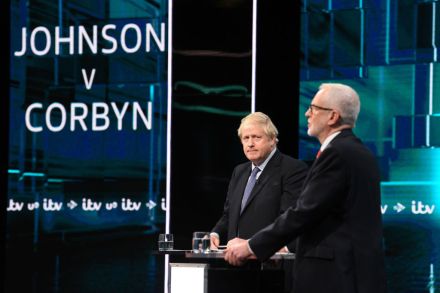
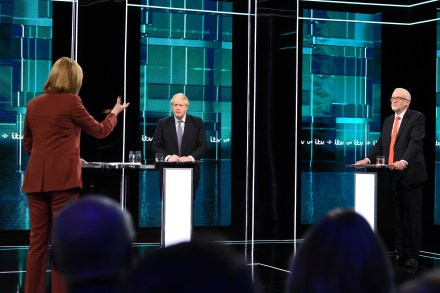
An attack line that both Corbyn and Johnson shied away from last night in ITV's debate best characterises the rotten core of this election. I had half expected Corbyn to make a big thing of the risk that even if Johnson gets his self-styled microwaveable Brexit deal zapped and approved by MPs, such that the UK leaves the EU on 31 January, there remains a significant residual risk we'll tumble into something very like a no-deal Brexit by the end of 2020 – since it is stretching credibility that a useful trade deal with the EU could be negotiated and approved by then, for all that Johnson claims the contrary.

Are Boris and Corbyn both playing us all for fools?

From our UK edition

A question I don't expect my colleague Julie Etchingham to put to the two party leaders in ITV's debate is the one that has been nagging away at me for days: why is the policy-making that will underpin the election manifestos we'll get from the parties over the next few days so lacking in intellectual rigour? What we have from both parties are big ambitions – 'free broadband for everyone' from Labour, 'Brexit totally done and dusted by the end of 2020' from Boris Johnson – based either on a highly selective use of second-hand research (Labour's analysis of the costs and practicability of nationalising full-fibre broadband roll-out) or predicated on the challenging notion that Johnson has near magical negotiating skills.

Jo Swinson’s anti-populist pitch

From our UK edition

I emerged with three thoughts from my interview with the Lib Dem leader Jo Swinson, which is three more thoughts than I often have after interviewing a senior politician. First, her attack on Labour was massively personalised as an attack on Jeremy Corbyn, who she says is not fit to be PM, rather than on the party itself. Second, she refused to “discuss hypotheticals” when I asked whether her condition for Lib Dems propping up a Labour government was that Labour would have to find a way for someone other than Corbyn to move in to No.10.

How an NHS crisis could lose the election for Boris Johnson

From our UK edition

The poor performance of the NHS relative to government targets is turning into a major headache for the PM. The point is that Johnson and the Vote Leave team won the EU referendum largely on the basis of their controversial promise to invest £350m a week into the health service. They were acutely aware that money for a public health service matters hugely to poorer people and matters disproportionately more than for those on higher incomes – who have the double benefit of being able to afford both private healthcare and healthier lifestyles. Johnson’s consigliere and Vote Leave campaign supremo Cummings has often said it was the £350m promise wot won it for Brexit.