Richard Orange

Story of a sinking land

From our UK edition

You couldn’t hope for a more perfect climate change victim than Ajay Patra, the head man of Ghoramara — the island in India’s Sunderban chain that is next in line to be submerged beneath the rising sea. You couldn’t hope for a more perfect climate change victim than Ajay Patra, the head man of Ghoramara — the island in India’s Sunderban chain that is next in line to be submerged beneath the rising sea. The hungry tide had already claimed all but seven of the 100 hectares his family had once owned, Ajay told me. Each year, he directs his villagers to pile felled trees onto the mud, in the deluded hope of building the island back up. And each monsoon, the sea ripped the crude barriers down, tearing off another chunk of his birthright.
The dark heart of India’s economic rise

From our UK edition

Richard Orange investigates endemic corruption, from pilfering and kickbacks to mafia rackets, in the state-owned coal mines that provide almost half of India’s energy needs The first sign of illicit industry in the West Bengal district of Raniganj is the number of bicycles wobbling precariously down its village tracks, their panniers piled to an improbable height with coal. Then there are bullock carts and the occasional truck, all carrying the same cargo. At New Kenda Colliery, one of the underground mines owned by Coal India, the state coal monopoly, it becomes obvious where it’s all coming from.

Rotten oranges and blighted hopes

From our UK edition

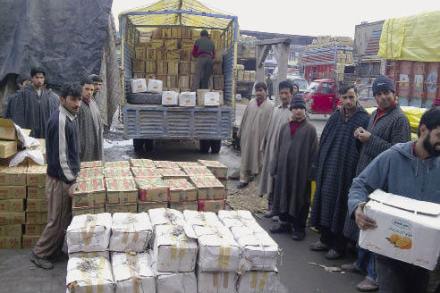
Ishaq Chowdhary pulled the top off a wooden crate to show oranges fringed with powdery white mould. It was a freezing morning at the fruit market in Srinagar, capital of the Indian state of Jammu and Kashmir, and market workers, huddling traditional fire-pots beneath their gowns, are sipping tea and starting to unload the day’s deliveries. The previous afternoon, five trucks rumbled into the market carrying oranges, pomegranates, bananas and grapes from Pakistan-administered Kashmir. When the first consignment of Pakistani goods rolled across the Aman Setu bridge, or ‘bridge of peace’, 100 days earlier, they were welcomed by cheering crowds.

Restoring the Taj is just part of Tata’s challenge

From our UK edition

As guests made their way out of the Taj hotel in Mumbai after spending New Year’s Eve in its restaurants, many stopped to study a small memorial plaque erected to commemorate the 12 staff who died protecting guests from terrorists at the end of November. If it has the same dignified simplicity as a British village war memorial, that’s probably no coincidence. Because within the Tata Group — the Taj’s owner, through a subsidiary called Indian Hotels — the ideals of duty, loyalty, courage and grit, which seem to British sensibilities to come from another era, are still very much alive. ‘There was not a single person who did not rise to do their duty,’ Indian Hotels’ patrician deputy chairman R.K.

Fading memories of the Raj in the tea gardens of Assam

From our UK edition

Richard Orange says the Indian tea industry is enjoying a revival — but that the traditional tea-planters’ way of life, established by the British, is passing into history There is not much to distinguish Dhanesheva Kurmi from the rest of the crowd at the Hautely Tea Estate, a remote garden an hour and a half’s bumpy drive from the Assamese town of Jorhat. Richard Orange says the Indian tea industry is enjoying a revival — but that the traditional tea-planters’ way of life, established by the British, is passing into history There is not much to distinguish Dhanesheva Kurmi from the rest of the crowd at the Hautely Tea Estate, a remote garden an hour and a half’s bumpy drive from the Assamese town of Jorhat.

New oil giants rise in Gandhi’s native land

From our UK edition

Gazing out over India’s Gulf of Kutch from the small jetty owned by Essar Oil, you would hardly think you were witnessing the birth of one of the world’s new industrial heartlands. Placid turquoise waters stretch out to the low landmass opposite; behind you lie mile upon mile of shimmering salt pans where flocks of flamingos aimlessly totter. But this great natural harbour — sheltered to the south by the Kathiawar peninsula, better known as the birthplace of Mahatma Gandhi — may soon be the world’s busiest oil terminal. So far, India has made its mark on the global economy by taking on outsourced clerical and call-centre work from the west; now it is turning its hands to the altogether more potent business of oil refining.

Winemaker to the maharajas

From our UK edition

It’s not often your host has passed up dinner with Mick Jagger and the Maharaja of Jodhpur to take you to his country house for the weekend. But that’s what Rajeev Samant, the pioneer of India’s wine craze, lets slip as we begin the long drive north from Mumbai to his Sula vineyard. Samant has come a long way since he drove a battered old Fiat up this road in the early 1990s to become a farmer on a patch of his father’s land — a gigantic risk for a young man who’d just chucked in a lucrative job in California’s Silicon Valley. ‘Every day I thank my lucky stars,’ he says. ‘I mean, I live this rock-star lifestyle.

The desert breeding ground of India’s billionaires

From our UK edition

‘This is backwoods, really backwoods,’ says Aditya, as the rackety, jam-packed bus pulls into Rajgarh, a small town in the north-west of Rajasthan, India’s desert state. ‘This is backwoods, really backwoods,’ says Aditya, as the rackety, jam-packed bus pulls into Rajgarh, a small town in the north-west of Rajasthan, India’s desert state. Aditya is the only person on the bus who speaks any English, and the goggle-eyed stares and toothless grins of many of his fellow passengers bear him out. They are clearly wondering what on earth a foreigner is doing in their out-of-the-way part of India and it’s only when I mention the name of Lakshmi Mittal that it clicks.

London’s diamond trade may not be forever

From our UK edition

Richard Orange says London’s traditional dominance of global dealing in uncut stones is under threat from new players based in India, China and Dubai ‘How does it feel to hold $9 million in the palm of your hand?’ One of the world’s leading diamond buyers, Rajiv Mehta, watches intently for my reaction to this question: the sachet of dull glassy pebbles I am gently weighing, if I could somehow get them out of this building and into the hands of some Antwerp middleman, would buy me one of London’s most prestigious addresses, my own island in the Bahamas, or a country-sized swath of the Argentinean pampas.

Pipeline politics is the new Great Game

From our UK edition

‘We’re always told that Russia is using its economic resources to achieve foreign policy aims,’ President Putin told journalists recently. But, he went on, it is ‘ill-wishers’ in the Western press who paint Russia as a threat to European energy security. ‘That is not the case.’ Yet within minutes of this assurance, Putin issued a bald threat to one of the EU’s newest members that was a textbook example of how Russia has bullied its way to energy dominance. If Bulgaria did not accept Russia’s terms for the planned pipeline from its Black Sea port of Bourgas to the Greek port of Alexandroupolis, Putin warned, it risked losing decades of revenues from shipping supplies of Russian oil.

Invasion of nerds leaves India’s high-tech capital yearning for its old identity

From our UK edition

‘This is a celebration of the nerd in each of us,’ declared Partha, the pony-tailed co-founder of Mindtree, an information technology consulting firm, flashing a nervous grin at thousands of young software engineers ranged in a marquee in front of him and going on to read out a dictionary definition: ‘an unstylish, unattractive, or socially inept person, slavishly devoted to intellectual pursuits’. He might well have been welcoming Gordon Brown, whose recent visit to India’s IT capital, Bangalore, made more headlines than it might otherwise have done because of the hullabaloo about Celebrity Big Brother.

‘This is not an industry for pussycats’

From our UK edition

If you built a composite portrait of Leigh Clifford from the handful of newspaper profiles ever written about him, you would be presented with an archetypal Aussie miner, as tough as the rocks his company digs from the earth. Shortly before taking up, six years ago, the post of chief executive of Rio Tinto — the London-based international mining giant — Clifford famously brandished a clenched fist at a group of environmental activists who stormed the stage at a shareholder meeting. He quickly withdrew when he realised how the picture might look in the papers, but one mining analyst still describes him as ‘a hairy-arsed mining man rather than a polished suit’.

A year in exile, but still in the game

From our UK edition

Bill Browder is strangely apologetic for the grandeur of his offices in Hudson House, a Lutyens mansion off Covent Garden. ‘I like the high ceilings,’ he says, scanning the room with a nervous smile, ‘It’s easier to work with some space around me.