Peter Jones

How the Romans handled rival religions

From our UK edition

A hadith attributed to Muhammad said that there would be 73 sects of Islam (of which only one would reach heaven). However many there are, they seem as likely to kill each other as they do the infidel. The one virtue of classical religion was that it embraced all gods, come what may. So when
Does might make right?

From our UK edition

The criminals Donald Trump and Vladimir Putin both believe that might is right. The whole question fascinated the ancient Greeks.  In his famous history of the long war between Athens and Sparta (431-404 bc), Thucydides (d. c. 400 bc) explored the question through speeches on both sides, but on one occasion – when Athens demanded

The Roman approach to ending a war

From our UK edition

We await the full details of Donald Trump’s ‘take it or leave it’ solution to the Ukraine war, but at least Romans liked that sort of clarity. Take the war between Rome and the Carthaginian Hannibal, begun in 218 bc. Rome had already defeated Carthage in a long drawn-out battle over the possession of Sicily.

Aristotle and the leisurely pursuit of education

From our UK edition

Nearly six million people are on out-of-work benefits. It is claimed that, for most of those, going back to work would not be financially worth it. Aristotle would have agreed with them because for him, leisure was the most important possession a man could have. The ancients generally had no concept of the dignity of

The ancient art of making friends in high places

From our UK edition

‘I get along with him well. I like him a lot,’ Donald Trump has said of Sir Keir Starmer. ‘He’s liberal, which is a bit different from me, but I think he’s a very good person and I think he’s done a very good job thus far. I may not agree with his philosophy, but

Do Gen Z really want to be ruled by a dictator?

From our UK edition

Generation Z(oomer), aged roughly between 13 and 28, have expressed a desire to be ruled by a dictator. That term derives from the Latin dictator, which referred to an official given absolute power (i.e. he was above the law) for a fixed term to do whatever he thought necessary to deal with a clearly identified

How the ancient Greeks tackled treaties

From our UK edition

Israel and Hamas signed a ceasefire agreement. Though the ancients would have employed oaths, the practical ancient Greeks often ensured there was a flexibility about them: the real world might intervene. For example, treaties between city-states were agreed between opposing generals. Hostages were exchanged, oaths sworn and the terms of the treaty widely inscribed on

Seneca’s guide to coping with disaster

From our UK edition

How does one attempt to console someone on the destruction of their home, a fate recently visited on so many citizens of Los Angeles? Seneca, the millionaire philosopher and adviser to the emperor Nero, associated consolation with ‘reprimanding, dissuading, exhorting, commending’. He exemplifies that in a letter musing on the reaction which his friend Liberalis

What Bridget Phillipson has in common with Plato

From our UK edition

One does not like to disagree with one’s editor, but while the image of Rome salting the earth of its bitter rival Carthage is a striking way of describing Labour’s plan to wreck our current system of education, Rome was not in the habit of destroying the advantages that its conquests produced. The salting story

The Greeks, not Labour, should be teaching children oracy

From our UK edition

The Education Secretary Bridget Phillipson wants schools to teach oracy, i.e. the ability to present orally a clear and cogent argument on a topic. Presumably the purpose is to teach ‘communication skills’, a vacuous term, well-suited to the modern world, with no interest at all in what it actually is that is being communicated. The

Lessons for Keir Starmer from Cicero

From our UK edition

The Prime Minister, Sir Keir Starmer, and his chosen Attorney-General, Baron Hermer, both professional lawyers, seem to take the view that lying is just an aspect of public relations and parliament an irrelevance. As the Roman republic collapsed under the assault led by Julius Caesar and Marc Anthony, Cicero reflected, in those perilous times, on

The curious cures of ancient Greek medicine

From our UK edition

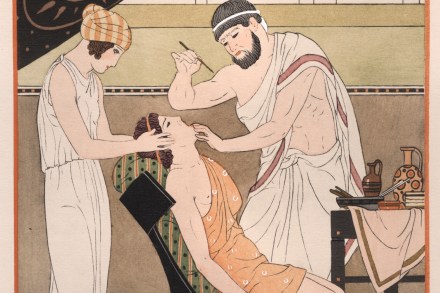
Ancient Greek thinkers tried to explain every natural phenomenon in human terms, without reference to magic or gods. That was a major intellectual revolution. Greek doctors’ contribution was to invent what has been called ‘rational’ medicine, embedding a principle of the highest importance, however hopeless its premise: which was that the health of the human

How Aesop’s fables apply to today’s politics

From our UK edition

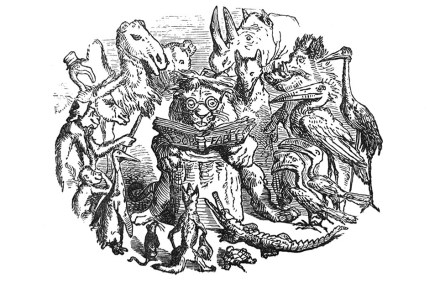
Aesop’s animal fables, as Robin Waterfield points out in his new translation, were certainly not written for children: the animals are ‘brutal, cunning, predatory, treacherous, and ruthless’, despising the weak and mocking people’s misfortunes. The ancients regularly used them against political opponents. Plenty could be so used today. Gnat, who had settled on Bull’s horn,

Anger management, ancient Greek-style

From our UK edition

A professor of neurophysiology has announced that anger is a good thing with a ‘very useful purpose’, unless it turns to aggression. Top thinking, prof! The first word of western literature is the ‘rage’ of Achilles, which Homer tells us was ‘murderous’ and brought endless grief to the Greeks. What? Come again, Homer old boy,

There was more to real-life gladiators than fighting

From our UK edition

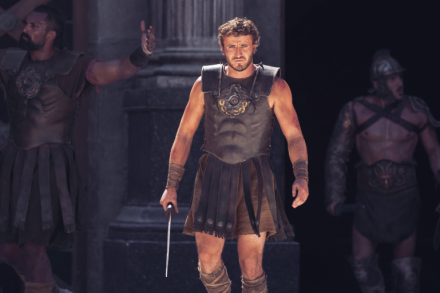
Many commentators have criticised the film Gladiator II on technical aspects of the fighting. But there was so much more to gladiators than that. The gladiator troupes, mostly criminals or enslaved prisoners of war, were housed in cramped cells in secure barracks, made to swear an oath to ‘be burned by fire, bound in chains,

What Kemi Badenoch can learn from her enemies

From our UK edition

Kemi Badenoch, in an act of unusual awareness for an MP, intends to learn from her own party’s mistakes as well as Labour’s. She must have been reading the Greek statesman Plutarch’s ‘How to profit from your enemies’, one of his 78 essays and dialogues on a wide range of topics, from the intelligence of

The Russell Brand of ancient Greece

From our UK edition

The ‘lifestyle guru’ Russell Brand is now under police investigation and (in desperation?) has taken to hawking magic amulets. Still, it has to be better than his announcement that he had become a Christian. As the Greek satirist Lucian pointed out, such a move did little good for one such would-be ‘celeb’ (Latin celeber, ‘busy,

The ancient answer to the welfare state

From our UK edition

Such is the increasing cost of the welfare state that at some stage a government – never this one – is going to have the ask the question: ‘Welfare for whom, and what should it cover?’ There was no welfare state in the ancient world. But there was the elite 2 per cent, who owned

Boris Johnson is no Pericles

From our UK edition

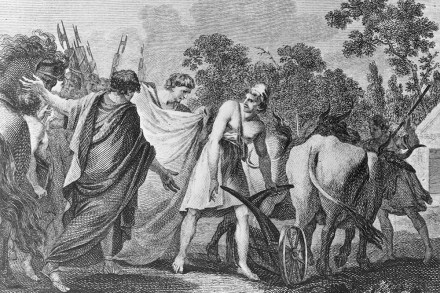
Boris Johnson’s Unleashed imagines him, like Cincinnatus, leaving his plough, saving Rome, and returning to it. But given that Boris is among the international elite, perhaps Alcibiades (c. 451-404 bc) would fit him better. Athenian elites had long had connections with the other power-brokers of the classical Greek world, Sparta and Persia. Born into such

Plutarch’s lessons for Labour

From our UK edition

The lives of those daily in the public eye are bound to attract attention, especially when they are politicians telling us what to do. The Greek essayist Plutarch (d. c. ad 120) wrote at length on this topic. How does Labour match up to his ancient ideals? A politician’s aim, Plutarch said, was to win