Peter Jones

It’s time to settle the Great Omicron Question

From our UK edition

Time to settle the Great Omicron Question. First, there is no word omikron (and no c) in ancient Greek. Second, the classical Greek (5th-4th centuries BC) name for omicron was an accented ou. In the 2nd century AD it was replaced by the name o mikron (‘little/short o’), when Greece was under Roman rule. So how did Greeks pronounce o mikron? The little o was pronounced short, as in ‘lot’. The letter i (iôta, whence our ‘jot’) was pronounced either long (as in ‘purine’) or short (as in ‘tin’). In the case of mikron, it was pronounced long. The r was lightly trilled. Finally, the last o was stressed. So o mikron was pronounced ‘o meekrrón’. So much for replicating ancient Greek.

Is Latin worth learning?

From our UK edition

A teacher wanting to teach Latin has enquired whether it is worth doing because the subject has ‘such a bad reputation’. As ever with such assertions, it is always wise to ask, ‘In whose eyes?’ The bizarre fact is that, both here and in the United States, the answer is in those of a certain type of academic, for a very specific reason. Dan-el Padilla Peralta, for example, a professor at Princeton University, wants classics to disappear because it has been used for 2,000 years as a justification for slavery, colonialism and fascism. But what ‘authoritative’ human (Plato) or text (the Bible) has not been used to justify something that some nutter has dreamed up?

The ancients would have approved of Durham’s prostitute plans

From our UK edition

The ‘globally outstanding’ University of Durham has plans to help its undergraduates who pay their way by prostituting themselves. Three heavyweight ancients, all from different perspectives, might have rather approved of the scheme. St Augustine, looking at the world as it was, regretted his conclusion but decided that if prostitutes were banned, society ‘would be reduced to chaos through unsatisfied lust’.

Greta and the gap between words and actions

From our UK edition

Greta Thunberg and her supporters were loud in protest at COP26, but one wonders to what end. They demanded deeds, not words, but words were all they had to offer, except when they were so devoutly letting down the tyres of SUVs. Ancient Greeks were extremely interested in the distinction between word (logos, cf. our ‘-logy’) and deed (ergon, cf. our ‘energy’). In one branch of usage, logos was seen in opposition to ergon. The distinction was that logos was merely verbal and therefore a potentially deceptive representation of reality, while ergon was the real thing, reality itself, a fact.

Could Cicero help MPs who can’t govern?

From our UK edition

MPs are not exactly attracting plaudits for their recent attempts at governing. Perhaps Cicero’s three-book work On Duties (De Officiis) might be of assistance. It was written in 44 BC, a few months after the tyrant Julius Caesar was assassinated. Seeing life as a complex of obligations to others and oneself, Cicero picks apart the challenges this raises. Book III is of particular interest, where he tackles the problem of how to resolve a situation in which there is a clash between what is advantageous and what is right. He is not looking for the perfect solution, he says — no one is perfect — but for a working solution that ‘comes within the range of our comprehension’ and is ‘relevant to all mankind’. His example is Caesar’s assassination.

Would the ancient Greeks have agreed that children are born evil?

From our UK edition

The ‘social mobility tsar’ Katharine Birbalsingh has suggested that children, born evil, ‘need to be taught right from wrong and then habituated into choosing good over evil’. The Twitter mob is equally certain that all children are born ‘good’, and it is their environment that spoils them. Ancient Greeks, ignorant of St Augustine, did not think that this was a simple either/or question but that moral capacity was determined in many different ways, depending on e.g. age, sex, status, intelligence, chance, fate (etc.) — and nature. Greeks thought the gods had little to say about the question, since myth did not suggest they were our moral superiors, though that did not stop gods intervening in a man’s life if they so chose.

The Globe, Plato and the corrupting force of art

From our UK edition

The Globe theatre’s project to ‘decolonise’ Shakespeare, as if that would make plays like The Tempest ‘acceptable’ to them and their audience, would have met with no approval at all from Plato (c. 425-348 BC). For him, all poetry and the arts were corrupt, and in his Republic, a discussion of how an ideal state should be constituted, he called for them all to be banned. Plato’s argument begins from exactly the same position as the Globe’s: that all art, but especially that which deals in words, has an educational effect. In other words, it instructs, whether it likes it or not (and Greeks did indeed argue that this was its effect, and even purpose).

Twitter has taken the place of the ancient curse-tablet

From our UK edition

Twitter and other easily accessible means of online communication have encouraged the public to believe that Their Voice Will Be Heard. When it isn’t, they express their frustration through abuse and threats or by blocking roads. In this way, the mentality of the ancient curse-tablet lives on. In the ancient world, the purpose of the curse was to ‘bind’ the person you disliked — i.e. frustrate them from achieving the end they wanted and you did not. It was written on a thin lead plate, rolled up tight, sometimes twisted (to ‘hobble’ the victim) and pinned (to constrain him), then placed into the tomb of someone who had died before their time.

Aristotle’s account of hatred perfectly fits Sussex University students

From our UK edition

Professor Kathleen Stock of Sussex University is accused by a group of students of being transphobic and a danger to transgender people because she believes that people cannot change their biological sex. ‘We’re not up for debate,’ the students said. ‘We cannot be reasoned out of existence.’ This, in Aristotle’s terms, is pure hatred. In his Art of Rhetoric, Aristotle tackled the emotions and made a most instructive distinction between hatred and anger. Anger (orgê), as he defined it, was ‘desire, accompanied by distress, for revenge because of an obvious but undeserved belittlement of oneself or those near to one’. If that is the case, he went on, the angry man must ‘always be angry with a particular person’.

What James Bond and Aristophanes have in common

From our UK edition

So James Bond is back, doing exactly what he always does, inviting the audience into a fantasy world for the pleasure of wondering ‘What if?’ In this respect, Bond films resemble the work of the world’s first recorded comic poet, the Athenian Aristophanes (c. 440-380 bc). His premise was that Athens’s problems could be solved only by little people of no importance, not the greedy, vain and incompetent leaders in the public eye. So the scene was set for the hero(ine) to put them firmly in their place. One favourite subject for his comic fantasies was the long war between Athens and Sparta (431-404 bc). Take three examples. In 421 bc Aristophanes sent a farmer Trygaeus up to heaven on a dung-beetle to find Peace and restore her to earth.

How the ancients handled refugees

From our UK edition

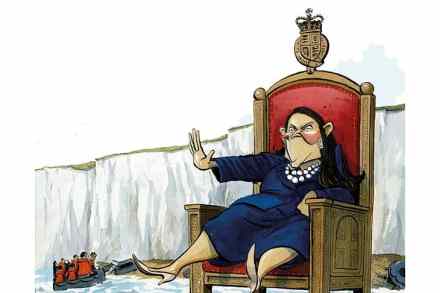
Hardly a day goes by without headlines about immigrants, asylum-seekers and refugees. In the ancient world, movements of people were also very common (state boundaries did not exist), often because war, famine or exile left them with no option. So how did refugees try to win acceptance? In Homer’s world of heroes (c. 700 bc), a man indicated he was harmless by kneeling before his (proposed) helper, perhaps touching the knee, and appealing for aid in the name of Zeus, god of suppliants. He expected a welcome into the household as a guest, and becoming part of that household, or being helped on his way. When Athens was a democratic city state (c.

The ancients knew politicians were powerless

From our UK edition

Why are cabinet ministers Liz Truss and Dominic Raab squabbling like children over access to grace-and-favour Chevening? Because they know they are, ultimately, powerless. The Greek statesman Solon (c. 590 bc) made the point long ago: ‘Those who have influence with monarchs are like pebbles used in calculations: for [depending on their place on the board] they can one moment represent a very large number, the next a very small one. So a monarch treats each of his advisers now as important and famous, now as valueless.’ Result: they seek to inflate their self-importance — while they can. No one understood that better than the Stoic philosopher Epictetus (d. ad 135).

Could Emma Raducanu be the new Marcus Rashford?

From our UK edition

The extraordinary sporting achievement of Emma Raducanu and the response it has received from royalty and politicians alike makes one wonder whether she, too, might start to encourage popular initiatives of the sort Marcus Rashford supports. Roman elites were keen to use such figures in the public eye to keep the people happy. Romans were a rough and ready lot and used rough and ready tactics when it came to drawing the attention of the elites to their concerns, e.g. food shortages. A street riot was one way of getting through to the bosses, and plenty of street leaders were happy to organise them.

Why trees mattered to the ancients

From our UK edition

A ‘State of the World’ report warns that a third of the world’s wild tree species are threatened with extinction. Agriculture and logging are the main culprits. They were in the ancient world too. It is hard to overestimate the importance of trees for past societies: they were the only source of fuel for heating, cooking, potting, including tiles and bricks, and smelting (coal came into play only from the 16th century), and of timber for building. The emergence of palace states and the growth of trade during the Bronze Age from c. 3000 bc — bronze, made by smelting tin and copper, was far more durable than copper — increased its use dramatically.

How the ancients showed their true colours

From our UK edition

In the 18th century, art historians’ admiration for the beauty of white-ish ancient Greek marble statuary led people to draw conclusions, on the back of their belief in classical ‘authority’, about white superiority. This, we are told, turned many classicists into racists. Today some members of the Cambridge Classics Faculty feel the white-ish plaster-cast replicas of those statues in their museum ‘entrench[es] racism’ in the same way. Their proposal is to put up a notice about it. Wow. Go, Cambridge! That’ll show those racists! And surely those still disgustingly white originals all over the world need notices as well. Two things need to be said.

The Romans would not have made the same mistakes in Afghanistan

From our UK edition

‘No one is stupid enough to choose war over peace. In peace sons bury their fathers; in war, fathers bury their sons,’ said Croesus to his conqueror, Cyrus of Persia, according to Herodotus. But actually man’s stupidity has lasted thousands of years, and one rather doubts whether the fanatical Taliban will buck that doleful trend. Romans were proud of their pax Romana, but it had been won in blood, over centuries, as they were well aware. ‘Who wishes for peace, let him prepare for war,’ said Vegetius. ‘Peace was secured by victories,’ boasted Augustus; Virgil talked of Rome ‘imposing the practice of peace’. Tacitus made the Caledonian leader Calgacus remark that Romans ‘make a desert and call it peace’.

The ancient Athenians knew how to soak the rich

From our UK edition

Oxfam is arguing that if all billionaires forked out 99 per cent of their profits made during the Covid pandemic, the whole world could be vaccinated and every unemployed worker given a handy payout. Dream on. The ancient Athenians had rather more intelligent ways of soaking the rich. They raised annual taxes only for specific, stated ends (‘hypothecation’). These were funded by the 300 richest property-owners. A typical wealth-level was four talents (2,400 drachmas; an average wage was about 350 a year) and around 100 events a year needed to be covered. The tax was called a leitourgia (literally ‘work for the public’) from which we get our ‘liturgy’.

The timeless appeal of Latin

From our UK edition

The government’s promise to fund a pilot scheme promoting the teaching of Latin in secondary schools is music to the ears of the charity Classics for All, which has introduced classical subjects into more than 1,000 state schools. Latin has been taken up with especial enthusiasm in primary schools, where word derivations have proved very popular. The ancients loved them too. The Roman Varro (116-27 bc) wrote a 25-volume de lingua Latina (‘On the Latin Language’). Six survive, three discussing etymology, all full of interest because Varro, ignorant of scientific etymology (it developed only from the 17th century onwards), produced total nonsense.

The Cambridge Greek Lexicon is an eye-opener for classical scholars

From our UK edition

The great Latinist D.R. Shackleton Bailey was once said to have been pinned into a corner at a party and ordered to reveal what he actually did. ‘I just look things up all day,’ came the tetchy reply. That will ring a loud bell with those who learned ancient Greek or Latin at school, especially when it came to looking up the meaning of a word in LSJ, Oxford’s big Greek-English dictionary, or rather lexicon (Greek lexikos, ‘of or for words’). It was named after the initials of its two original editors (Henry) Liddell and (Robert) Scott, and a later revising editor (Henry Stuart) Jones, and was so full of Greek that it took about a day to find the meaning you were actually looking for.

Simone Biles, Plutarch and an Olympic trial

From our UK edition

The outstanding gymnast Simone Biles has pulled out of several Olympic events, saying: ‘I just don’t trust myself as much any more.’ Many took the view that this was a fashionable ‘mental health’ issue. Ancient Greeks might have come up with a rather different analysis. Plutarch (c. ad 100) is said to have been the author of a letter of condolence to one Apollonius whose son had just died. In it he considered how best one should react to loss in the context of the whole field of human suffering, which Greeks regarded as the common lot of all mankind. For example, Achilles in the Iliad claimed that Zeus possessed two storage-jars, one filled with evil, the other with blessings. A man could be served from the jar of evil alone, or from a mixture of both.