Peter Hoskin

What will the UK’s proposed ECHR reforms actually come to?

From our UK edition

Two items of news that may unsettle stomachs in Euroland today: i) that Ireland is planning to hold a referendum on the new European fiscal treaty, and ii) that the UK is pushing — as April's European summit in Brighton approaches — for the European Convention on Human Rights to be rewritten so that national courts have greater discretion and power. The BBC's James Landale has more details on the latter here, but the basic point is that the government has circulated a ‘position paper’ that proposes injecting a few principles and particulars into the ECHR. One of these is ‘subsidiarity’, the idea that decisions should be made at the lowest level possible.
A tax battle that the government won’t be able to avoid

From our UK edition

The government is very pleased with itself today for closing a couple of tax loopholes such that Barclays will have to pay £500 million more to the Exchequer. And little wonder why. Not only does it support their rhetoric about a ‘tougher approach’ to tax avoidance, but — on the principle that ‘every little helps’ — it also hammers another few chips from the deficit. Broadly speaking, this sort of action is uncontroversial. In the battle of wits over taxation, the government is well within its legal rights to close loopholes, just as companies are well within theirs to exploit them.

Osborne faces the fire over fuel duty

From our UK edition

Will fuel ever stop being a cause of political discontent? It was the fuel protests of 2000 that first tarnished Blair's electoral allure, according to some of the advisors who were around him at the time. It was a question about petrol prices that provided Gordon Brown with one of the most awkward moments of his premiership. And it was the same issue that punctuated the build-up to George Osborne's Budget and Autumn Statement last year, and now to next month's Budget too. The Mail, the Sun, Tory backbenchers and others are once again lobbying the Chancellor to act. Of course, there are clear reasons why fuel is always such a hot topic.

Europe’s latest tonic could worsen Osborne’s political problems

From our UK edition

Seems that the latest plan to fix the eurozone involves cooking up a pot of alphabet soup. Over in Mexico, G20 finance ministers are currently discussing whether to blend two existing eurozone bailout funds, the EFSF and the ESM, with some extra money from the IMF. They hope that this EFSF-ESM-IMF mix will add up to about £1.25 trillion of ready cash for failing eurozone economies. ‘Look at the size of our fund,’ they will then say, as they try to settle nerves across Europe and beyond. Details are lacking, but some things are already worth noting about this potential mega fund. First is that it seems to be coming about with permission from Germany.

The ruckus over Lords reform

From our UK edition

Both the Tory and Lib Dem manifestoes promised to reform the House of Lords, as did the Coalition Agreement, but the gulf in enthusiasm between the two parties is enormous. For many Lib Dems, this is of course — as Nick Clegg put it in December — ‘one boat that urgently needs rocking’. For many Tories, it is something to be ambivalent about, or to oppose. Which is why the politics around the ongoing Lords Reform Bill are likely to be so fraught. James has already written of how there are ‘more than 81 [Conservative] MPs prepared to vote against it.

Willetts tries to dampen the flames around Ebdon

From our UK edition

Siphoning the contents of two brains through one mouth and on to a single page will generally produce eclectic results. And that's certainly the case with David Willetts' interview with the Times (£) this morning. The universities minister manages to range across subjects that include Robert Falcon Scott, climate change, the Falklands and universities access. He even reheats one of his old theories about Feminism and social mobility in a way that (coupled with the interview's headline: ‘Moving on and up is very hard — and feminism is partly to blame’) makes it sound far more provocative than I think it's meant to be, and much weaker for it.

Rumble in the Commons

From our UK edition

From the Sun: ‘A LABOUR MP was arrested late last night for assault after allegedly headbutting a Tory rival in a House of Commons bar. Witnesses allege Eric Joyce, 51, launched an unprovoked attack on Stuart Andrew, 40. It is claimed Joyce, MP for Falkirk, had to be held back by several Labour colleagues. A source said: “Stuart was given a Glasgow kiss.”’ Read the full report here. UPDATE: Joyce has been suspended by the Labour Party. The Standard's Joe Murphy has a particularly detailed account of it all here.

Murphy launches Labour’s defence review

From our UK edition

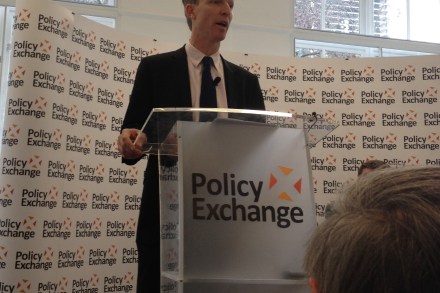
Remember when Jim Murphy spoke about defence cuts last month? It was not only a smart refinement of Labour's fiscal position, but also a preview for the defence review that they're conducting as an alternative to the government's SDSR. Well, that review was officially launched this morning, and I was in the audience on reporting duty. Here's a quartet of quick observations that I bashed out on my phone: 1) Cuts, cuts, cuts. There was, it is true, a greater emphasis on the ‘constrained fiscal circumstances’ in Murphy's opening remarks than there is the consultation paper that Labour released today. But that emphasis was still striking in itself.

When failure actually counts as success

From our UK edition

Michael Gove's latest prognosis for schools was delivered at a lunch in Westminster yesterday, but it's important enough to repeat the morning after. The Independent has a full report here, but the key quotation is this: ’Education is like trying to run up a down escalator. There are some uncomfortable decisions that will have to be taken. There will be years when, because we are going to make exams tougher, the number of people passing will fall. There are headteachers who have been peddling the wrong sort of approach to teaching for too long, who are going to lose their jobs.’ Just read that bit again: ‘the number of people passing will fall’. It's a deeply encouraging admission by Gove, and one that he ought to repeat frequently.

Nick Clegg’s NHS squeeze continues

From our UK edition

As I said last week, Nick Clegg is in a tricky position when it comes to this Health Bill. Thanks to the concessions that he secured and welcomed last year, he can't now just slander it outright. But thanks to the concerns of his own party, he will also be reluctant to endorse it in full. The result is the sort of ambiguous performance that the Deputy Prime Minister put in on ITV's Daybreak show this morning. He did get stuck into Labour for their ‘outrageous’ misrepresentation of the reforms. But when it came to actually supporting the Bill, it seemed to me that he used generalisations — such as, ‘I am behind reforming the NHS to improve care for patients’ — that could permit a slight change of heart about the specifics in future.

IDS defends his work scheme — but he may have to change it

From our UK edition

Articles by politicians are often flat and passionless. Not so Iain Duncan Smith's effort for the Daily Mail today. The welfare secretary sets about defending the government's Work Experience scheme for unemployed young people, but it soon turns into a full-blooded attack on its detractors. ‘I doubt I’m the only person who thinks supermarket shelf-stackers add more value to our society than many of those “job snobs” who are busy pontificating about the Government’s employment policies,’ he bristles, ‘They should learn to value work and not sneer at it.

Greece saved at last? Nope…

From our UK edition

Greece sorta defaulted last night. That's what you need to remember when reading of Greek Prime Minister Lucas Papademos's ‘happiness’ at the €130 billion deal reached by eurozone finance ministers in the early hours. Sure, the country will now be able to pay off its creditors when various loans mature on 20 March. But the concurrent ‘voluntary’ haircut of 53.5 per cent for private bondholders will still be seen as a ‘restricted default’ by credit rating agencies. And it could feasibly get worse if those private bondholders decide not to play along and instead trigger a credit event, either manageable or messy.

Miliband guarantees a return to Brown’s Big Idea for the NHS

From our UK edition

It would be so much easier for Ed Miliband to attract headlines if he could shout in Andrew Lansley's face. As it is, the Labour leader has had to make do with giving a speech today attacking the NHS reforms. Within the parameters of what he might say, it's an okay effort. The predictable lines about ‘creeping privatisation’ are leavened by the admission that ‘the question is not reform or no reform. It is what type of reform.’ And he adds, by way of a cross-party sweetener, that he would ‘get round the table’ with David Cameron to discuss ‘the future of the NHS’. But the substance of the speech, rather than its rhetoric, is a little more questionable.

A question of trust for Andrew Lansley

From our UK edition

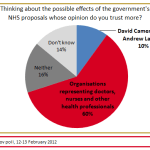
It's not too surprising that people trust ‘organisations representing doctors nurses and other health professionals,’ well above David Cameron and Andrew Lansley, when it comes to the NHS reforms. People are sceptical of politicians in a way that they aren't of the health service, its unions and its workers. 64 years of ‘national religion’ status for the NHS, and many more years of gross political let-down, have made sure of that. But today's YouGov findings still shine a fresh light on Cameron and Lansley's changing approach to the reforms.

If Cameron doesn’t talk about greater powers for England, Labour will

From our UK edition

Action over Scotland is certainly producing a reaction in England. It's not what you'd call an ‘equal and opposite reaction’ yet, but it's there — and it's crystallised by Tim Montgomerie's article for the Guardian this morning. I'd recommend that you read it in full, but Tim's basic point is that David Cameron could score a ‘triple crown of political victories’ by moving towards a more federal UK: ‘By offering to extend Scottish devolution he can be the Conservative leader who saves the union. By promising to balance Scottish devolution with a commitment to new arrangements for the government of England, he can radically improve his own party's electoral prospects.

A silent revival

From our UK edition

Peter Hoskin says that thanks to the DVD and advances in film restoration there has never been a better time for movie fans Whatever happened to silent cinema? Oh, yes, that’s right, it was supplanted by the talkies in the late Twenties and early Thirties, until it suddenly came back to life in time for the Academy Awards next week. Never since the first Oscars were handed over in 1929 has a silent film looked more likely to win the Best Picture statuette. And even if The Artist doesn’t achieve what every bookie expects it to, then there’s always Martin Scorsese’s Hugo; not itself a silent film but — perhaps a first for a 3D kids’ film — it does revolve around the work of the early cinematic pioneer Georges Méliès.

L’entente nucléaire

From our UK edition

There's no wound that a press conference won't heal, or at least that's the impression that David Cameron and Nicolas Sarkozy created earlier. The pair played down the tensions and grudging handshakes of the past few months to talk up Britain and France's ‘incredibly strong relationship based on shared interests’. And there was more than just talk too: they announced a £500 million deal between French and British companies for nuclear power plants. And they hailed progress towards the creation of a joint ‘command and control centre’ for military operations.

Miliband’s NHS pledge

From our UK edition

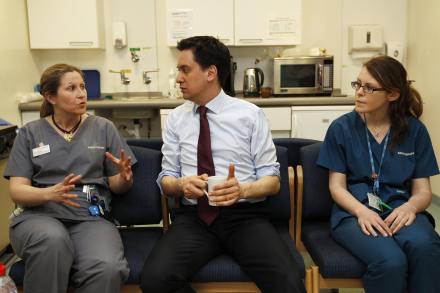
Ah, there he is! With the coalition — and David Cameron — dominating the political news on every day of this half-term week, Ed Miliband has finally caused a ripple in the national consciousness. He's appearing before nurses in Bolton today to make a pledge: ‘Before he became Prime Minister, David Cameron concealed his plans for creeping privatisation of our National Health Service. So people didn’t get a vote on these plans at the last election. But I give you my word that if he goes ahead, they will be a defining issue at the next.’ Put aside the rhetoric about ‘creeping privatisation’ (which would surely make Tony Blair shudder), and it's understandable why Miliband is stressing this point.

Cameron’s new offer for Scotland could mean a new offer for England

From our UK edition

The consensus opinion across most of today's papers appears to be that Dave done good in Scotland yesterday. And now the Prime Minister's cause has been helped that little bit more by the Lords Constitution Committee. ‘We are firmly of the view that any referendum that is held must be a straight choice between full independence or the status-quo,’ says the committee's chairman Baroness Jay. ‘A third “devolution-max” option is clearly something every part of the UK must have a say in as it has the potential to create different and competing tax regimes within the UK.’ The strange thing is, a UK-wide referendum on ‘devo max’ could actually produce the sort of result that Alex Salmond would want.