Peter Hoskin

Why David Miliband’s article matters

From our UK edition

The most curious thing about David Miliband's article for the latest New Statesman — which is causing quite a stir this morning — is that it should appear now. After all, the Roy Hattersley essay that it purports to be responding to was published, so far as I can tell, last September. That's five months ago. Which is fine, if it's really taken MiliMajor that long to get around to it. But it certainly fuels the idea that he has chosen now, this moment, to make a political intervention — and Hattersley is just an excuse. And the intervention itself? Basically, Miliband warns against what he calls 'Reassurance Labour', a strain within the party that has cosy ideas about a big, centralised state and its capacity to do good.
Your six-point guide to the Green Budget

From our UK edition

As promised earlier, here's my more detailed supplementary take on today's IFS Green Budget. I've distilled it down into six points, but obviously there's much, much more in the actual document itself. I'd recommend that you read the chapters on public sector pensions and pay, the 50p rate, and child benefit, in particular, if you're so minded — as they're very good summaries of some complicated fiscal areas. Anyway, here are my points: 1) The scary graph. As it does every year, the IFS has produced what I call the ‘scary graph’. It shows what our debt/GDP ratio would look like for decades hence under various circumstances.

The view from the Institute for Fiscal Studies

From our UK edition

It's the halftime coffee break here at the launch of the Institute for Fiscal Studies' Green Budget, so I thought I'd send CoffeeHousers a quick update. But first, just to be clear, that's green meaning green, not green meaning environmental. This is the IFS's annual, different-hued version of the Treasury's Red Book. It's their overall take on the economy and public finances. So far, there has been little that will surprise or disconcert George Osborne as he prepares his own Budget: the picture is expectedly grim. As John Walker, chairman of Oxford Economics, put it in his warm-up routine on the general economy, 2011 was ‘disappointing’ and 2012 will be ‘another difficult year’.

<del>Sir</del> Fred Goodwin

From our UK edition

And so Fred Goodwin has lost his knighthood. Here's the Cabinet Office statement (and some of my previous thoughts here): 'It will soon be announced in the London Gazette that the Knighthood conferred upon Fred Goodwin as a Knight Bachelor has been cancelled and annulled. This decision, not normally publicised in advance, was taken on the advice of the Forfeiture Committee, which advised that Fred Goodwin had brought the honours system in to disrepute. The scale and severity of the impact of his actions as CEO of RBS made this an exceptional case.

Cameron cheered by the Lib Dems, spared by the Tories, mocked by Labour

From our UK edition

If you wanted proof that Cameron has softened his stance towards Europe since the hard chill of December, then just look to the Lib Dems. Nick Clegg, unlike then, was sat next to the Prime Minister as he gave his statement to the Commons this afternoon. And the questions that followed from the likes of Menzies Campbell and Simon Hughes were generally warm and approving. Campbell started by, in his words, ‘praising the pragmatism of the PM’. Hughes celebrated a ‘more successful and satisfactory summit than the one in December’. That praise, while friendly enough, creates obvious problems for Cameron — and it was those problems that Ed Miliband sought to exploit in his questions to the PM.

Miliband the eurosceptic? Not yet

From our UK edition

Ed Miliband is not naturally a eurospectic, but he certainly sounded like one during his appearance on ITV's Daybreak show earlier. ‘I'm very concerned about what David Cameron has done,’ he said in reference to the PM's equivocation over Europe yesterday. ‘He's sold us down the river.’ Whether this is Miliband committing towards the sort of euroscepticism that is being urged on him by some of his colleagues, it's too early to say. It's only words, after all. But my guess is that — just as when Miliband attacked Cameron for not signing up to the latest treaty, but couldn't say whether he'd have signed it himself — this is more him trying to have his cake and eat it.

Cameron softens his stance on Europe — but who benefits?

From our UK edition

‘We will insist that the EU institutions — the court, the commission — that they work for all 27 nations of the EU.’ So said David Cameron, back in December, suggesting that he'd block Europe's ‘fiscal compact’ countries from using EU-wide institutions to enforce their, er, fiscal compact. But now this component of his ‘veto’ appears to have come to naught, and that veto is looking all the thinner for it. On the Today Programme this morning, William Hague confirmed that Britain wouldn't block the use of EU institutions, such as the court, for the fiscal union. ‘We're not intending to take action about that now,’ is how he put it rather resignedly.

Greece is still the word ahead of today’s eurosummit

From our UK edition

How about this for a claim by Nicolas Sarkozy, made in a TV appearance yesterday? ‘Europe is no longer at the edge of the cliff.’ It's quite some statement, so let's hear it again: ‘Europe is no longer at the edge of the cliff.’ Of course, Sarkozy has reasons for saying it beyond mere pre-electoral braggadocio: the rates paid on Italian and Spanish 10-year bonds have generally been falling since the the beginning of the year; the euro has been making some tentative progress against other currencies; and so on. But it still constrasts heavily with much else that is being said around the eurozone. Only last week, Angela Merkel was talking of the overall failure to ‘stabilise the situation’ in Greece.

The government’s Hester problem intensifies

From our UK edition

First there was Fred Goodwin, now there's Stephen Hester. The chief executive of RBS is fast becoming the bête noire of the British banking system, thanks to his roughly £1 million share bonus which, we learn in the Sunday Times (£) this morning, may be topped up with an extra £8 million over the next few years. Little wonder that Iain Duncan Smith admitted on the Marr show earlier that there may be a severe public backlash, and that the government could suffer from it. He suggested that it would be better, for all concerned, were Hester just to forego the million. It's one of those debates where it's easy to see and understand both sides of the argument.

Miliband hopes to put a cap on his welfare policy problems

From our UK edition

A-ha! Labour have hit on a line on the benefits cap, and Liam Byrne is peddling it in the Daily Telegraph this morning. ‘Now, there are some people who are against this idea altogether,’ he writes, ‘Neither I, nor Ed Miliband are among them.’ The way he sees it, he goes on to explain, is that there should be a cap but it should be set locally, so that it could be higher than £26,000 in more expensive areas such as London, and potentially less in other areas. Bryne adds that there should be an ‘an independent body like the Low Pay Commission to determine the level at which it is set for different area.’ The Times has a useful article (£) by Roland Watson and Michael Savage, tucked away on p.

Transparency marches on

From our UK edition

It has been quite a few days for transparency in Westminster. First, Ben Gummer's ten minute rule bill for tax transparency — which would see every taxpayer in the country receive a statement detailing what they owe and what the money's being spent on — earned itself a second reading in the House. And now, today, the Department for Education releases its new ‘performance tables’ for secondary schools. You can sift through them here, and I'd recommend you spend at least a couple of minutes doing just that.

Dave in Davos

From our UK edition

https://www.youtube.com/watch?v=iWDdpmS89LQ Reading Cameron's speech to the suits in Davos, one thing stands out: he's in no mood to stop ‘lecturing’ the eurozone, as Nicolas Sarkozy would put it. The whole thing is saturated with firm advice for our European brethren, from generalities such as ‘Tinkering here and there and hoping we’ll drift to a solution simply won’t cut it any more,’ to specific policies that the Continent should introduce so that it can ‘recover its dynamism’. He even found space to attack the ‘madness’ of a Tobin tax, as well as to hawk the coalition's deficit-reduction plan. It's the sort of advice that could, of course, put Cameron further at odds with his fellow European leaders.

‘We choose to go to the moon in this decade…’

From our UK edition

Newt channels JFK, sorta, in Florida last night: Although, sadly for moon colonists (and Jurassic Park enthusiasts), Romney has now pulled level with Gingrich in most of the Florida polling — and is now, slightly, the favourite to take next week's primary.

A Lib Dem demand that the Tories should get behind

From our UK edition

Remember those Lib Dem calls for a mansion tax at the weekend? I said at the time that, ‘the Lib Dems appear to be drawing more attention to which of their own policies they are fighting for within government, whether those policies make it to the statute books or not.’ Well, now they're at it again. Nick Clegg is giving a speech this morning in which he'll urge George Osborne to go ‘further and faster’ in raising the income tax threshold to £10,000 a year. It was the stand-out policy of the Lib Dem manifesto, so it's hardly controversial that Clegg should want to see it enacted ASAP. But it's still striking that he's making this appeal in public. A year ago, he'd have emphasised what the coalition was already doing to raise the threshhold.

Bad news doesn’t have to be surprising

From our UK edition

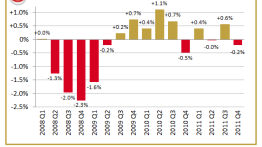
I'm still of the mind that Westminster fusses too much about these quarterly growth figures, particularly when parts of the country have been in economic decline for decades. But there's no doubting that they have the capacity to shift the political mood, both here and around the country. There is something disheartening about the idea that the economy returned to shrinkage in the final quarter of last year (even if today's preliminary figure of -0.2 per cent might be revised upwards, or downwards, in due course). You can expect Ed Miliband to make much of it in this afternoon's PMQs. The politics of the situation are not stacked entirely against George Osborne, though. His major consolation today is that everyone expected this sort of minor contraction.

Obama delivers his pitch for a second term

From our UK edition

A Romney-seeking missile. That was what much of Barack Obama's State of the Union Address amounted to last night. He didn't mention the Republican presidential challenger by name, of course. That would have been too obvious. But he did dwell on those sorts of issues around taxation and jobs — including his ‘Buffett Rule’, by which, we learn, millionaires should pay at least a 30 per cent tax rate — that have been causing Romney trouble. To underline the point that ‘a billionaire [should] pay at least as much as his secretary in taxes’, Warren Buffett's secretary was even among the Obamas' guests for the evening. Obama's ploy, when presenting all this, was to be upfront about his own privilege.

Cable teaches Umunna a lesson about the past

From our UK edition

If you were in a particularly soggy mood, you'd almost feel sorry for Chuka Umunna. He'd managed to force Vince Cable into the House this afternoon, to announce the coalition's plans for curbing executive pay a day earlier than planned, and he must have been feeling pretty swell about it. This was, on paper, the initiative seized; a chance to prise open the Business Secretary's differences with his Tory colleagues. But, in practice, it was something completely different. In practice, Cable dispatched his opponent with ruthless ease. You might even have found yourself in the unthinkable position of cheering him on. A large part of it was Umunna's petty, needling set of questions.

Lib-Dem-a-rama

From our UK edition

There are Lib Dems everywhere today, CoffeeHousers, and they're differentiating like crazy. We had Nick Clegg himself on the Andrew Marr show earlier, waxing lukewarm about Boris Island, and there have been moments of assertiveness from his party colleagues as well. Here's a quick round-up: 1) Chris Huhne. The embattled energy minister hasn't taken to the airwaves today, but he is omnipresent nonetheless. A good portion of Clegg's Marr appearance was devoted to him, with the Deputy Prime Minister stressing that ‘he has been crystal clear that he denies any wrong doing’ — but not quashing the idea that Huhne would lose his job if those denials turn out to be false.