Paul Wood

Paul Wood was a BBC foreign correspondent for 25 years, in Belgrade, Athens, Cairo, Jerusalem, Kabul and Washington DC. He has won numerous awards, including two US Emmys for his coverage of the Syrian civil war

Colin Powell: A great man – and a failure

From our UK edition

My memory of Colin Powell feels personal, even though we were 6,000 miles apart at the time. I was in Baghdad, covering the invasion of Iraq for the BBC. Powell was giving the speech of his life at the UN Security Council, accompanied by Powerpoint, trying to convince the world that Iraq had weapons of mass destruction. I had just come from a press conference with senior Iraqi officials, who denied there were any WMDs in the country. They were shifty, oleaginous, terrified of Saddam. It wasn’t hard to believe they were lying and that dignified, decent Colin Powell, was right. ‘If Powell says so,’ I thought, ‘it’s probably true.

Douglas Murray, Paul Wood, Tanya Gold

From our UK edition

19 min listen

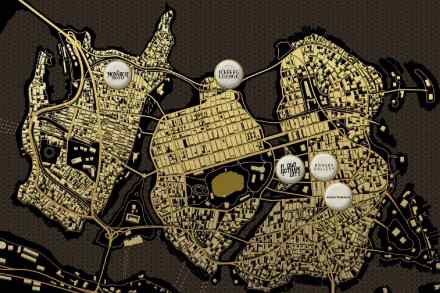
On this week's episode, we’ll hear Douglas Murray on how the pandemic has made cynics of us all. (00:50)Paul Wood on why after 10 years he and his family are leaving Lebanon. (08:02)And finally Tanya Gold gives her review of a Batman-themed restaurant.

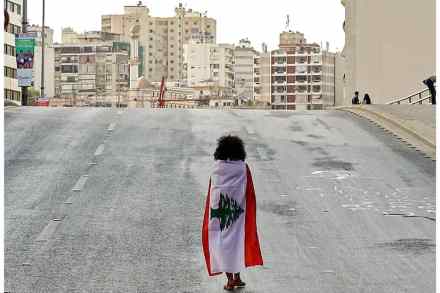
I’ve just watched Lebanon commit suicide – and it’s heartbreaking

From our UK edition

I’m sorry, Lebanon. We love you but we can’t take it anymore. We’re breaking up with you. My wife and I have lived in Lebanon, on and off, for almost ten years. Our retreat began in the summer when we couldn’t face going to the beach with our two-year-old daughter. Every year, Lebanese scientists publish a report saying that the seawater around many of the beaches is full of fecal bacteria. Raw sewage is discharged into the sea along Lebanon’s coast; from some beaches, you can actually see the pipe. Lebanon’s failure to do something as basic as treat its sewage is one result of its corrupt politics. The venality of the people in charge is visible all around. Drive out of Beirut and every green space has been built over.

How America squandered its moral authority in Iraq

Day by day, you could almost see America’s moral authority draining away in Iraq. The weapons of mass destruction that the US had invaded the country to find didn’t exist. And it sometimes seemed as if a monstrous trick had been played on American troops: they were promised a welcome with ‘flowers and sweets’; they got roadside bombs and suicide attacks. In 2004, a year after the invasion, a 19-year-old Marine — outside the US for the first time in his life — looked up at a minaret sounding the call to prayer and asked me: ‘What are they saying? “Kill Americans?

iraq

America abandoned this fight before the Afghans did

From our UK edition

39 min listen

On this week’s podcast:In the latest issue of The Spectator, we cover the Afghanistan issue extensively, looking at everything from why the West was doomed from the start, to how events in Afghanistan have transformed central Asian politics. On the podcast, journalist Paul Wood and our own deputy editor Freddy Gray, both of whom feature in this week’s issue, join Lara to talk Biden, Boris and the new 'progressive' Taliban. (00:37)'This is not your father's Taliban' - Paul WoodNext up, thousands of women whose menstrual cycles have been affected by the Covid vaccine have now come forward to make their symptoms known, including our host Lara Prendergast, who writes about her experience in this week's Spectator.

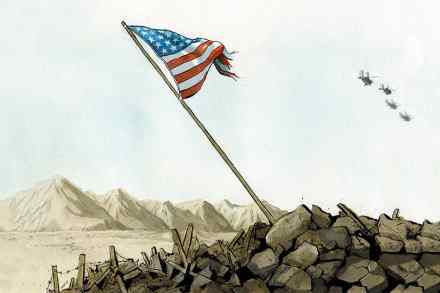
America abandoned this fight before the Afghans did

From our UK edition

The bravest woman I ever met was a schoolteacher in Afghanistan. She was a tiny figure in a black abaya and headscarf, but during the dark days of Taliban rule she had turned her home into a secret classroom for women and girls. Every lesson there was a victory against the odds. It was very difficult for her pupils even to leave their houses; usually they had to go out with a male relative. She would teach her class in whispers, everyone waiting for the sharp rap on the front door that would mean they had been discovered. When British soldiers arrived in her part of Afghanistan, Helmand Province in the south, she opened a proper school. On the day I visited, there were computer classes, paid for by the British taxpayer.

Will America rescue the mullahs?

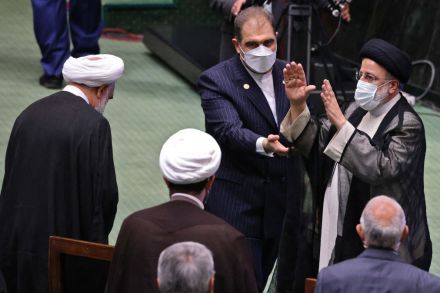
‘Death to Khamenei. Death to the dictator.’ Iran’s new president, Ebrahim Raisi, is sworn in today against a backdrop of protest, the sound of chanting echoing in his ears, whether literally or figuratively. The chants are often about the Supreme Leader, Ali Khamenei, but are also directed at the regime as a whole. ‘Clerics get lost’ is another favorite. Street demonstrations began three weeks ago in the province of Khuzestan but spread to many other places, including the capital, Tehran. People are angry about water shortages and the wretched, broken state of the economy. The question now is whether the protests will build and, if so, whether Raisi will live up to his terrifying reputation and crush them.

iran mullahs

Party time: what is the cost of freedom?

From our UK edition

34 min listen

How free are we after freedom day?(00:27) Also on the podcast: Why does it take hours to refuel your car in Lebanon?(10:19) and finally… Is British gardening wilting or blooming?(21:21) With The Spectator's economics editor Kate Andrews, Michael Kill, CEO of the Night Time Industries Association, journalists Paul Wood and Tala Ramadan, author James Bartholomew and gardener and writer Ursula Buchan.

The crisis in Lebanon is a warning for the West

From our UK edition

 Beirut On the highway into Beirut the other day, we drove past a petrol queue that was more than two miles long. On and on it went, the drivers sweating and swearing in brutal heat. Some had run out of fuel while they waited, having to push their cars when the queue inched forwards. There were people on laptops working from their cars during the day-long wait. Petrol queues are an everyday fact of life in Lebanon, but this was something else. Seeing that I was a foreigner, a frustrated driver gestured at the long line ahead of him and shouted: ‘Lebanon!’ He was summing up the fury and disgust felt by the Lebanese at what has happened to their country.

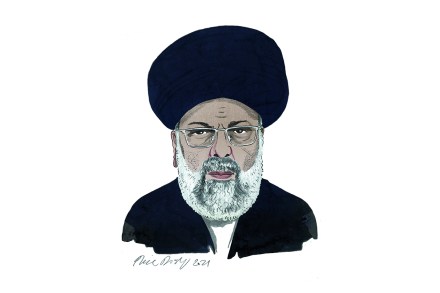
Iran’s president is a mass murderer

The US and other western countries are faced with a dilemma: how to bring to justice a man with the blood of thousands on his hands when you have to do business with him. Ebrahim Raisi’s path to the presidency of Iran is strewn with corpses. He comes to office this month already under American and European sanctions for the mass murder of prisoners in 1988. Some 5,000 may have been killed, though we can only guess at the true number of dead. It was a crime against humanity in the strict legal meaning of that term. At an earlier stage in his career, Raisi is said to have personally supervised the torture of dissidents, but in the 1988 case his responsibility was bureaucratic. He was a grim fanatic, eager to carry out orders. He was — and remains — Iran’s hanging judge.

raisi

Triumph of the Taleban: the unfolding disaster in Afghanistan

From our UK edition

There’s an apocryphal story, told and retold by journalists many times over the course of America’s longest war. A Taleban prisoner is sitting, relaxed, across the table from an American interrogator: ‘You may have all the watches,’ the prisoner says, ‘but we have all the time.’ Now, the Taleban’s patience is finally paying off. President Joe Biden has promised that the last US soldier will be out of Afghanistan by the heavily freighted date of 11 September. In fact, all the troops may be back on American soil by the even more symbolic date of 4 July. Other Nato soldiers — including a small British training mission — are hastily lowering their flags and scuttling out. They leave in their wake an unfolding disaster.

Should Khashoggi have been warned?

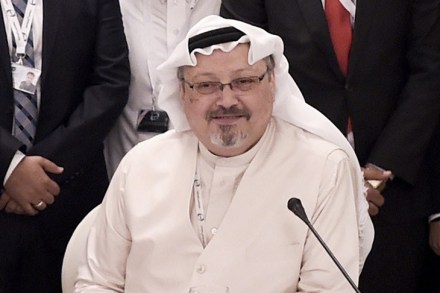
An executive in charge of a security company based in Arkansas has given the New York Times a document confirming that they trained four members of Saudi Arabia’s so-called Tiger Squad, responsible for murdering the dissident journalist Jamal Khashoggi. As has now been established by several different investigations, Khashoggi was lured to the Saudi consulate in Istanbul, injected with a drug — perhaps morphine — and suffocated with a plastic bag, his body then cut into pieces, apparently on the Saudi deputy consul’s desk. This latest information raises the question of what the US might have known about the Tiger Squad and its operations. Could the US intelligence agencies have warned Khashoggi not to go to Istanbul?

Jamal Khashoggi TIME person of the year
currency

What happens when your currency collapses?

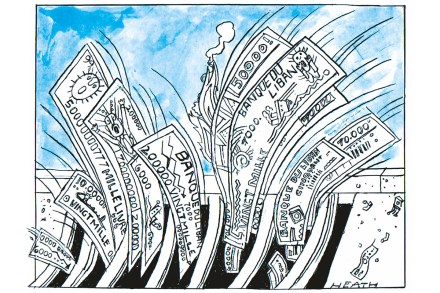
I’m a millionaire. A million in crisp, new bills is stacked up on the table in front of me. Unfortunately, it’s Lebanese lira and cost me about $75 a week ago. It’s already worth only $65, and by the time you read this, it will be worth even less. The Lebanese currency has lost more than 90 percent of its value over the past 18 months and is continuing its steady decline. It would be foolish to keep more than a few days’ spending money on hand, so everyone has a moneychanger. Mine is Mohammed, who pops round on his moped with ever-fatter stacks of notes with ever more zeros on them. The currency grows physically as it shrinks in value. He passes over a wad of cash and says, smiling: ‘Our leaders are stupid and corrupt.

Biden’s Saudi problem

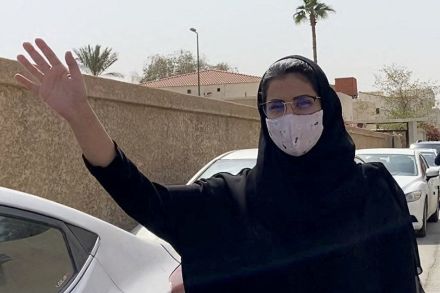
A few weeks ago, the Saudi human rights activist Loujain al-Hathloul was summoned to the offices of the General Directorate of Investigation at the Interior Ministry in Riyadh. Ostensibly, the Saudi secret police — the Mabahith — simply wanted to tell her that her appeal against her conviction for ‘treason and terrorism’ had been turned down. But her brother, Walid told me it was really a warning: Keep quiet, we’re watching you; the Americans may have got you out of prison; we can send you back whenever we want. She has been out of prison since February, serving the rest of her sentence on probation. Though aged 31, her long black hair is now streaked with gray, the outward sign perhaps of what her family say was an attempt to ‘break’ her in prison.

loujain al-hathloul

Is the worst yet to come in the Middle East?

From our UK edition

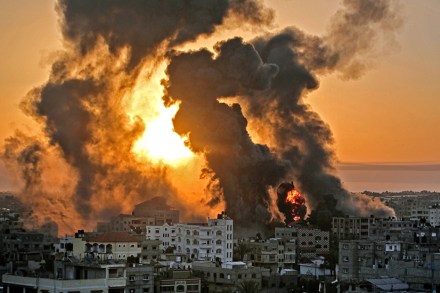
Beirut We can’t say yet if the latest fighting between Israel and Hamas is the start of ‘the big one’, a new Palestinian intifada, or uprising. That possibility was raised by the grandest of Middle East commentators, Thomas Friedman, in the New York Times. Friedman is sometimes mocked for his prognostications. A ‘Friedman’ is defined as six months because of his repeated statements that the ‘next six months’ would be critical for the US in Iraq, the light at the end of the tunnel visible only then. He also praised the ‘new ideas’ of Saudi Arabia’s ruler, Mohammed bin Salman, before it turned out that one of those new ideas was to dismember his critics with a bonesaw.

The mad world of David Icke

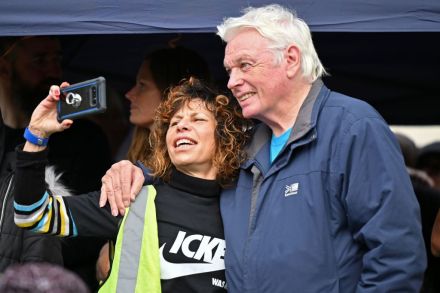
Americans might need reminding about David Icke. He was a British soccer player who went on to become a popular sports presenter for BBC television in the Eighties, and that’s how most people thought of him until he popped up on the Wogan talk show in 1991 and agreed that, yes, the reports were true: he was the Son of God. Icke appeared with a mullet haircut, a turquoise tracksuit — turquoise is ‘the frequency of love and wisdom’ — and the blank eyes of a madman. The world would end in 1997, he told the audience, who reacted with laughter. He replied that people had laughed at Jesus too. The laughter was liberating. The mockery of the small-minded lost its sting and he became a proto-Alex Jones, the TV conspiracy theorist host of Infowars, only with more mysticism.

david icke

Migrant smuggling is one of Lebanon’s last businesses

From our UK edition

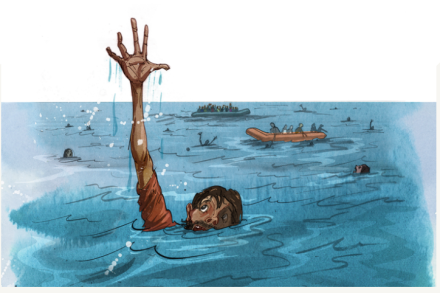
Ibrahim Lachine sold his mother’s furniture to pay for a place on a smuggler’s boat from Lebanon to Cyprus and left without saying goodbye. Stealing was, he admits, a bad thing to do, but the boat mafia wanted $700 (£500) and he couldn’t see any other way to get the money. He was 22 and hadn’t worked for three years. Food came from charities. Rent hadn’t been paid in months. Ibrahim leans back on a plastic chair, tall and angular in a black tracksuit and black running shoes. ‘We were very sad and very poor.’ Then he grins, a little embarrassed but mostly pleased with himself. He says he waited until one morning when his mother and his four sisters went out to visit a relative.

Isis’s weakness is now its strength

From our UK edition

As coronavirus swept the globe a year ago, Isis began issuing pronouncements. ‘God, by his will, sent a punishment to the tyrants of this time and their followers,’ said one such; ‘we are pleased about this punishment from God for you.’ With the world on lockdown, Isis followers were urged not to sit around at home but to ‘raid the places’ of the enemies of God. ‘Don’t let a single day pass without making their lives awful.’ The virus might have begun as God’s punishment to China for persecuting the Uighurs but, as one Isis video put it, the pandemic was a chance to attack Americans, Europeans, Australians and Canadians. For a moment, the jihadis toyed with the idea of sending infected volunteers to sicken the enemy.

What did Kushner know about Khashoggi?

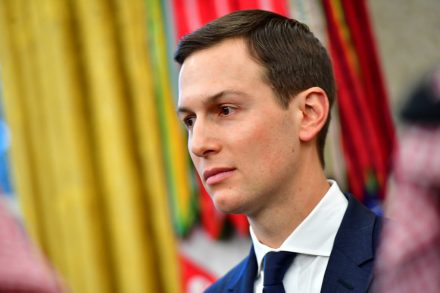
These are dangerous times for the Saudi crown prince, Mohammed bin Salman, and perhaps for Jared Kushner too. The Biden administration has released an intelligence report accusing MbS of ordering the killing of the Saudi dissident journalist Jamal Khashoggi in 2018. What does President Trump’s son-in-law have to do with this? Kushner went to Saudi Arabia in October 2017, staying up until 4 a.m. to ‘swap stories and plan strategy’ with MbS, as the Washington Post reported at the time. The following month, MbS began a crackdown, arresting and torturing enemies who included some of the richest and most powerful men in the Kingdom. Meanwhile, dissidents abroad were persuaded to come home, or — in some cases — simply kidnapped.

kushner

Stop the real steal

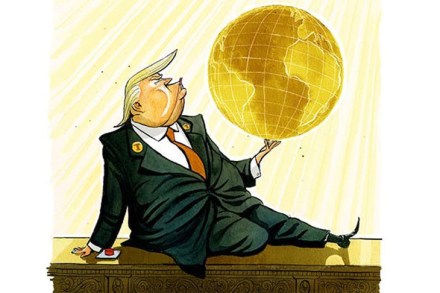
If you want to get rich, start a religion. L. Ron Hubbard said so and he should know. Failing that, start a political party. No one would take Donald Trump seriously as a religious figure (would they?), but it’s no surprise that the most grasping president ever to occupy the Oval Office has thought about forming his own political party, the ‘Patriot party’. Trump being Trump, he changed his mind almost immediately. Creating a new political party is hard work:there are lots of rules to follow, legal requirements that can’t be ignored if you’re going to get your big payday. The main one — perhaps most discouraging for Trump — is that the political party actually has to exist.

trump