Owen Matthews

Owen Matthews

Owen Matthews is an Associate Editor of The Spectator and the author of Overreach: The Inside Story of Putin’s war on Ukraine.

‘More than half our squad were executed’: Inside Russia’s rotten army

The Russians are on the warpath – and Europe is Vladimir Putin’s next target. That was Sir Keir Starmer’s alarming claim at the Munich Security Conference earlier this month. Britons ‘must be ready to fight, to do whatever it takes to protect our people, our values, and our way of life’, Starmer warned. Britain and Germany’s top military commanders delivered the same message in a recent article. Russia’s military posture ‘has shifted decisively westward’, wrote Air Chief Marshal Sir Richard Knighton and General Carsten Breuer. Soon the Kremlin ‘may be emboldened to extend its aggression beyond Ukraine’. Really? According to much western coverage in mainstream and social media, the Russian army is crumbling, corrupt and inept.

Is the war in Ukraine any closer to ending?

Is the latest round of Russia-Ukraine peace talks, sponsored by the United States and currently under way in Geneva, likely to hasten the war’s end? Donald Trump seems to believe so. On Friday, the US President claimed that 'Russia wants to make a deal, and Zelensky will have to hurry. Otherwise, he will miss a great opportunity. He needs to act.' Europe, for its part, remains deeply sceptical and is urging Ukraine to fight on. As the EU's Foreign Affairs chief Kaja Kallas told the Munich security conference last week, 'the greatest threat Russia presents right now is that it gains more at the negotiation table than it has achieved on the battlefield.

How the Washington Post became a liability for Bezos

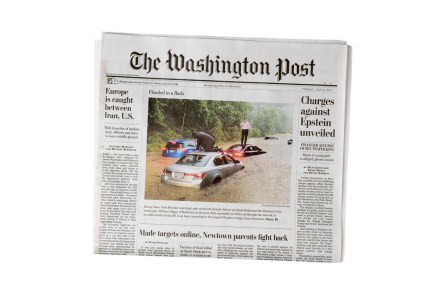
What does Jeff Bezos’s gutting of the Washington Post say about America’s sense of itself and of its place in the world? Bezos has scrapped much of the paper’s foreign coverage, as well as the books and sports sections. Over three hundred reporters and editors have been fired – including publisher Will Lewis. The Ukraine bureau has been closed, along with Berlin and the entire Middle Eastern and Iran team. You’d think there wasn’t much going on in the world. Does that mean that American readers are no longer interested in books or foreign news? That doesn’t sound true. The numbers of literate, educated and interested readers in the US who were devoted followers of the Post’s world-class books section and prizewinning foreign coverage haven’t collapsed.

Why is America determined to pick a fight with Poland?

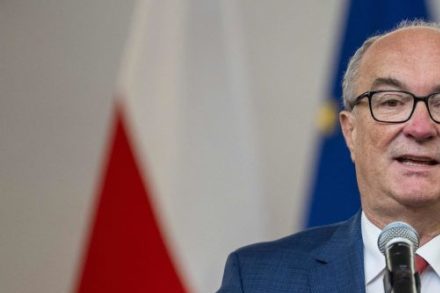
Until very recently it was hard to find more stalwart allies of America in Europe than the Poles. Poland was an early supporter of Washington’s policy to expand Nato and actively pushed for a stronger US role in central and eastern Europe. The Poles also stood up as an enthusiastic member of every US-led military coalition, taking leading roles in Afghanistan and Iraq. It was to Warsaw that US President Joe Biden travelled – twice – in the wake of Putin’s invasion of Ukraine to give barnstorming speeches affirming that America would stand by Kyiv.  All the more surprising, then, that the recently appointed US ambassador to Warsaw chose to pick a diplomatic fight that threatens to snowball into a profound rupture between the two onetime allies.

The secrets of Putin’s shadow fleet

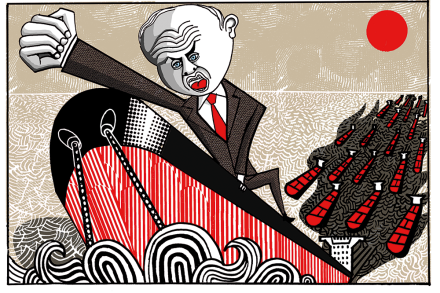
Of all the weapons in Vladimir Putin’s arsenal, the most strategically crucial has proved to be not hypersonic missiles but the motley fleet of oil tankers that have allowed Russian oil to keep flowing to international markets. Oil dollars have been the lifeblood of Russia’s war economy during four years of conflict. And the West’s failure to shut that export business down has, so far, been the single most important factor behind Putin’s continued military resilience. Economic sanctions were supposed to be the West’s superpower to punish the Kremlin for invading Ukraine in February 2022. So how come Russia now exports more oil by sea than it did at the beginning of the war?

Sean Thomas, Mary Killen, Owen Matthews & Patrick Kidd

From our UK edition

28 min listen

On this week’s Spectator Out Loud: Sean Thomas explains how an AI-generated goth girl became a nationalist icon; Mary Killen argues we should all regret the loss of the landline; Owen Matthews says that banning Russian art only weakens Ukraine; and finally, Patrick Kidd makes the case for letting children experience alcohol. Produced and presented by Patrick Gibbons.

Sean Thomas, Mary Killen, Owen Matthews & Patrick Kidd

Why is Ukraine trying to cancel Swan Lake?

From our UK edition

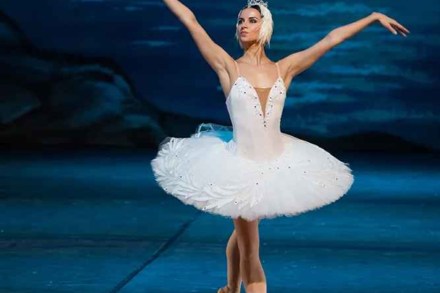
Two of Ukraine’s most famous ballet dancers face dismissal, cancellation and possible mobilisation into the army. Their crime? They dared to dance a segment of Russian composer Pyotr Tchaikovsky’s Swan Lake during a European tour. The Ukrainian Ministry of Culture slammed Serhiy Kryvokon and Natalia Matsak’s performance as ‘promoting the cultural product of the aggressor state’. The National Opera of Ukraine cancelled Kryvokon’s next scheduled performance – as well as his exemption from compulsory military service and permission to travel. If the dancer returns to his homeland, he will not be able to leave again.

Will the Abu Dhabi talks bring peace to Ukraine?

From our UK edition

Representatives of Russia, Ukraine and the US will meet today in Abu Dhabi to push forward a peace deal, the first time Moscow and Kyiv have spoken formally since April 2022. The surprise announcement of the tripartite talks came after a flurry of shuttle diplomacy, with White House envoy Steve Witkoff and President Donald Trump’s son in law Jared Kushner meeting with Putin in the Kremlin while Ukrainian president Volodimir Zelensky rushed at short notice to Davos for a face-to-face meeting with Trump himself.

The Kremlin’s plan to create a new wave of Ukrainian refugees

From our UK edition

What is the limit of Ukrainian civilians’ endurance? In nearly four years of relentless war, Ukraine’s people have faced summary executions, ‘drone safaris’ where unmanned aerial vehicles hunt people down city streets and constant bombardment of cities by swarms of drones and missiles. This winter their remarkable resilience faces its severest test yet as Russian forces reach a tipping point in their systematic attempt to knock out the country’s energy infrastructure. In each of the past three winters, Vladimir Putin has attempted to render Ukraine’s cities uninhabitable by plunging them into darkness and cold, without success. But this time it looks like the Kremlin’s campaign to weaponise winter may be succeeding.

Maduro’s capture is mixed news for the Kremlin

For the Kremlin, the US’s snatching of Venezuela’s President Nicolás Maduro is a humiliation with a silver lining. True, little more than a year after the precipitous fall of Syria’s Bashar al-Assad, Russia has been shown to be completely hopeless when it comes to keeping its allies in power. In Caracas, US airborne forces breezed past Russian-supplied S-300 air defense systems, which were part of a $20 billion package of maybe not-so-great Russian military equipment that Moscow sold the Venezuelans. The Kremlin has lost a strategic bridgehead in South America which it could, potentially, have used to disrupt and challenge Washington’s regional hegemony – if Moscow weren’t so committed financially and militarily to its war in Ukraine.

Europe has left Ukraine living on borrowed time

Russia started the war on Ukraine, so Russia should pay for the damage it has wrought. Such was Volodymyr Zelensky’s forceful message to European leaders last night as he pleaded for a ‘reparations loan’ backed by the €190 billion (£167 billion) of Russian Central Bank capital frozen in a Belgian clearing bank since Putin’s full-scale invasion. 'Just as authorities confiscate money from drug traffickers and seize weapons from terrorists, Russian assets must be used to defend against Russian aggression and rebuild what was destroyed by Russian attacks,' Zelensky told his European allies. 'It’s moral. It’s fair. It’s legal.' But after negotiations that went late into the night, Europe ultimately shied away from grabbing Russia’s money.

Only the US is taking peace seriously in Ukraine

What exactly is the ‘platinum security guarantee’ that Donald Trump is pushing Volodimir Zelensky to accept? While the full details remain confidential, the deal is described as an ‘Article 5 style’ guarantee after the clause in Nato’s charter that states that ‘an armed attack against one Nato member shall be considered an attack against all members’ and triggers ‘an obligation for each member to come to its assistance.’  Sounds reassuring. Except that little weasel word ‘style’ covers an abyss of real-world back-pedalling and caveats. For a start, Nato’s charter does not oblige members to actually take military action if one is attacked but instead leaves that decision to individual states.

The war in Ukraine is reaching its endgame

Painfully and chaotically, the outline of the peace deal that will eventually end Russia’s invasion of Ukraine is emerging as the US leans on Kyiv to abandon key red lines. It may still be months before the guns finally fall silent. But one by one various roadblocks to an eventual agreement are falling away. Crucially, this week Volodymyr Zelensky conceded that his country needed new presidential and parliamentary elections. Moreover, for the first time, he floated the possibility that a Ukrainian military withdrawal from Donbas could be put to a national referendum.  "The Ukrainian people must answer the territorial question," Zelensky told reporters on Thursday. "I say clearly: yes, I support elections.

The war in Ukraine is reaching its endgame

From our UK edition

Painfully and chaotically, the outline of the peace deal that will eventually end Russia’s invasion of Ukraine is emerging as the US leans on Kyiv to abandon key red lines. It may still be months before the guns finally fall silent. But one by one various roadblocks to an eventual agreement are falling away. Crucially, this week Volodymyr Zelensky conceded that his country needed new presidential and parliamentary elections. Moreover, for the first time, he floated the possibility that a Ukrainian military withdrawal from Donbas could be put to a national referendum.  'The Ukrainian people must answer the territorial question,' Zelensky told reporters on Thursday. 'I say clearly: yes, I support elections.

Will US businesses profit from a return to the Russian market?

Rome Will peace in Ukraine also prove to be a great deal for US business? Vladimir Putin would certainly like Donald Trump to think so. Within days of Trump’s election victory last November, the Kremlin ordered major Russian corporations to prepare detailed proposals for economic cooperation with Washington. Coordinating these efforts were Maxim Oreshkin, deputy head of Putin’s presidential administration, and Kirill Dmitriev, the US-educated Harvard, Stanford and Goldman Sachs alumnus who heads Russia’s sovereign investment fund.

Europe’s kind words and bear hugs can’t save Zelensky

From our UK edition

If bear hugs were army divisions and brave words cash euros, Volodymyr Zelensky would have ended his tour of European capitals this week the best-armed and best-funded leader in the world. Zelensky faces the danger that giving too much to Putin would make Ukraine ungovernable 'We stand with Ukraine,' vowed Sir Keir Starmer after hosting a summit for President Zelensky and top European allies at Downing Street on Monday. 'We support you in the conflict and support you in the negotiations to make sure that this is a just and lasting settlement.' Germany’s Chancellor Friedrich Merz declared that 'nobody should doubt our support for Ukraine' and that 'the destiny of this country is the destiny of Europe'.

What Ukraine really needs from Europe

If bear hugs were army divisions and brave words cash euros, Volodymyr Zelensky would have ended his tour of European capitals this week the best-armed and best-funded leader in the world. "We stand with Ukraine," vowed British Prime Minister Sir Keir Starmer after hosting a summit for Zelensky and top European allies at Downing Street on Monday. "We support you in the conflict and support you in the negotiations to make sure that this is a just and lasting settlement." Germany’s Chancellor Friedrich Merz declared that "nobody should doubt our support for Ukraine" and added that "the destiny of this country is the destiny of Europe." France’s President Emmanuel Macron promised that Europe has "a lot of cards in our hands.

Why Putin thinks he’s winning

The Kremlin pulled out all the stops for the visit of Donald Trump’s son-in-law Jared Kushner and special envoy Steve Witkoff to Moscow yesterday. Accompanied by Putin’s envoy Kirill Dmitriev, Witkoff and Kushner strolled through crowds on Red Square with minimal security after lunching at a fancy restaurant on Petrovka street. Not coincidentally, Chinese foreign minister Wang Yi was also in town for a meeting with Russian Security Council head Sergei Shoigu, where Russia affirmed its support for Beijing’s One China policy.  It was a sophisticated piece of great power signaling intended to send a multi-part message to Donald Trump.

Why Putin thinks destiny is on his side

From our UK edition

The Kremlin pulled out all the stops for the visit of Donald Trump’s son-in-law Jared Kushner and special envoy Steve Witkoff to Moscow today. Accompanied by Putin’s envoy Kirill Dmitriev, Witkoff and Kushner strolled through crowds on Red Square with minimal security after lunching at a fancy restaurant on Petrovka street. Not coincidentally, Chinese foreign minister Wang Yi was also in town for a meeting with Russian Security Council head Sergei Shoigu, where Russia affirmed its support for Beijing’s One China policy.  It was a sophisticated piece of great power signalling intended to send a multi-part message to Donald Trump.

The path to peace in Ukraine will be tortuous

From our UK edition

In order to impose peace terms, you first need to win the war. That fundamental principle seems, for the moment, to elude Ukraine’s European allies. Donald Trump, on the other hand, has taken the more pragmatic – some would say more cynical – view that Ukraine will never defeat Russia and therefore needs to make the best of a bad lot. Trump’s strategy for peace in Ukraine has been to browbeat Volodymyr Zelensky into approving a deal acceptable to Vladimir Putin. In fairness, Trump has also gone some way to putting the squeeze on the Kremlin too, by sanctioning the oil giants Rosneft and Lukoil, authorising the Ukrainians to use US--provided long-range weapons against Russian targets, and threatening to provide Kyiv with Tomahawk cruise missiles.