Michael Tanner

Straight talking

From our UK edition

It’s widely agreed that the most difficult form of opera to bring off is operetta, whether of the Austro-German or the French tradition — interesting that the Italians wisely eschew the genre (so far as I know), while the British stay with G&S and their inviolable traditions, including the audience’s laughing in all the right places. In the past four days I have been to two performances of French operetta, neither of them much of a success, for quite different reasons. Opera Danube is a young company devoted to nurturing singers who recently graduated from one or another of the many music schools. It works with the Orpheus Sinfonia, a small orchestra of players at the same stage of their careers.

Northern lights | 28 January 2016

From our UK edition

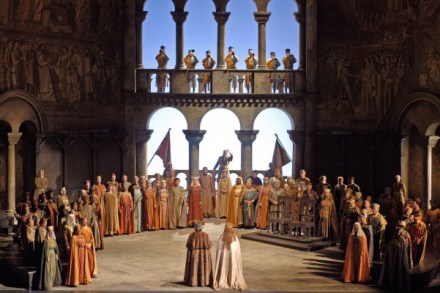
Opera North continues to be the most reliable, inspiring, resourceful and enterprising opera company in the United Kingdom, and all that without taking account of its extremely limited budget. From April through July it will be presenting its remarkable interpretation of Wagner’s Ring cycle in various cities, including London, so it may not be surprising that before that it is mounting much more modest fare — as indeed everything else is. Giordano’s Andrea Chénier (1896) seems to be undergoing something of a revival, and this new production in Leeds is the first time it has ever been performed in the north of England.

What a tawdry piece it is: Met Opera Live’s Les pêcheurs de perles reviewed

From our UK edition

Les pêcheurs de perle Met Opera Live This is the first production at the Metropolitan of Bizet's early opera for a century, and it isn't hard to understand why. What a tawdry piece it is, the kind of thing that might have been written deliberately to get Edward Said's goat. Musically it contains one gem, the unforgettable duet for baritone and tenor, unforgettable any time you've heard it for at least a week. Bizet obviously knew when he was onto a good thing, for he recalls the tune countless times in the course of the opera. It has no motivic significance, but since he seems unable, in this opera, to think of any other decent melodies, the obvious thing to do was to keep audiences happy by using it to paste together a work which has almost no kind of coherence.

In two minds

From our UK edition

There are some operas, as there are some people, that it is impossible to establish a settled relationship with, and in my case Debussy’s Pelléas et Mélisande is one of them, in fact by far the most pressing one. I never know in advance how I’m going to react to it, and to some extent the actual performance I see is not the determining factor. I’d like, just once, to see the play and find out how I reacted to that. For Debussy offers such a vivid and sometimes perplexing counterpoint to Maeterlinck’s words that one’s reactions to the characters and their actions are always in flux — at least so long as you don’t see the opera too often.

Boulez est mort

From our UK edition

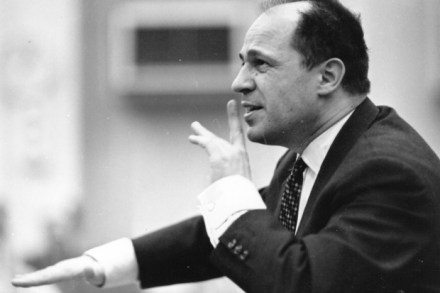
Pierre Boulez, who died last week at the age of 90, would have been the last person, one hopes, to want a unanimous chorus of praise to surge from the media, to an extent that has not been seen at the death of any other classical musician — certainly not at Stravinsky’s, to mention one far greater figure. His fellow musicians have been among the most fulsome: ‘He taught us how to listen, he gave us new ears,’ said Sir Simon Rattle, and on the many specially devised programmes others have made similar claims, if less succinctly. They really ought to know better. That kind of remark shows the same ignorance of and contempt for history as Boulez himself delighted in.

Royal Opera’s Cavalleria rusticana isn’t nearly vulgar enough

From our UK edition

How often do you get a chance to see two operas by Leoncavallo in the same city in the same week? Never, until this last week in London, when Opera Rara gave a concert performance of Zazà at the Barbican, and six days later the Royal Opera mounted its first production since the 1980s of Cav. and Pag. Both Leoncavallo and Mascagni are routinely thought of as one-opera composers. Zazà didn’t do a lot to undermine that view, and I doubt whether if it had been staged it would have made any stronger an impression. Like Pag., its libretto is by the composer: Wagner seems to have made that temporarily mandatory. But the plot is feeble almost to the point of nonexistence.

That Force of Destiny isn’t a great evening is the fault of Verdi not ENO

From our UK edition

The Force of Destiny, ENO’s latest offering to its ‘stakeholders’, as its audiences are now called thanks to Cressida Pollock, the new CEO, is perhaps Verdi’s most interesting failure. It’s an opera with too much fine, even magnificent, music to be neglected, but it doesn’t add up to a satisfactory experience. Even epics, which Force is routinely categorised as, have their limits of accommodation. Henry James described War and Peace as ‘a loose, baggy monster’, but what would he have called Force if he had had the least interest in opera or music? There are times when we are longing for the central story of vengeance and fate to get a move on.

The Met’s Tannhäuser is outstanding – despite a vast and expressionless leading man

From our UK edition

This was a superb, thrilling performance, chiefly thanks to James Levine and his amazing orchestra - he got a tremendous reception before the opera started, an expression of the admiration and affection of the audience; but he and we in the cinema should be spared the sight of his conducting, now a matter of limited gestures and unlimited facial expressions. He timed the whole work more sensitively than I have ever heard it before, so that there were almost no longueurs, which is a remarkable feat. Choosing the, or more accurately a Paris version, even Levine couldn't prevent the opening scene between Venus and Tannhäuser being tedious.

What’s the point of the Met’s new Otello?

From our UK edition

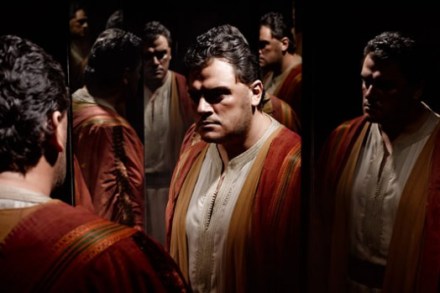
The new production of Verdi's Otello at the Met, with set designs by Ed Devlin, did make me wonder, as I watched it in the Cambridge Picture House, why they had bothered, since in no respect does it improve on many traditional productions. The sets are kind of sumptuous, but then what looked like a solid wooden or stone building turns out to be perspex, with neon lighting, and liable to slide around for no obvious reason. The costumes are suitably period, lavish, spotless. From the cinema-goer's point of view, the most irritating thing is that the camera remains almost always on the person singing.

Ariadne shows what a wonderful operetta composer Richard Strauss could have been

From our UK edition

‘Oh, those Greeks! They knew how to live. What is required for that is to stop courageously at the surface, the fold, the skin, to adore appearance... Those Greeks were superficial — out of profundity [Nietzsche’s own italics].’ Thus said Nietzsche in the preface to The Gay Science. I expect Richard Strauss knew the passage. At any rate, many of his works give the impression of being composed by someone who wasn’t sure how profound he could be, or wanted to be, or indeed what profundity was. This is most evident in Ariadne auf Naxos, which deals explicitly with these issues. To add to his perplexities at this time, Strauss had Hugo von Hofmannsthal lecturing him in letters.

Please let’s have more musicals like this Kiss Me, Kate at Opera North

From our UK edition

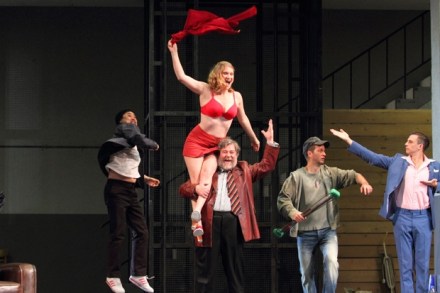
Opera North’s new production of Cole Porter’s masterwork Kiss Me, Kate has been so widely and justly praised that I wonder whether there is much for a week-later reviewer to add. It’s not as if the work needs much exegesis or critical commentary, though it may be worth pointing out that what we hear in Leeds amounts to a new critical edition, in which the conductor, David Charles Abell, has played a major role. Musicals have been treated with as little respect as Italian operas were in the 19th century, with arias and whole scenes added or subtracted according to the taste and abilities of the performers, the management’s judgment of the initial reception, and the casualness with which manuscripts and orchestral parts have been handled.

Anna Netrebko’s ascent to greatness: Il Trovatore at the Met reviewed

From our UK edition

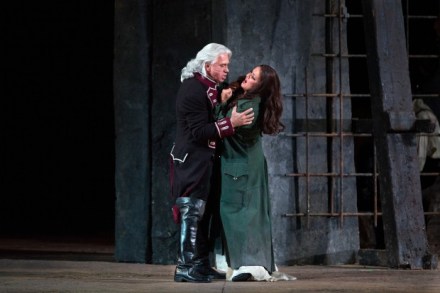
The Met in HD series got off to an exciting start this year with Il Trovatore, an opera I adore but have never seen a satisfactory performance of, until this one. The production by Sir David McVicar is in his now traditional style, with a reasonable number of very solid-looking props designed by Charles Edwards, and more or less time-honoured operatic acting, but done with intensity and conviction, so that this hardened team of Verdi experts were able to give their all, and obliged by doing so. The result, to my surprise, was that I not only enjoyed this uniquely energising work, but for the first time was moved by it. This despite the Met audience's evident desire to turn it into a costume concert by protracted applause after almost every solo.

Incomprehensible genius

From our UK edition

London’s Goethe-Institut has a two-month season of films of Rainer Werner Fassbinder (whose 70th anniversary it’s celebrating), but only five movies, each one alternating with a film influenced by him from another country. Considering that Fassbinder created about 60 films, it seems rather a slim effort. Still, half of his output is available on DVD, at no vast cost, and, having revisited many of the films in the past few days, I am more struck than ever by how great he was, and how, thanks to innumerable kinds of pressure, he only intermittently did justice to his phenomenal creativity and energy. He exasperates as often as he enthrals and moves.

All roads lead to Callas

From our UK edition

Bellini belongs to that category of not-quite-great operatic composers whose works are also very difficult to perform adequately, and don’t seem to be all that popular when they are. But Welsh National Opera’s theme for the season of Madness means that as one of the leading exponents of operatic insanity Bellini is bound to turn up, and WNO does him proud vocally, if not in production, by mounting I puritani, his last and for some aficionados his finest opera. Norma seems to me to be clearly superior, certainly as drama. I puritani has a wretched libretto, not only linguistically feeble but also with a hopeless plot. It certainly does contain wonderful music, above all of course Elvira’s mad scene in Act II (she has one in each of the three acts).

Strauss-ful

From our UK edition

Richard Strauss’s Daphne is one of the operas he wrote during the excruciatingly long Indian summer of his composing life, where he seems, in one work after another, to be looking for a subject worthy of his skills, and only finding one in Capriccio, his last opera. For that, he and his ideal interpreter Clemens Krauss collaborated on a libretto that, while garrulous, has a real topic to deal with, and handles it with no portentousness or pseudo-depth. None of that can be said about the depressing series of operas he composed in the 1930s, which either have a serious topic to deal with but not the drama or the music to do it justice, or are nothing more than word- and note-spinning.

Watching the clocks

From our UK edition

When I saw the first performance of this production of Ravel’s two operas at Glyndebourne three years ago, I thought it was the nearest thing to operatic perfection I had witnessed. But this revival is even finer. Whereas I concluded last time that L’heure espagnole was fundamentally an old-time bore that goes on for far too long — only 50 minutes, but it seemed much longer — this time I found it absorbing from start to finish, though I still think it is no funnier than most of what used to be called dirty jokes. The decisive difference, I think, is the conducting of Robin Ticciati (or was it where I was sitting, the front row of the circle as opposed to the centre of the stalls?).

Better than Bayreuth

From our UK edition

Which of Wagner’s mature dramas is the most challenging, for performers and spectators? The one you’re seeing at the moment, seems to be the answer for me. The better I know them, the more apprehensive I get about whether I can rise to their level, and whether the performers can, and whether we can pace ourselves and not flag at the prospect of the last act, in most of them the greatest and most exhausting. In the end, though, I think Tristan und Isolde takes the biscuit. It’s a matter of gratitude, almost, if the Prelude isn’t as overwhelming as it naturally tends to be. At Longborough this year it wasn’t, and I was duly grateful.

Dietrich Fischer-Dieskau

From our UK edition

For anyone who has been interested in classical vocal music since the middle of the last century, whether choral, operatic or solo, there has been one inescapable name and voice: Dietrich Fischer-Dieskau. His repertoire was gigantic, surely larger than that of any singer ever. He began public concerts and recordings in the late 1940s and only gave up in the 1990s, when he took to conducting and narrating, as well as painting, writing a large number of books about German composers (including a ridiculous one on Wagner and Nietzsche) and of course coaching young singers.

Carmen v. Carmen

From our UK edition

It’s been a busy operatic week, with a nearly great concert performance of Parsifal in Birmingham on Sunday (reviewed by Anna Picard in last week’s Spectator), Carmen at the Coliseum on Wednesday, Donizetti’s Poliuto at Glyndebourne on Thursday and Carmen, also at Glyndebourne, on Saturday. A trajectory that Nietzsche would have approved of, moving from brooding northern transfiguration to sunlit, brilliant southern violence and destruction. Poliuto is mostly known, if at all, in the live recording made at La Scala in 1960 as a vehicle for Callas’s return, in a role that made comparatively small demands on her, and much larger ones on Franco Corelli and Ettore Bastianini.

Why do directors of comic opera encourage performers not to behave like human beings?

From our UK edition

The Royal Academy of Music's Sir Jack Lyons Theatre is closing, whether for refurbishment or to make way for something more ambitious I don't know. It's a place where I have spent many great evenings, with immense amounts of young vocal talent - most of it never heard of again - under the batons of Colin Davis, Jane Glover and other superb conductors. Next year's productions will be in Hackney, Shoreditch and in the underground hangar across the Marylebone Road. To bring the curtain down on the old theatre, the RAM chose two comic English one-acters, of a certain vintage, the 1950s - that abused decade. The first was Walton's The Bear, from Chekhov.