Michael Hann

The joy of Chris Stapleton

From our UK edition

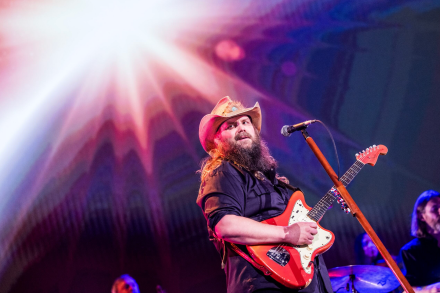
Chris Stapleton is a barrel-chested man of 46, who hides his face beneath a beard that must have taken years to grow, hair that tumbles down past his shoulders and a hat that could probably accommodate rather more than ten gallons. He sings songs about being imperfect, with a band behind him making a sound that one might have heard in 1972. He is so purely, absolutely and definitely American he might as well have petrol for blood and ‘The Star-Spangled Banner’ on a permanent loop in his head.

An uncompromising master: David Gilmour, at the Royal Albert Hall, reviewed

From our UK edition

It doesn’t matter which dictionary you consult, they all agree on what a song is: words, set to music, that are sung. Yet it’s also an entirely inadequate description, since there are so many types of song. Take David Gilmour and Neil Finn, both men of passing years who like to switch between electric and acoustic guitars, both backed by plenty of singers and kindred instrumentation (though Finn didn’t have a pair of harps on stage with Crowded House), both playing music largely rooted in the late 1960s, both offering lightly mind-bending songs. Yet this misses something crucial.

The world is on fire – yet navel-gazing still reigns in pop

From our UK edition

There is no better cultural weather vane than pop. It’s not that pop singers possess incredible analytical skills – they don’t. It’s more that it’s in their interests to reflect some prevailing mood. And what people call a vibe shift can often be gleaned by comparing two artists. Take those featured this week: one very much au courant, the other regarded as a searing commentator on 1980s Britain. It’s a very good album, one for sitting down and listening to rather than standing in a vast shed to hear Over the past couple of years, Raye – a 26-year-old Londoner – has become rather a star. You may remember that she had a bunch of hit singles early on, but her label showed no interest in releasing an album.

How some of the most derided bands of all time are making a comeback

From our UK edition

The fate of the pop musician – at least the pop musician below the top tier of stardom – has historically been to fall from fashion. At some point in their rise they will be of the moment, the spirit of the age, and then they won’t be. At best, they’ll have a slow but perfectly lucrative fade, as their fanbase dwindles to the zealots. At worst they’ll become a punch line, a raised eyebrow: ‘What were we thinking?’ Every hit, every sold-out show, is just another step closer to irrelevance. ‘There’d be 800 teenagers in a club in Minneapolis, which felt absurd: we’re old enough to be their parents’ It may be that the single greatest artistic effect of the Covid pandemic has been to change that.

My night with the worst kind of nostalgia 

From our UK edition

American Football are a band whose legend was formed by the internet: some Illinois college kids who made an album for a little label in 1999, went their separate ways, and in their absence found that a huge number of people had responded to their music. They duly reunited in 2014. They are often identified as emo, the most confounding of all genre names, given it means everything and nothing, but American Football are not of the eyeliner and dyed-hair variety exemplified by My Chemical Romance, nor the angsty pop-punk variant of Weezer or Jimmy Eat World, nor the shouty hardcore punk evolution of the genre’s founders in the 1980s.

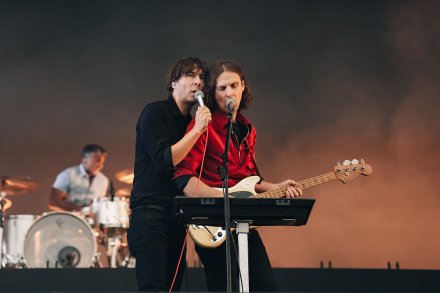
Delightful: Phoenix, at All Points East, reviewed

From our UK edition

A few years ago, my nephew informed me that he and his friend were planning to come up to London for the weekend for the Wireless Festival. Did they need somewhere to stay? He looked at me like I was a mad old man. No, of course not. They were going to camp. In Finsbury Park. Because when you go to festivals, you camp. Thankfully, he didn’t turn up on the Victoria Line with his tent and then wonder why no one else was similarly equipped. Phoenix have the air of being as much a lifestyle choice as a pop group Inner-city festivals such as Wireless and All Points East are almost always a series of single-day events. APE is a ruthlessly programmed festival. Rather than try to be all things to all people, each day is targeted at some section of the festival-going population.

Triumphant: Big Thief, at Green Man, reviewed

From our UK edition

One of the first things I learned after seeing Big Thief triumph at Green Man is that some long-time fans are worried about them. There’s an extra percussionist; the bassist has been replaced; and the singer is now front and centre. Have they just become a conventional rock band, people mutter. Have they lost the intimacy they once had? I’d never seen Big Thief before, which is something of an error on my part. Not least because I can’t answer those questions: I have nothing to compare Saturday night’s performance with. I can only say that without caring about what they were in the past, they are extraordinary in the present: both grand and welcoming.

Fantastic – and genuinely indie: Personal Trainer, at the Shacklewell Arms, reviewed

From our UK edition

Remember when we all knew what indie meant? Indie was what John Peel played. It was music that was recorded, manufactured and distributed independent of the major labels. In practice, that tended to be music played by young white people, usually more in hope than expectation of either competence or success. As the years passed it came to be applied particularly to a kind of whey-faced, solipsistic music, played on guitars by people who were either too clever by half or too wimpy by half. By dusk, what had not long before looked like the seventh circle of hell had transformed These days, though, indie means whatever you want it to mean. Entirely mainstream soft pop acts with massive worldwide hits on major labels – such as Glass Animals – are classed as indie.

Charismatic, powerful and raw: Patti Smith, at Somerset House, reviewed

From our UK edition

There are certain long-established rules for describing Patti Smith. Google her name and the words ‘shaman’ and ‘priestess’ and you’ll see what I mean. For the best part of 50 years she’s been treated as though she’s a mystical object, a human convergence of ley lines, as much as a rock singer. In the courtyard at Somerset House, she didn’t exactly discourage the clichés. There was a long lecture on the power of the full ‘buck’ moon, which was hidden by clouds but still prompted the people in front of me to pull out their phones to check astronomy apps. There was a lengthy hymn to William Blake that concluded: ‘And then the children, the chimney sweeps, remembered him.

Teenage Swifties restored my faith in strangers

From our UK edition

Taylor Swift is the last of the monocultural pop icons. Put it this way: I bet you’ve heard of her. Your parents have heard of her. Your children have heard of her – and so have your grandchildren. This used to be commonplace – but not now. She transcends pop music. This might be why so much of the discussion of the Swift phenomenon has been about the facts and figures: hers is the first tour to gross more than $1 billion, while global leaders have begged for her to visit their countries due to the financial boost she brings. Not to mention her tendency to pump out new editions of her albums every 20 minutes to keep her top of the charts as loyal fans loyally part with their cash.

‘Psychedelic folk that twists and leaps’: Beth Gibbons, at the Barbican, reviewed

From our UK edition

A decade ago, a group of people who owned small music venues came to the conclusion that the kinds of places they ran were teetering on the brink of a catastrophic extinction event. And so they formed the Music Venue Trust, which has spent ten years kicking cans and shouting the odds about the need to preserve these places, about how they are the production lines from which the festival headliners of tomorrow come. A brilliant guitarist, a fascinating songwriter, St Vincent cycles sleekly through styles with utter assurance Quite right. Good, small venues are the best place to enjoy both live, loud, raucous music and intimate performances where the crowd’s hush is as deafening as any amp.

Nickelback may not be cool but they are very good at what they do

From our UK edition

In May 2013, Rolling Stone polled its readers in an attempt to discover which band might be crowned the worst of the 1990s. The winners – or losers, depending on how you look at it – were Creed, trailed in second place by Nickelback. Eleven years on and Creed appear to have turned that status around, in America at least – Vanity Fair, Vice and Slate have noticed that they have, whisper it, become cool. And Nickelback? Well, no one’s claiming coolness for them: last year they released a documentary called Hate to Love: Nickelback, a recognition of the fact that, outside their fanbase, they are usually mentioned only as a punchline.

Quentin Letts, Owen Matthews, Michael Hann, Laura Gascoigne, and Michael Simmons

From our UK edition

31 min listen

On this week’s Spectator Out Loud: Quentin Letts takes us through his diary for the week (1:12); Owen Matthews details the shadow fleet helping Russia to evade sanctions (7:15); Michael Hann reports on the country music revival (15:05); Laura Gascoigne reviews exhibitions at the Tate Britain and at Studio Voltaire (21:20); and, Michael Simmons provides his notes on the post-pub stable, the doner kebab (26:20). Produced by Patrick Gibbons and Oscar Edmondson.

The unstoppable rise of country music

From our UK edition

When a major artist releases a new album, the first thing to follow is the onslaught of think pieces. And when Beyoncé released Cowboy Carter earlier this year, the tone of these think pieces – especially on this side of the Atlantic – was one of slightly baffled congratulation. Here, at last, was a pioneer who might drag this hidebound genre – of sequins and satin, of lachrymose, middle-aged songs about drink and divorce – into the modern age. ‘Modern country is like punk for the Hannah Montana generation’ The only problem is that Beyoncé was not leading; she was following. Beyoncé pivoted to country not to make it cool, but because it’s become cool – and more of a commercial powerhouse than it has been for years.

Lovely slice of Cosmic Scouse: Michael Head & the Red Elastic, at EartH, reviewed

From our UK edition

One of the more bizarre but recurring tales about how the music of Liverpool has been shaped over these past 45 years concerns Courtney Love, the American musician famed, music aside, for being married to Kurt Cobain, and for being wildly unpredictable. This story claims the 17-year-old Love, who had travelled across the Atlantic to be near the bands she loved, introduced Liverpudlian musicians to LSD, setting in train a decades-long phenomenon known as ‘Cosmic Scouse’.

Adrianne Lenker is a treasure for the ages 

From our UK edition

You could very well sum up their differing approaches to American roots music from how they were dressed. Both wore cowboy hats and both wore trousers, but Adrianne Lenker’s were faded denim, while Lainey Wilson went with shiny brown leather. Lenker, looking austere and speaking and singing softly, played music plucked from eternity, demanding you concentrate on her stillness. Wilson, on the other hand, was here to make the crowd feel good; a little melancholy on the big ballads, sure, but she’s an entertainer in the grand tradition of country music.

Why garage punk is plainly the apogee of human achievement

From our UK edition

How is it that a group that sounds like the Hives are selling out the Apollo? In a world configured according to expectation, the highlight of their year would be an appearance at the Rebellion punk festival in Blackpool, probably high up the bill on the second stage. They’d headline their own shows at places like the Dome in Tufnell Park to an audience made up of three-quarters old blokes and a quarter skinny young kids, suited and booted like it’s 1966 and Antonioni’s about to shout ‘Action!’. Afterwards, a DJ would play the Sonics and the Electric Prunes and the Chocolate Watchband.

Never admit that your band is prog – it’s the kiss of death

From our UK edition

Sensible prog-rock bands try to ensure no one ever realises they play prog. What happens when you are deemed a prog band is that you are condemned to the margins – little radio airtime, few TV appearances, barely any coverage in the mainstream press – because it has been decided you exist solely for the delectation of a tribe that baffles the rest of the world. Once non-proggers have decided you are prog, that’s it. There is no way back for you. Just collect your Campaign for Real Ale membership card, go home and practise your drum solos. Once non-proggers have decided you are prog, that’s it. There is no way back for you Hence Radiohead – absolutely, indubitably a prog band, right down to the tricksy time signatures – don’t bang on about Tales From Topographic Oceans.

The horror of London’s music venues

From our UK edition

There were headlines last month about the plight of live music in Britain. More than a third of grassroots venues are making a loss; more than 100 of them are ceasing to put on live music or closing altogether. Cue the stories about how, if it wasn’t for these broom cupboards giving musicians the opportunity to learn their trade, you’d never have got all those acts you know and love. All true, of course. We need small venues, and not just for the health of the music industry but for the simple pleasure of sipping a pint watching a young band in a small room. What use is a venue when a couple of hundred people can’t even see the stage? But dear God, the bigger venues that accommodate graduates of the grassroots circuit need to up their game, too.

The joy of meat-and-potatoes rock

From our UK edition

‘Meat-and-potatoes rock’ is the pejorative term critics use when describing groups of white men with guitars who play loud, uncomplicated music. Why would anyone enjoy such stuff, when there are the ceviches of hyperpop, the flavoured foams of experimental hip-hop, the chargrilled seasonal vegetables of jazz? Don’t they know the world has moved on? Unfortunately, the world has a habit of not listening to the critical consensus. The highest new entry in last week’s album chart came from the Snuts, a meat-and-potatoes guitar band. This week’s No. 1 album is all but guaranteed to be by Liam Gallagher and John Squire, the Toby Carvery of meat-and-potatoes rock.