Luke McShane

Luke McShane is chess columnist for The Spectator.

No. 714

From our UK edition

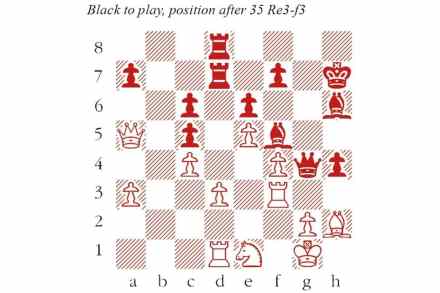
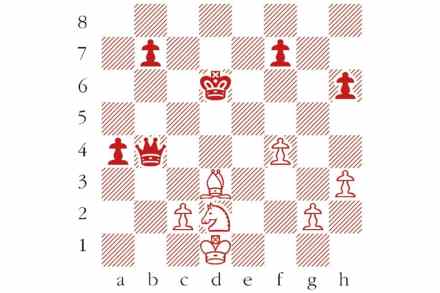
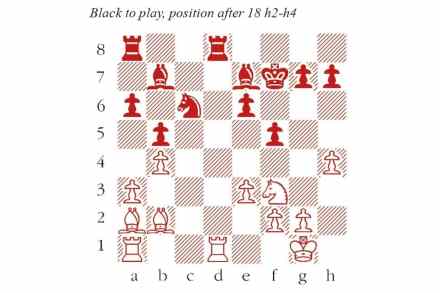
Black to play. Smirnov – Duda, Chennai Olympiad 2022. With his next move, Duda forced a decisive gain of material. What did he play? Answers should be emailed to chess@spectator.co.uk by 9 August. There is a prize of £20 for the first correct answer out of a hat. Please include a postal address and allow six weeks for prize delivery. Last week’s solution Last week’s solution: 1 Qh8! Depending on Black’s response, mate follows with Qb8, Qf8, Qe5 or Qd4. Last week’s winner Richard Booth, Cheltenham, Glos.

A lucky escape

From our UK edition

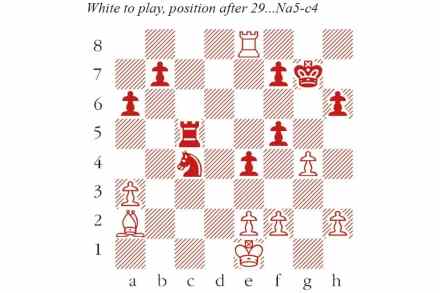
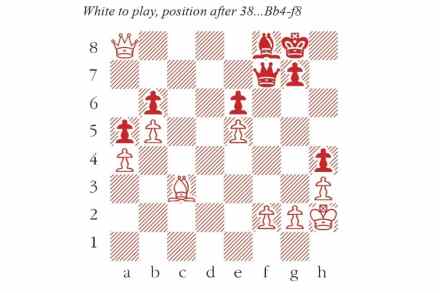
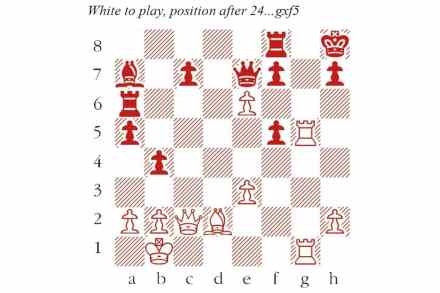
I chatted to a spectator after one of my games at the Sparkassen Chess Trophy in Dortmund. ‘A close shave today, wasn’t it?’ he began. ‘Yes, I can’t believe my opponent escaped with a draw.’ ‘No, I think you were losing.’ ‘Oh, but didn’t you see my beautiful mating idea with b5?’ ‘There’s a fly in the ointment – have another look,’ he said. [The penny drops, eventually.] ‘Oops. Ah well, better lucky than good!’ Fortunately, my opponent shared my delusion during the game. And doubly so, in that my misplaced confidence spared me the need to conduct an arduous defence. My opponent has just snatched a pawn on a3. After 39 Rf4 Re8 40 Rff7 Rb8 my rooks would hit a brick wall.

No. 713

From our UK edition

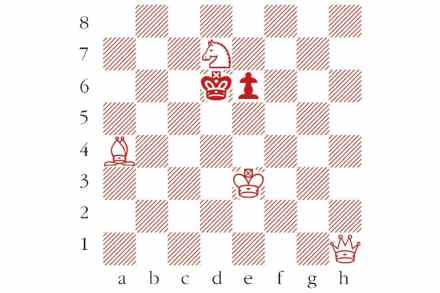
White to play and mate in two. Composed by Henri Rinck, La Strategie, 1892. Answers should be emailed to chess@spectator.co.uk by Monday 2 August. There is a prize of £20 for the first correct answer out of a hat. Please include a postal address and allow six weeks for prize delivery. Last week’s solution 1 Rc2!

Heavy is the head

From our UK edition

On International Chess Day, 20 July, Magnus Carlsen announced that he will not defend his world championship title next year. The Norwegian won the title in 2013 by beating Viswanathan Anand in Chennai, and went on to defend his title against Anand once more, then Sergey Karjakin, Fabiano Caruana and most recently Ian Nepomniachtchi. Carlsen stressed that he has no intention of retiring. In fact, his stated goal is to keep improving, unencumbered by the grind of preparing for a new world championship match. (Each one might easily demand six months of preparation.) Reaching an international rating of 2900 is still a target he has in mind, though that Everest remains a long way off.

No. 712

From our UK edition

White to play and mate in two. Composed by Philip Hamilton Williams, British Chess Magazine, 1895. Answers should be emailed to chess@spectator.co.uk by Monday 25 July. There is a prize of £20 for the first correct answer out of a hat. Please include a postal address and allow six weeks for prize delivery. Last week’s solution 1 Nd6! wins. If 1...Qxd6 2 Nf7+ or 1...

Wetware

From our UK edition

Modern chess computers, like the program ‘Stockfish’, are treated as oracles. Plug in a position, start the engine, and within a fraction of a second it will identify the best move and its numerical evaluation (+1.27 pawns!). So it is a natural misconception that an ambitious player must commit to endless clicking and memorising. On that theory, grandmasters are simply the ones who have set upon this treadmill with unusual fervour. I have done my share of gawping at the screen, but in wiser moments, I remember that when Stockfish is running, my brain goes to sleep. The firehose of answers is unmemorable if you don’t articulate any questions.

No. 711

From our UK edition

White to play. Short-Timman, Staunton Memorial 2008. Short played 1 Qb3, missing an unusual opportunity to cause havoc with the pair of knights. Which move gives White a decisive advantage? Answers should be emailed to chess@spectator.co.uk by Monday 18 July. There is a prize of £20 for the first correct answer out of a hat. Please include a postal address and allow six weeks for prize delivery. Last week’s solution 1 Bb6! wins the queen, since 1…Qxb6 2 Qxd7 is mate!

Silver and gold

From our UK edition

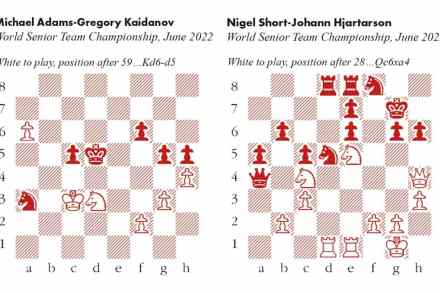
The ‘English chess explosion’ that began in the 1970s produced a bumper crop of grandmasters, which meant that by the late 1980s, England was second only to the Soviet Union in international team events. Those days are behind us, but the march of time means that England is now a force to be reckoned with in senior team events. The World Senior Team Championship took place last month in Acqui Terme, Italy. England’s over-50s team got a boost from the addition of Michael Adams, who reached that milestone last year. With Nigel Short, Mark Hebden, John Emms and Keith Arkell, they began the event as top seeds. In the fourth round, they saw off a serious challenge from the second seeded USA, with its team of emigrants from the former USSR.

No. 710

From our UK edition

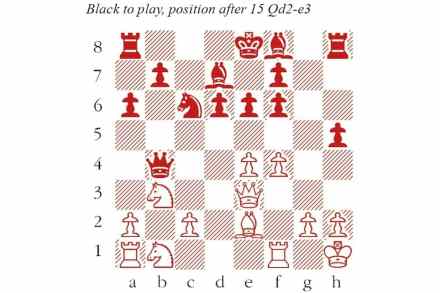
White to play. J. Polgar-Carlsen, Casual blitz game, Madrid 2022. Carlsen’s last move 15…Ra8-c8 was a losing blunder. How did Judit Polgar exploit it? Answers should be emailed to chess@spectator.co.uk by Monday 11 July. There is a prize of £20 for the first correct answer out of a hat. Please include a postal address and allow six weeks for prize delivery. Last week’s solution 1 Be5! Black resigned.

Nepo’s playbook

From our UK edition

Ian Nepomniachtchi is back for more. The former world championship challenger left his rivals in the dust at the Candidates tournament in Madrid, seizing victory with a round to spare. So he will once again challenge Magnus Carlsen, in a world championship match slated for 2023. Or will he? A few weeks after beating Nepomniachtchi the first time around (in Dubai 2021), Carlsen stoked some intrigue when he stated: ‘It is unlikely that I will play another match unless maybe if the next challenger represents the next generation.’ ‘Nepo’ does not fit the bill; at 31, he is the same age as Carlsen.

No. 709

From our UK edition

White to play. Miles-Pritchett, Lloyds Bank Masters 1982. Tony Miles found a powerful counter to the queenside threats. What did he play? Email answers to chess@spectator.co.uk by Monday 4 July. There is a prize of £20 for the first correct answer out of a hat. Please include a postal address and allow six weeks for prize delivery. Last week’s solution 1 Ke6! Wins, e.g. 1…Nc6 2 Kf6 Nd8 3 h7+ Kh8 4 Ke7 Nc6+ 5 Kf8. The game went 1…Nd3 and after 2 Kf6 Kh8 3 h7! Black resigned, e.g. 3…Nf4 4 g7+ and Kf7.

Maximum mischief

From our UK edition

Forbidden things have a secret charm – that delicious paradox applies to the chessboard just as it does in life. Moves which appear to be unthinkable (for example, when the piece in question can be readily captured) can create a strong aesthetic effect. Composers of chess problems often make great play of this fact – so much so that it is a useful rule of thumb for a solver. If you spot a move which appears to be prevented for several reasons, there’s a good chance you have your solution. Once in a while, this pursuit of maximum mischief proves its worth in practical play as well.

No. 708

From our UK edition

White to play. Rezasade-Movsesian, Bundesliga 2022. White was an underdog in this game, but found a subtle winning idea. What did he play? Answers should be emailed to chess@spectator.co.uk by Monday 27 June. There is a prize of £20 for the first correct answer out of a hat. Please include a postal address and allow six weeks for prize delivery. Last week’s solution 1 Qxh5+! Kxh5 2 Bf7#.

Cream of the Candidates

From our UK edition

The Candidates tournament is underway in Madrid, where eight of the world’s best players vie for the right to challenge Magnus Carlsen in the World Championship. As the event began, Carlsen gave his judgment on each player’s prospects, dividing them into three tiers. Tier 1: Fabiano Caruana and Ding Liren are ‘the best and most consistent’. Tier 2: The ‘dark horses’ are Ian Nepomniachtchi, winner of the previous Candidates event, and Alireza Firouzja, whose meteoric rise last year took him to no. 2 in the world rankings (though since overtaken by Ding). Tier 3: The rest – Richard Rapport, Jan-Krzysztof Duda, Hikaru Nakamura and Teimour Radjabov. Of course, none of the latter players is an easy mark.

No. 707

From our UK edition

White to play. Trent-Carlstedt, Hamburg 2022. Lawrence Trent spotted a way to deliver a quick mate. Which move did he play? Answers should be emailed to chess@spectator.co.uk by Monday 20 June. There is a prize of £20 for the first correct answer out of a hat. Please include a postal address and allow six weeks for prize delivery. Last week’s solution : 1 Rc1! with the idea 1…Kb8 2 Kxb6 Ka8 3 Rc8# After 1…b5 or 1…Ka8 White plays 2 Kc7!

Have they spotted it?

From our UK edition

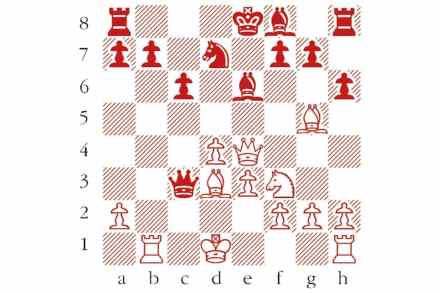
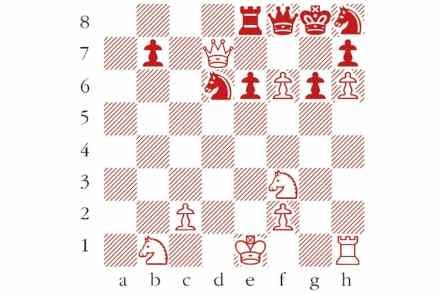
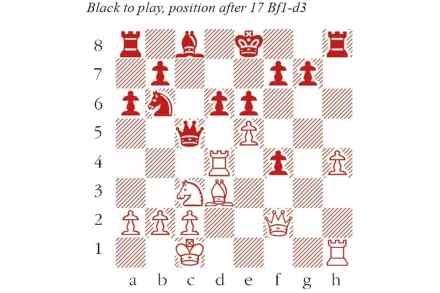
Returning to the board, Mamedyarov looks at Anand’s outstretched hand with bemusement. It can’t be a draw offer – that would be a rude way to do it, and besides, the tournament rules prohibit an early peace treaty. No, Anand is resigning! He looks crestfallen, like a child whose ice cream has fallen to the ground. Mamedyarov pauses before taking his hand, and now Anand looks puzzled by his opponent’s hesitation. Here is the position: Vishy Anand-Shakhriyar Mamedyarov Norway Chess, June 2022 (See left diagram) Anand had just played 22 Qd3-b5, which pressures e8 and b7. No sooner had he played it than he spotted the flaw – Black can win on the spot with the brilliant 22…Qxf3+!, since 23 Kxf3 Nh4 is mate.

El Ajedrecista

From our UK edition

Gilberto Rodriguez Orejuela, ‘El Ajedrecista’, died in prison in the United States on 31 May. The Colombian drug lord, a leader of the Cali cartel in the 1990s, acquired his splendid nickname, which translates as ‘the Chess Player’, on account of his ability to stay a step ahead of his rivals and pursuers. Curiosity sent me hunting for more information, and in doing so I stumbled into an unexpected rabbit hole. For it turns out that ‘El Ajedrecista’ was also the name given to a primitive chess-playing automaton, designed by a Spanish engineer, Leonardo Torres y Quevedo, and unveiled at the University of Paris in 1914.

No. 706

From our UK edition

White to play and mate in 3. Composed by Sigmund Franz Josef Lehner, 1864. There are several ways to give mate in 4 moves, but it takes a delicate finesse to get the job done in 3. What is White’s first move? Answers should be emailed to chess@spectator.co.uk by Monday 13 June. There is a prize of £20 for the first correct answer out of a hat. Please include a postal address and allow six weeks for prize delivery. Last week’s solution 1 Bf4!

No. 705

From our UK edition

White to play. Giri-Praggnanandhaa, Chessable Masters 2022. A game from the preliminary stages. What did Giri play to induce resignation? Answers should be emailed to chess@spectator.co.uk by Monday 6 June. There is a prize of £20 for the first correct answer out of a hat. Please include a postal address and allow six weeks for prize delivery. Last week’s solution 1…Qe2! If 2 Rxe2 Rb1+ 3 Bf1 Rxf1 mate Last week’s winner Ashley Murphy-Elliott, Oakworth, W.

A rising star

From our UK edition

Ding Liren took first place at last month’s Chessable Masters, the fourth event in the 2022 Meltwater Champions Tour. But it was his defeated opponent in the final, 16-year-old Rameshbabu Praggnanandhaa from India, who stole the show. The teenager’s reputation is already well established, and he made headlines in the (non-chess) media in February when he beat Magnus Carlsen in a rapid game at the Airthings Masters, the first event in the tour. Remarkably, at the Chessable Masters, he added a second victory over Carlsen, who blundered in an almost even position in their game from the preliminary stage. Even more impressive were the scalps he took in the knockout stages. In the quarter finals he scored a 2.5-1.