Lloyd Evans

Lloyd Evans

Lloyd Evans is The Spectator's sketch-writer and theatre critic

PMQs sketch: John Bercow’s bid for stardom continues

From our UK edition

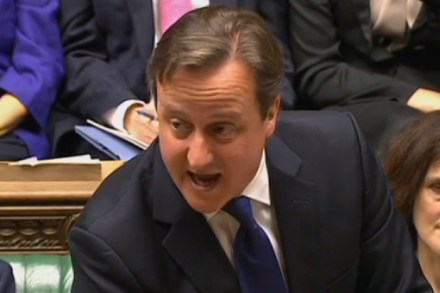
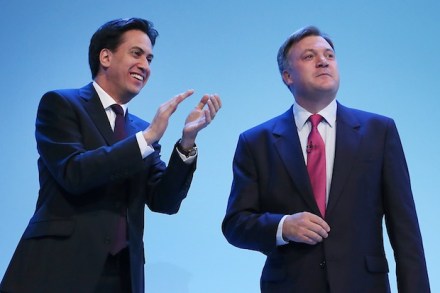
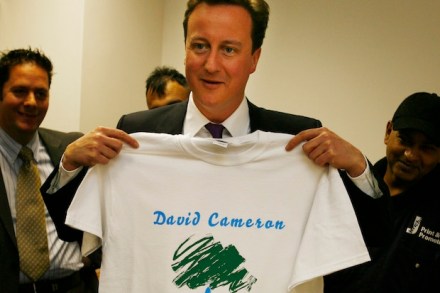
Nope. Nothing doing. Ed Miliband spent all morning racking his brains but he couldn’t think of a single disaster to pin on David Cameron at PMQs. So he made one up. A crisis, he declared sonorously, is about engulf the NHS this winter. Our A&E departments will soon be overwhelmed by flu-victims expiring on trolleys and frost-bitten pensioners spilling out of broom cupboards. He dared the prime minister to deny it. Forget this winter, said Cameron, there’s an NHS crisis already. And it’s happening in Wales where Labour is in control of the health service. This spiked Miliband’s guns. He was about to claim that the crisis had already begun in England. Instead, he accused Cameron of failing to hit his NHS targets ‘for 15 consecutive weeks.

Toffs rule! 

From our UK edition

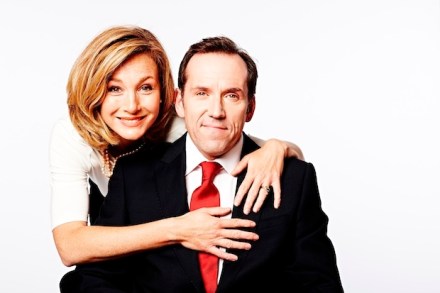
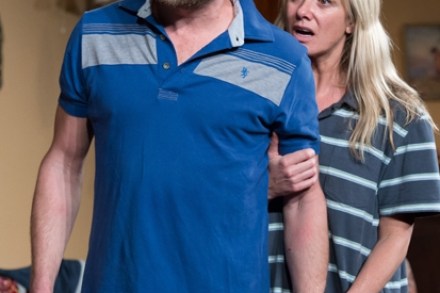
This is a strange one. Simon Paisley Day’s new play feels like a conventional comedy of manners. Three couples pitch up at a Welsh cottage for a relaxing weekend away from the kiddies. Trouble erupts instantly. Keith and Briony bicker over the milk that the swollen-breasted Briony has to express into plastic bottles. Keith secretly craves his wife’s ‘liquid love’ and he tiptoes around the cottage trying to glug it back without being spotted by the others. Ross and Rosy arrive. They’re an achingly smug yuppie twosome. They finish each other’s sentences. They tee up each other’s anecdotes. They stand in the kitchen entwined in each other’s arms and gaze out at their friends like kittens on a Christmas card.

PMQs sketch: Ed Miliband’s fuel bill and Labour’s trappist vow on public finances

From our UK edition

It was a doddle for Ed Miliband at PMQs this afternoon. The nation watched agog yesterday as the energy companies deployed a handful of silk-lined suits to justify their price hikes to a parliamentary committee. Miliband arrived at the house knowing that victory was simple. He just had to fuse the Tories and Big Energy in the public mind and then sit back and enjoy the results. But he got ambushed by David Cameron who had a surprise document up his sleeve. Miliband’s fuel bill. First Cameron reminded us of his advice to consumers last week. ‘Switch your energy company and save £200.’ This idea had been instantly derided by the Labour leader. Yet he himself had just changed supplier. Cue Tory hilarity. Cameron twisted the blade.

Zoë Wanamaker: We need more giants like Obama

From our UK edition

It’s all true about Zoë Wanamaker. She’s like a wood-nymph from the Tolkien franchise. Pixie features, nut-brown eyes, a mischievous tight-lipped smile and a warm cackling laugh. Next week she makes a guest appearance at the Hampstead Arts Festival to discuss her acting career. Had she heeded the advice of her parents — Sam Wanamaker and the Canadian actress Charlotte Holland — she might never have followed them on to the stage. ‘You don’t want to go into that. It’s full of disappointment and rejection,’ they told her. ‘Do something else. Get a proper job.’ Wanamaker’s idea of a proper job was to become a painter. ‘I went to art college for a year to learn to develop my painting technique.

The Light Princess badly needs a mission

From our UK edition

There are many pleasures in The Light Princess, a new musical by Tori Amos. George MacDonald’s fairy story introduces us to a beautiful red-haired royal, Althea (Rosalie Craig), who has a mysterious resistance to gravity. After various tribulations she abandons life on dry land and becomes a mermaid. The show meets these technical challenges with some brilliance. Althea seems to float mysteriously across the stage in midair while being supported on the limbs of black-clad gymnasts. Later she moves to a lake, which is suggested by intricate layers of shimmering blue cloth. But despite the sumptuous and ingenious special effects, the show hasn’t a powerful enough storyline or sufficient character interest to become a hit. The engine-room is absent.

PMQs sketch: Cameron is a buffoon who might as well eat his own manifesto

From our UK edition

At PMQs today, the Tories’s energy policy went bi-polar. The Conservatives now seem to touch both extremes of the debate. For eight years they’ve presented themselves as a gang of happy tree-huggers who applaud every green subsidy going. But today David Cameron announced his plan to ‘roll back some of the green regulations and charges’. John Major started it all. Yesterday he lurched back into front-line politics by suggesting that energy companies should pay a windfall tax this winter. Otherwise, he said, the poor will have to choose between starving or freezing to death. Number 10 called this bombshell ‘interesting’. Ed Miliband asked David Cameron if John Major was now a Marxist. ‘Has he been claimed by the red peril?

Did gay Conservatives have it easier in the past? Tory Boyz makes me think they did

From our UK edition

Bang! The race is on. James Graham is the celebrated author of This House, a superb examination of Labour’s administrative bellyflops during the 1970s, which premièred at the National last year. Some time ago, Graham was asked to update his 2008 play, Tory Boyz, about homosexuality in the Conservative party. Over the same period, the Tories have been furiously updating themselves. Who will embrace the future first? Graham’s play is a blend of then and now. He imagines an openly gay youngster working in the Tory policy unit, and he compares his experience with Ted Heath’s career in the 1950s. (That Heath was gay is taken for granted.) But the sprint is over before it’s even begun.

The Labour education secretary who could have been Britain’s first woman PM

From our UK edition

Decent, clever, charming, eloquent, hard-working, conscientious and terribly, terribly nice, Shirley Williams is one of Britain’s best-loved politicians. Mark Peel’s admiring biographybegins in Chelsea in 1930. Shirley, as he matily calls her, was the eldest daughter of the political philosopher George Catlin and the bestselling author Vera Brittain. Life at home was affluent, comfortable and high-minded. The Brittains were privileged toffs who set out to remove privileges from toffs they felt lacked their idealism and sophistication. Shirley’s support for this manifesto achieved a stridency that sometimes grated even on her mother. Vera complained to a friend that the 16-year-old Shirley kept me up till 2 a.m.

PMQs sketch: Exaggerations, solecisms and clangers

From our UK edition

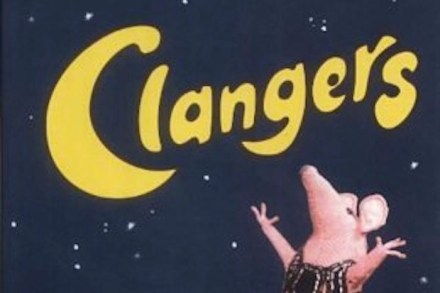
The Clangers are back. And not just on television. At PMQs, both the party leaders tried to embarrass each other with solecisms, exaggerations – and, yes, clangers – which they’d dropped in the past. Ed Miliband led with the cost of living crisis and said ‘record numbers are now working part-time’. Cameron retaliated with a Miliband prediction from October 2010. ‘The government programme will lead to the disappearance of one million jobs,’ Wrong! A million jobs have been created. Miliband brought up his pet-policy, the energy bill freeze, and accused Cameron of supporting the Big Six fuel giants. A price con, not a price freeze, said Cameron. And why had Miliband not parked our bills in the chiller-cabinet while he was Energy Secretary?

Question Time sketch: Adam Afriyie proves his enemies right

From our UK edition

Question Time last night featured Tory bad boy, and granny’s favourite, Adam Afriyie. Gosh he was a spectacle to behold. Coiffed and primped like a Savile Row supermodel, he looked as if he’d spent six months in makeup. His tailored suit was as smooth as Clingfilm. His hair was a combed flap of silvery darkness. His flawless white shirt was set off by a knotted tie of regal purple that nestled at his throat like a priceless jewel that faraway brigands are plotting to steal. Surely, one thought, this is not a politician. This is a kidnapped prince in a Tintin story. Afriyie has learned some of the rough-and-tumble skills.

An audience with the Queen and Mrs Thatcher

From our UK edition

A feast of pleasures, and some annoyances, at the Trike. Handbagged, by Moira Buffini, is a fictional account of the weekly audiences between Mrs Thatcher and the Queen. The staging is extremely odd. Buffini gives monarch and prime minister two impersonators each. This enables us to trace the minor developments in hair colour and frock choice between 1979 and 1990. But also encourages the pairs of actors to outdo each other. Here are the results. Marion Bailey plays the older Queen as an unbudgeable human lighthouse. The facial gestures are beautifully done and Bailey gets that stoical out-thrust lip pout that has become the Queen’s signature grimace in recent years.

PMQs sketch: Ed Balls leaves them wanting more

From our UK edition

Here’s a favourite Tory joke. Question: What does ‘BBC’ stand for? Answer: Buggers Broadcasting Communism. David Cameron seemed tempted to try this gag at PMQs today. He mentioned the Beeb four times in sardonic asides. ‘Let’s praise the BBC for once,’ he said, bitingly. He woke this morning, he said, to a BBC report stating that public satisfaction with council services had risen despite the cuts. ‘I thought I’d died and gone to heaven.’ He berated Ed Miliband for wanting to introduce new decarbonisation targets. ‘Even the BBC doesn’t agree with that.’ And he attacked Milband’s promise to freeze energy bills as evidence that ‘he’d like to live in a Marxist universe.

Sketch: Question Time is no longer an honest debating chamber

From our UK edition

A good honest debating chamber. That’s how Question Time is billed. In fact it’s an unseemly gold-rush for applause. The panelists are a set of needy egos with semi-fictionalised hairdos. And the audience is composed of wonks and party activists posing as disinterested voters. Last night’s episode was particularly fractious. The crowd was keen to hear about the Daily Mail’s attack on Ralph Miliband ‘as the man who hated Britain.’ But the first question concerned benefit reductions for the under-25s. Quentin Letts, of the Mail, seemed uncharacteristically nervous. He said his ‘prejudice’ would be to target cuts on the young rather than the elderly. He meant ‘preference’. Rather a shaky start.

The peril with Brecht is that he will always be Brecht

From our UK edition

Brecht in the West End? Quite a rarity. Jonathan Church’s zippy and stylish version of The Resistible Rise of Arturo Ui arrives from the Chichester Festival garlanded with plaudits. Brecht’s wartime allegory was intended as a warning to America that its idolisation of gangsters made it vulnerable to a fascist takeover. Ui begins as a petty criminal mocked by Chicago’s established hoodlums. To revive his fortunes, he orders his thugs to vandalise grocery shops and to extract protection money from their owners. This brings him into conflict with Chicago’s mighty Cauliflower Trust. A huge warehouse belonging to a leading merchant is burned to the ground and Ui orchestrates a show trial that enables him to abolish the civil authority and seize control of the city.

Barking in Essex: a hit with hen-night hysterics

From our UK edition

How appropriate. Barking in Essex, a farce about gangsters, has been dishonestly billed as ‘a new comedy’. The script was written in 2005 by Clive Exton (1930–2007), who pre-dates Woody Allen by half a decade. The storyline — thieves quarrel over stolen loot — is a trusty antique featured in ‘The Pardoner’s Tale’ and in Tarantino’s Reservoir Dogs. The plot moves fast. We open in a monstrously tacky mansion where a criminal matriarch, Emmie Packer, is in a flap. She’s just informed her son Darnley, and his wife, Chrissie, that she’s blown three million quid from a bank heist and the robber is on his way to claim the loot. Run for it! A pretty young lawyer, Allegra, arrives.

A grand tour in a glass

From our UK edition

What a challenge. To travel across Italy in an afternoon of wines. I arrived at the soaring spaces of Lindley Hall in Victoria, where Berry Bros & Rudd had assembled 43 growers from 11 regions for its Grand Tour, Italy 2013. Master of ceremonies David Berry Green strolled among the tables tasting and gossiping, introducing old friends to new. An Englishman living in Barolo, Piedmont, David is a lean, towering figure who looks like the youthful Jeremy Irons. His passion is infectious. After chatting to him for ten minutes, I felt I’d watched a documentary about Italy. Wine, he told me, was imperial Rome’s secret weapon. The Romans conquered with the sword but pacified with the grape.

Hysteria is a pile-up of unmotivated absurdities

From our UK edition

Terry Johnson’s acclaimed farce Hysteria opens in Sigmund Freud’s Hampstead home in 1938. The godfather of psychobabble is ambushed by a beautiful maniac named Jessica, who forces him to analyse her, and then hides in his closet and strips naked. Along comes Freud’s old chum Yahuda, a bumbling twerp who doubles as the farce’s authority figure. His presence forces Freud to improvise countless daft wheezes in order to prevent Jessica from being discovered. You may wonder if Freud is the best candidate to star in this kind of sex caper. And you’d be right. He is, in fact, the worst candidate.

Theatre review: Fleabag’s scandalous success

From our UK edition

Suddenly they’re all at it. Actors, that is, writing plays. David Haig, Rory Kinnear and Simon Paisley Day are all poised to offer new dramas to the public. But someone else has got there first. You may have spotted Phoebe Waller-Bridge playing a secretarial cameo in The Iron Lady. She’s a rangy Home Countries brunette with rosy lips, large inviting eyes and an angular, forthright face that suggests intelligence, amusement and a hint of subversive sexual power. Her immaculate skin is as white as a snowdrop. All in all, she’s perfectly set up for a steady career in frocks and pearls playing Downton gold-diggers and hyperventilating Jane Austen virgins. But she seems to want more, something wilder, something weirder, from her profession.

PMQs sketch: All Miliband has left is food banks and class war

From our UK edition

Tough times for Ed Miliband. He looked pretty glum at the start of PMQs. Was he wishing that Syria had developed in a different direction? A few weeks of statesmanlike ‘unity and consensus’ – while Assad got his wrists slapped by a volley of Tomahawks – might have suited him better. Instead he was forced onto the domestic agenda. And it’s turning into quicksand. All his best accusations have been sucked into the mire. He can no longer mention the following: flat-lining, Plan B, the double dip, the bedroom tax, the benefit cap, cutting too fast and too deep. As for his trustiest platitude – ‘a recession made in Downing Street’ – that now sounds as quaint as ‘dial-up’ or ‘Suffragette’. Is anything left?

Sketch: Dancing on the head of a BBC pin

From our UK edition

The BBC’s managerial superstars, past and present, arrived at the Public Accounts Select committee yesterday afternoon to answer questions about executive pay. Like a frightened flock of geese they all began waddling in the same direction. Away from responsibility. Up first was Mark Thompson. The former D-G had jetted in from New York and his aim was to exonerate himself with a bulldozer strategy. ‘I paid senior staff fortunes to remove them swiftly. Delay would have cost more. I saved the BBC millions. I was brilliant. No one can touch me. Beat that.’ The Thompson tank was very effective and flattened all questioners. The issue then turned to the BBC Trust’s ability to hold the executive to account.