Lloyd Evans

Lloyd Evans

Lloyd Evans is The Spectator's sketch-writer and theatre critic

Bid low, break even

From our UK edition

A new Seagull lands in Regent’s Park. Director Matthew Dunster has lured Chekhov’s classic into a leafy corner of north London to see if it needs an upgrade. The new script, by yuppie-baiting playwright Torben Betts, is casual, slangy and sometimes gauche. Favourite moments have been struck out including the great opening line, ‘Why do you always wear black?’ And Betts decides to make Chekhov’s characters swear. ‘Bollocks’, ‘piss off’. I don’t know Russian but I’m sure Chekhov didn’t need coarse language to portray coarse souls. The outside staging has been jazzed up too. A clunking great mirror hangs over the playing area like a bit of broken satellite.


PMQs Sketch: Airports and angry Nats

From our UK edition

Chooom! Davies has arrived. Sir Howard’s report made a text-book landing on the PM’s desk yesterday afternoon and began taxiing towards Cameron’s in-tray. But the PM hasn’t read it yet. Or so he claimed at PMQs. He therefore avoided any commitment to building a third runway at Heathrow. And his excuse? Wilful ignorance. Seriously? He hasn’t read it? Given the time and cash the damn thing has gobbled up he might have glanced at the executive summary. Sir Howard has worked his way through twenty million smackers reaching a foregone conclusion. His defenders point out that this money was very well spent because Sir Howard pays scrupulous personal attention to every detail of an important commission.

Common sense suggests Britain’s economy doesn’t depend on the EU

From our UK edition

They say you have to be nearly 60 to have voted in the 1975 referendum. I voted in that referendum. I was 12. My mum had forgotten her glasses. We were a Labour household and as we left the polling station she said, ‘You did vote “in”, like Harold Wilson suggested?’ ‘No,’ I replied, ‘I’m with Tony Benn. I want “Out”’. Benn wasn’t right about much but he asked three good questions about the Common Market. Who appointed these people? What are the limits to their power? How do we get rid of them? Satisfactory answers are still unforthcoming. And his clear-headed approach may persuade others of the need to quit. Common sense suggests that our economy doesn’t depend on the EU.

Savile exposed

From our UK edition

Ho hum. Bit icky. Not bad. Hardly dazzling. The lukewarm response to An Audience With Jimmy Savile has astonished me. This is the best docudrama I’ve seen on stage. From the early 1970s, Britain swooned before Savile. Marketing pollsters found him the country’s best-loved celeb (bar the Queen Mum). He enforced his influence by winning over several establishments at once, the royals, the Beeb, the NHS, the media, the charity sector, Westminster. Evidence of his criminality existed but it never affected his reputation. He’s the nearest we’ve come to Hitler. The show takes the format of a TV biography which is intercut with scenes from Savile’s early life and testimony from his victims. Alistair McGowan’s ownership of Savile’s persona is astounding.

At this rate Labour won’t even be a debating society in five years time

From our UK edition

The phoney war continues. While Labour searches for its next Michael Foot, the party’s stand-in boss, Harriet Harman, seems keen to lose the 2020 election as soon as possible. Some argue Ed Miliband has already performed that task. Either way, defeat is the only thing Labour does efficiently nowadays. Ms Harman attacked the PM’s plan to abolish a policy that many hail as Gordon Brown’s Worst Ever Idea: tax credits. These mean that thousands of Whitehall scribblers deposit cash with workers who then return the money, via thousands more scribblers, to the government which never owned it in the first place. Labour loves the N Korean ambience of this system because it turns every citizen into a state vassal.

Own goal

From our UK edition

For nine years Patrick Marber has grappled with writer’s block (which by some miracle doesn’t affect his screenplay work), but the pipes are now ungummed and wallop! his new bolus of creativity splatters across the Dorfman stage. It’s a wordy three-hander set in the swamp of non-league football. Marber brilliantly captures the grubbiness and despairing optimism of ageing sportsmen who inhabit a golden age that never was. We meet Kidd, a hopeless but garrulous manager, as he tussles with Yates, a lugubrious old kit-man, for a controlling stake in a dazzling young talent, Jordan. The emotional terrain is lifted directly from Pinter and Mamet: male losers fighting over scraps of nothing.

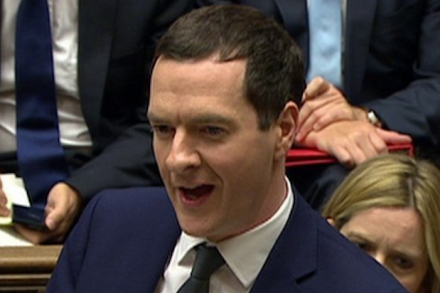
PMQs sketch: He lays roads. He decrees bridges. Is there anything George Osborne can’t do?

From our UK edition

At last it happened. Benn led Labour. Hilary Benn, grandson of a hereditary peer, stood up at PMQs on behalf of the dispossessed. Gravitas was his chosen register. Radicalisation was his chosen theme. His policy: more cash for cops and teacher to discourage Muslims from joining the death-cult. Let’s hope it works. The SNP’s Angus Robertson asked how Sir John Chilcot is proceeding with his slim volume of research into the Iraq war. Who knows? It’s said that Lord Lloyd Webber has already abandoned his ‘Chilcot the Musical’ project because investors couldn’t agree how many years each performance should last. His spokesman, pressed this morning for a deadline, confirmed that the report will appear, ‘before the decade is out.

Fine producers who don’t employ disabled actors and actors will just learn how to fake disability

From our UK edition

Jenny Sealey, director of Graeae Theatre Company, has had a brainwave. Fine producers who don’t employ disabled actors. She’s particularly concerned about the failure of opera directors to hire performers with impaired sight and hearing: ‘There is no diversity whatsoever inside those opera houses. And that is disgusting.' She wants her new fines siphoned into ‘a training pot so that we can be training deaf and disabled artists.’ Her company, by the way, trains such performers. And that’s fair enough. Nick your rivals’ lunch and eat it yourself. Standard practice in most industries. But the Sealy Code may not prove entirely workable. First of all, fines need to be policed and enforced. And a system of appeals will be required as well.

Hard reign

From our UK edition

King John arrives at the Globe bent double under the weight of garlands from the London critics. Their jaunt up to Northampton for the première seems to have cast an opiate glaze over their faculties. Plays that are rarely revived earn their hermit status for a reason. They lack social skills or winning graces. They’re hard to get on with. Shakespeare launches his account of the bad king’s ‘troublesome raigne’ by exploring the shadowy crenellations of Plantagenet genealogy. A decent cast performing at full whack to an eager crowd couldn’t keep my brain engaged. After 70 minutes, the folds of my eyes were feeling as heavy as piano lids. Then, a sensation. A scene of extraordinary force and daring.

PMQs sketch: Dave gloats in front of Saint Hattie

From our UK edition

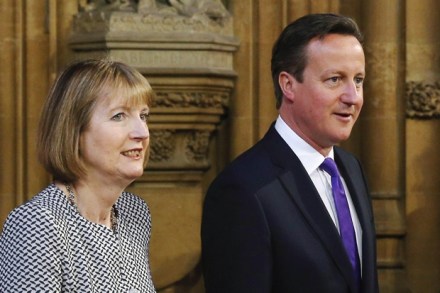
Poor old Labour. They’re still so crushed by the election result that they put up dead-parrot Harriet Harman against Cameron every Wednesday. Why not let the leadership candidates use him for target practice instead? PMQs is sometimes a contest of ideas and sometimes a contest of insults. Today it was a contest of moral registers. Harman asked about the EU referendum and Cameron scoffed at her colleagues for voting en bloc for a referendum they’ve opposed for five long years. ‘The biggest mass conversion since that Chinese general baptised his troops with a hose pipe.’ Harman was off. She scrambled to the top of Sanctimony Hill and delivered a sermon on the mount. Cameron was the prime minister, she conceded. ‘He won the election.

Close encounters | 4 June 2015

From our UK edition

In October 2011 anti-capitalist vagrants built an open-air squat outside St Paul’s within shrieking distance of London’s financial heart. The City thrummed all night with the dob-dob-dob of bongo recitals while the rebels held angry debates beneath their plastic canopies and declared the Square Mile knee-deep in ordure. To press the point they used nearby alleys for their ablutions. This half-forgotten protest has become a play in which the central figure, the dean, has to choose between evicting and accommodating his crusty tenants. Conscience informs him that the noisy campers are Christ’s spiritual heirs. But temporal responsibility obliges him to heed his Square Mile parishioners and sweep the ragamuffins from the City’s doorstep.

PMQs sketch: And they’re back

From our UK edition

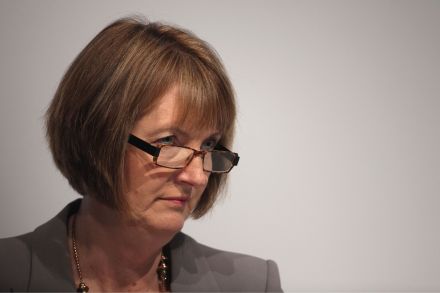
‘Don’t gloat’. Cameron trotted along to the Commons today with this commandment ringing in his ears. He nearly managed it. But his manner betrayed his state of mind. There was an audible zing, an irrepressible sunniness in his voice as he inaugurated his second term. ‘This morning I had meetings with ministerial colleagues and others.’ Rarely has that formula held such a fizzy, cocaine kick. Labour’s acting leader, for now, is Harriet Harman. Is she about to pack it in? She seemed passionless and out of sorts. A scowl kept stealing across her lips as she delivered her joke-free lines. She was like a disgruntled lady mayoress opening a fete in a June downpour. Come on Hattie! That’s not the Labour way. Not at all.

One foot on the catwalk

From our UK edition

St James Theatre hosts a new play about Alexander McQueen (real name Lee), whose star flashed briefly across the fashion world before his suicide in 2010. It opens with a mysterious stalker, Dahlia, breaking into McQueen’s Mayfair home and demanding that he make her a dress. ‘I’m calling the police,’ he shrieks but she placates him and they embark on a surreal odyssey to his childhood haunts where they meet his mentors past and present. A pretty clunky start. Who is Dahlia? A dramatic ploy, a figment of McQueen’s imagination or a real person? We don’t know so we don’t care about their relationship. Still less about her flipping dress.

Yank bait

From our UK edition

Here come the Yanks. As the summer jumbos disgorge their cargoes of wealthy, courteous, culture-hungry Americans, the West End prepares to bag a fortune. Death of a Salesman is just the kind of timeless post-war classic that Americans adore, isn’t it? Not quite. Arthur Miller is mistrusted in his homeland. For starters he was a closet pinko who kept the closet door wide open. He was wooed by Hollywood but spurned every inducement. He married Marilyn Monroe and failed to make her happy. And top of the chargesheet is this play, which proposes that the American dream is a con, a swindle, a diabolical cruelty that hounds mortals to death by engorging their bellies with fantasies of happiness. It’s a superb artefact but relentlessly uncomfortable to sit through.

Will anything go right for Nigel Farage?

From our UK edition

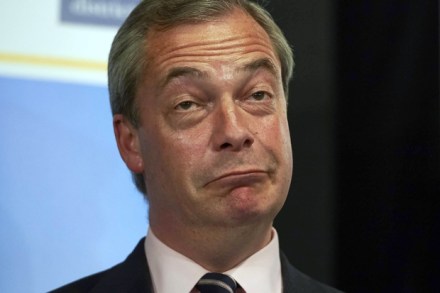
Anxious viewers tuned into Question Time last night to watch live coverage of the ongoing Nigel Farage crisis. Quite a week for the Ukip leader. Up and down. In and out. And back in again. His pitch for a Westminster power-base imploded on election day. And he promptly quit, as promised. But his resignation fared no better than his parliamentary campaign. His withdrawal was rejected. Won’t anything go right for him? He explained to a glum audience in Uxbridge that after losing South Thanet he retreated to ‘a darkened room’ to examine his future. ‘I was going to walk out of there a free man but they dragged me back!’ This jaunty account received not a bat’s squeak of laughter from the crowd.

Four play | 14 May 2015

From our UK edition

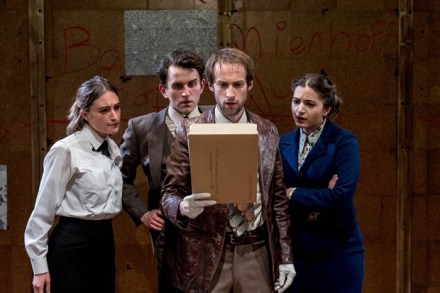
If Julian, Dick, George and Anne had become terrorists they’d have called themselves The Angry Brigade. It’s such a Wendy house name. The quartet of violent outcasts met in a Camden squat in the late Sixties and moved to Stoke Newington where they rented a house to deflect unwanted attention. They began planting bombs around London in the hope of jerking the proles from their consumerist trance and sparking a communist war. They preferred catchy locations for their fireworks: the Albert Hall, a BBC film unit, an MP’s garden. And it took the cops ages to track them down and sling them in jail. James Graham’s new play uses a neat staging device. There are four terrorists and four detectives, and the same actors play both hunters and quarry.

Shakespeare’s duds

From our UK edition

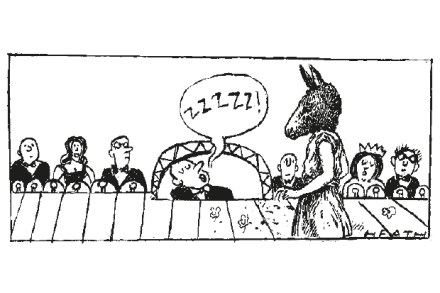
I love Shakespeare. But when he pulls on his wellies and hikes into the forest I yearn for the exit. A Midsummer Night’s Dream has a moonlit, sylvan location populated by a syrupy crew of hectic fairies, humourless bumpkins, panting maidens and swooning aristocrats in disguise. Shakespeare wrote it during his apprenticeship and he had yet to learn that several romances are far less interesting than just one. The result is a cloying, over-busy fantasy whose highlight is a love potion that makes a sprite called Titania fall in love with a donkey called Bottom. If you find the passion that flowers between a Sloane-y dryad and a pack animal hilarious then poor you.

Channel 4’s The Vote reviewed: ‘complex, acute, very funny and oddly moving’

From our UK edition

He’s back on top form. James Graham has taken the unlikeliest setting, a polling station during the last hour of a general election, and turned it into a beautifully crafted comedy drama. The Vote at the Donmar was broadcast on Channel 4 last night at 8.30 p.m. We’re in a knife-edge London marginal constituency where a polling blunder has been uncovered. A wizened pensioner voted twice by accident. Once in his brother’s name, once in his own. Panic stations. Democracy is threatened. Kirsty, an excitable teller, tries to even up the score by persuading a relative who hasn’t voted to cast his ballot under her discreet direction. This he does. But he votes for the wrong party. Now two extra votes are needed.

Pinter without the bus routes

From our UK edition

David Mamet is Pinter without the Pinteresque indulgences, the absurdities and obscurities, the pauses, the Number 38 bus routes. American Buffalo, from the 1970s, is one of Mamet’s early triumphs. Don is a junkshop owner who believes a customer cheated him over a rare nickel so he gets his young pal Bob to steal it back. An older friend, Teach, persuades Don to ditch Bob and let him commit the burglary. That’s it. That’s all that happens in this narrow, gripping thriller, which takes the brutal male culture of the Wild West and imports it to the Chicago slums where three lonely outcasts fight desperately for scraps of cash and friendship. On paper it all sounds grey, miserable and petty. On stage it’s magnificent, multicoloured, vast and tragic.

State of play

From our UK edition

Writers and producers have shown little appetite for putting the coalition on stage. Several reasons suggest themselves. In 2010 wise pundits assured us all that the Rose Garden duo would squabble and part long before the five-year term expired, and theatre folk were persuaded not to gamble on a ship that might sail at any moment. And the conduct of parliamentarians has been pretty unhelpful to dramatists. Chastened by the expenses scandal, MPs have reinvented themselves as models of probity and self-restraint. The Commons has been all but free of sin. Eric Joyce cracked a few skulls. Nadine Dorries bunked off for a fortnight in the jungle. The occasional ex-minister has been caught hustling undercover hacks for a day or two’s work. Even the cabinet have behaved like nuns.