Lloyd Evans

Lloyd Evans

Lloyd Evans is The Spectator's sketch-writer and theatre critic

Party piece

From our UK edition

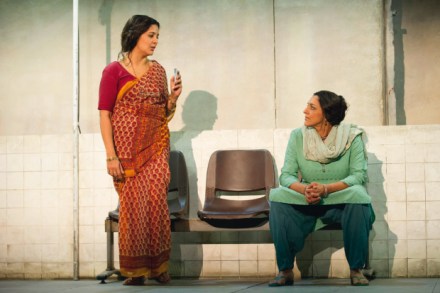
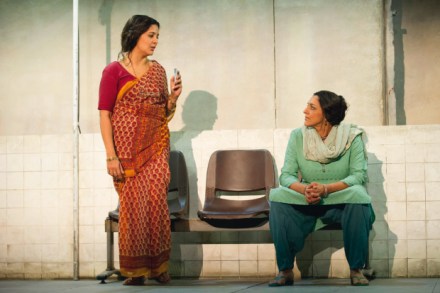
The National Theatre could hardly resist Barber Shop Chronicles. The play shines a light on a disregarded ethnic community, black urban males, who like to hang around in barber salons seeking friendship, laughs and tittle-tattle. Setting the play in a single venue would just be a sitcom, like Desmond’s, so the show establishes a series of shops stretching from London to the capitals of various sub-Saharan nations. This makes it a global epic. In theory, at least. In fact, it’s still a sitcom with some melodramatic bits on the end. The disjoined structure is tiresome at first as the action keeps legging it from Britain to Nigeria and Ghana and back again. Inevitably, the intellectual level is pretty undemanding, somewhere between music-hall and panto.

Fantastic Mr Fox

From our UK edition

Sand in the Sandwiches is the perfect show for those who feel the West End should be an intellectual funfair. It sets out to amuse, surprise, divert, uplift and nothing more. Edward Fox’s biographical portrait of John Betjeman has a smattering of his most famous poems ingeniously woven into the narrative. Fox knows his stuff. His shrill, elongated upper-middle-class accent is 99 per cent impersonation and 1 per cent exaggeration. He reminds us that when Betjeman said ‘Edwardian’ he rhymed the second syllable with card, not sword. From early boyhood Betjeman knew that poetry would be his trade. Aged 14, he read the sonnets of Oscar Wilde’s chum, Bosie, and judged them superior to Shakespeare’s. He sent the ageing poet an admiring letter.

Army surplus

From our UK edition

Georg Büchner, a justly neglected German playwright, died at the age of 23 leaving a half-finished script about a mad soldier and his cheating girlfriend. This relic has fascinated dramatists ever since because Büchner is regarded as a visionary left-wing artist cruelly stolen before his time. (Not a moment too soon, if you ask me.) Jack Thorne is the latest to rehash the leftovers. It’s 1981 and we’re in a divided Berlin. We meet a mopey British squaddie, Woyzeck, who shares a flat with his girlfriend from Derry who has the voice of a seagull and the personality of a dishcloth. The flat pongs because it’s located over a slaughterhouse. Bad choice. Let’s move, says Woyzeck. Great, says the Bogside dishcloth. This starts the story.

Jeremy Corbyn survives his trial-by-sofa

From our UK edition

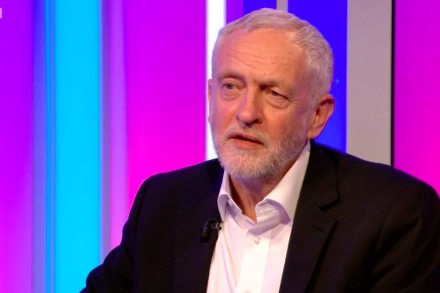
It started with a fib. Jeremy Corbyn endured a trial-by-sofa on BBC One last night and he was asked if there were ‘boys jobs’ and ‘girls jobs’ in his household. He shook his head. Which is a total porkie. He’d parked his missus at home while he answered questions on prime-time television. A clear division of labour. Boys speak up, girls shut up. The presenters were so soft on him they might have been members of his campaign team. Maybe they are. He was allowed to dodge the awkward issue of Brexit. ‘What’s the biggest thing you’ve changed your mind over?’ ‘What’s the biggest change in my life?’ he mused, deftly removing the toxic ingredients from the question.

Sado-erotic review

From our UK edition

The Olivier describes Salomé by Yaël Farber as a ‘new’ play. Not quite. It premièred in Washington a couple of years ago. And I bet Farber was thrilled at the chance to direct this revival at the National’s biggest and best equipped stage. She approaches the Olivier’s effects department like a pyromaniac in a firework factory. She wants everything to go off at once. And it does. Goatherds yodel. Bells bong. Flutes warble. Birds parp. A revolving conveyor belt twirls spare actors around the stage in dizzy circles. Chord surges swell and fade on the soundtrack. Kneeling shepherdesses sift mounds of soap powder into mahogany salad bowls.

Killing time | 18 May 2017

From our UK edition

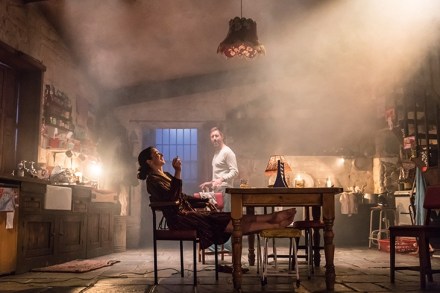
Jez Butterworth’s new play The Ferryman is set in Armagh in 1981. Quinn, a former terrorist, has swapped the armed struggle for a farming career and now lives with his sick wife, their countless kids, his sister-in-law and her only son. But the IRA, who murdered his brother as punishment for his disloyalty, are due to pay a visit with unknown intentions. More violence, perhaps? Protection money? Or both. Well, neither, it turns out. They merely want Quinn to refrain from blaming his brother’s death on them. Rather a low price to ask. And yet Quinn is willing to defy them even though he knows they repay disobedience with murder, and he now has a dozen vulnerable dependents to protect. These plot elements don’t quite stack up.

Sins of the flesh | 11 May 2017

From our UK edition

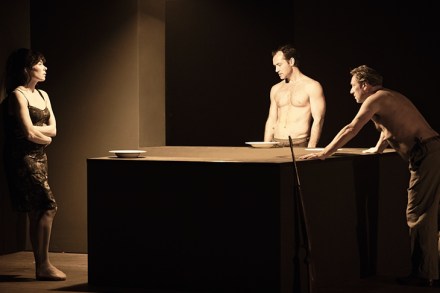
Obsession at the Barbican has a complicated provenance. The experimental Belgian director Ivo van Hove adapted the show from a Visconti film based on the novel The Postman Always Rings Twice. This version originated in Amsterdam and was rendered into English by a London playwright. The story mixes surrealism with torrid carnality. Sexy Hannah is married to nasty Joseph, who runs a failing hotel. Hunky Gino (Jude Law) seduces Hannah. Let’s elope, he suggests. No, says Hannah. Gino hangs around the hotel mending a truck engine parked by Joseph in the foyer. Gino gets the engine working and it soars upwards and hovers 30 feet in the air. But even with a miraculous levitating engine to attract the punters, the hotel remains empty.

Theresa and Philip bored the nation with their strong and stable relationship

From our UK edition

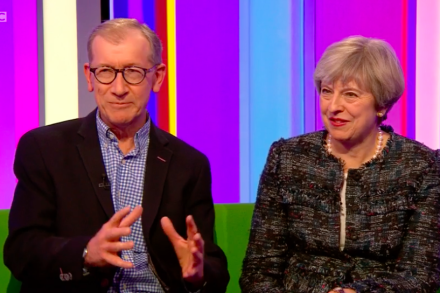
How was last night’s TV squirm-athon? The sacrificial victims handled it pretty well, at first. Theresa May and her unknown husband, Philip, were roasted live on a BBC sofa. The idea, presumably, was to make them seem relaxed, normal, unexciting, not too posh, at ease with themselves and, above all, genuine. Dull Phil sported a bland shirt, no tie, and a forgettable jacket. With his gnomish pallor and his thick-rimmed spectacles he resembled Sir Ian McKellen entering a Woody Allen lookalike contest. Mrs May was in headmistress mode. Her wandering lips – each has a life of its own – were painted in hard-Brexit scarlet. She wore a black-and-white tunic that looked like a pixellated chess board.

Masonic bodge

From our UK edition

Left-wing groupie Paul Mason has written a costume drama about the suppression of the Paris commune in 1871. We meet Louise Michel and her all-female gang of arsonists as they’re carted off to jail for setting fire to the Tuileries. After a harsh stint in the cells, they’re shipped out to the French colony of New Caledonia, in the eastern Pacific, where they live in an open prison. Things aren’t too bad. They mingle with the natives, enjoy the local hooch, and sing comradely songs about ‘spilling the blood impure’. Escape is on the agenda. A committee of anarchists is said to be making swift progress across the ocean in a rescue ship.

Pleasing pedantry

From our UK edition

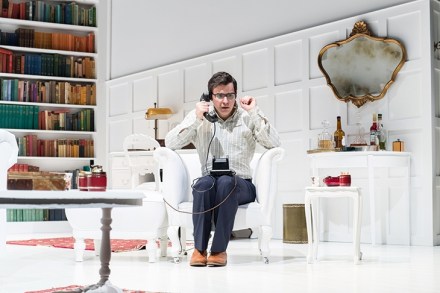
Christopher Hampton’s 1968 play The Philanthropist examines the romantic travails of Philip, a cerebral university philologist, forced to choose between his unexciting fiancée and a predatory seductress. The play’s opening scene contains one of the most brilliant comic shocks in all drama. And the paradoxes and flashes of Hamptonian wit are an everlasting treat. ‘I’m a man of no convictions,’ says Philip. ‘At least I think I am.’ The production, brilliantly directed by Simon Callow, is exquisite to look at. Libby Watson creates a stark white sitting room, with great pools of crimson carpet, enlivened by colourful rows of books that are harmonised carefully, but not obtrusively, with the overall palette.

Parliament’s departing greybeards enjoy one final waffle at PMQs

From our UK edition

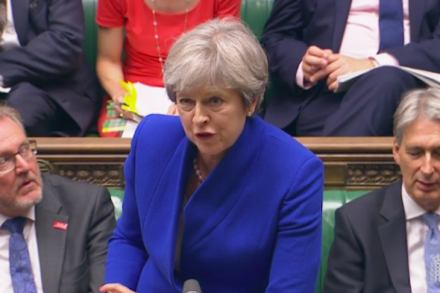
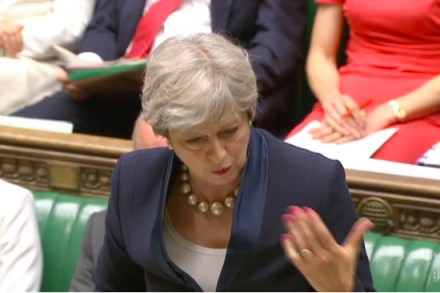
There was astonishment at the start of PMQs as Michael Fabricant’s wig flew up into the air. Fortunately its owner was rising to speak at the same time so no embarrassment was suffered. John Bercow indulged the house in this last session before the election and let MPs give speeches rather than ask questions. The results were mixed. Was it classic Westminster-in-action? Or classic Westminster inaction? The exchanges lasted twice as long as normal and were less than half as informative. Theresa May crammed every sentence with Crosby buzz-phrases. ‘Strong economy’, ‘stable Conservative leadership’ she said about a zillion times. Her remote-controlled backbenchers followed suit.

Boozy bard

From our UK edition

Even the Bard’s staunchest fans admit that ‘Shakespeare comedy’ may be an oxymoron. That’s the assumption of the touring company Shit-Faced Shakespeare, which produces the plays as adventures in boozy slapstick. The audience is encouraged to swig along too. I saw their hooch-assisted Much Ado. The colourful costumes looked a bit am-dram, perhaps deliberately, and the stage was decorated with cheap flapping drapes on which gargoyles, arches and other medieval devices had been painted. Enter a larky compère in puffy breeches carrying a horn. ‘PARP PARP’. He announced that a member of the cast had just consumed two beers and half a litre of gin in the dressing room. Which is quite a lot.

Jeremy Corbyn is already anticipating his political extinction

From our UK edition

Just seven weeks till Jezza-geddon. The Labour leader seemed to anticipate his political extinction with a dead-sheep performance at PMQs. Poor Corbo. He’s never shaken off the air of Speakers’ Corner. He belongs outdoors, with a step-ladder and a bull-horn, ranting away at tourists and pigeons. Today he was faced with a carefully drilled Tory militia eager to demonstrate their unity. It was impressive but dispiriting as well. Every preferment-seeker and red-box wannabe on the backbenches had been ordered to lace their query to the PM with extravagant praise of Tory economic genius. Up they popped, in wearying succession, the pliable Pippas, the malleable Marys, the robotic Richards, the pushover Pauls. It wasn’t a debate. It was a flash-mob of Duracell Bunnies.

Law in action

From our UK edition

It’s like Raging Bull. The great Scorsese movie asks if a professional boxer can exclude violence from his family life. Nina Raine’s new play Consent puts the same question to criminal barristers. We meet four lawyers engaged in cases of varying unpleasantness who like to share a drink after a long day in court. They gossip about the more horrific behaviour of their clients with frivolous and mocking detachment. But when their personal relationships start to falter under the strains of infidelity, they’re unable to relinquish their professional expertise, and their homes become legalistic battlefields. This sounds like a small discovery but Raine turns it into a grand canvas.

Kill the DJ

From our UK edition

Don Juan in Soho rehashes an old Spanish yarn about a sexual glutton ruined by his appetite. Setting the story in modern London puts a strain on today’s play-goer, who tends to regard excessive promiscuity as a disease rather than a glamorous adventure. And the central character, a vulgar aristocrat named DJ who grades everyone on a scale of ‘fuckability’, contravenes the sentimental egalitarianism of our current sexual code. Writer Patrick Marber offers us a version of London where the social structure of the Regency still endures. Educated Englishmen are the only fully evolved human beings. Beneath them swarms an amusing underclass of thick, greedy motormouths from whom the Englishman must recruit his prostitutes and servants.

LA story

From our UK edition

BREAKING NEWS: ‘Enjoyable play found at Royal Court.’ Generally, the Court likes to send its customers home feeling depressed, guilty, frightened or suicidal. And, generally, it succeeds. The Kid Stays in the Picture is based on the memoirs of Hollywood super-mogul Robert Evans. Director Simon McBurney uses artful lighting and complex staging effects to disguise the fact that this is just a glorified book-reading of the kind broadcast by Radio 4 every day of the week. The performers are concealed by deep shadows or behind screens and this threatens to break a basic rule of live theatre: an actor who can’t be seen can’t be heard. But the performers are audible enough and one of them, Danny Huston, has a wonderfully gnarled and leathery voice.

Jeremy Corbyn looks lost at the despatch box

From our UK edition

Tactics! At long last. Jeremy Corbyn actually used tactics at today’s PMQs. For the first time ever he divided his six questions into two three-ball overs. He spent the initial trio on last week’s terror attacks. Then, after an unsettling delay, he used three more on Mrs May’s fibs about school budgets. She says they’ve been ‘protected’. He says they’ve been ‘cut’. Protected. Cut. Cut. Protected. On it went. Mr Corbyn had a superb ally in the Public Accounts Committee which seems to support his view. The exchange might have been tricky for Mrs May but Mr Corbyn still can’t ram home a simple advantage. Rather than forcing her to repudiate the committee and its grandees he brought in a new, and far weaker, witness.

Royal prerogative

From our UK edition

No one should complain that My Country; a work in progress is a grim night out. It’s rare for a good play to be written by royal command. The co-authors are the Queen’s personal minstrel, Carol Ann Duffy, and the director of her Royal National Theatre, Rufus Norris. These inspiring artistes have sent their vassals beyond the security of London to annotate ‘the words of people across the UK’ in the hope of understanding a humanitarian disaster: Brexit. The show makes its prejudices clear by dedicating the script to a Remain voter, Jo Cox, who was murdered by a Leave supporter. And it promotes the view, common among Remainers, that Brexit is a crisis caused by thick proles.

PMQs sketch: Come on Eileen, says Corbyn

From our UK edition

A bizarre exercise in diplomacy from Jeremy Corbyn at PMQs. He manoeuvred the PM into a tricky corner and then stepped gallantly in to disperse the trouble he’d arranged. She’d been caught violating a manifesto commitment to protect school funding. The statistics proved it too. Corbyn’s back-room elves had devised a clever way to summarise the difficulty. Averaging out the cuts will mean, in effect, that every primary school loses two teachers and every secondary loses six. It was good stuff. Danger for the PM. But Corbyn, for some unfathomable reason, decided not to pursue his advantage and he proceeded to flannel his way out of his opponent’s problem. He dithered and waffled and found himself stranded in one of his platform speeches.

Ersatz erudition

From our UK edition

Harry Potter, who uses the stage name Daniel Radcliffe, is a producer’s delight. By now it’s becoming clear that the four-eyed wizard lacks distinction as an actor. He’s not a comedian, certainly not a leading man or a heart-throb, and he hasn’t the ugliness or eccentricity to be a villain. But this Polyfilla quality means he can be dropped into anything without harming the fabric. His presence in Rosencrantz and Guildenstern Are Dead — a difficult and at times flimsy exhibition of varsity wit — is an insurance policy that will guarantee brisk business at the box office.