Lloyd Evans

Lloyd Evans

Lloyd Evans is The Spectator's sketch-writer and theatre critic

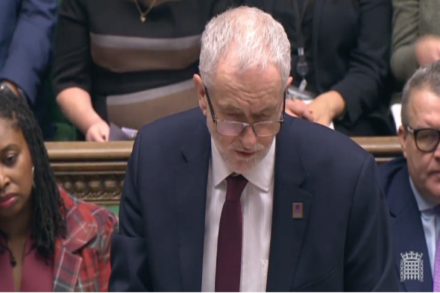
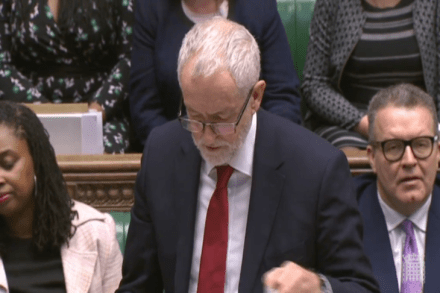
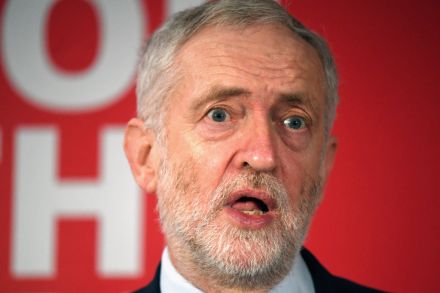
Jeremy Corbyn scores six own-goals in a row at PMQs

From our UK edition

Ah the joys of political marriages. Theresa May’s pact with the DUP bolstered her at PMQs today, and she delivered her most assured performance since the election. Having an ally who secretly hates you is the ultimate liberation, as David Cameron discovered with the LibDems. May is free to flourish the ultimate get-out clause any time: ‘Them lot made me do it,’ is the best excuse in Westminster. And the DUP are a pretty formidable outfit. Grouped en masse around the microphone they look like a pack of concrete gnomes designed to halt a speeding tank. The Easter Island statues would probably deliver a softer Brexit. Jeremy Corbyn had a huge task today. When the government is teetering, the pressure on the opposition leader is enormous. And what a day this was.

Dancing queen

From our UK edition

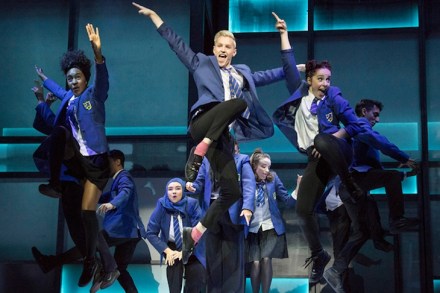
Everybody’s Talking About Jamie opened at the Sheffield Crucible in February for a standard three-week run. The show is based on a BBC documentary, Jamie: Drag Queen at 16, about a working-class lad who attended his school prom in a scarlet frock. Director Jonathan Butterell saw the potential to create a replica Billy Elliot and he brought in two co-writers to turn the material into a comic musical. Word of mouth was excellent and the show received immediate offers for a West End transfer. The action starts in a Sheffield comp where a class of 16-year-olds are being given career advice by a computer. Blond misfit Jamie is encouraged to train as a forklift-truck driver. But he has other ideas. With his mum’s help he sets off in search of his inner self as a gender-fluid diva.

How did Damian Green ever reach the Cabinet?

From our UK edition

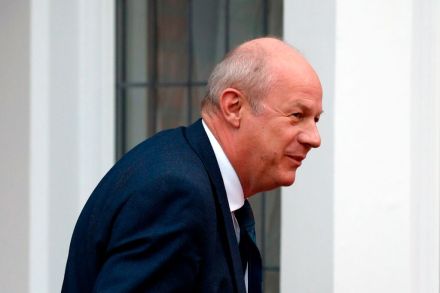
The PM is in the middle-east on her ‘strong and stable leadership’ tour. Replacing her at PMQs stood Damian Green, a hesitant, avuncular figure who seems ill-suited to front-line politics. He’s uncomfortably tall, and he dips his chin as he speaks to make his troubled, slender jowls less conspicuous. His hair has quit the fray and left a dignified grassless dome as its memorial. His demeanour is all antiquarian gentleness. He might be the head of parchments at a museum of medical history. How he reached the cabinet is a mystery. His opponent, Emily Thornberry, is a resourceful court-room performer who started the session by getting the jury (that is, us,) on her side with a few self-deprecating jokes.

Net effect | 23 November 2017

From our UK edition

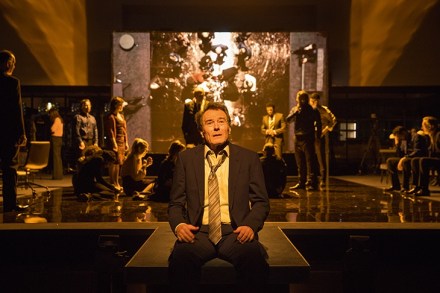
The inexplicable popularity of Ivo Van Hove continues. The director’s latest visit to the fairies involves an updated version of Network, a creaky and over-rated news satire from 1976. Van Hove appears to be unconstrained by thrift or self-discipline and he fills the Lyttelton stage with expensive clobber. It’s like a hangar full of half-tested prototypes. Centre, a TV studio featuring three cameras and an anchor man’s desk the size of a lifeboat. Behind it, a controller’s gallery with lots of TV monitors shielded by wobbly glass. Stage-rear, a vast flat-screen telly that relays the action as it happens but with an irritating quarter-second delay.

Funeral Phil has a sense of comedy that goes unnoticed

From our UK edition

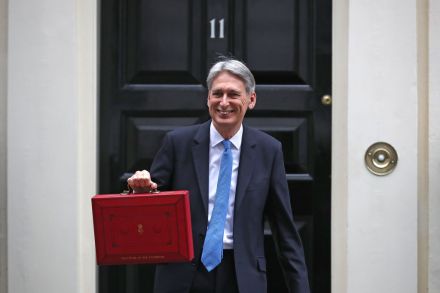
Odd-looking chap, the chancellor. Give him a moustache and a top hat and he could be Neville Chamberlain. Or a funeral director. With his stooping frame and his watchful hook-nosed features he has the air of a vulture about to feast on carrion. But he struck a kindlier note at the Budget as he set out his vision of a thrusting, modern economy. ‘Every one of our citizens,’ he trilled, ‘can contribute to – and share in – the benefits of prosperity.’ The UK, he said, ‘is a beacon of creativity, a civilised and tolerant place that cares for the vulnerable and nurtures the talented.’ Was he practising a voice-over for a housing development in paradise?

Faking it | 16 November 2017

From our UK edition

David Mamet’s plays are tough to pull off because his dialogue lacks the predictable shapeliness of traditional dramatic speech. He prefers the sort of meandering, oblique, backtracking and self-deluding conversation you might overhear in a hotel dining-room. Glengarry Glen Ross opens in a restaurant, where a handful of realtors are discussing the perils and joys of their craft. The scene culminates in one of the landmarks of American drama. Top salesman Ricky approaches a potential customer in disguise and delivers a sales pitch that sounds like a poetic meditation on destiny and existence. It’s impossible to say what darkness this little masterpiece emerged from but Christian Slater (Ricky) captures all of it, abruptly and shockingly, with laser-like precision.

Jeremy Corbyn’s post-election glow appears to have faded

From our UK edition

Angela Eagle, as befits her oxymoronic name, looks like a cherub and attacks like a raptor. Today her outfit was deceptively mumsy. A no-nonsense jacket, a sky-blue sweater, an arc of pearls, like a smile, laid across her breast-bone. Eagle is the mistress of the poisoned barb and she’d been whittling away at her missile all morning. Up she got and let fly. Her aim was true, her weighting perfect. ‘In June, the prime minister told the country she was the only person who could offer strong and stable leadership. With her cabinet crumbling before her eyes, can she tell us how it’s going?’ And nothing happened. Or barely anything. The gales of hilarity that usually greet Ms Eagle’s questions failed to materialise.

To hell and back

From our UK edition

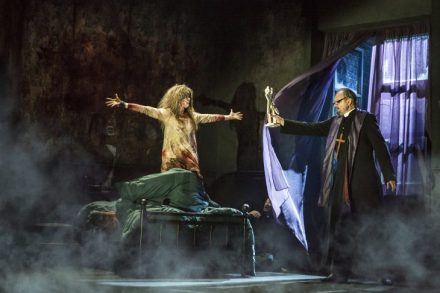
The Exorcist opened in 1973 accompanied by much hoo-ha in the press. Scenes of panic, nausea and fainting were recorded at every performance. Movie-goers showed up to witness mass hysteria rather than to enjoy a scary movie. This revival, produced by Bill Kenwright, targets the early 1970s demographic. At press night, the stalls were thronged with pensioners eager to relive a lurid evening from their adolescence. As one who dislikes shocks of any kind, I sat through this ordeal with my eyes bent towards the floor and my fingers wedged so firmly in my ears that their tips turned crimson. The show opened with a CRUMP loud enough to shake the theatre to its foundations. Everybody screamed. Then they all giggled. This pattern of shrieking followed by feathery tittering continued throughout.

Not with a bang but with a whimper

From our UK edition

Bang! A brand new theatre has opened on the South Bank managed by the two Nicks, Hytner and Starr, who ran the National for more than a decade. Located near a river crossing, their venture bears the unexciting name ‘Bridge’. If these two adopted a child, they’d call it ‘Orphanage’. Visitors approach along the Thames embankment and arrive at a soaring cliff of glass whose revolving doors usher them into a large anonymous foyer. It feels like a student union bar or a bit of an airport. Dangling from the ceiling are dozens of light bulbs, their radiance muted with tea-stained shades that cast an absolving glow over facelifts, hairpieces and liver spots.

PMQs Sketch: Sex scandals and private jets

From our UK edition

Bit of a rum PMQs. The evolving sexual scandals cast a pall over proceedings. Up first, Dennis Skinner, who revealed the truth about HS2. It’s a wicked plot to treat northerners as ‘second class citizens’. He said that tunnels are to account for 30 per cent of the southern route but only 2 per cent of the northern bits. Selectively-educated Mr Skinner knows perfectly well that this is about economics. A Home Counties property costs more than its northern counterpart so burrowing under a house is cheaper than sending an express train through the master-bedroom. But perhaps he’s got a point. Couldn’t HS2 be entirely subterranean? Effectively this would mean extending the London Underground from Euston to Edinburgh.  Not a bad idea.

Family planning

From our UK edition

Beginning starts at the end. A Crouch End party has just finished and the sitting room is a waste tip of punctured beer cans, tortured napkins and crushed nibbles. Wine bottles lie scattered across the carpet like fallen ninepins. Hostess Laura invites her last guest, Danny, for a final glass of Chardonnay. Twitchy conversation ensues. Then she tells him point-blank that she’s fallen in love with him, even though they’ve only just met. He rejects her weird come-ons (‘Kiss me, you lemon’) with evasive hyperactivity. He dashes about the room filling a bin-liner with defunct wine bottles and pulverised cheesy Wotsits. She forces him to sit next to her on the sofa, where he squirms and flips like a beached haddock. What’s wrong with him?

It’s time to bin Bercow

From our UK edition

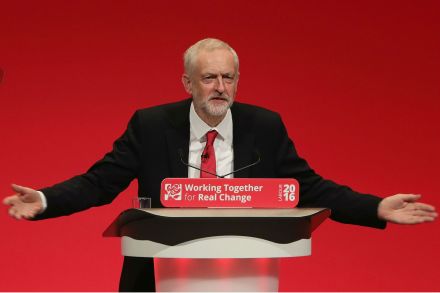
Jeremy Corbyn wanted to repeat last week’s victory on Universal Credit. He landed no serious blows but he made the government look silly in its handling of the reforms. Mrs May brought up Labour’s record, and the ‘tax credit’ merry-go-round devised by Gordon Brown. Voters were fleeced by one arm of government and reimbursed by another. And the pick-pocket prime minister denied responsibility for the theft while claiming credit for the reparations. Mrs May stressed the indispensable virtue of UC: it helps people ‘back into work’ rather than trapping them beneath the man-hole cover of dependence. Back into work. Corbyn was silent about that. Perhaps he’s aware of a conundrum that underlies his movement.

The bad sex award

From our UK edition

Simon Stephens gives his plays misleading titles. Nuclear War, Pornography and Punk Rock contained little trace of their advertised ingredients. Heisenberg: The Uncertainty Principle includes no information about the German physicist or his theories. This is a sentimental romcom starring Anne-Marie Duff as a giggling airhead who stalks a grunting Cockney shopkeeper played by Kenneth Cranham. He’s 75 years old and though she’s in her mid-forties she has the skittish desperation of a gold-digging pensioner trying to act the nubile bimbo. Both characters are bored loners adrift in London. And because they’re solidly working class (she’s a receptionist, he’s a butcher), they excite our curiosity as lesser beings far removed from our own social milieu.

John Bercow’s ego trip lets May off the hook at PMQs

From our UK edition

PMQs began with an announcement. The life president of the John Bercow fan-club rose from the Speaker’s chair to welcome a distinguished Dutch parliamentarian sitting up in the gallery. No one recognised the name of this blow-in from the land of windmills. But he is no doubt as important in his own domestic circle as Mr Bercow is in his. Taxpayers will be thrilled to know that the Speaker makes pals on his overseas junkets. And how apt that a man of such humble stature has befriended a parliamentarian from the Low Countries. Mr Bercow spent most of the session demonstrating his mastery of events by interrupting MPs with his slim list of antiquarian heckles. ‘Calm yourself,’ ‘Take a rest, man’. ‘Honourable members must contain themselves.

Perishable goods

From our UK edition

  Labour of Love is the new play by James Graham, the poet laureate of politics. We’re in a derelict colliery town in the East Midlands where the new MP is a malleable Blairite greaser, David Lyons. He arrives to find the office in crisis. The constituency agent, Jean, has handed in her notice but David is smitten by her acerbic tongue and her brisk management style so he asks her to stay. She agrees, reluctantly, and they settle into a bickering rivalry underpinned by affection. But is there more? Possibly, yes, but both are held back by their natural reticence and by fate. Secret declarations of love go astray. One letter is sent to the wrong person and another, written in code, makes sense only when read backwards. These contrivances aren’t entirely satisfying.

Theresa May has yet another bad day at the office

From our UK edition

Theresa May needed to play a blinder today. But she left herself looking heartless and complacent. Jeremy Corbyn attacked her on the Universal Credit system which seems as useful as a windmill on the moon. He said UC was leading to ‘debt, poverty and homelessness.’ Mrs May replied that tremendous improvements had been achieved since January. Only 20 per cent of initial payments are late, she trumpeted, (although she used the formula '80 percent are on time’). Corbyn asked about delays twice more, and Mrs May’s patience dissolved. She did a little pantomime of being bored. Her eyes glazed over. Her chin tilted upwards. Her focus went into the middle-distance. A short breath was sucked in over her lower teeth.

Verbal diarrhoea

From our UK edition

In Beckett’s Happy Days a prattling Irish granny is buried waist-deep, and later neck-deep, in a refuse tip whose detritus inspires a rambling 90-minute monologue. ‘An avalanche of tosh’ was the Daily Mail’s succinct summary. Wings is similar but worse. Mrs Stilson (Juliet Stevenson), an American pensioner sheathed in white, hovers over the stage on ropes and talks non-stop gibberish. ‘Three times happened maybe globbidged, rubbidged uff to nothing there try again window up!’ Thus begins her battle with intelligibility. ‘And vinkled I,’ she goes on, ‘commenshed to uh-oh where’s it gone to somewhere flubbished what?

Bloody minded

From our UK edition

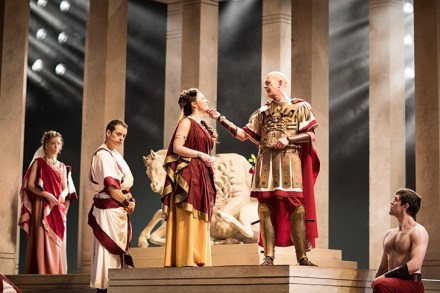
Tristan Bernays loves Hollywood blockbusters. His new play, Boudica, is an attempt to put the blood-and-guts vibe of the action flick on the Globe’s stage. The pacy plotting works well. Boudica revolts against the Romans who have stolen her kingdom. The queen is imprisoned and flogged while her two maiden daughters are savagely violated. Vowing revenge, she allies herself with the reluctant Belgics and they attack and destroy Camulodunum (Colchester). The first half is a rip-roaring crowd-pleaser. After the interval, an anticlimax. London is sacked but the Romans cling to power and when Boudica dies, her bickering daughters fight rather tediously over the succession. What counts here are the externals: the costumes, the accents, the fights, the stunts.

Speech therapy

From our UK edition

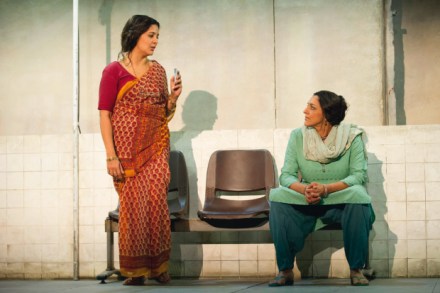
Oslo opened in the spring of 2016 at a modest venue in New York. It moved to Broadway and this imported version has arrived at the National on its way to a prebooked run at the Harold Pinter Theatre. It’s bound to be a hit because it’s good fun, it gives a knotty political theme a thorough examination, and it’s aimed squarely at the ignorant. In the early 1990s Norwegian diplomats set up ‘back-channel’ talks between the PLO and Israel. The play follows that process and it treats geopolitics like a flat-share comedy. The bickering partners are hauled in by the lordly Norwegians and forced to hammer out their differences around the table. Play-goers need have no prior knowledge of Israel and its fraught relationship with the Palestinians.

Age concern | 14 September 2017

From our UK edition

Stephen Sondheim’s Follies takes a huge leap into the past. It’s 1971 and we meet two middle-aged couples who knew each other three decades earlier at a New York music hall. The building faces demolition and the owner is throwing a party for his old dancing-girls. Dominic Cooke’s lavish production of this vintage musical boasts 58 performers, 160 costumes and 200 production staff. Yet it’s a curiously small show that could be performed, with a few cuts, in a pub theatre. There are four main characters and a smattering of cameos. Phyllis and Ben are rich New York grandees, unhappily married. Their chums Bud and Sally are also wealthy and disappointed with life.