Lloyd Evans

Lloyd Evans

Lloyd Evans is The Spectator's sketch-writer and theatre critic

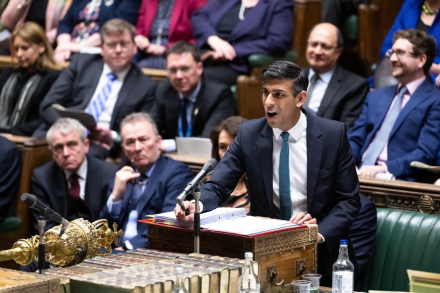
Rishi Sunak is starting to enjoy PMQs

From our UK edition

A bad day for daffodils. Hundreds of these little golden trombones were cut down this morning so that our MPs could display their bogus affection for Wales. Honestly, sporting a daff on St David’s Day is like clapping for the NHS – a badge of insincerity. The issue of the moment, the Windsor Framework, barely got a mention at PMQs. Hats off to the marketing genius who coined the phrase ‘Windsor Framework’. Such a cosy, domestic and stylish term. One imagines a pine gazebo by John Lewis or a luxurious summerhouse from Habitat. A place where friends and families can relax forever. To Ulster-watchers, it’s odd that the agreement has been reached with so little acrimony. Usually when a deal is about to be done, the factions boil over with fury. Not this time.

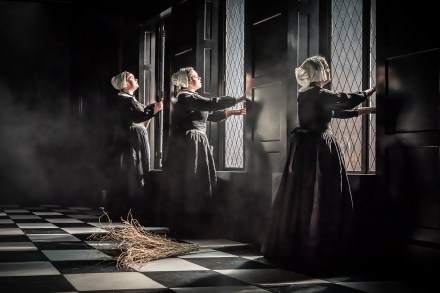
Approaches perfection: Medea, @sohoplace, reviewed

From our UK edition

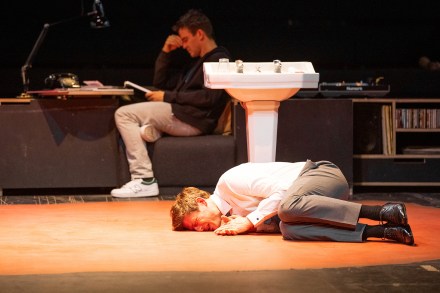
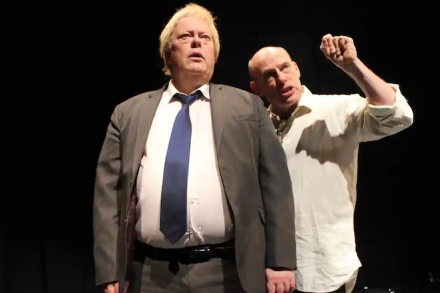
Winner’s Curse is a hybrid drama by Dan Patterson and Daniel Taub which opens as a lecture by a fictional diplomat, Hugo Leitski (a dinner-jacketed Clive Anderson). Leitski offers to teach us the subtle art of negotiation. An expert diplomat, he explains, must convince each side that they’re the winners in the negotiation and that their opponents have lost. In his youth he helped to broker peace between two Slavic nations, Karvistan and Moldonia, and the action switches from Leitksi’s lecture room to a seedy hotel, the Black Lagoon Lodge, where the peace deal was agreed.

The secret truth about Dom: The Play

From our UK edition

‘Who wrote it?’ asks the Times, of Dom: The Play. I’ll let you in on a secret: it was me. If you’re selling a product, you need to advertise what you’re flogging, rather than its creator. That’s why, when my satire about Dominic Cummings launched at The Other Palace in Victoria this week, I withheld my name from the poster and the programme. Simple reason: my name doesn’t shift tickets. And a poster without the waffle is likely to cut through better. As a result, our poster has the show’s emphatic title in crimson letters beneath three shots of Dom's face taken from different angles. This has a decent chance of attracting the gaze of the fickle and easily distracted public. It’s a split-second opportunity. Shout at them. Grab their attention. ‘Dom the Play.

Small boats are Rishi’s big problem

From our UK edition

Small boats are becoming a big problem for Rishi. Four Tory backbenchers raised the issue at PMQs. Andrew Selous asked about a ‘much-loved’ hotel in his constituency which the Home Office has annexed on behalf of their beloved migrants. Weddings and family parties have been cancelled. Selous, rather ludicrously, asked the PM to ‘redouble his efforts’ to solve the crisis. Let’s look at the maths. Redoubling zero gives you zero. And zero is what Rishi is doing to deter the boats and send new arrivals packing. He confessed as much. The PM is campaigning to please people who loathe him Some time in the future he plans to pass a miraculous new bill aimed at bogus asylum claimants but he has little faith in its effectiveness.

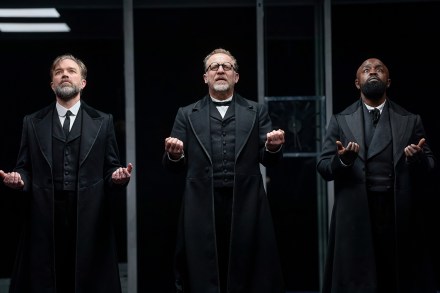
How has it escaped being cancelled? The Lehman Trilogy, at the Gillian Lynne Theatre, reviewed

From our UK edition

Standing at the Sky’s Edge is an ode to a monstrous carbuncle. The atrocity in question is a concrete gulag, Park Hill, built by Sheffield council in the 1960s as a punishment for hard-up locals who couldn’t afford to buy a house. The show is a propaganda effort on behalf of bossy, big-state, high-tax Labour authorities so the smiling residents of the brutalist eyesore keep telling us how much they love their multistorey dungeon. ‘You can see the whole city from up here,’ say the characters, as if no Sheffield resident had ever mounted any of the bluffs or heights that surround the area. The script is honest enough to admit that Park Hill’s secondary purpose is to reduce the city’s population by encouraging depressives to jump from its upper levels.

A sex farce reminiscent of Alan Clark’s diaries: Phaedra, at the Lyttelton Theatre, reviewed

From our UK edition

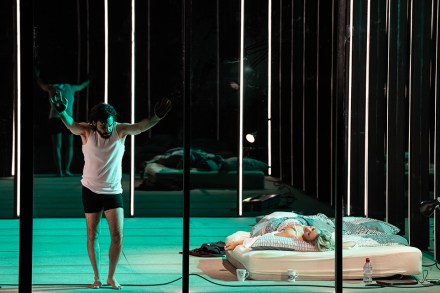
Simon Stone claims that his new comedy, Phaedra, draws on the work of Euripides, Seneca and Racine. In fact, the porn-mag narrative resembles a passage in Alan Clark’s diaries where the priapic scribbler seduces a mother and daughter in rapid succession. That’s what happens to Sofiane, a homeless Moroccan lecher, aged 41, who has the looks of George Best and the sexy drawl of a Riviera gigolo. He befriends Helen, a senior Labour MP, who shares her picture-perfect London home with her two brattish children and her high-flying husband Hugo, who speaks 15 languages. Helen appears to be starved of sex and male attention, which seems rather improbable for a Westminster insider.

There was nothing funny about PMQs

From our UK edition

PMQs looked like a comedy routine. But there was nothing funny about it. President Zelensky, AKA Uncle Volod, has come to town to address a joint session of both houses. As a warm-up act, MPs behaved like a gang of armchair Rambos and competed to fawn over Uncle Volod while pledging taxpayers’ cash to the defence of his borders. This wasn’t a debate but a scripted event staged to please a leader who appears to have no trouble travelling the world, or welcoming celebs like Boris to his capital, even though he claims to be personally locked in a life-or-death struggle with the largest country in the world. The party leaders sounded identical.‘This terrible conflict must end with the defeat of Vladimir Putin in Ukraine.’ That was Sir Keir Starmer.

Forgettable romcom with an irritating title: Lemons Lemons Lemons Lemons, at the Harold Pinter Theatre, reviewed

From our UK edition

A romcom with an irritating title, Lemons Lemons Lemons Lemons Lemons, has opened at the HP Theatre starring Jenna Coleman and Aidan Turner. Telly addicts will recognise their names. They play two London yuppies, Oliver and Bernadette, who are struggling to communicate properly. Out of nowhere, the state imposes a gruesome new ‘Hush Law’ that forbids citizens from uttering more than 140 words a day. It lasts just 85 minutes and you’ll have forgotten you saw it by the time you get home All kinds of questions arise. Why was the Big Hush introduced? Whose interest does it serve? How is it policed? By overstepping your quota of natter, are you committing a civil or a criminal offence? Why can’t you rely on texts, emails, sign language, Morse Code or semaphore?

Piers Morgan is no match for slick Rishi Sunak

From our UK edition

Gold wallpaper? All gone. That was the first big revelation of Piers Morgan’s interview with Rishi Sunak to mark the PM’s 100th day in No. 10. Every trace of Boris’s trailer-trash décor has been replaced with squeaky-clean white visuals. Piers and Rishi went head-to-head in a characterless kitchen-diner that looked like the show-home of a new-build flat in Milton Keynes. Piers got straight down to business and raised the issue that obsesses the entire nation: himself. He boasted that he’d reached No. 10 long before Rishi when he interviewed Tony Blair many years ago; he recalled that the Blairs had a singing fish nailed to the wall that crooned, ‘Don’t Worry, Be Happy,’ at the touch of a button.  ‘What’s your mantra?’ he asked.

Did Rishi really not know about Zahawi’s tax troubles?

From our UK edition

Necromancy was the main theme at PMQs. The Labour party has realised that Nadhim Zahawi’s resignation has left a gaping hole in their ‘sleazy Tories’ strategy. They badly need him back on stage. Sir Keir Starmer addressed Rishi’s fanciful claim that the rumours about Zahawi’s tax affairs were unknown to him until recent weeks. Sir Keir quoted three daily papers that mentioned Zahawi’s murky financial affairs last July. And he treated Rishi’s denials with blokeish scorn. ‘Oh come on. Anyone picking up a newspaper would have known it.’ Is it credible that Rishi knew less about Zahawi than the media, the whole of parliament and most voters? Rishi mounted a feeble defence and said he’d followed the correct procedures.

These drag queens haven’t a clue how banal their problems are: Sound of the Underground, at the Royal Court, reviewed

From our UK edition

Sound of the Underground is a drag show involving a handful of cross-dressers who spend the opening 15 minutes telling us who they are. Then, rather ominously, they announce: ‘We’ve written a play.’ But they haven’t really. The scene shifts to a kitchen where the drag queens meet to discuss their pay and conditions, and the show turns into an advertisement for their woes. Drag is facing a crisis, we hear, caused by its sudden popularity. Drag queens are in demand from TV bosses and corporate executives but the artistes feel dismayed and traduced by this surfeit of opportunity. They loathe RuPaul, a cross-dresser favoured by the BBC, and they blame him for betraying the true spirit of drag, whatever that may be. One of them calls RuPaul ‘exclusionary’.

Nadhim Zahawi is toast – and PMQs proved it

From our UK edition

God. What a grisly PMQs. Last week, Sir Keir Starmer politicised the case of an NHS patient who died before an ambulance could save her. Today he tried to make a political point about a murder. ‘It’s hard to convey the agony they’ve been through,' he said of a meeting with the victim’s family, 'They say the government has blood on its hands.’ Poor taste. And poor tactics. His real aim today was to destabilise the forgetful minister, Nadhim Zawahi. By using a family’s grief as a warm-up act, he created a gruesomely funereal mood – when he turned to Tory sleaze it seemed stagey and opportunistic.  Rishi Sunak is the wrong man to patronise Zahawi is the keen-as-mustard member for Stratford-upon-Avon who refers to the Bard as, ‘my constituent, William Shakespeare.

Pure, heavenly escapism: The Unfriend, at the Criterion Theatre, reviewed

From our UK edition

The Unfriend is a smart new family comedy which opens on the sunlit deck of a cruise ship. Peter and Debbie, a boring middle-class couple, are introduced to a clingy American tourist, Elsa, who worms her way into their affections. Before they know it, they’ve agreed to let her visit them at home after the cruise. A few weeks later, she shows up unannounced. By now the pair have learned from Google that Elsa is suspected of murdering her husband and several other members of her family. But they’re far too nice, and too English, to tell her to get lost. The crafty Elsa forms an alliance with their angry teenage kids, Rosie and Alex, and uses them to shield her from Peter and Debbie’s suspicions. It’s an amusing set-up and the script just about makes it credible all the way through.

PMQs gets worse every week

From our UK edition

Gruesome rhetoric at PMQs. The horror began with Sir Keir Starmer revealing that he can tell the time. ‘It’s three minutes past twelve,’ he announced. Rowdy Tories immediately demanded to know how soon he’d alter that statement. Sir Keir postulated a medical emergency, a patient suffering from ‘chest pains and fearing a heart attack,’ hoping for an ambulance to arrive within 18 minutes. But when, he asked the Prime Minister, would the vehicle actually show up? Rishi waffled about investing extra cash in this, that and the other part of the NHS.  ‘He’s deflecting,’ said Sir Keir. ‘The clock started ticking straight away,’ meaning 12.03 with the paramedics due to show up at 12.20. ‘So I ask him again. When will that ambulance arrive?

Comes close to perfection: Watch on the Rhine, at the Donmar Warehouse, reviewed

From our UK edition

Watch on the Rhine is the curiously misleading title chosen by Lillian Hellman for a wartime family drama that became a film starring Bette Davis. The location is not Europe but America and the show opens with Fanny Farrelly, a member of the New England gentry, arriving in her sumptuous drawing room for breakfast. The character of Fanny is an instant classic. A crashing snob, a bundle of nerves, a lethally bitchy matriarch, she dominates her household by cultivating favourites and crushing enemies with her venomous tongue. And yet her servants treat her with tolerance and affection. To them she seems a tricky but essentially decent oddball who needs careful handling. When they complain about her behaviour, she graciously accepts their chastisement and apologises for overstepping the mark.

Is Starmer about to finally goad Corbynistas into action?

From our UK edition

New year, new Labour. Sir Keir deployed his latest strategy at PMQS, contrasting the Tory-run NHS with the glorious record of the Labour administration. When his party were in power, he argued, the NHS was such a triumph that hardly anyone used it. There was no need. Doctors’ appointments were available within days. Cancer referrals took no more than two weeks. Waiting lists were a fraction of their current levels, he went on, (although he quietly admitted that 2.3 million people were usually awaiting treatment when Labour ran the system). Again and again he cited his party’s golden age. Labour, Labour, Labour. Marvellous, outstanding, world class. Sir Keir’s lurch to the right is dangerous because it may goad the dormant Corbynistas into action.

Clever and witty state-of-the-nation play: Kerry Jackson, at the Dorfman Theatre, reviewed

From our UK edition

The National’s new comedy by April De Angelis is a clever and amusing attempt to deliver that most elusive artefact, the state-of-the-nation play. It’s easy to pan this production because the plot lacks surprises and the script is overly indebted to Abigail’s Party. The two lead characters are formulaic creations who reflect political polarities: left vs right, Remain against Leave. Kerry Jackson is a stroppy Essex blonde who loves Thatcher, despises foreigners and supports Brexit. She takes a shine to an overeducated wine snob, Stephen, who rides a bike and lectures in philosophy. Kerry’s new bistro in Walthamstow needs customers and she begs Stephen to post a favourable review in the local free sheet. In return she agrees to hire his mopey daughter as a waitress.

Harry’s interview is an explosive, flame-throwing spectacle

From our UK edition

Bombs away! Prince Harry’s mission to dump ordnance on his nearest and dearest continued last night in a riveting interview with Tom Bradby of ITV. Their explosive tete-a-tete began well for the royal escapologist who described the heart-breaking scene on 31 August, 1997, when Charles (whom he calls ‘Pa’) woke him at Balmoral. ‘Darling boy, mummy’s been in a car crash.’ Harry’s instinct was to rush to her bedside but Pa didn’t mention a hospital visit. And he kept calling him ‘darling boy’ which seemed unusual. Eventually the truth dawned and Harry immediately went into denial. He convinced himself that Diana had faked the accident to escape her hellish life.

Eccentric triviality aimed at 1970s feminists: Orlando, at the Garrick Theatre, reviewed

From our UK edition

Orlando opens with a pack of Virginia Woolfs on stage. All wear the same costume of horn-rimmed spectacles, long tweed skirts and woolly cardigans, and they comply with current diversity targets. There’s a white Woolf, a black Woolf, a mixed-race Woolf, an East Asian Woolf, and a male Woolf with a deep voice who seems to have wandered in from Little Red Riding Hood. The pack of Woolfs chat away about how to tell the story of an English aristocrat, Orlando, who was a teenager in the 1590s. He enters the stage dressed like a girl. (Confusion over sexual identity is the show’s big idea.) After an opaque interview with Elizabeth I, Orlando moves to the Jacobean era, then to Charles II’s court, then to an embassy in Constantinople and so on.

From Attenborough to Harry and Meghan: my 2022 naughty list

From our UK edition

Christmas bores ‘Did you know? Jesus was actually born in September.’ A festive lunch isn’t complete without this historical footnote being aired by the family nerd. Obviously Baby Jesus wasn’t born in December when it’s pretty nippy in the Holy Land and no sane person would set off by donkey to fill in a census form. But the month of September is pleasantly balmy, and everyone is free to travel because the harvest has been gathered. So, yes, Joseph and his pregnant wife ventured forth on the family donkey to stay in Bethlehem where a room had been booked at their favourite inn. But wait. A donkey? An inn? These were significant luxuries in Roman times. And the arrival of friends with costly gifts, including gold, suggests a certain affluence.