Lisa Haseldine

Lisa Haseldine

Lisa Haseldine is The Spectator's online commissioning editor - foreign affairs.

Why Trump’s team snubbed the London Ukraine peace talks

From our UK edition

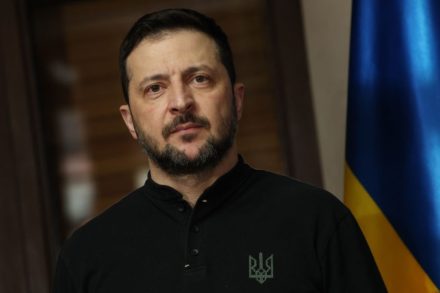
Has the moment arrived when Donald Trump abandons the last iota of his support for Ukraine in the war against Russia? Taking to his social media platform, Truth, the American President appeared to suggest so. Referring to his Ukrainian counterpart Volodymyr Zelensky, Trump wrote, 'He can have peace, or he can fight for another three years before losing the country'. The latest trigger for Trump's ire against Zelensky appears to be the Ukrainian President's firm rejection of any peace deal that included Ukraine having to concede Crimea – illegally annexed by Russia in 2014 – as legal Russian territory. ‘Ukraine does not legally recognise the occupation of Crimea. There’s nothing to talk about,’ Zelensky said last night.

Why Putin wants a truce

From our UK edition

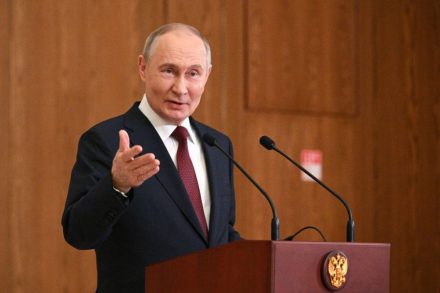
At 4 p.m. UK time today, Russian troops were instructed to temporarily lay down their weapons in Ukraine. The order, issued by Russian president Vladimir Putin to mark the Easter weekend, is nominally in force for 30 hours until midnight on Easter Monday. ‘We are proceeding on the assumption that the Ukrainian side will follow our example,’ he said. All military operations, the President added, would supposedly be halted during that time period. From Putin’s statement it doesn’t look as if this ceasefire was discussed with his Ukrainian counterpart Volodymyr Zelensky, or anyone from his administration, before he announced it. But it appears that for the rest of this weekend – maybe, just maybe – quiet will reign on the battlefields of Ukraine.

Trump tells Russia to ‘get moving’

From our UK edition

With just under a week to go until the supposed Easter deadline, it appears that Donald Trump is no closer to securing a peace deal between Russia and Ukraine. The President’s special envoy to the Middle East Steve Witkoff travelled to St Petersburg yesterday for talks on ‘aspects of a Ukraine settlement’ with Vladimir Putin. The fact that neither produced a read-out of the four and a half hour meeting afterwards implies that, yet again, Trump’s representative has come away without having achieved much meaningful progress. While the Americans may have hoped yesterday’s meeting would perhaps bring Putin closer to the negotiating table with Ukraine, the Russians were clearly under no such illusion.

The promise Putin made to Russia – and broke

From our UK edition

When Vladimir Putin launched his bid to be elected as Russia’s president in 2000, he had already been in the role for a month and a half. His predecessor Boris Yeltsin had stepped down on 31 December 1999, appointing his young prime minister in his place to prevent political opponents from prosecuting him and his associates – on well-founded grounds – for corruption. At the time, less than a decade after the collapse of the USSR, Russia had fair elections, freedom of expression, a thriving press and a growing economy. A quarter of a century on, all of that has gone. Today marks exactly 25 years since Putin was elected President of Russia for the first time.

Is Putin’s partial ceasefire really a victory for Trump?

From our UK edition

It may be taking him longer than the 24 hours he pledged on the campaign trail, but it appears that US President Donald Trump might be getting somewhere on halting the war between Russia and Ukraine: following a call lasting an hour and a half, he has persuaded Vladimir Putin to agree to a partial ceasefire in the conflict.  According to the statements beginning to emerge from the Kremlin and White House, the call appears to have gone well. This is despite Putin seemingly delaying the call by at leat 50 minutes, after speaking at a conference for business lobbyists in Moscow earlier in the afternoon.

Is Putin really open to a ceasefire with Ukraine?

From our UK edition

Vladimir Putin is apparently open to a ceasefire in the war against Ukraine. But is he really? Just like that, the response that America, Ukraine and its Western allies had been waiting for has arrived. Speaking this afternoon in a joint press conference with Belarusian President Alexander Lukashenko, the Russian President commented for the first time on America’s proposal for a 30-day ceasefire in the conflict. ‘We agree with the proposal to stop military actions,’ he said. The truce, he said, should lead to ‘long-term peace and eliminate the root causes of the crisis’.  As with many statements which turn out to be too good to be true, the Russian President then followed this with a ‘but’: ‘There must be nuances,’ he added.

Ukraine agrees to US plan for 30-day ceasefire with Russia

From our UK edition

Ukraine has agreed to an American proposal for an immediate 30-day truce in the war against Russia. Kyiv's decision to accept a month-long ceasefire follows nine hours of talks with members of US President Donald Trump's administration in Saudi Arabia today.  Making a statement this evening following the conclusion of the talks, the US Secretary of State Marco Rubio said that the 'ball is now in Russia's court' to agree to the ceasefire. It would be 'the best goodwill gesture' Moscow could provide, Rubio added. Confirming Rubio’s announcement, Ukrainian President Volodymyr  Zelensky – who didn’t take part in today’s discussion – declared that ‘Ukraine accepts this proposal, we consider it positive, we are ready to take such a step’.

Will the EU ever get tough on defence?

From our UK edition

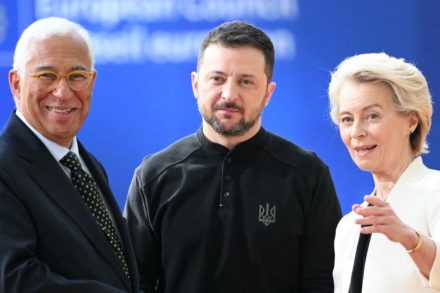
European leaders are in Brussels today for an emergency summit on defence, and the future of both Ukraine and the continent. In a further attempt to hash out a peace plan for Ukraine, the 27 EU heads of state are joined by Volodymyr Zelensky. Arriving this morning, Zelensky declared, ‘It’s great we are not alone’. As part of today’s agenda, members of the bloc are expected to endorse Ursula von der Leyen’s ReArm Europe plan – which will make €150 billion (£125 billion) available in loans for members to boost defence spending. The summit will also likely discuss French President Emmanuel Macron’s proposal to extend his country’s ‘nuclear umbrella’ to its continental neighbours.

Europe’s rearmament is off to a feeble start

From our UK edition

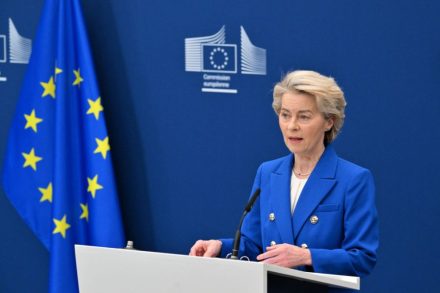
If there is one silver lining to Donald Trump’s Oval Office bust-up with Volodymyr Zelensky last Friday, it is that Europe is finally getting serious on rearmament and defence. Or is it? On Tuesday, Ursula von der Leyen, president of the European Commission (EC), announced a package of measures designed to encourage EU member states to up their defence spending. If they make full use of the new proposals, von der Leyen said, it would amount to an increase of up to €800 billion (£661 billion) spent on defence across the bloc. Announcing the package, she declared: ‘We are in an era of rearmament. And Europe is ready to massively boost its defence spending.

Trump: To help Ukraine, Europe must help itself first

From our UK edition

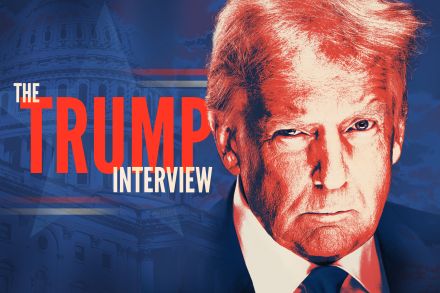
Fresh off the back of a summit with Prime Minister Keir Starmer in Washington, the President of the United States granted The Spectator's US Editor-at-Large Ben Domenech an exclusive interview in the White House. One of the most pressing topics discussed by Starmer and Trump was support for Ukraine in its efforts to resist Russia’s invasion – and America’s threat to throw in the towel as Europe’s peacekeeper. It was time for Europe, Trump told The Spectator, to step into the breach. Trump’s inability to resist promoting the superiority of American support for Kyiv aside, he is correct ‘They have to step up, but they also have to get equipment,’ the President said. ‘They have to spend more money.

Merz is caught in a defence spending trap of his own making

From our UK edition

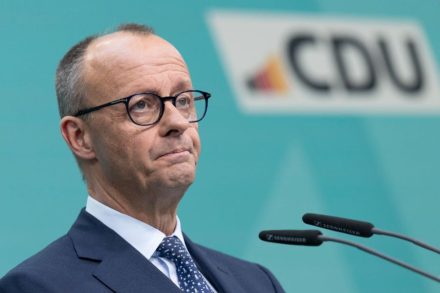
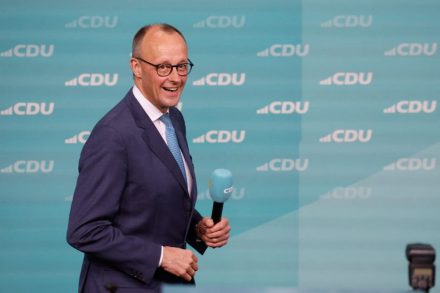
It’s not just in Britain that defence spending is top of the agenda. In Germany, too, the debate has turned to how the government can resurrect the country’s hollowed-out armed forces. Friedrich Merz, leader of the CDU and the man pipped to become the next chancellor, is driving the discussion. But unlike the grudgingly positive response Prime Minister Keir Starmer has received for pledging to increase UK defence spending to 2.5 per cent of GDP over the next two years, Merz is blundering his way into an almighty row – and possibly a constitutional crisis.

Friedrich Merz on track to win German federal election

From our UK edition

After two torturous months of campaigning, the wait is over. Friedrich Merz, leader of the conservative CDU party, is on track to win Germany’s federal election. According to the official exit poll, published at 5pm UK time, his party has won 28.9 per cent of the vote. This means they are set to become the largest party in Berlin’s new parliament. Hot on the heels of the CDU is the far-right Alternative für Deutschland (AfD) party, which has achieved 19.7 per cent of the vote. While it is its highest ever result in a federal election, their projected vote share suggests the far-right party will be just shy of the 20 per cent mark – several percentage points lower than polls had predicted for much of the campaign.

What to look out for in Germany’s federal election

From our UK edition

After two long months of campaigning, Germany heads to the polls today for its federal election. Approximately 60 million voters across the country’s 16 states will elect the new government. Will incumbent SPD chancellor Olaf Scholz’s party be punished for his three years in power? Will the far-right Alternative für Deutschland (AfD) cruise to its highest ever federal result? Will Friedrich Merz’s conservative CDU do well enough to only need one partner to form a coalition? This is what to watch out for tonight. To enter the Bundestag, the parties need to win at least 5 per cent of the national vote.

Hugh Schofield, Igor Toronyi-Lalic & Michael Simmons, Lisa Haseldine, Alice Loxton and Aidan Hartley

From our UK edition

37 min listen

On this week’s Spectator Out Loud: Hugh Schofield asks why there is no campaign to free the novelist Boualem Sansal (1:26); The Spectator’s arts editor, Igor Toronyi-Lalic, reacts to the magazine’s campaign against frivolous funding and, continuing the campaign, Michael Simmons wonders if Britain is funding organisations that wish us harm (8:00); Lisa Haseldine reflects on whether the AfD’s rise could mean ‘Weimar 2.0’ for Germany (17:08); reviewing Thou Savage Woman: Female Killers in Early Modern Britain, by Blessin Adams, Alice Loxton explores the gruesome ways in which women killed (25:05); and, from Kenya, Aidan Hartley reflects on how a secret half-brother impacted his relationship with his father (35:13).  Produced and presented by Patrick Gibbons.

Putin is watching Trump attack Zelensky with glee

From our UK edition

Britain might not even be close to putting boots on the ground, but proposals by Keir Starmer to send UK troops to Ukraine have already been rejected by the Kremlin. Put forward by the Prime Minister as part of a plan to send a 30,000-strong European peace-keeping force to the country in the event of a ceasefire with Russia, this idea is ‘unacceptable’, the Kremlin has said. Reacting to plans reportedly being prepared by Prime Minister Keir Starmer with leaders on the continent (some of whom have already refused to involve their countries in), Putin’s spokesperson Dmitry Peskov said such a proposal was ‘a matter of concern’ as it would amount to the deployment of Nato troops on Ukrainian soil.

How far-right might Germany go?

From our UK edition

In the Thuringian city of Weimar, opposite the theatre where the National Assembly hashed out Germany’s constitution in 1918, stands the museum of the history of the Weimar Republic. ‘A spectre is rising in Europe – the spectre of populism,’ a plaque reads. ‘Forces long thought overcome seem to be returning to threaten the basis of democracy. The Weimar Republic and its neighbours knew the phenomenon only too well.’ It’s a warning that will be weighing on the mind of Friedrich Merz, the leader of the conservative Christian Democratic Union (CDU) party and the man who will probably become Germany’s next chancellor. The federal election this Sunday is the culmination of a messy and fraught campaign.

Starmer backs Nato membership for Ukraine

From our UK edition

Keir Starmer has reassured the Ukrainian president Volodymyr Zelensky of Britain’s ‘commitment to Ukraine being on an irreversible path to Nato’ membership. The Prime Minister made the comments in a phone call with his Ukrainian counterpart this morning. This appears to be a rebuttal of comments made by senior members of US President Donald Trump’s team stating that Nato membership for Kyiv in the aftermath of the war with Russia is unrealistic.  Starmer’s pledge to Zelensky comes after the US defence secretary Pete Hegseth declared on Wednesday during a defence summit in Brussels that ‘the United States does not believe that Nato membership for Ukraine is a realistic outcome of a negotiated settlement’ to end the conflict with Russia.

The surprising fall of Germany’s populist far-left party

From our UK edition

For all the alarm about the instability of German politics, the results of this month’s federal election campaign seem – on the surface – largely baked in. The conservative CDU party, led by the bullish Friedrich Merz, is expected to win, with approximately 30 per cent of the vote. The far-right Elon Musk-loving Alternative für Deutschland (AfD) is predicted to come second with around 21 per cent.  But dive deeper, and the polls show that German politics is still very much in flux. Chancellor Olaf Scholz’s SPD party is fighting for third place with the Greens. And there are three parties which may well fail to meet the 5 per cent threshold needed to enter the Bundestag.

Car rams crowd in Munich, injuring at least 28

From our UK edition

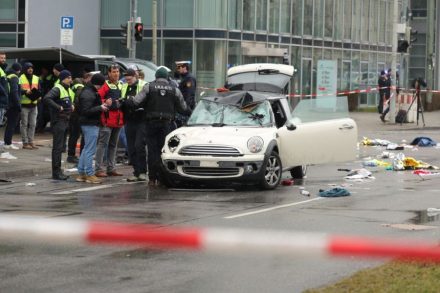
This morning, at around 10.30 local time, a white Mini Cooper ploughed into a crowd of more than 1,000 people in central Munich, south Germany. According to the local authorities, at least 28 people have been injured, with several suffering life-threatening injuries, including a child. Pictures from the scene show a battered car, with a smashed windscreen, surrounded by debris and discarded first aid material. According to Bavarian police, the driver of the car, who was arrested at the scene, is a 24-year-old Afghan failed asylum seeker. The man is reportedly known to the police and has a history of drug and theft-related offenses. The German newspaper Der Spiegel is reporting that the driver of the car applied for asylum after arriving in the country in 2016.

Donald Trump says Ukraine peace talks should start ‘immediately’

From our UK edition

Donald Trump has spoken to Vladimir Putin on the phone and agreed to begin negotiations to end the war in Ukraine ‘immediately’. The US President announced details of the conversation between the two leaders on his social media platform Truth Social. According to Trump, the pair had a ‘lengthy and highly productive’ discussion, touching on AI, the Middle East, the ‘power of the dollar’ and bonded over how valiantly their two nations had fought side by side against the Nazis in the second world war. ‘But first, as we both agreed, we want to stop the millions of deaths taking place in the war with Russia/Ukraine.’ In a move bound to have thrilled Trump, he claimed that ‘President Putin even used my very strong Campaign motto of “COMMON SENSE”.