Jonathan Jones

Mitt Romney picks Paul Ryan

From our UK edition

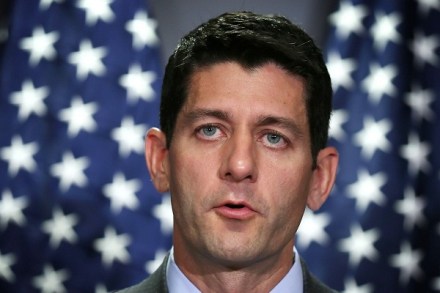
Mitt Romney will announce his choice of running mate at one o'clock this afternoon, but members of the campaign have already confirmed his identity: Congressman Paul Ryan. I reported yesterday that the Republican right has been pressuring Romney to pick Ryan, and it looks like he's bowed to that pressure. Despite having served as chairman of the House Budget Committee for the past year and a half – and his high profile role in budget negotiations – Ryan is still relatively unknown. A new CNN poll shows that only 27 per cent of Americans have a favourable view of the Congressman and 19 per cent an unfavourable one, which means that the majority haven't heard enough about him to form an opinion.
Romney’s not-so-boring white guy

From our UK edition

The next big event of the US presidential election will be Mitt Romney's announcement of his Vice Presidential nominee. For the past few weeks, the two clear favourites have been Ohio Senator — and Budget Office director under George W Bush — Rob Portman and former Minnesota Governor Tim Pawlenty. Both certainly fit the description of 'incredibly boring white guy' that one Republican official said the Romney campaign was looking for. But in the last couple of days, Romney has come under increasing pressure from the Right to pick Paul Ryan: a white guy, yes, but not so boring.

The Bank of England: no Paul the Octopus

From our UK edition

When challenged on the Bank of England's poor record of economic forecasting by Ed Conway of Sky News this morning, Mervyn King said: 'This isn't a spot the ball contest where you're trying to hit one point on the picture. This is a question of assessing the balance of risks…  We don't pretend to have a crystal ball to see the future. All we can do is assess the balance of risks. I think this is a reasonable judgment about the balance of risks. It doesn't say that there will be a recovery. It says that in our central view there will be a recovery, and there are risks on both sides to that — both on the upside and on the downside.

Briefing: Obama v Romney, three months out

From our UK edition

It's coming up fast: there are now just three months to go to Election Day in the United States. And right now, Barack Obama's looking a good bet — although certainly not a safe one — for re-election. The forecasting model designed by the New York Times's Nate Silver — which accounts for both polls and economic data — currently puts Obama's chances of victory at 72.4 per cent, his strongest position so far. Interestingly, though, Obama's lead in the polls is not all that big. Silver's model, which includes national and state-level polls and takes into account the house effects of each pollster as well as the difference between polls of 'registered voters' and those of 'likely voters', puts Obama's lead at about 1.5 percentage points nationally.

Salmond’s stock is falling

From our UK edition

'Poll shows support for UK split has dropped,' proclaims the Scotsman today . Looking at the actual poll , the headline may be over-reaching slightly: YouGov's latest figures are within the margin of error of the ones from January, and anyway the question is worded differently. But it should certainly be worrying for Alex Salmond and the Yes campaign that they don't appear to have made any headway at all. Indeed, as Marcus Roberts of the Fabian Society (who commissioned the poll) says, Salmond's halo seems to have slipped a little this year. The Spectator's Politician of the Year in 2011 has struggled to shrug off the critics who say he's fuzzy on what an independent Scotland would look like.

The Tea Party claims another scalp

From our UK edition

They may have failed to install one of their candidates as the Republican's presidential nominee, but the Tea Party is having better luck in other elections. Last night, Ted Cruz — backed by Sarah Palin, Rick Santorum and Ron Paul — beat Lieutenant Governor David Dewhurst 57-43 in the Republican primary for Texas's senate election in November. Despite being outspent nearly three-to-one, Cruz — who has never run for office before — achieved a remarkable turnaround. In the first round of the primary just nine weeks ago, Dewhurst beat him 45-34 (as neither got more than 50 per cent it went down to last night's run-off). In the second round, Cruz received 149,000 more votes than he had in May, while Dewhurst's count dropped by 146,000.

Briefing: the Libor review

From our UK edition

'It is clear that urgent reform of the Libor compilation process is required,' says Martin Wheatley of the Financial Services Authority. Hardly a revelation: it's been clear since Barclays was fined for its part in the manipulation. Some were even pushing for reform back in 2008, such as the then-president of the New York Fed (now Obama's Treasury Secretary) Tim Geithner. But it is significant that Wheatley is saying this now, as he's been tapped by George Osborne to lead a review of how Libor is set. The FSA hardly has much credibility on this — even Mervyn King is keen to pass the buck to them — but Wheatley only joined in 2011, and so is one of the few unsullied people at the top of the financial regulation world.

Briefing: The fight for the House of Representatives

From our UK edition

A couple of weeks ago, I took a look at the tight battle for control of the United States Senate. This week: the House of Representatives. The fight for the lower chamber of Congress is much harder to assess. There are, after all, 435 individual contests — each with its own unique candidates, characteristics and electorate — compared to the 33 Senate races. At the moment, Republicans have a strong majority, holding 242 seats (if you include the Michigan one recently vacated by Thad McCotter) to the Democrats' 193 (including two vacancies). After a terrible set of results in the 2010 midterms, the Democrats have a mountain to climb to retake control and reinstall Nancy Pelosi as Speaker.

A tale of two economies

From our UK edition

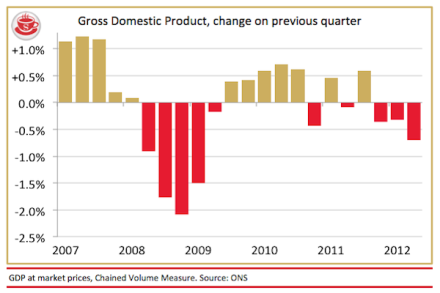
While our economy was contracting by 0.7 per cent, America's was growing by 0.4 per cent, according to the first estimate just released by the US Bureau of Economic Analysis. But, as the graph below shows, those 2012 Q2 figures just represent a continuation of the divergent economic paths the two countries have been on since 2010. In America: steady if unspectacular growth. In the UK: stagnation followed by a second recession. P.S. The Americans report GDP figures as 'annualised growth rates' — that is, the percentage GDP would grow by if it grew for a whole year at the same rate as it did in the quarter — which is why you'll see a figure of 1.5 per cent in US reports today. On that metric, the British economy contracted at an annualised rate of 2.8 per cent in Q2.

Has Olympic fever arrived yet?

From our UK edition

A few years ago, comedian Marcus Brigstocke beautifully summed up the national response to the news that we'd be hosting the Olympic Games: ‘“Would you like the oldest, most historically significant athletic competition the world has ever known, attracting athletes from every known nation on the face of the planet to come here and perform at the peak of their abilities in the very country where you live?” Most British people go “Where will we park?”’ Mitt Romney made a similar observation last night, albeit without the humour. When asked by NBC's Brian Williams whether London's ready for the Games, he said: ‘You know, it’s hard to know just how well it will turn out.

How big are the cuts so far?

From our UK edition

'Osborne's austerity is killing the recovery.' It's a familiar refrain, one that we hear every time there's bad economic news. And, sure enough, today's terrible GDP stats have sparked yet another rendition. Take this, for example, from the TUC's Brendan Barber: 'The government's austerity strategy is failing so spectacularly that is has wiped out the recovery completely.' But very rarely is that austerity quantified. Just how big are these cuts that have supposedly crippled the British economy? Well, according to the latest ONS figures, total managed expenditure stayed roughly flat in the coalition's first year, before being cut by just 1.8 per cent in real terms (£12.6 billion) in 2011-12.

GDP down 0.7% in Q2

From our UK edition

The ONS's first estimate of GDP in Q2 of 2012 shows a 0.7 per cent fall on Q1. It's worth remembering that this is just a preliminary estimate and subject to revision later, but that's a very big drop — the largest since the beginning of 2009 — driven largely by a big 5.2 per cent contraction in the construction sector. The ONS does point out that the extra Jubilee bank holiday will have hurt the economy, as will the record rainfall in April and June — but don't expect Osborne to highlight this, for fear of a repeat of the ridicule he experienced for pointing to snow and the royal wedding in the past. The latest drop means that GDP has fallen by a total of around 1.

Measuring well-being: a tough but important job

From our UK edition

'If you treasure it, measure it.' So Gus O'Donnell said when addressing the All Party Parliamentary Group on Wellbeing Economics in November. Well, the government has decided it treasures our well-being, and so is determined to measure it. It's an incredibly tricky task — as I've noted before — but it's a significant step forward that the Office for National Statistics has at least begun to try, and has finally started collecting a wealth of well-being data. In April, the ONS began asking people four questions to measure their subjective well-being on a scale of one to ten: Overall, how satisfied are you with your life nowadays? Overall, to what extent do you feel the things you do in your life are worthwhile? Overall, how happy did you feel yesterday?

Briefing: HSBC, money laundering and Lord Green

From our UK edition

What's HSBC done wrong? Put simply, HSBC was not rigorous enough in preventing money laundering through its banks. Last week, the United States Senate's Permanent Subcommittee on Investigations released a damning report finding that HSBC had 'exposed the US financial system to a wide array of money laundering, drug trafficking, and terrorist financing risks due to poor anti-money laundering controls'. In particular, the committee criticised the way HSBC treated its Mexican arm.

Public finance statistics point to a miserable autumn statement

From our UK edition

Today's round of public finance statistics bring mixed news for the government. The headlines have focused on the fact that borrowing last month — at £14.4 billion — was £0.5 billion higher than in June 2011. But considering that the monthly borrowing figures end up being revised by an average of £1.7 billion (usually downwards), we shouldn't get too fixated on a difference of a few hundred million. What is perhaps more worrying is the trend in the financial year so far. Superficially, the numbers look pretty good: a total of £14.9 billion in borrowing since April, compared to £38.4 billion in the same three months of last year.

Osborne’s ‘hideous choice’ if growth downgrades continue

From our UK edition

So the IMF has revised its forecasts for the UK's GDP growth downwards — to 0.2 in 2012 and 1.4 in 2013 from the 0.8 per cent and 2.0 respectively it predicted in April. It's bad news, certainly — not least because we've been downgraded more than most other countries, and we're now forecast to grow more slowly than Germany and (this year) France. But it's worth bearing in mind that the IMF — for all its ability to drive headlines — is just one of many organisations playing the forecasting game, and these downgrades actually just bring them into line with the average.

The fight for the Senate

From our UK edition

The battle for control of the White House is, of course, the big US politics story of the year. But what about the building at the other end of Pennsylvania Avenue — the Capitol, which houses Congress? All 435 seats in the House of Representatives are up for re-election, as well as 33 of the 100 Senate seats. Currently, the Democrats control the Senate, with 51 Senators and two independents who caucus with them. But it will be tough for them to retain control, as they are defending 23 seats this time to the GOP’s 10 — and most of the seats up this time were last up for election in 2006, which was a very strong year for the Democrats.

Cutting immigration would explode the debt

From our UK edition

Ever wondered what would happen to the British economy if net immigration were slashed to zero? Well today’s ‘Fiscal Sustainability Report’ from the number crunchers at the Office for Budget Responsibility provides a glimpse of what such a future might look like — and it is a grim picture indeed. They’ve put together projections for the economy — and the public finances — all the way to 2062. Of course such long-term predictions should be taken with a pinch of salt. As Pete says over at ConservativeHome, ‘today’s OBR figures will probably bear as much comparison to the 2060s as the Jetsons will’.

Get set for rebellion number 248

From our UK edition

The coalition’s backbenchers have already proven the most rebellious of any government. There have already been — by my count, adding the 239 rebellions up to the end of April listed in Philip Cowley and Mark Stuart’s Bumper Book of Coalition Rebellions to the eight listed on the Public Whip since then — 247 votes on which at least one Tory or Lib Dem backbencher has cast their vote against the government whip. That's not quite the most of any parliament — there were 309 against Wilson and Callaghan in the 1974-79 parliament, 259 against Blair from 2001 to 2005, and 365 against Blair and Brown in the last parliament — but then this one's just over two years in.

QE is no substitute for a growth strategy

From our UK edition

So the Bank of England is firing up the presses again, and injecting another £50 billion of Quantitative Easing (on top of the £325 billion we’ve had so far), in a desperate bid to get the economy moving. The Bank’s certainly right that growth’s not forthcoming. GDP in the first quarter of this year was 0.2 per cent below where it was in the first quarter of 2011, and the prospects for Q2 aren’t looking too bright either — especially with the extra Jubilee bank holiday.