John Keiger

John Keiger

John Keiger is a former Research Director at the University of Cambridge and author of the biography of French president Raymond Poincaré

Could coronavirus lead to Frexit?

From our UK edition

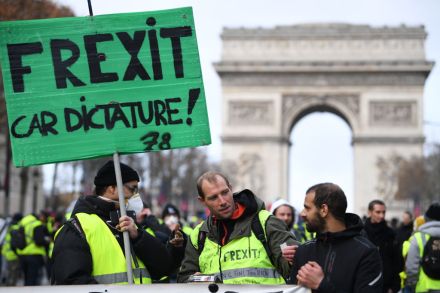
Is France flirting with the idea of Frexit again? Coronavirus is currently provoking a chorus of ‘reprendre le contrôle’ (take back control) across the political spectrum. The epidemic is laying bare France’s dependence on outside states for essentials such as masks, medicines, test kits and ventilators. Even arch-Europhile Emmanuel Macron visiting a French mask manufacturer declared this week: ‘We have to produce more in France, on our territory, from now on to reduce our dependency… we must rebuild our national and European sovereignty’. His reference to Europe is not unusual, but highlighting national sovereignty is. The second ‘take back control’ stimulant comes from growing irritation with the European Union.
Macron’s updated coronavirus statistics will test French morale

From our UK edition

On Saturday night France’s Prime Minister spoke to the French people flanked by the Health Minister, the Director General of Health (DGS) and three epidemiologists, to reassure the public that the government would be more transparent about the spread of coronavirus. Despite President Macron’s increasing media appearances in the ‘war on corona’ a 25 March opinion poll showed 90 per cent of the French public are anxious, 39 points more than on 11 March before the lockdown. Although 64 per cent claimed their morale was holding up, 56 per cent said they had lost faith in the executive’s management of the crisis.

Can we trust France’s coronavirus casualty count?

From our UK edition

It is said that the first casualty of war is truth. In the purported war on coronavirus, Rod Liddle rightly asks ‘how reliable are the coronavirus figures?’ and comes to the conclusion the answer is 'not very'. He is right, for at least two important reasons.  Firstly, not all states are carrying out the same number of tests per million people. For Germany, it is 2,023; Britain, 960; and France, 560. That has a consequence on the number of positive infected cases. Given that the most widely-accessed world rankings of total cases per country used by the media, such as Worldometers (updated in live-time), are based on that figure, the results are not hugely helpful.

‘Germany will pay!’ is Macron’s coronavirus mantra

From our UK edition

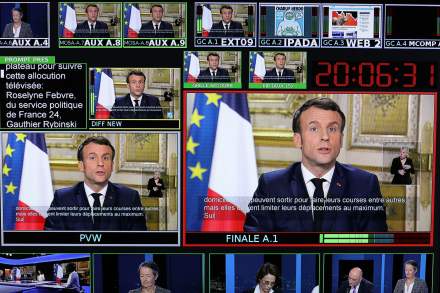
In his broadcast to the nation ten days ago, president Macron tub-thumped his war campaign on coronavirus. Six times he repeated the word ‘war’. Yesterday, he visited the front: Mulhouse in Alsace, on the Franco-German border, where France’s largest virus cluster is overwhelming the region’s hospitals. Live TV saw him, masked up, in an army field hospital, surrounded by soldiers in combat gear. From there he spoke again to the nation. France, he intoned, was at war in this region, a region scarred by past wars. By remaining united France would defeat the coronavirus enemy. And he launched military ‘Operation Résilience’ to take the combat further. Macron’s advisors have allegedly been briefing that he is the new Clemenceau.

France’s downward spiral of coronavirus repression

From our UK edition

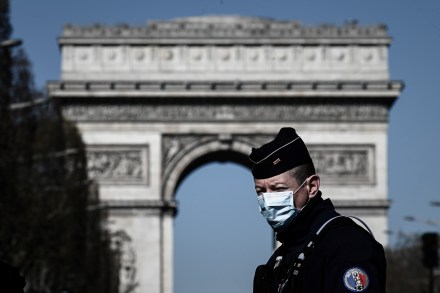
In France there is a palpable sense of administrative and political panic in how to deal with the coronavirus epidemic. As I write from Perpignan on the French-Spanish border on the morning of 24 March, France has 19,856 coronavirus cases and 860 deaths; Britain 6,650 and 335. After Italy and Spain, France is the third worst affected country in Europe (Germany has more cases because it tests more, but only 123 deaths), but it has imposed and enforced the most severe lockdown. France went into lockdown on 17 March. The administrative state immediately generated an array of bureaucratic forms: a certificate to leave your house to walk the dog or go shopping; a certificate justifying your attendance at work rather than working from home.

Save French food!

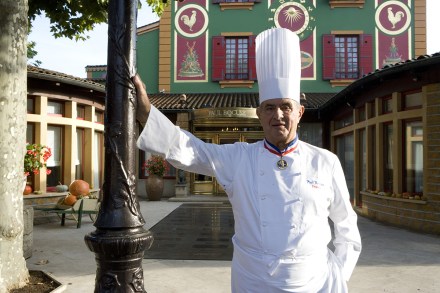
The annual publication of the century-old Michelin restaurant guides creates an excitement in France akin to the Oscars, but the 2020 Guide Michelin is provoking dyspepsia. This is the first time since 1965 that the restaurant founded by Paul Bocuse — the pope, the Napoleon, of French cuisine — no longer figures among the 27-strong group of French restaurants receiving the ultimate culinary accolade: three-star status. Two years after the maestro’s death, the black truffle soup and volaille de Bresse en vessie Mère Fillioux no longer seduce Michelin inspectors. What Bocuse called la sainte trilogie, butter, cream, wine, has lost its infallibility. And Monsieur Paul is not the first to go.

french food

Coronavirus means the EU will never be the same again

From our UK edition

The European project was built on the idea of rendering future war among European states impossible. The EU is programmed to avoid armed conflict among its member states, a situation that would blatantly undermine its very essence. But who could have predicted that an epidemic would shake its foundations. In the space of a couple of weeks fundamental tenets of the EU project have received a body blow and may not recover from the coronavirus epidemic. The European Stability Pact requires member states to respect a three per cent budget deficit. France was about to breach that anyway and has used Covid-19 as a cover to go much further, as will Italy, Greece and others. The Pact also requires states’ national debt to go no higher than 60 per cent of GDP.

The arrogance of France’s coronavirus rhetoric

From our UK edition

‘At the beginning of a pestilence and when it ends, there’s always a propensity for rhetoric. In the first case, habits have not yet been lost; in the second, they’re returning. It is in the thick of a calamity that one gets hardened to the truth – in other words to silence.’ Albert Camus, The Plague. Faced with Covid-19, France has not yet reached that moment of silence when one gets hardened to the truth. Rhetoric still has the upper hand as President Macron’s address to the nation on Monday night revealed.

Revealed: Michel Barnier and France’s Brexit stitch-up

From our UK edition

The glaring difference between the EU and British negotiating goals has been brought into plain sight. In readiness for the upcoming Barnier-Frost negotiations, the French senate produced for the French government a set of requirements that Michel Barnier should work to in the negotiations. Those recommendations, which it published on 6 March, are extremely hardline. If Britain were to accept even a few of the key objectives, it could undermine Brexit. Given president Macron’s power in the European Council it is safe to say that most, if not all, of the recommendations will figure prominently in Barnier’s negotiating file. Frost will have to be on his guard to resist them when talks get underway.

Why Paris will fail in its bid to usurp the City

From our UK edition

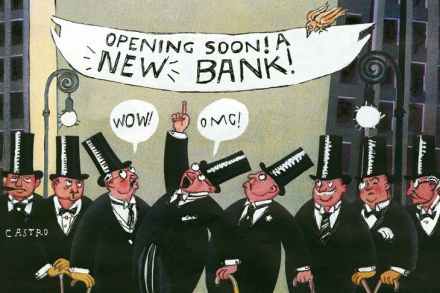
Looming behind the Frost-Barnier negotiations is a battle between London and Paris as financial centres. After the June 2016 referendum, the French failed miserably to seduce City institutions away from the UK. There was no exodus from London, and of those few relocations to the continent, most avoided Paris, preferring to scatter widely from Dublin to Frankfurt and Amsterdam.  After failing in the first instance, the French will now attempt to do so by force under the cover of the EU negotiations.

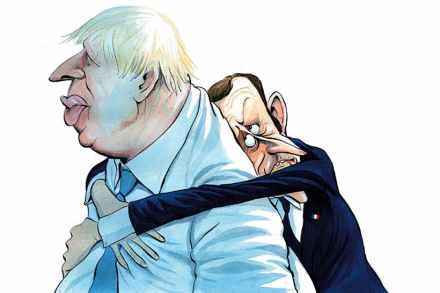
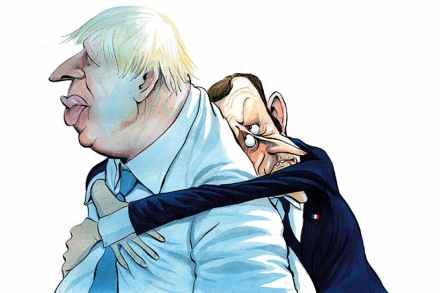
Macron lacks Boris’s Napoleonic flair

From our UK edition

'I’d rather have lucky generals than good ones’, Napoleon - or Eisenhower - was supposed to have said, ‘they win battles’. Emmanuel Macron is a good general, but not a lucky one. Since he stood for the presidential election in May 2017, he has demonstrated strategic ability in identifying the reforms France needs to modernise its economy. He has conducted those reforms with considerable courage in the face of strong opposition overhauling outdated labour laws, unemployment benefits, restrictive practices in the national railway system and now he is tackling the over-generous pension system. And his strategy is beginning to show positive results for the French economy. 2019's GDP at 1.

Frost vs Barnier: who will triumph in the Brexit trade talks?

From our UK edition

What would Disraeli make of Brexit? His advice to ‘read no history; nothing but biography, for that is life without theory’ is a useful starting point. Brexit has been – and continues to be – a hotch-potch of biographies where human weaknesses, strengths and foibles chafe and collide. The upcoming clash between the EU’s chief negotiator Michel Barnier and his British counterpart David Frost is no exception. On 2 March, Barnier, who is responsible for leading the ‘Task Force for relations with the United Kingdom’ will face Frost, the British head of ‘Taskforce Europe’, across the negotiating table for the first time.

Macron’s British charm offensive is only just getting started

From our UK edition

In the excitement/misery of leaving the EU at the end of January many overlooked a touching note written by President Emmanuel Macron to the British people. It was a ‘love letter’ of sorts, a mixture of déclaration d’amour and regretful confession, which bore all the hallmarks of a note from the jilted to the jilter, warm in parts but suffused with a peevish undertone. After three and a half years of condescension, lecturing and veiled threats, Britons are unused to being the object of courtly love. But Macron’s billet doux is about much more than Brexit. Brexit is the catalyst for a deeper concern that Britain is embarking on a global strategy that could see her loosen her commitment to Europe as in the past. Macron knows his history and his geopolitics.

Macron will win and lose in his battle to change France

From our UK edition

Winston Churchill’s comment about France has lost none of its piquancy. Churchill famously said of the difference between Britain, France and Germany: 'In England, everything is permitted except what is forbidden. In Germany, everything is forbidden except what is permitted. In France, everything is allowed, even what is prohibited.' France’s debilitating national transport strike, now in its 47th day, proves it. Ever since the Enlightenment, France has led the world in developing universal principles to govern citizens’ lives in the name of equality. This differs from the approach across the Channel, where piecemeal legislation of customary English common law means everything is permitted except what is forbidden, in the name of liberty.

2020 looks set to be a miserable year for Emmanuel Macron

From our UK edition

Emmanuel Macron’s 2020 ‘to do’ list is nothing if not challenging. Starting with the domestic it offers no respite in its international agenda. Nation-wide transport strikes opposed to the President’s root and branch pension reform have been paralysing France for 23 days, now longer than the legendary 1995 strike that forced President Chirac to withdraw his pension reform. Neither side looks ready to concede and for the moment public opinion supports the strikers. The economic costs are considerable; for France’s national railway, SNCF, the cost is put at nearly half a billion euros while the broader economic impact on tourism and lost sales during the Christmas period will hit French growth.

Will Boris’s Whitehall overhaul work?

From our UK edition

Boris Johnson's big election win means the Tories have taken back control of Parliament. The PM's majority ensures that he can deliver on Brexit and also push through his party's agenda for government. One of the more eye-catching policies planned is a shake-up of Whitehall and the British civil service. Without a radical change, policy implementation will flounder. But will Boris's Whitehall overhaul work? Dominic Cummings, who appears to be the driving force behind these plans, is certainly no fan of Whitehall. In a 2014 blog, he quoted from a TS Eliot poem about the Treaty of Versailles to sum up what he saw as the dismal failure of the civil service to turn policy ideas into action.

France’s doomed socialist project should make Corbyn voters think twice

From our UK edition

What will happen if Jeremy Corbyn wins? Will it be a nightmare on Downing Street, as Liam Halligan suggests in this week's Spectator? Or might Corbyn not be as bad as his critics fear? Helpfully, France provides a useful parallel of what prime minister Jeremy Corbyn might mean for Britain. And it doesn't make happy reading for the Labour leader. It's Spring 1981 and France, the fifth largest economy in the world, elects the most left-wing administration since before the Second World War following eight years of conservative rule. The government immediately begins implementing its radical manifesto: nationalisation of 11 industrial conglomerates and most private banks, higher tax-rates at the upper levels and a special wealth tax.

How might a big Boris victory change Britain?

From our UK edition

If Boris Johnson wins a clear majority on 12 December, it could mark a big turning point in British history. The brakes will be off for the United Kingdom to formally leave the European Union by 31 January 2020. Then the new Tory government will decide how radical its future relationship with the European Union and the rest of the world should be. Make no mistake: this election matters and will be talked about in years to come. World war one and two both wrought significant change to Britain. So, too, did the 1956 Suez debacle, which drained British self-confidence to such an extent that the country lurched into over-reliance on the USA and then the European communities. It led ultimately to 1973’s European Communities Act that sealed British EEC membership.

Expect fireworks at this week’s Nato summit

From our UK edition

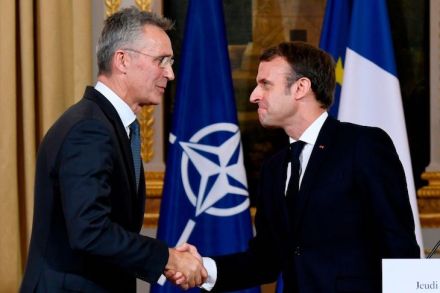
This week is seminal for Boris Johnson and Emmanuel Macron. Boris, in Watford, is hosting one of the most important Nato summits for years. Its significance is not because it marks the Alliance’s 70th anniversary, but because of President Macron’s ‘disruptive’ and trenchant criticism of the Atlantic Alliance as close to ‘brain dead’, which has touched a nerve. The French President went on to reiterate his remarks at an Elysée press conference, with a visibly uncomfortable Nato Secretary General, three weeks later.