John Hare

Swallowed by the Russian Bear

In the 13th century, having overrun and terrorised Europe as far as Budapest, and in the process possibly bringing with them the flea which caused the Black Death, the heirs to Genghis Khan and the Golden Horde had also conquered territory to the east as far as the Korean peninsular. The assiduous Swiss scholar and explorer Christoph Baumer chronicles the ensuing sagas of the remaining individual khanates in great detail. But by the 16th century it is clear that although a few pockets still flourished, producing impressive buildings and works of art, these erstwhile mighty nomadic clans had sunk to a point where they had disappeared from the consciousness of the outside world.

The lure of the desert

From our UK edition

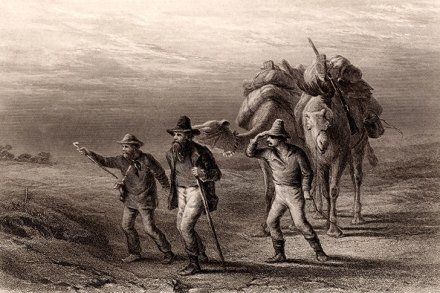
The great deserts of the world hold a compelling attraction for a rare breed of men who are ‘unwise and curiously planned’. Once under the spell of that seemingly infinite arena of sand and stone, many are helplessly hooked. It is an arena where the sun burns down relentlessly during the day, to be replaced at night by a hauntingly beautiful backdrop of brilliant stars. Where the moon shines with a light which softens the austere outline of rocks and hills and casts a diffused greyness over the desert sands.

In the steppes of the Golden Horde

From our UK edition

When I first visited the complex of Buddhist cave grottoes, dating from the fifth to the 14th century, at Bezekilk in Xinjiang province, China, I was struck by the destruction wreaked on them by Muslims whose religion proscribes figurative images of human beings. Eyes had been gouged out and figures lacerated with knives. When and by whom had the vandalism of these exquisite and colourful portraits been done? I later learnt that the Buddhist Uyghurs of the Kingdom of Qocho and Turfan, in which Bezekilk was situated, were converted to Islam by conquest during a holy war at the hands of the Muslim Chagatai Khizr Khwaja. Not easy information to assimilate. The activities of Genghis Khan and the Mongol hordes are widely known but not always in detail.

In the steppes of the ancients: travels on the Silk Road

From our UK edition

It is difficult to fault this remarkable volume. The publishers have created a book of quality with stunning illustrations and lucid maps. It will, I believe, become a standard reference for all who study the complex history of Central Asia and the Silk Road. This is the second volume in Christoph Baumer’s projected four-book series on Central Asia and shows its author to be an extraordinary person, whose skills encompass those of an explorer, a geographer, a historian, an archaeologist and a photographer. Moreover, in each of these exacting disciplines he is no amateur. He displays the rare qualities of both an academic and a man of action. His sparkling prose ensures that the armchair traveller will not nod off.