Isabel Hardman

Isabel Hardman

Isabel Hardman is assistant editor of The Spectator and author of Why We Get the Wrong Politicians. She also presents Radio 4’s Week in Westminster.

What’s the point of Starmer’s reshuffle?

From our UK edition

Will Keir Starmer’s mini-reshuffle of ministers and key aides solve the Prime Minister’s problems? The Prime Minister has moved Darren Jones from the Treasury to the Cabinet Office in a change widely interpreted as an attempt to sideline Rachel Reeves and boost the government’s ability to deliver on its reforms. Jones was Chief Secretary to the Treasury, but his new Chief Secretary role is designed to ‘drive forward progress in key policy areas’. It is a response to Starmer’s growing frustration that the Whitehall machine isn’t moving fast enough to deliver his reforms.

Is the Blair-Cameron consensus on education over?

From our UK edition

19 min listen

GCSE results day has brought a mixed picture; the pass rate has fallen, yet the regional gap has reduced and the gender gap is the narrowest it has ever been. Isabel Hardman and Sir Nick Gibb, former Conservative schools minister, join James Heale to discuss education policy, how changing cultural expectations may be helping the gender gap and why Labour seem determined to attack the Conservatives’ record on education. In Nick’s words, is Education Secretary Bridget Phillipson a ‘more political figure than education figure’? Plus: how the recent High Court ruling over migrant hotels could spark a crisis for the government as more councils, including Labour-controlled ones, seek an end to the policy. Produced by Patrick Gibbons.

The woman I’m not – Nicola Sturgeon

From our UK edition

Nicola Sturgeon has all the usual things she wants to achieve in her memoir: rumours to scotch, a legacy to spell out, and so on. But the most important thing to the former first minister seems to be telling her readers that she is in fact not Nicola Sturgeon. The ‘seemingly confident, combative woman who dominated Scottish politics for more than a decade, unnerved the Westminster establishment, helped lead Scotland to the brink of independence and steered it through a global pandemic’ (her words) is in fact an outfit that the real author of Frankly has been wearing for a very long time. She seems quite keen to cast it off. In 1992, she says, ‘Nicola the soundbite, facsimile politician was born’.

Who is the real Nicola Sturgeon?

From our UK edition

18 min listen

There has been a drip feed of stories over the past few days from Nicola Sturgeon's memoir Frankly which hits the shelves this week. In her book, the former First Minister of Scotland covers a slew of topics including SNP infighting and her relationship with the late Alex Salmond, her sexuality and the police probe into SNP finances, and the gender reform bill that contributed to her leaving frontline politics. Spectator writer and Scottish Daily Mail columnist Euan McColm and Isabel Hardman – who has reviewed the book for this week's Spectator – join Lucy Dunn to discuss. For Euan there is a humility in the prose that he just doesn't recognise in the Sturgeon of real life – is she trying to discover herself? Produced by Patrick Gibbons.

Keir Starmer is taking Boris Johnson’s approach to PMQs

From our UK edition

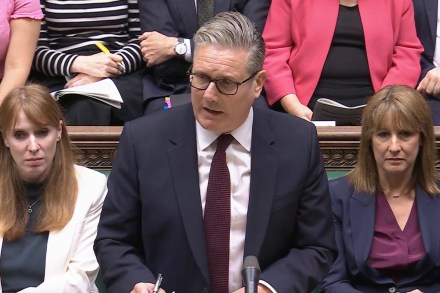
Keir Starmer joked at Prime Minister’s Questions today that Tory MPs seemed to be on recess already. But he wasn’t exactly firing on all cylinders either, giving automated answers to Kemi Badenoch’s questions about tax and the economy. Having complained volubly about prime ministers not answering the questions he asked as leader of the opposition, he now has a stock set of his own personal flannels with which to dodge giving real answers as Prime Minister.

Badenoch got what she wanted at PMQs

From our UK edition

If he were measuring his success at Prime Minister’s Questions purely by avoiding making any senior colleagues cry, Keir Starmer had a reasonably good session today. Rachel Reeves was beaming on the front bench, and next to her Yvette Cooper was joining in with the smiling too. It was the same level of smiling sincerity as you might see at an overlong secondary school piano recital, but the Prime Minister can probably take that as a win. He repeatedly spoke over his shoulder to Reeves, partly to show they were indeed in ‘lockstep’, but also presumably so he could check that she was still grinning.

Wes Streeting takes on the doctors

From our UK edition

The public won’t forgive and nor will I, said Health Secretary Wes Streeting of plans by junior doctors to strike over his refusal to cave to demands for 29 per cent pay rises. Speaking to the Times he said: ‘There are no grounds for strike action now. Resident doctors have just received the highest pay award across the entire public sector. The Government can’t afford to offer more and it wouldn’t be fair to other NHS workers either, many of whom are paid less’.  Is Wes Streeting right? And who's going to come out on top – the Health Secretary or the junior doctors?

So much is still unanswered about NHS reform

From our UK edition

Given we have known for a good while that Labour thinks the way to save the health service is to move care out of hospitals and into the community, you might have expected today’s NHS ten-year plan to explain how the government is going to do that. The preventive agenda is not a new idea that needs explaining, it’s been around for the entire 77-year history of the health service. The problem, therefore, is not the lack of an idea, it’s that reform never actually happens. The important and urgent priorities of waiting lists and emergency units always end up dominating, and the neighbourhood health centres, walk-in clinics, polyclinics or the ‘health centres’ set out in Labour’s original plan for the NHS under Nye Bevan, end up coming a distant second, if at all.

NHS reforms: Labour puts on a brave face

From our UK edition

14 min listen

Today Wes Streeting – with the help of Keir Starmer and Rachel Reeves – announced his 10 year plan for curing the NHS. It’s all about creating a ‘Neighbourhood Health Service’, but what does actually mean in practice?  Much of the plan was leaked in advance: first, focusing on preventing disease before it becomes too late; second, improving community healthcare services to help reduce pressure on hospitals; and third, embracing the tech revolution to bring the NHS into the ‘digital age’. One of the glaring omissions is a chapter on how this will all be delivered. Perhaps the most notable part of today’s launch was the decision to include Rachel Reeves – last seen in the Commons looking distraught as the Prime Minister (brutally) failed to back her.

Landscape designer Tom Stuart-Smith on mistakes, sand and weeds

From our UK edition

If you’re looking for an early example of Tom Stuart-Smith’s work, you’d have to go to a car park to find it. The now world-famous landscape designer started his career doing ‘awful supermarket projects’ where ‘landscape was perceived as just something they kind of had to do’. This was in the 1980s: today, if you want to see a Stuart-Smith landscape, you can go to St Paul’s Cathedral, where he has designed a public ‘reflection garden’, the walled garden at the Knepp Estate, or the Hepworth Gallery in Wakefield, where sculptures sit among naturalistic sweeps of grasses and perennials.

Chancellor in tears during PMQs

From our UK edition

11 min listen

There were extraordinary scenes in PMQs today. Rachel Reeves appeared distraught as the Prime Minister failed to guarantee her security when asked by leader of the opposition Kemi Badenoch. It was brutal to watch, as the iron chancellor’s lip quivered and a tear rolled down her cheek. In many ways, you can’t blame her – with her headroom narrowing, she will be forced to find a further £5 billion worth of savings to allow for the government’s botched welfare bill. No. 10 has since clarified that Rachel Reeves has not resigned and will not be sacked, stressing that it was ‘personal’ matter that had upset her, ‘which - as you would expect - we are not going to get into. The chancellor will be working out of Downing Street this afternoon’.

Starmer throws his Chancellor under the bus

From our UK edition

Keir Starmer was utterly brutal at today’s Prime Minister’s Questions, though towards his own Chancellor, rather than the opposition. He refused to say, when invited by Kemi Badenoch, that Rachel Reeves would be in position until the end of the parliament. Behind him, Reeves looked utterly miserable, to the point that Badenoch highlighted it in one of her questions. The Chancellor either had a particularly badly-timed case of hay fever, or was struggling emotionally during the session, with what appeared to be a tear rolling out of her eye when Starmer was only partially defending her. Reeves was nodding and agreeing with him, but looked devastated at the same time The focus on Reeves came about because Badenoch naturally attacked Labour on last night’s welfare bill shambles.

Martha’s Rule should be a model for changing the NHS

From our UK edition

What do we really need to change about the NHS? Later this week we will finally get the NHS plan from Health Secretary Wes Streeting which, like all the other big reforms before, promises to make the health service fit for the future and focused on patients. Streeting has been more articulate than many previous ministers about the failings of the current setup, saying the NHS today is often organised around the needs of the system, rather than the people it is meant to serve. One of the most pernicious aspects of this is the way the health service deals with mistakes. Streeting has already trailed ‘pioneering AI technology’ in the new plan which he says will ‘rapidly analyses healthcare data and ring the alarm bell on emerging safety issues’.

Labour MPs are still sceptical of the Welfare Bill

From our UK edition

Liz Kendall tried to use her Commons statement on the government’s U-turn on some of the disability benefit cuts to persuade her colleagues that the changes made the legislation worth supporting. Not all of them sounded very convinced: there were repeated complaints about a ‘two-tier system’ whereby two people with the same needs would get completely different levels of support. MPs were also concerned they were signing ‘blank cheques’ by voting on the bill tomorrow when full details of the changes won’t be available until later in the year. And there were suspicions that the changes won’t be as meaningful as ministers have suggested.

Does Starmer still want to be PM?

From our UK edition

13 min listen

There have been a number of navel-gazing interviews with the Prime Minister over the weekend. Across thousands and thousands of words, he seems to be saying – if you read between the lines – that he doesn't particularly enjoy being PM. In better news, Labour seems to have quelled the welfare rebellion. Liz Kendall is making a statement in the Commons this afternoon, in which she will outline the concessions that Labour has made on its controversial welfare bill. All in, the cost has spiralled by £3 billion per calendar year – which an already put-upon Chancellor will have to find. Whilst it remains the largest rebellion of this government, the number of rebels has shrunk to around 50.

The NHS isn’t being honest about the maternity crisis

From our UK edition

Wes Streeting has announced yet another inquiry into NHS maternity safety: this time a national investigation which the Health Secretary wants to address ‘systemic problems dating back over 15 years.’ This rapid review, modelled on the Darzi review of the NHS, will report in December 2025 and will work across the entire maternity system, using the findings of previous reviews and urgently examining the ten worst-performing maternity services in the country.

The assisted dying debate is not ‘Parliament at its best’

From our UK edition

MPs are coming to the end of the assisted dying debate. The speeches can be roughly divided into the following camps: those who, like the Bill’s sponsor Kim Leadbeater, are very much in favour of the Bill and confident in its drafting; those who are in favour of the principle of assisted dying but who are so concerned about the drafting of the Bill that they are opposed to it; and the implacable opponents to the principle. The speeches from the latter two camps largely focused on the argument that today’s vote is not about the principle of assisted dying but about the Bill as it stands. The proponents of the legislation, though, have largely focused on the need to back assisted dying as a principle.

What you need to know ahead of the assisted dying vote

From our UK edition

14 min listen

It’s a historic day in Westminster, where MPs will vote on the assisted dying bill – the outcome of which could have huge repercussions for healthcare, politics and the courts. It’s such a significant day, in fact, that we’ll be recording another podcast just after the result is announced at around 2.30 p.m. Kim Leadbeater’s camp remains confident that the bill will pass, although many anticipate a much closer vote than at the second reading. This is in no small part due to high-profile members of the party being opposed to the legislation, and Keir Starmer remaining characteristically evasive on the issue. The backdrop, of course, is the resignation of a government whip, Vicky Foxcroft – though over a separate issue: Liz Kendall's plan to cut personal independence payments.

Labour whip resigns over disability benefit cuts

From our UK edition

This evening, the Labour MP Vicky Foxcroft has resigned as a government whip over the disability benefit cuts. In a letter to Keir Starmer, she writes that she is quitting the frontbench 'with a heavy heart', adding: Foxcroft's resignation suggests that the rebellion over disability benefit cuts really is quite serious I have wrestled with whether I should resign or remain in the government and fight for change from within. Sadly it now seems that we are not going to get the changes I desperately wanted to see. I therefore tender my resignation as I know I will not be able to do the job that is required or me and whip – or indeed vote – for reforms which include cuts to disabled people's finances.

Rayner’s PMQs clash shows why Reform is doing so well

From our UK edition

Kemi Badenoch will have been irritated to miss today’s Prime Minister’s Questions, given it denied her the opportunity to accuse Labour of delaying the inevitable on a national inquiry into grooming gangs. Sadly for those watching, the fact that today’s session was a battle of the deputies did not mean that the rest of us were able to avoid hearing two parties who have both clearly failed to address grooming gangs properly over the years arguing about who cared more about the issue. That the parties are going round in circles on both topics underlines the failure of Labour and the Tories Chris Philp, the shadow home secretary, was standing in for Badenoch, and Angela Rayner, the deputy prime minister, was deputising for Keir Starmer, who is on his way back from the G7 meeting.