Harry Mount

Harry Mount is a barrister, editor of The Oldie and author of How England Made the English (Penguin) and Et Tu, Brute? The Best Latin Lines Ever (Bloomsbury).

It’s better to be quick than clever

From our UK edition

What’s the biggest division in life? Between clever people and stupid people? Between the good-looking and the ugly? No. The fundamental difference is between the ones who do things quickly and the ones who do them slowly.  You know that friend who emails you back the moment you email them for a favour? Or the builder who comes round the morning you ring him? These are the modern saints – the hyper-efficient deities who put to shame that other friend who only ever rings when they want something out of you; or the plumber you have to ring three times and only ever rings back to say he isn’t coming after all.

How to avoid the tourist backlash

From our UK edition

Europe is revolting against the tourist invasion. This summer, Venice has started charging a tourist tax to keep visitors at bay. Mallorca, Menorca, Ibiza and Formentera have just set up inter-island protests under the slogan, ‘Let’s change course – let’s set limits to tourism’. Barcelona is planning to ban Airbnb. In the Cinque Terre, on the Italian Riviera, some of the coastline is now one-way, to restrict tourist traffic. On another bit of the Ligurian coast, plans are afoot to charge walkers. You can see why – the famous cities and resorts of Europe have become one vast Queueworld, where tourists gather in great numbers, intense heat – and, increasingly, intense misery.

Why does the National Trust hate itself so much?

From our UK edition

In its latest bout of self-hatred, the National Trust has declared that ‘people from the global majority are widely under-represented in the outdoors, accounting for only 1 per cent of National Park visitors in 2019’. That’s despite 15 per cent of the population in England and Wales being represented by the global majority. It’s one of the National Trust’s peculiar, masochistic tendencies that it isn’t happy with its members And so, as part of their Walk Together Pathway, the Trust is training 24 people from the global majority to become ‘qualified walk leaders’. Why on earth do you need to be trained to lead a walk? How many qualifications do you need to say, ‘Let’s go for a walk on Saturday.

Conspicuous luxury looks cheap

From our UK edition

Street robbery has become an epidemic. Horrible thugs are stealing luxury watches and jewellery in broad daylight. The number of luxury watches stolen almost doubled in England and Wales between 2015 and 2022 – with 25,802 stolen in 2022. The problem is particularly bad in London, where the Metropolitan Police have set up a special unit to tackle the problem. Even the greediest thief isn’t about to strip your suit off your back It's an unforgivable crime. Lock the muggers up and throw away the key. Of course people should be free to walk the streets, decked in gold and silver. Oh for the legendary days of medieval England when you could supposedly leave a bag of coins nailed to a tree for a year and no one would steal it.

Easter special: how forgiveness was forgotten

From our UK edition

36 min listen

This week: how forgiveness was forgotten, why the secular tide might be turning, and looking for romance at the British museum.  Up first: The case of Frank Hester points to something deep going on in our culture, writes Douglas Murray in the magazine this week. ‘We have never had to deal with anything like this before. Any mistake can rear up in front of you again – whether five years later (as with Hester) or decades on.’ American lawyer and author of Cancel Culture: the latest attack on free speech, Alan Dershowitz, joins the podcast to discuss whether forgiveness has been forgotten.

Could I find love at the British Museum?

From our UK edition

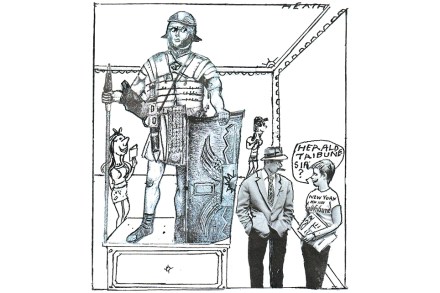
Mirabile dictu, as we Latin lovers like to say. In other words, wonderful news! Attractive women have fallen for ancient Rome – and for classicists. Well, that’s what the British Museum thought when it cooked up its advertising campaign for its new show, Legion: Life in the Roman Army, about Roman legionaries. The Museum put up a controversial social media post, promoting the exhibition as an opportunity for single women to find single men. I spotted a lissom blonde in green T-shirt and tie-dye trousers. We fell in step as we approached the gift shop The post read: ‘Girlies, if you’re single and looking for a man, this is your sign to go to the British Museum’s new exhibition, Life in the Roman Army, and walk around looking confused. You’re welcome x.

Harry Mount, Lara Prendergast, Catriona Olding, Owen Matthews and Jeremy Hildreth

From our UK edition

29 min listen

On this week's Spectator Out Loud, Harry Mount reads his diary, in which he recounts a legendary face-off between Barry Humphries and John Lennon (00:45); Lara Prendergast gives her tips for male beauty (06:15); Owen Matthews reports from Kyiv about the Ukrainians' unbroken spirit (12:40); Catriona Olding writes on the importance of choosing how to spend one's final days (18:40); and Jeremy Hildreth reads his Notes On Napoleon's coffee. Produced by Cindy Yu, Margaret Mitchell, Max Jeffery and Natasha Feroze.

When John Lennon took on Barry Humphries

From our UK edition

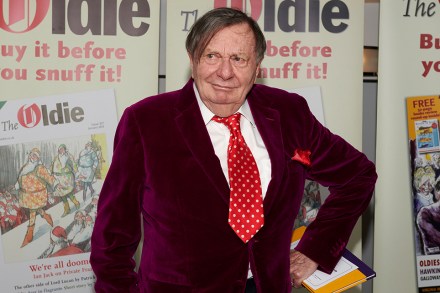
Barry Humphries would have been 90 on 17 February. To commemorate his life, Radio 4 is broadcasting Barry Humphries: Gloriously Uncut that evening. For the programme, I recalled the joy of talking to Barry about the column he wrote for the Oldie. What a delight, too, it was to hear from the great diplomat Sir Les Patterson on everything from Australian politics to the history of lesbianism: ‘A lot of high-achieving Sheilas – like Cleopatra, Mary Queen of Scots, Boadicea, Dusty Springfield and Florence Nightingale – all paddled the pink canoe at some stage of the game.’ One day, he asked my colleague Penny about me. On hearing I wasn’t married, he said, deadpan, ‘Is he a vagina-decliner?’ Barry had immaculate manners and so asked Penny not to pass on the question.

Lionel Shriver, Angus Colwell and Toby Young

From our UK edition

32 min listen

On this week’s episode, Lionel Shriver asks if Donald Trump can get a fair trial in America (00:39), Angus Colwell speaks to the Gen-Zers who would fight for Britain (08:25), Matthew Parris makes the case for assisted dying (13:15), Toby Young tells the story of the time he almost died on his gap year (20:43), and Harry Mount tells us about the grim life of a Roman legionary (25:38).

The grim life of a Roman legionary

From our UK edition

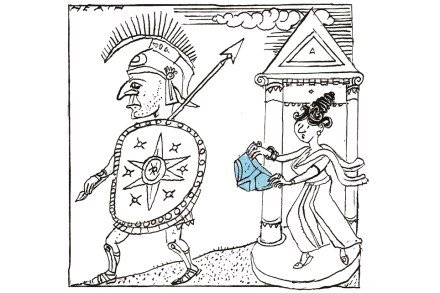
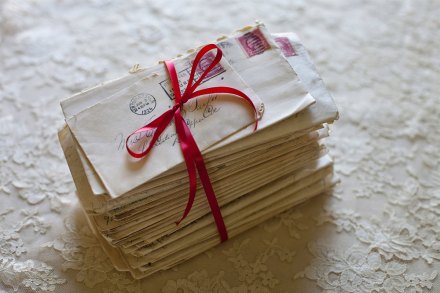
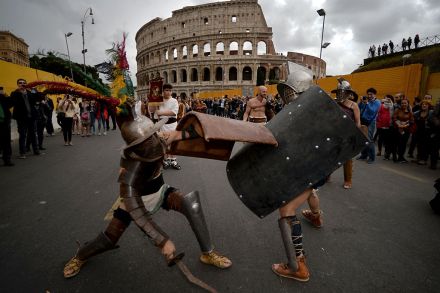
Over the heather the wet wind blows, I’ve lice in my tunic and a cold in my nose. The rain comes pattering out of the sky, I’m a Wall soldier, I don’t know why. The mist creeps over the hard grey stone, My girl’s in Tungria; I sleep alone. W.H. Auden was right. Life for a Roman legionary on Hadrian’s Wall was bloody miserable. The Vindolanda letters sent to and from legionaries living near the wall – on show in a new British Museum exhibition – chime with Auden’s lines in ‘Roman Wall Blues’. The Romans hated the English weather. In one letter found at Vindolanda fort, near Hexham, Northumberland, a legionary hears about some prized woollen underpants.

Starmer is wrong to defend the National Trust

From our UK edition

Keir Starmer is drawing up his battle-lines for the next election. First, he came for the public schools, pledging to whack VAT on school fees. Now he’s going for the traditionalist wing of National Trust members.  In a speech today, he accuses the Tories of 'waging a war' on charities and civic society. He claims the Conservatives have denigrated the National Trust by accusing it of pursuing a 'woke' agenda: 'In its desperation to cling onto power, at all costs, the Tory party is trying to find woke agendas in the very civic institutions they once regarded with respect.' The National Trust was once a byword for high-minded thought So that’s how Starmer is dividing the electorate for the general election.

The Elizabethan grandeur of Middle Temple Hall

From our UK edition

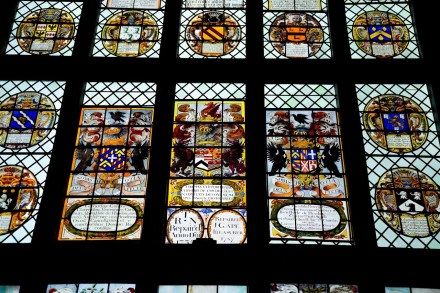
It’s the most beautiful restaurant in London – and the oldest. Built in 1573, Middle Temple Hall is celebrating its 450th anniversary. It’s also where Shakespeare held the premiere of his Christmas play, Twelfth Night, in 1602. How strange that hardly anyone knows about the best Elizabethan hall in London. It’s mostly used by barristers but the public can eat there too, as long as you book ahead.  I looked up to high table to see a purple-faced bencher, glaring down at me The food is lovely, substantial, marvellously unponcey fare and fantastically good value for such a staggering spot – on the western edge of the City, on the banks of the Thames. When I was there this month, I had cream of mushroom and tarragon soup (£4.

A definitive biography of Liz and Dick, Hollywood’s most controversial and glamorous couple

What is it about Richard Burton and Elizabeth Taylor that still hooks us in, thirty-nine years after his death and twelve years after hers? In his magnificent, definitive double biography, Roger Lewis nails down the answer. Liz Taylor was the last great Hollywood movie star, starting in the golden age in National Velvet (1944), aged twelve. As Lewis puts it, her origins were in the magazines and movies of the Forties: “the era of Bing and Bob, Big Bands, such as Glenn Miller, Bogie...Tom and Jerry, Disney.

lewis

The joy of an archive

From our UK edition

It’s amazing how quickly you become ancient history. Thirty years after I left Oxford, my old college, Magdalen – alma mater of Oscar Wilde, Edward VIII and my fellow undergraduate George Osborne – sent out a request to former students. The college archivist asked for ‘Academic work. Records of student societies. College magazines and newsletters. Posters and programmes. Menus and tickets. We need them.’ Hard-copy memories have been increasingly replaced by digital records, as the British Library has discovered to its cost. It has just suffered a ransomware attack, paralysing its online systems. The library’s curator of digital publications, Giulia Carla Rossi, is concerned about the fragility of digital publications.

In defence of Eton’s Provost

From our UK edition

The world divides into two groups. Those who liked school and those who didn’t. Sir Nicholas Coleridge, the next Provost of Eton, is firmly in the first group. In an article in the Telegraph, he has frankly admitted that he prefers people who went to Eton, as he did. He said: I am bound to say that if I meet somebody that I have never met before – for example, if I am travelling abroad, or through work or something – and it emerges that they were at Eton, I feel an interest in them that is multiplied by at least ten. If we are being completely candid, I do accept that I prefer the company of Etonians to the company of people from any other school in the world. This might sound shockingly snobbish to some.

Women are obsessed with the Romans, too

From our UK edition

Infamy! Infamy! That was my response to the TikTok trend about ancient Rome. Women asked their partners how often they thought about the Roman Empire. Many men admitted they thought about it every day; three times a day, said one. One confessed he was obsessed with ‘aqueducts and the fact that they had concrete that could harden’. The scoundrels who came up with the idea should have asked women. Because they, too, are obsessed with ancient Rome. ‘I’ll be at a picnic when I look at my sandwich and suddenly ask: “Did you know the Romans had sandwiches?”’ Professor Mary Beard told me: ‘I must confess that I probably think about the Roman Empire about 50 times a day… but then it is what I do. But I don’t think about macho men in military kit or orating in togas.

How the Aeneid was nearly destroyed

From our UK edition

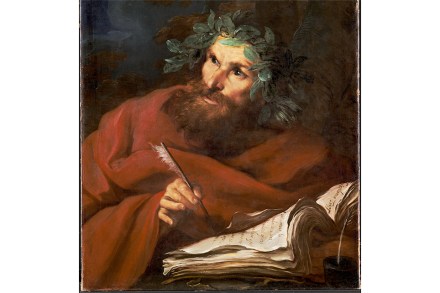
According to legend, Vergil declared of himself ‘Mantua me genuit, Calabri rapuere, tenet nunc Parthenope: cecini pascua, rura, duces.’ (‘Mantua bore me, Calabria took me; now Naples holds me: I sang of pastures, fields, and leaders.’) In her rigorously researched biography, the American classicist Sarah Ruden shows that this is largely true – even if the author of the Aeneid was in fact born 30 miles from Mantua, in a little village called Andes, in 70 BC.  Ruden must necessarily rely on Vergil’s most influential biography, written by Suetonius more a century after his death.

Why some men are obsessed with the Roman Empire

From our UK edition

Why do men think about the Roman Empire so much? That’s the subject of a new social media trend, where women ask their partners how often they think about ancient Rome.  Some men do it every day; one admitted to doing it three times a day. But why is it men who love the Empire so obsessively? 'There’s so much to think about,' one man said to his fiancée on TikTok. Another admitted he loved 'their aqueducts and the fact that they had concrete that could harden'. He’s right. The Pantheon in Rome was built out of a special Roman concrete that has held up its extremely delicate dome since 126 AD. Some academics say that the teaching of Roman history has concentrated on its masculine aspects: gladiators, legions, warfare and imperial eagles.

What’s in a school nickname?

From our UK edition

‘Have you met Sperm?’ a friend from Westminster School asked me at a teenage party once. Sperm was a charming, pretty, confident girl but, still, I didn’t feel quite ready to use her startling nickname on our first meeting.   My own nickname – Mons, Latin for Mountain or Mount – seemed unadventurously fogeyish by comparison. I didn’t pass it on to Sperm.   Old school nicknames can be fantastically rude – but the ruder they are, the more affectionate Old school nicknames can be fantastically rude – but the ruder they are, the more affectionate. Sperm happily responded to the nickname – and her friends used it in an utterly friendly way. They had long detached the word’s meaning from its use as a name.

‘She had no neutral gear’: Lindy Dufferin remembered

From our UK edition

In 1957, when my dear godmother, the Marchioness of Dufferin and Ava (1941-2020), was 16, she began her diary. The granddaughter of the Duke of Rutland and daughter of Loel Guinness, an MP, financier and Battle of Britain pilot, Lindy Dufferin had a gilded childhood. Her entries as a teen are like no other: ‘Randolph Churchill [Winston’s son] was staying the night here… It was most embarrassing because Randolph was very drunk…’ In October 1957, she was in Paris: ‘The Dutchess [sic] of Windsor came… I did a show of Rock & Roll. It was all great fun. Bon Soir!’ But, amid all the luxury, a note of seriousness enters – there was art, too. Clandeboye became a kernel of art, literature and music. Vikram Seth stayed.