Gavin Mortimer

Gavin Mortimer

Gavin Mortimer is a British author who lives in Burgundy after many years in Paris. He writes about French politics, terrorism and sport.

Is Giorgia Meloni stoking Britain’s migrant crisis? 

From our UK edition

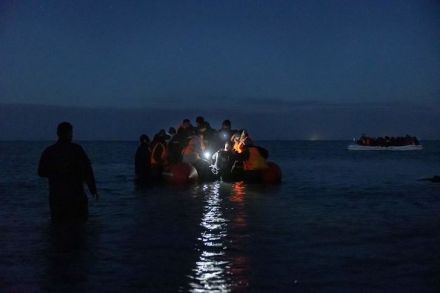
In the last week, more than 1,000 migrants have crossed the English Channel, which is twice the number of people that the government’s barge can house on the Dorset coast.   This was unveiled last week as the latest wheeze to address Britain’s migrant crisis: a floating barge with 222 rooms to house up to 500 migrants as their asylum applications are processed. It might be an idea to put in an order for a few more.   According to Frontex, the European Border Agency, 5,622 migrants landed on the Kent coast in January and February this year, an increase of 82 per cent on the same period in 2022.  This is despite the fact there has been a marked decrease in Albanians crossing the Channel because of Rishi Sunak’s deal with his Albanian counterpart.

The French left is in thrall to violence

From our UK edition

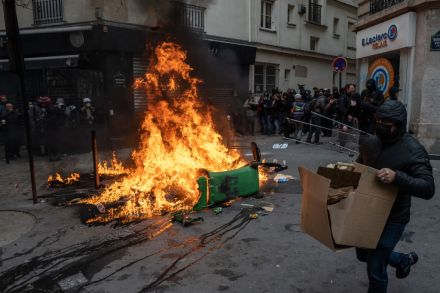
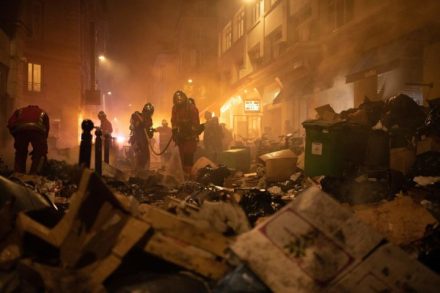
Since the middle of March in France, 1,247 Gendarmes, police and fire fighters have been injured in the line of duty. There have been over 2,500 deliberate acts of arson and around 350 buildings have been vandalised in some shape or form.  Forty-seven of those gendarmes were injured on Saturday March 25 when they were attacked by a large and well-organised army of environmental extremists at Sainte-Soline in western France, some of whom came from Germany, Italy and Switzerland. The previous October 61 gendarmes were wounded at the same location. Television footage of last month’s violence showed the extremists advancing towards the gendarmes in a well-drilled military manoeuvre, throwing Molotov cocktails from behind shields.

France’s Boomers have a lot to answer for

From our UK edition

Paris has banned e-scooters after the people were asked to vote in a referendum. Not many of the capital’s 1.38 million registered citizens bothered to cast their ballot on Sunday, but of the 103,000 who did 90 per cent voted against.   The Mayor of Paris, Anne Hidalgo hailed the referendum as a red letter day for ‘participative democracy' over ‘democracy of public opinion and polls’. The city’s three e-scooter operators – Dott, Lime and Tier – quickly cried foul, citing what they described as ‘very restrictive voting methods’; only 21 voting stations were open, and there was no internet voting.

Did Brexit save Britain from France’s fate?

From our UK edition

Stéphane Rozès, the author of a book entitled ‘Chaos’, was on French radio this week receiving congratulations for being a visionary. The chaos which he described in his book, published last November, is now being played out in France, as hundreds of thousands of people take to the streets. Asked to explain its cause, Rozès explained that it has been building since 1992, the year France signed the Maastricht Treaty, the beginning of the European Union.  Rozès is not alone in this view. One of France’s best known philosophers, the left-wing Michel Onfray, has been saying the same thing for years. ‘France died in 1992, the date of the Maastricht Treaty,’ he said in an interview in 2018.

Is Macron heading for his Margaret Thatcher moment?

From our UK edition

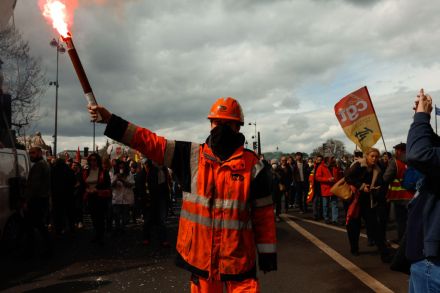
There was a sense of foreboding in France at the start of this week. After the anarchy of last Thursday and the extraordinary violence in western France on Saturday, where radical environmentalists fought a pitched battle with police, what would the next seven days bring?  Much of the media speculated that the 10th day of action organised by unions in protest at the government’s pension reform bill would result in the sort of scenes witnessed across France five days earlier, with city halls torched, shops sacked and police stations attacked. Jean-Luc Mélenchon, the leader of the left-wing La France Insoumise, was accused by the government on Monday of tacitly encouraging the disorder. Yesterday, he called for protestors to make their point peacefully.

Why Macron cancelled the King

From our UK edition

Many on the French left were in buoyant mood on Friday after the success of the previous day. They claimed that three million people were on the streets to protest against Emmanuel Macron’s pension reform bill, and they hope there will be a similar turnout on Tuesday for the next organised demonstrations.  Commentators have described the cancellation as a ‘humiliation’ for Macron. Is it? Or is the humiliation the Republic’s?  Few wished to dwell on the violence – the burning of town halls and the smashing of shops – and some, like Philippe Poutou, who stood for the New Anti-capitalist party in last year’s presidential election, claimed that protestors have ‘the right to respond’.

France is on a knife edge

From our UK edition

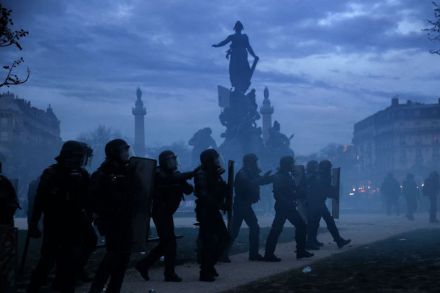
Yesterday was a day of anarchy in France – and the protests overnight have led to King Charles's state visit to France, which was due to start this weekend, being cancelled. The King had been due to visit Paris and Bordeaux, two of the cities hit by the most extreme violence. In Bordeaux, a town hall was sacked. In Lorient, a police station was attacked – and in Nantes a court was vandalised. The worst of the violence was in Paris. Hundreds of thugs clad in black fought running battles with police, 149 of whom were injured, and they also smashed and looted shops, banks and restaurants.

Has Emmanuel Macron become France’s ‘Caligula’? 

From our UK edition

The government of Emmanuel Macron won a vote of no confidence in the National Assembly on Monday by a mere nine votes. The cross-party no-confidence motion, tabled by a Centrist coalition fell just short of the 287 votes it needed to bring down the government.  To succeed the no-confidence motion required the support of the centre-right Republican party, augmenting the votes of the left-wing NUPE coalition and Marine Le Pen’s National Rally party, both of whom are opposed to the government’s reform bill that was passed last Thursday without a parliamentary vote. Instead, on Macron’s orders, Prime Minister Élisabeth Borne used a controversial clause in the Constitution, Article 49.3, to pass the bill.

Why Macron doesn’t fear the Parisian street protests

From our UK edition

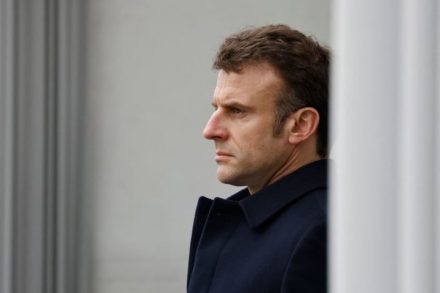
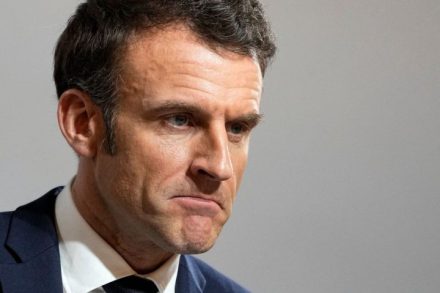
France is on the brink of another revolution! The proles are swarming to the barricades and it’s only a matter of time before President Macron is dragged from the Élysée palace.  That is the gist of some of the more excitable reporting about what happened yesterday in France. It was certainly a dramatic day after the government forced through its pension reform bill that will increase the age of retirement from 62 to 64. It did so on the orders of Macron, deploying a controversial clause in the constitution – article 49.3 – which legalises a bill without the need for a parliamentary vote.   Where were the opposition MPs in 2020, raging against a breakdown in democracy? It’s becoming a habit of Macron’s.

Paris is stinking

From our UK edition

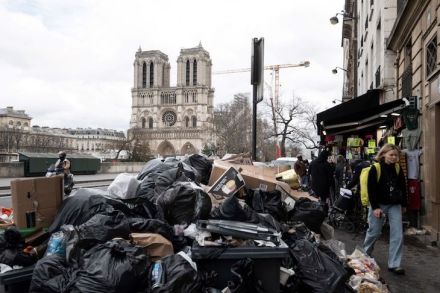
They say Spring is a magical time to visit Paris but perhaps not this year. It’s not so much love that is in the air of the French capital but the stench from 7,000 tons of uncollected rubbish.  The city’s refuse collectors have been on strike as part of the nationwide protests against the government’s pension reform. Workers at the three incinerators that dispose of Paris’s garbage have also downed tools and the walkout will last until at least Monday 20 March.   It’s not a strike that affects all the capital. In some of the arrondissements, private firms empty the bins and it is business as usual for them.

How Albania’s mafia took control of Europe’s trafficking network

From our UK edition

America must get tough against the Mexican drug cartels, former US Attorney General, William Barr, declared earlier this month. Likening them to Isis, he backed a joint resolution from two Republican senators, giving the US president authority to deploy the military against the cartels in Mexico. Failure to do so would, he warned, allow the cartels to continue flooding the US with their ‘deadly drugs on an industrial scale’. America’s anti-drug strategy was ineffective because, he said, ‘it leaves the drug supply chain untouched…real progress requires aggressively attacking the drug supply at its source. The head of the snake is in Mexico.’  Europe must apply a similar approach if it’s to solve the migrant crisis.

Sunak needs more than Macron’s help to crack the Channel crisis

From our UK edition

There was more than a whiff of ‘bromance’ between Rishi Sunak and Emmanuel Macron when they met at the Anglo-French summit in the city of love. The weather in Paris was grey and cold, but there was no denying the warmth of the greeting that Macron extended to Sunak as the PM arrived at the Elysee yesterday. This is hardly a surprise: after Boris Johnson and Liz Truss, the president was just pleased to be hosting a PM who knows how to mind his Ps and Qs.   Sunak said he was ‘fortunate’ and ‘excited’ to have the opportunity to work with Macron, whom he described in French as ‘mon ami’. Macron looked genuinely touched to be addressed in such heartfelt terms.

Can Macron get through the day without insulting the Brits? 

From our UK edition

The editorial in today’s Le Figaro heralds the dawn of a 21st century Entente Cordiale and the newspaper carries an interview with Rishi Sunak. Speaking ahead of today’s Anglo-French summit in Paris, Sunak says he wants to ‘open a new chapter with France’.   Le Figaro pins the blame for the deterioration in relations between the two countries since the last summit in 2018 on the British, specifically Boris Johnson and his ‘anti-French populism’. The French believe that is now a thing of the past with Sunak in No. 10. This conveniently overlooks the fact that if Johnson was the bête noire of the French, Emmanuel Macron hasn’t exactly been the most diplomatic leader.

Failing to stop the Channel crisis will cost Rishi Sunak his job

From our UK edition

Finding an effective solution to Europe’s migrant crisis has eluded the continent’s leaders for a decade. Presidents, prime ministers and chancellors have tried, and failed, to tackle the issue. Above all, governments have been scared to stand up to the powerful pro-migrant lobby which has controlled the narrative since the crisis began in 2011. Is this about to finally change?  Prime Minister Rishi Sunak is determined to make good on his vow to stop the small boats crossing the Channel. This week, Home Secretary Suella Braverman will explain how this will be done. Under a new bill, anyone arriving in the UK on a small boat will be prevented from claiming asylum, with the Home Secretary having a duty to ‘detain and swiftly remove’ those who break the law.

How much longer will MI5 cloak its incompetence in secrecy?

From our UK edition

The incompetence of MI5 in failing to prevent Salman Abedi detonating his bomb at the Manchester Arena in 2017 beggars belief. According to Sir John Saunders, who chaired the inquiry into the Islamist atrocity which killed 22 people, a better response from MI5 ‘might have prevented the attack’.  In publishing his 226-page report, Sir John did not spare the intelligence service for missing several opportunities to thwart Abedi, who made little attempt to conceal his extremist ideology. MI5’s most calamitous mistake was to sit on a piece of intelligence that they received, information which has not been disclosed for national security reasons.  Has a deadly brew of arrogance and naivety been further addled in recent years by political correctness?

Elly Schlein shouldn’t be a problem for Georgia Meloni

From our UK edition

There is much excitement among western Europe’s chattering classes after Elly Schlein was elected the new leader of Italy’s left-wing Democratic party. It is the first time that a woman has led the Italian left. The Guardian quoted the 37-year-old as saying her party will now be ‘a problem’ for Giorgia Meloni, Italy’s conservative PM.  On the contrary. Schlein’s elevation to party leader is an electoral gift for Meloni, whose sex is the only thing she has in common with her new foe. Schlein has not drawn any lessons from the collapse of the French Socialists Meloni was raised by a single mum in a working-class district of Rome and supported herself working as a bartender and a nanny in her youth.

How Putin is fomenting Europe’s migrant crisis

From our UK edition

'Watch the Sahel,' warned Tony Blair in an article marking the first year of Russia’s invasion of Ukraine. Because of Russian influence, the region 'will be the source of the next wave of extremism and migration to Europe,' the former PM forecast in the Daily Telegraph.  As the increased numbers crossing the Mediterranean from Africa to Europe in 2022 demonstrated, the next wave of migration has started. Frontex, the EU’s border agency, reported recently that last year migration across the Central Mediterranean 'rose by more than half to well over 100 000 detections'.  This mass movement of people is creating tension, not only in Europe.

Was Jean Raspail racist?

From our UK edition

Fifty years ago, one of the most controversial books of the late 20th century was published. Camp of the Saints was written by Jean Raspail, a French travel writer, who explained decades later that the idea for the novel had come to him one day in 1972, as he looked out at the Mediterranean from the Côte d'Azur. ‘I don't know what went through my mind,’ he said. ‘The immigration problem didn't exist yet. The question suddenly arose: ‘What if they came?’ The book is the story of a million migrants from India, who landed on the south coast of France in an armada of boats. They were welcomed by the left, who saw them as fellow citizens of the world, cheering them on their way to Paris with a cry of ‘We’re all from the Ganges now!

Macron is unwise to snub Meloni over Europe’s migrant crisis

From our UK edition

Emmanuel Macron and Giorgia Meloni are no strangers to having a spat. The first was last autumn, about migrants; this time they have fallen out over Ukraine.  The Italian prime minister made no secret of her irritation with the French president last week on discovering he had invited Volodymyr Zelensky to Paris. It was, declared Meloni, ‘inappropriate’ for Macron to host the Ukraine president for dinner last Wednesday at the Elysee. German Chancellor Olaf Scholz received an invite too, which evidently antagonised Meloni even more.  ‘There were two European leaders, there were 25 missing,’ reflected the Italian PM. ‘When it comes to Ukraine, what interests us above everything else is to give a message of unity.

What UEFA won’t tell you about the Stade de France fiasco 

From our UK edition

UEFA has published its independent review into the chaotic Champions League final last May and it is brutally honest in admitting its own failings. The events in and around the Stade de France as Liverpool played Real Madrid in European football’s showpiece event made global headlines for all the wrong reasons. Television pictures of French police teargassing supporters, including children, were beamed around the world and caused a political furore in Paris. The government, notably the Interior Minister Gérald Darmanin and the Minister of Sports, Amélie Oudea-Castera, initially blamed English fans for the trouble, a position they maintained for weeks until the accumulation of evidence elicited what can best be described as a reluctant and half apology from Darmanin.