Fraser Nelson

Fraser Nelson

Fraser Nelson is a Times columnist and a former editor of The Spectator.

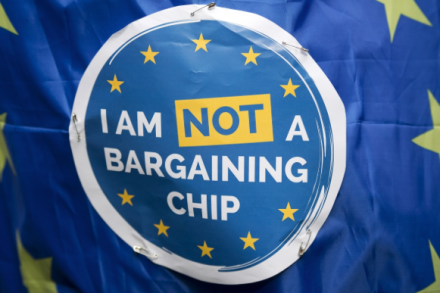
Theresa May is (slowly) seeing sense on EU nationals. Will the EU do the same?

From our UK edition

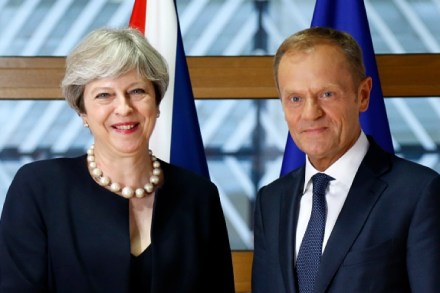
Theresa May has made a far better offer to EU nationals, saying they will be granted permanent residence after staying five years. But the EU has not. Donald Tusk, president of the European Council, has said that her offer is 'below our expectations and risks worsening the situation for our citizens'. He wants the European Court of Justice to have authority over the UK government in policing its pledge to EU citizens. Theresa May has ruled out any ECJ authority saying, quite rightly, that the Brexit vote was a move to end all that. So where now? Joseph Muscat, the prime minister of Malta which holds the rotating EU presidency, warned of the danger of 'pitfalls', in which people were 'treated differently' depending on when they arrived in the UK.
What are the Conservatives for?

From our UK edition

Should it be Boris? He was twice elected mayor of a Labour city and if the Tory mission is to stop Jeremy Corybn, surely you need someone charismatic to see off a populist. Then again, David Davis is a dependable caretaker, a bruiser who can hold the line on Brexit. Or why not skip a generation? There’s the articulate Priti Patel and the accomplished Dominic Raab. And to make this party go with a bang, why not ask Michael Gove to be someone’s campaign manager? He’ll change his mind on the day and then: pow! They’ll all form a circular firing squad, like last time, and whoever’s left standing wins. To their credit, the Conservatives recognise their capacity for self-destruction.

At long last, Theresa May offers assurance to EU nationals

From our UK edition

After a year of prevarication, it has emerged that the Prime Minister has agreed to offer permanent residency to all EU nationals who were living in Britain. Under current rules, anyone who has been here for five years can apply for permanent residency status: not quite the same as citizenship, but it confers the same rights as UK citizens enjoy. Two-thirds of our EU migrants are covered by this. What's new is that no one will be booted out (which would anyway be illegal) but it seems that those who hit the five-year mark, say, in 2022 will also be able to apply for permanent residency. Her offer is conditional on reciprocity - but the EU has already said it would reciprocate. Hopefully, the question can now be closed.

Why is Philip Hammond trying to destabilise his government’s Brexit talks?

From our UK edition

You can see why Theresa May locked her Chancellor up in a cupboard during the general election campaign. Not only was his credibility shot in his bungled Budget, where he seemed not to realise that his plan to raise National Insurance violated the manifesto upon which he was elected, but he’s now still seeking to undermine his colleagues on Brexit. The UK position is clear: yes, we’d like a good deal with the EU but if one is not forthcoming then we’d walk away and use the default World Trade Organisation rules. Hardly a leap into the unknown; the WTO rules govern the UK trade with our largest single partner, the United States. And the guidelines have already been guaranteed.

Yes, Grenfell is a scandal. No, Theresa May does not have blood on her hands

From our UK edition

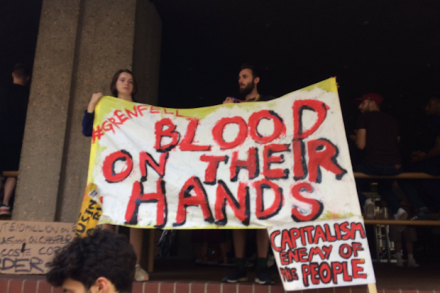
“Burn neoliberalism, not people” said Clive Lewis in a tweet showing the skeleton of Grenfell Tower. Odd words from a Labour MP. When asked just what he meant, he explained that his 'agenda' is to 'end not just the current government but Thatcherite economic dogma'. In this way the grief and anger after the Grenfell Tower disaster has been moulded into a march on No10 with chants of 'May must go' and 'blood, blood, blood on your hands'. Just a few days ago, John McDonnell was calling for a protest march in Westminster. Now, he has got one. https://twitter.

Those who died at Grenfell Tower were the victims of bad government

From our UK edition

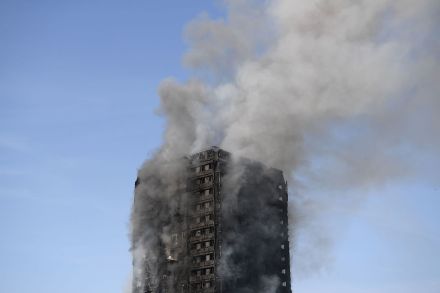
Had the Grenfell Tower tragedy befallen one of the millionaire high-rises built along the Thames recently, it would still be a catastrophe that shocked the country and the world. But what makes this disaster so numbing and sickening is to see, in the faces of the dead, some of the most vulnerable people in our society. People who were, in effect, in the care of the state – that is to say, in our collective care. If we pay taxes and vote, we’re part of a system that’s supposed to devote the greatest attention to those in greatest need of government help. And on Tuesday night, dozens of them were killed – through, it seems, near-contemptuous neglect from various layers of government.

Unemployment is at its lowest since 1975. Can someone tell the Tories?

From our UK edition

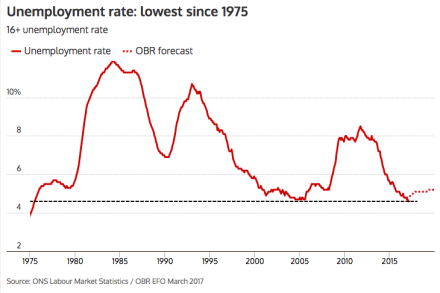
British government may not be strong and stable but the economy is still the most formidable job creating machine in Europe. And while it's certainly true that much of the rise in employment is down to immigration, British unemployment is also down – figures today show the lowest level since 1975. My old friend Simon Nixon writes in the Times today about Britain becoming the new basket case of Europe, and has been making similar noises since the Brexit vote. He may well he right, but so far this basket is carrying more jobs than at any time in history. Don't expect the Tories to make this point: they've been out to lunch since the Brexit vote, and barely mentioned the economy in the campaign.

Jo Swinson favourite to be new Lib Dem leader as Tim Farron quits

From our UK edition

After a fairly disastrous general election campaign, Tim Farron has quit as leader of the Liberal Democrats. You can see why: he wanted to pose as the champion of Remain yet for for the first few weeks he seemed unable to move the conversation beyond his views on gay sex and marijuana. His attempt to rekindle the Brexit wars was a complete flop. The LibDems are an unlikely alliance of evangelical Christians and social liberals, and Farron's appointment embodied a clash that the media delighted in exposing. He said, today, that has decided that the two are impossible to reconcile: "I have found myself torn, living as a faithful Christian and leading a political party in the current environment.

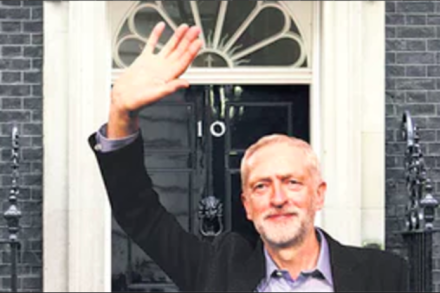
Jeremy Corbyn is now bookies’ favourite to be next UK Prime Minister

From our UK edition

Well, this is going well. As the Tories pretend that all will be well under a reprogrammed Maybot, the expectations outside SW1 are rather different. Let's say someone moves against her, the other candidates start to move too – and before you can say Boris the party has formed another circular firing squad. What happens? What if the Tories can't keep it together and there's another general election? The bookies have decided: Jeremy Corbyn is more likely than anyone else to succeed Theresa May. Now the bookies get things wrong almost as regularly as pollsters, but expectation matters a lot in politics – and business. If most Tories think Corbyn is close to power, then this explains their good behaviour.

George Bridges resigns as Brexit minister – has the unravelling begun?

From our UK edition

The reshuffle might be over, but the government is still changing shape. It has emerged that George Bridges has quit as a Brexit minister. He was highly rated by David Davis, his erstwhile boss, and had established himself as one of the most able ministers in the government – precisely the sort of person they can’t really afford to lose at this time. So why has he walked out now? We are only given a diplomatic answer: he’d been contemplating moving on for some time, and it seemed like a good time. If this rationale sounds familiar it’s precisely the formula that Katie Perrior deployed when she quit as Theresa May’s communications chief after just nine months in the job.

Yes, the lowest-paid did best under Cameron

From our UK edition

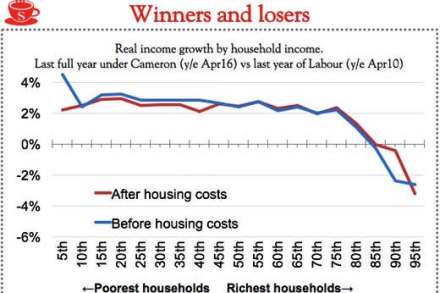
Was the general election a vote against austerity? I was on the Today programme this morning to discuss this point, and in the course of the interview said that the lowest-paid did best under the Cameron years. This raised some degree of incredulity from Twitter, reported by Huffington Post. What planet am I on? I thought I’d answer. The Cameron years were tough, especially for those on welfare. But the aim was always to make people better-off by moving them into work. David Cameron did cut tax for employers, with corporation tax far lower. Liam Byrne, with whom I was on the Today programme, said that companies hoarded cash – but he didn’t say that they also employed a lot more people than they used to. So while 442,000 public sector positions were cut, 3.

It’s a question of when, not if, Theresa May will resign as Prime Minister

From our UK edition

Only one Cabinet member – Chris Grayling – had a good word to say about Theresa May and even he waited hours to say it. The silence of the others underlines the scale of trouble that the Prime Minister is in with her own party after blowing its majority in pursuit of a personal mandate. If she had won a landslide (which seemed to be there for the taking), she wanted to make it a very personal landslide, asking people to ‘vote for me’ rather than her party. As I say in my Daily Telegraph column today, the defeat must now be owned by her personally. And the silence of her Cabinet is intended to let her dwell upon this fact: she shut most of them up during the campaign, hoping to personalise the glory of victory. They now want her to personalise the misery of defeat.

Ruth Davidson’s Scottish Tories have shown Theresa May what success looks like

From our UK edition

Extraordinary results for the Conservatives in Scotland, where the party – under Ruth Davidson’s leadership rather than Theresa May’s – is doing extraordinary well taking 13 seats. Alex Salmond, former Scottish First Minister, has just lost to to a Conservative in Gordon.  So has Angus Robertson who is the SNP leader in Westminster. Overall, the expectations are that the SNP will lose 20 of their 59 seats - the unionists had hoped to deprive them of ten at most, and would have settled for five. Amongst the many sentences I never thought I would type, I can add this: Scotland seems to is the only bright spot for the Tories, so bright that Scotland might well end up imposing a Tory government upon England.

The pound plunges as markets start to take in the enormity of May’s blunder

From our UK edition

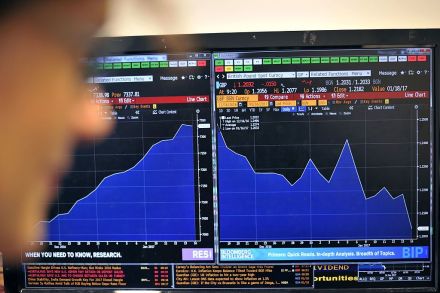
The pound has plunged sharply on the exit poll, as markets start to come to terms with the idea that Theresa May might have blown it. It's 1.7 per cent down against the dollar, 1.8 per cent against the Euro - expect those gains to deepen if tonight's results confirm the results of the exit poll. For a simple reason: Theresa May asked for a general election to strengthen her hand in Brexit negotiations. If the public refuses to do so, she will be hugely weakened in the biggest negotiation that any Prime Minister has had to undertake. If, indeed, she survives long enough to undertake it - which is by no means certain if she does worse than David Cameron managed to do against Ed Miliband.

Why Theresa May is pointing the finger at American tech giants

From our UK edition

  After the 9/11 attacks, Tony Blair traced the jihadi menace to the problem of ungoverned spaces, like Afghanistan. In her speech after the London Bridge attacks today, Theresa May used similar language to describe cyberspace. “We cannot allow this ideology the safe space it needs to breed,” she said. “Yet that is precisely what the internet and the big companies that provide internet-based services provide”. What could she have in mind? Not the dark web: that’s notorious but it's beyond the (current) ability of government to regulate or remedy.

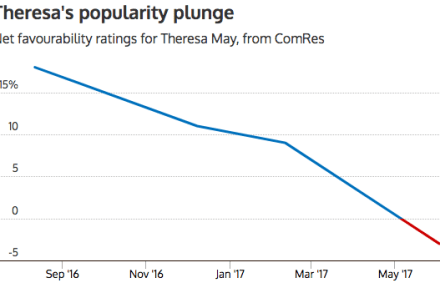
Theresa May’s popularity rating turns negative, but Tory lead remains intact

From our UK edition

When the Conservatives were rebranded “Theresa May’s team” and the party's name purged from its literature, there were two explanations. One, that the UK system of Cabinet government doesn’t suit the Prime Minister, so wants an election where she’d campaign by diktat in order to govern by diktat. She'd go fetch a three-figure majority, then her Cabinet meetings would be a bit like the Spitting Image sketch about vegetables (above). The other explanation was more plausible, and benign: that her personal approval ratings were the highest recorded for any Prime Minister so it made sense for the Tories to campaign on the leader.

Why we can’t be sure that Theresa May won’t blow it

From our UK edition

We’ve just had our pre-election meeting at The Spectator, and agreed the usual drill for the big night. Election day itself is dead: we relax and steel ourselves for the evening. There'll be the normal 8.30pm curry as we wait for the exit poll and we'll lay on some wine (and desk space) for contributors who'll be near our Westminster office. Katy Balls will stay up late – that’s how she likes it – and I’ll try to grab some sleep early and come into the office for 2.30am. Katy, James Forsyth and Tom Goodenough will do the night shift; Will Heaven, John O’Neill and I will do the early morning shift. We’ll record a podcast after the 10pm exit poll, which we probably won't need to revise because they're usually right.

Diary – 1 June 2017

From our UK edition

In such gorgeous weather the best part of Scotland to visit is not (as so many seem to think) the West Highlands but my native north-east. Moray, a region of whisky and white beaches, has long been the country’s best-kept secret, but it has become rather spoiled of late by its new status as a battleground seat. Plenty of its SNP supporters voted for Brexit, leading to a conflict of loyalties that seems to have been resolved in favour of the Tories. They almost won the council last month and if they take the constituency they’ll depose Angus Robertson, leader of the SNP in Westminster. Nicola Sturgeon is worried enough to come up and offer her support.

Fact-checking what Nicola Sturgeon told Andrew Neil about education

From our UK edition

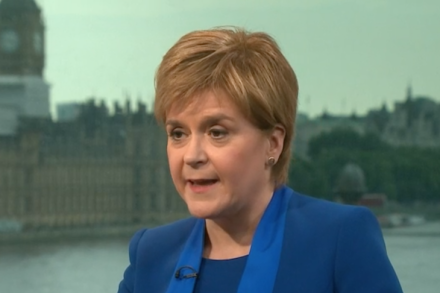
I’ve been on the campaign trail in Scotland, and was struck by how often education was raised by voters – underlining a trend of the SNP’s domestic record catching up with Nicola Sturgeon. She had come prepared for her interview with Andrew Neil on this point, but how reliable were her answers? Ms Sturgeon’s tactic is to drag any discussion about education into the land of acronyms and statistics, knowing that the best way to get out of a tight spot is to make the subject sound dull, or parochial. But online, we have infinite space to team up with people who know these briefs, and scrutinise politician’s answers. The result is below. A health warning: this is about details, and about Scotland.

In the digital age, terrorists have far more places to hide

From our UK edition

We learn this morning that MI5 has launched an internal inquiry into how they didn’t catch Salman Abedi, the Manchester bomber. He was reported to them five times, apparently, even by his imam – the spooks looked into him, but after a while discontinued their investigation. Perhaps we will learn that there has been an egregious intelligence failure but I doubt it. I suspect that in time, we’ll learn every detail about the case of Salman Abedi and it will likely expose the grim realities of counter-terrorism. And also that, as I argued in my most recent Daily Telegraph column, we’re about as safe as we’re ever likely to get.