Dot Wordsworth

Cravat

From our UK edition

‘French,’ cried my husband. ‘It’s bloody French.’ We were clicking on a computer screen in response to the dear old Telegraph’s invitation to ‘test out your etymological knowledge’. The little game accompanied news of an exhibition in London called The English Effect, mounted by the British Council. I had already got one of the 20 questions wrong, because I didn’t know the origin of honcho and clicked on the option ‘Mexican’ (whatever that means) instead of Japanese. In a way honcho is American, having been ‘brought back from Japan by fliers stationed there during the occupation and during the Korean fighting’, according to the journal American Speech in 1955, as I discovered later.

Behalf

From our UK edition

Why has behalf so rapidly collapsed into misuse? Everyone says things like ‘On my behalf I don’t want money’, or ‘The car crashed through bad driving on your behalf’. Rather than attributing the action to a vicarious agent, they simply mean ‘for my part’ or ‘on your part’. I should like to see what the Oxford English Dictionary has found out about this usage, but it has not updated its entry for behalf since 1887. Even then, it was bemoaning the ‘loss of an important distinction’ between in behalf of and on behalf of. Someone complained to The Spectator 202 years ago about a line in a play that ‘ought, by no means, to be presented to a chaste and regular audience’.

Aspiration nation

From our UK edition

I still haven’t got over aspiration nation, the Chancellor’s watchword in this month’s Budget, which now seems a long time ago. Why is it so annoying? One aspect is the rhyme. It stops short of being a repetition, like Humbert Humbert, but settles for a jingle, like Gilbert the Filbert. Another annoyance is the jamming together of two nouns. I can see that aspiring nation would have a different meaning, as would aspirant nation, but aspirational nation is more like it. No doubt the clangour was intentional. There are plenty of precedents. The National Council of Teachers of Mathematics (a US organisation) has a website called Calculation Nation. Someone in America runs a blog called Information Nation with the subtitle: ‘It rhymes so you know it must be clever.

Enthronisation

From our UK edition

They were worrying in Canterbury about a clash between the inauguration of the Pope and the enthronisation of the Archbishop of Canterbury. It was a near miss. You might think the word enthronisation sounds like something that George Bush had coined. Yet it has been in use longer than enthronement, which is not known until 1685. Two centuries earlier, Malory was writing of intronyscacyon in the Morte d’Arthur. In the succeeding centuries the word was applied to Archbishops of Canterbury, to the King, the Great Sophi of Persia, the Pope, the Ark of the Covenant and to Satan. Enthronisation is not just a word from distant centuries.

Austerity

From our UK edition

‘Remember snoek?’ asked my husband, as if I were old enough to be his mother. In 1947, ten million tins of this distinctive-tasting fish, Thyrsites atun, were imported from South Africa to take the place of sardines. The Conservatives complained in Parliament that the Labour administration’s austerity diet was damaging the health of British people. It was more likely that people simply felt put upon, developing a dislike of the very name snoek, which had been favoured officially as preferable to the alternative snake mackerel. We tend to identify austerity with Attlee (1945-51), though the word as a political ideal had been introduced under the coalition during the second world war.

Lurch

From our UK edition

My husband made a little joke. ‘There’s no such thing as a free lurch,’ he said, looking up from his Sunday Telegraph. In it, David Cameron had declared: ‘The battle for Britain’s future will not be won in lurching to the right.’ Lurching is a nicely pejorative word. A lurch could only be welcome accidentally. The word suddenly popped up in the 19th century. No one is known to have used it earlier than Byron in 1819, in Don Juan, where he contrives a Byronic rhyme: ‘A mind diseased no remedy can physic/ (Here the ship gave a lurch, and he grew sea-sick).’ Its origins are mysterious but nautical. A clue may be found in the works of William Falconer, who is more or less a one-book man.

Contamination

From our UK edition

A shrouded skull flanked by serpents above a tureen inscribed with the words, ‘There is death in the pot’ (2 Kings 4:40), ornaments the title page of A Treatise on the Adulterations of Food by Frederick Accum (1820). Accum details hair-raising additions to food in the pursuit of profit, not just alum to bread but lead pigments to anchovy sauce and laurel berries to custard (which made three little children in Yorkshire fall insensible for ten hours, and lucky to survive). Alum is a mineral otherwise used as a styptic. Three decades on, Tennyson in Maud wrote: ‘Chalk and alum and plaster are sold to the poor for bread / And the spirit of murder works in the very means of life.

Release

From our UK edition

The centenary of George Barker’s birth was mentioned in the Times Literary Supplement recently. His ‘first two books — one of verse, the other prose — were released in 1933’. Released? Isn’t that what happens to films and Engelbert Humperdinck? Released suddenly seems to have replaced published. Certainly Amazon is reinforcing the trend, because if you order a book that has not yet been published, a message pops up with the date on which ‘this item will be released’. Until then it is available ‘for pre-order’ or, as we used to say ‘to order’.

Electrification of the ring fence

From our UK edition

At the age of 55, Gervase Markham set off to walk from London to Berwick without using any bridge or boat, and without swimming, but relying only on a staff to help him leap. That was in 1622. When he returned, with a certificate from the mayor of Berwick, many of his friends — 39 of them — refused to pay up on the wagers they had laid. I mention Markham because he is the first person known to have used the term ring fence. Last week George Osborne, the Chancellor of the Exchequer, aged 41, said he was going to electrify the ring fence. He has not yet made the walk to Berwick.

Vulnerable

From our UK edition

‘I’m a vulnerable adult,’ said my husband when I asked him why he was shouting the other morning. He had spilt some water from the hot kettle on his slippered foot. Unlike Achilles, his vulnerability extends beyond the pedal extremities. But I shouldn’t like it to be thought that he was making fun of anyone who is called vulnerable. Their numbers seem to be growing. When that policewoman was jailed last week for talking to the News of the World, the judge said he would have put her down for three years had she not been in the process of adopting a ‘vulnerable child’. I thought all little children were vulnerable, but the judge made it clear that this one had made ‘a disastrous beginning in life’.

Onesie

From our UK edition

The onesie has brought Britain one step nearer fainéant infantilism than the slanket. The slanket, a portmanteau of sleeved and blanket, reached a height of popularity in 2009. It looked like a monk’s habit, except it fastened at the back, like a hospital gown. The slanket’s purpose was cosiness while watching television, which people in Britain, apart from us, dear reader, do for more than four hours a day. I admit that during the recent wintry weather I put on my tweed overcoat one evening at home. Unlike the overcoat, the slanket was not intended to be worn in the street. The onesie has been worn in public by some rich celebrities. I’d expect it to be worn publicly by the sort of people who go out in shellsuits or more recently trackie bottoms.

Lang Syne

From our UK edition

Those of us who only pronounce the words auld lang syne on New Year’s Eve and have a vague grasp of their grammatical function may be cheered by a sign at Ballyhalbert in Co. Down that reads: ‘Shore Road, formerly — lang syne, Tay Pot Raa.’ So we are learning quickly. Lang syne means ‘formerly’, and the local words for ‘tea pot’ are tay pot, and for ‘road’, raa. Hence Faas Raa. But what language is this? The Good Friday Agreement of 1998 declared that ‘part of the cultural wealth of the island of Ireland’ was Ulster-Scots. This is undeniable. In 2001, the United Kingdom recognised ‘Scots and Ulster Scots’ as ‘a regional or minority language’.

Breaded cats

From our UK edition

I don’t know whether people know what belling the cat means now. In an allusive language like ours, some references sink out of sight. But the old tale is that a council of mice resolved to hang a bell round a cat’s neck, to warn them of its approach. Which of them would have the temerity to hang the bell on the cat? The tale pre-dates Langland, who, in Piers Plowman in the 1370s, referred to the plan to get ‘a belle of brasse… And hangen it up-on the cattes hals’. (Hals is just an old word for ‘neck’, related to Latin collum, and our collar.) Langland doesn’t use the word bell as a verb, and nor, the OED says, did anyone until 1762, in James Man’s edition of an old history of Scotland.

The history of the coffee house

From our UK edition

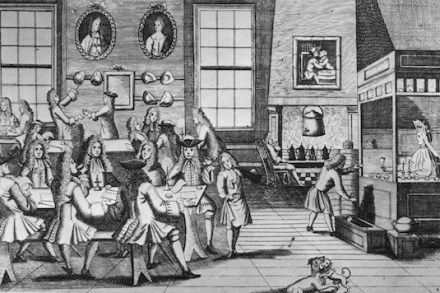
In the series of radio programmes on culture, a guest of Melvyn Bragg’s declared that the distinction between high and low culture was never strict, as a Wagner opera was first performed in a music hall. This is to suggest that music halls always offered acrobats and performing dogs. But the Liverpool Music Hall, for example, advertised in 1814: ‘Beethoven, The Mount of Olives (“A New Sacred Oratorio”)’. The fortunes of the name music hall are paralleled by coffee house. We hear, from George Sandys’s visit to Constantinople in 1610, of ‘Coffa-houses’ where they sit ‘chatting most of the day, and sippe of a drinke called Coffa’. Pepys went to a coffee house in 1664 ‘to drink Jocolatte’.

Coffee house

From our UK edition

In the series of radio programmes on culture, a guest of Melvyn Bragg’s declared that the distinction between high and low culture was never strict, as a Wagner opera was first performed in a music hall. This is to suggest that music halls always offered acrobats and performing dogs. But the Liverpool Music Hall, for example, advertised in 1814: ‘Beethoven, The Mount of Olives (“A New Sacred Oratorio”)’. The fortunes of the name music hall are paralleled by coffee house. We hear, from George Sandys’s visit to Constantinople in 1610, of ‘Coffa-houses’ where they sit ‘chatting most of the day, and sippe of a drinke called Coffa’. Pepys went to a coffee house in 1664 ‘to drink Jocolatte’.

Elven

From our UK edition

Like many, I have just read The Hobbit again, which I hadn’t done since reading it to Veronica as a girl. Even when solemn, Tolkien knows what he is doing with language. It was at his most relaxed that he could be careless, as in the early pages where he too often repeats dreadful (in its modern sense). But he does not employ the ‘Wardour Street’ fake antique that Fowler complained of in others: words like anent, trow, ween, whilom or wot. As a professional philologist he knew the history of every word he used. Some of the words that give a feeling of antiquity to The Hobbit end with –en. This suffix is used in six different ways in English, and I won’t go through them all.

Omnishambles | 28 December 2012

From our UK edition

‘Serious fellows, these Americans,’ said my husband, applying stereotypes with a broad, patronising brush. He had a point, though, for Merriam-Webster’s, the dictionary people, announced that their word of the year, 2012, was a dead heat between socialism and capitalism. ‘We saw a huge spike for socialism on election day,’ said one of its editors. ‘Lookups of one word often led to lookups of the other.’ Lookups, eh? Like pressups, cockups and kneesups? These lookups are online clicks. It is odd to think that undecided voters should have been swayed by reading a short definition of socialism. Back in Blighty, Oxford Dictionaries’ word of the year was omnishambles, about which I wrote on 28 April.

‘Everything goes dead mad’: the strange world of sportspeak

From our UK edition

What tense shall we use? That’s the first question autobiographers must settle. The historic present might convey a sense of immediacy. ‘I’m just one race away from becoming an Olympic champion,’ Victoria Pendleton writes, describing events four years ago in Beijing. ‘My legs have been unbelievably quiet. They lead down to my feet, and I pump them effortlessly, hard and fast, up and down, round and round.’ It proved a winning formula. Things hadn’t always been so easy. ‘I am not the same girl who took a Swiss Army knife and used it on herself because the cutting was less hurtful than the darker pain inside,’ we discover on page six of Between the Lines.

Principle

From our UK edition

‘Have you read it then?’ asked my husband on the afternoon Lord Justice Leveson’s report was published. Of course I had not, and he only asked to annoy. But, then, nor could that strange Mr Miliband have read all 2,000 pages when he urged the world: ‘We should put our trust in Lord Justice Leveson’s recommendations.’ He sounded like the sort of person who ticks the little box saying ‘I agree to the terms and conditions’ only to regret it when the flight is cancelled. Anyway, I am not going to discuss the Leveson report. What did catch my ear, though, were some words of David Cameron in his Commons statement in response to it. He listed the ‘requirements’ of a regulatory system, such as the power to impose million-pound fines.

Norovirus

From our UK edition

‘I wandered home ’tween twelve and one,’ sang my husband, waving his head from side to side in the fond belief that it made him look more like Olivia Newton-John, ‘I cried, “My God, what have I done?” ’ I was feeling a little queasy to start with, and this did not help. The occasion, if not excuse, for my husband’s rendition of Banks of the Ohio was my having succumbed to a member of the Norovirus genus. It takes its name from Norwalk (pop. 17,012) in Ohio. Norwalk, Ohio, is named after Norwalk, Connecticut, which the British set on fire in 1779. The householders were compensated with land south of Lake Erie, where the village, later city, of Norwalk, Ohio, grew up.