Dot Wordsworth

Eight hard words

From our UK edition

I was humiliated in trying to make out the meaning of eight hard words. See how you do: claustration, edulcoration, eidolic, idoneous, infraction, straticulate, tergiversation, velleity. The little list was included in his edition of Fowler’s Modern English Usage by the late R.W. Burchfield in 1996. He made the point that the first four of these Latinate words did not appear in the Concise Oxford Dictionary. Yet one man’s hard word is another man’s fodder for daily discourse. I wouldn’t count infraction as hard. But I failed on idoneous, which the Oxford English Dictionary (in 1899) called ‘now rare’.

Little England

From our UK edition

In the art of insult, the sting lies in the adjective, no matter how derogatory the noun. So it is ‘You stupid bastard.’ Last week, David Cameron, by calling opponents of the EU Little Englanders, wanted the epithet little to be transferred to them. He urged voters to say: ‘We don’t want the Little England of Nigel Farage; we want to be Great Britain.’ It recalled a remark from 2014 by Nick Clegg, who actually asked where voters wanted to live — ‘Great Britain or little England?’ Literally, that makes no sense. Great Britain is not a kind of Britain that one would like. It is a geographical term. In 1604 James was proclaimed ‘King of Great Britain’ — Scotland, England and Wales. But what does Little England mean?

How’s your father

From our UK edition

‘Very funny, I don’t think,’ said my husband when I mentioned Harry Tate, although Tate died in 1940 and even my husband wasn’t going to the music hall then. But one of Tate’s catchphrases, How’s your father, has just been put into the Oxford English Dictionary. What does it mean? Many people nowadays will answer ‘rumpy-pumpy’ or some such low euphemism. When Tate popularised it, in 1915 or before, it was just a piece of nonsense to make his act more absurd, like Tiddy Doll the gingerbread seller drumming up trade 100 years earlier: ‘Mary, Mary, where are you now, Mary? I live, when at home, at the second house in Little Ball-street, two steps under ground, with a wiscum, riscum, and a why-not....

Including

From our UK edition

Just as, in writing, many people use an exclamation mark to indicate that they have made a joke, so there is much to be said for dressing up in special clothes before making a humorous speech. The best man at a wedding does that, and so, once upon a time, did the MPs chosen to propose and second ‘an humble address’ to the monarch after the King’s or Queen’s Speech at the opening of Parliament. They wore court dress with ruffles and stockings. I’m not sure when this stopped. Someone will tell me. But it was in force when Frank Markham (who began as a Labour MP and ended as a knight of the shire sitting in the Conservative interest) seconded the motion in 1938. One of his ideas for a joke was to comment on American English.

Concept

From our UK edition

‘It was nothing special, but it was a pub,’ said my husband, looking up from his copy of Bar magazine (which is not to do with the law). He was referring to the Grapes in George Street, Oxford. Obligingly, I asked him what it was now. ‘It’s a “craft beer and pizza bar concept”,’ he replied, snorting. Since he often snorts anyway, he put quite a stertorous effort into sounding dismissive. I was surprised, not by the snorting but by the reappearance of the vogue term concept, which I thought we had got rid of, along with situation. A kind friend of a friend with knowledge of the ‘hospitality sector’ confirmed that the word has swarmed, like ants on a muggy afternoon, all over the trade press.

Exclamation marks

From our UK edition

‘Like eating in the street,’ said my husband. Astonishing! He’d said something not only coherent in itself but also connected to a remark I’d been addressing to him. I had just said that at school I had been taught that the use of the exclamation mark was vulgar or rude. Observant readers will have noted that I have already used one exclamation mark in this column. My defence is that I exclaimed. I agree that exclamation alone does not constitute conversation. On Twitter, a new and annoying cliché, often appended to a photograph, is the bare exclamation: ‘Wow! Just wow!’ It usually belongs to the genre ‘clickbait’, disappointing the reader once it is clicked on and studied.

Sadiq Khan’s virtues

From our UK edition

The new Mayor of London, Sadiq Khan, said he wanted ‘the most transparent, honest and accessible administration London has ever seen’. It sounds lovely, especially if the Underground is cheap too. Mr Khan’s are a very 21st-century triad of virtues, though honest might sound old-fashioned. It would once have appeared on a housemaid’s reference: ‘Diligent, sober and honest’, i.e. not lazy, drunken and thieving. We now grow sceptical of politicians who begin replies by saying ‘To be honest’ (as if this was a rare departure). Honesty once measured outward respectability, as reflected in a Tudor description of Eton as ‘an honest Colege of sad Priestes, with a greate nombre of children’.

Shakespeare’s pronunciation

From our UK edition

Sir John Harington told a story in 1596 about a lady at court asking her gentlewoman to inquire which Mr Wingfield was asking to see her. On being told that it was Mr Jaques Wingfield, the gentlewoman blushed and came back with the genteel answer that it was Mr Privie Wingfield. The story depended on Jaques being pronounced in those days like jakes, meaning ‘lavatory’ or ‘privy’. Harington took the joke to extremes, writing a whole book on lavatories called the Metamorphosis of Ajax, a punning title. Shakespeare might have been making the same joke as Harington’s when, in As You Like It, he had Touchstone referring in front of Audrey to Jaques as ‘Master What-ye-call-it’.

Queue

From our UK edition

The language that President Barack Obama used was evidence of skulduggery, Nigel Farage declared. ‘The UK is gonna be in the back of the queue’ if it leaves the European Union, Mr Obama said, standing next to David Cameron in front of a gilt and stencilled Victorian wall in the Foreign Office. There! Americans say stand in line, Mr Farage suggested, so Mr Obama must be delivering words fed to him by the snake Cameron. Some reports had Mr Obama saying at the back of the queue, unconsciously adjusting his words to the British English idiom, rather than in the back of it, as though it were an estate car (station wagon). When did the British learn to queue?

Sex worker

From our UK edition

‘Of course,’ said my husband in his worst smirky way, as though waiting for an appreciative chuckle, ‘as soon as she found out he was a politician, she broke off the affair.’ That was not the only unoriginal remark about poor old John Whittingdale, who last week admitted to going out with a woman for six months without realising that she was a prostitute. Hearing about the thing on Sky News, I thought its use of sex worker for the woman was an eccentric example of political euphemism. But then I found the BBC using sex worker, and even reputable newspapers. The Times too called her a sex worker. In one report, the BBC referred to ‘a relationship that John Whittingdale had with a woman who turned out to be an escort’.

Illegitimate

From our UK edition

‘The Archbishop of Canterbury has discovered he is the illegitimate son of Sir Winston Churchill’s last private secretary,’ Charles Moore told us last weekend. As a bonus in this Trollopean tale we learnt that, by Church of England canon law, ‘men born illegitimately were for centuries barred from becoming archbishops’, or indeed bishops.

Dreadlocks

From our UK edition

‘Why are you filming this?’ ‘For everyone’s safety.’ Those are the last words in a 46-second video that was watched by more than three million people on YouTube last week. The question was asked of the unseen cameraman by a black woman who had been haranguing a white youth at San Francisco State University for wearing dreadlocks (or the best he could manage with his weedy hair). I’ve written about being safe in universities before, but this incident focused on cultural appropriation, which is a new crime discovered by people who think it in fact misappropriation to adopt the cultural expression of another ethnic group. Search me. Of course the wearing of dreadlocks has a meaning, even if few can agree on it.

Gender fluid

From our UK edition

Benjamin Franklin thought that an excess of electric fluid gave rise to positive electricity, and a deficiency of the fluid to negative electricity. ‘New flannel, if dry and warm, will draw the electric fluid from non-electrics.’ By an electric he meant substances such as glass, and indeed the air. I’m not sure how much we think of electricity as a fluid today. James Thurber’s mother worried that it would run out of the sockets unless one left a plug in them, but she was perhaps unusual. Flann O’Brien put forward the similar theory that darkness was due to the accretion of ‘black air’.

Butterbump

From our UK edition

‘Still I’m called Buttercup —poor little Buttercup,’ sang my husband in an inappropriate and displeasing baritone. Not wishing to encourage him, I simply said: ‘Darling, it’s butterbump.’ A furniture company called Loaf has been advertising ‘butterbump sofas’, supposedly named for their bringing out customers in a cross between goosebumps and butterflies. It doesn’t sound a very agreeable sensation. The sofas in question have buttons deeply indenting the upholstery in a quincunx pattern. I suspect the sofa--marketing department hopes to charm shoppers with the word butterbump, just as some people take pleasure in serendipity and hagrid. But butterbump is no neologism. It exists as an old name for a bittern.

Cock

From our UK edition

On the Radio 4 news at 11 o’clock last Saturday morning there was a joky report about roosters in Brisbane. The cocks, it said, were annoying people with their crowing. The news at noon called them not roosters and cocks, but cockerels and fowls. I wrote here in 2005 about the advent of the ‘Year of the Cockerel’ and suggested that cock would soon be unusable because it put everyone in mind of a rude word for penis. Things have got worse since then. Mealy-mouthed folk who say cockerel simply ignore its meaning, which is ‘a young cock’. It’s like calling all cats kittens. Oddly enough, the Oxford English Dictionary says that cockerel is ‘archaic or dialect’.

Swastika

From our UK edition

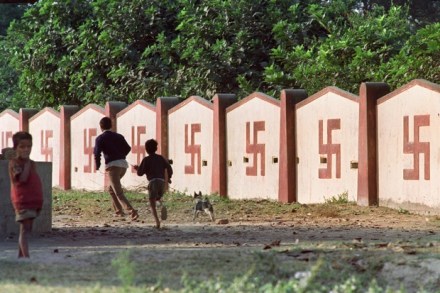
There is a nice row of swastikas at head height in Burlington Gardens, behind the Royal Academy. They are carved below a plaque ‘Founded ad MDCCCXXXVI’. (The date refers, not to the Academy, but to the University of London, which had its offices here until 1900.) The architect was James Pennethorne. His swastikas did not derive from India, I think, but from Greek temples he visited in Italy in 1826. Greek buildings often have swastika elements, if only by running together two strips of the key pattern. I was thinking about this because of the news that, in prospect of the Olympic Games in 2020, Japan was planning to change the sign for a temple on tourist maps from swastikas to little pagodas. The Japanese symbol is called manji and derives from Chinese writing.

Leap in the dark

From our UK edition

‘They all laughed at Christopher Columbus,’ sang my husband flatly, ‘when he said the world was round.’ I wasn’t going to tell him yet again that George and Ira Gershwin were wrong and everyone knew the world was round when Columbus set off. But there is a connection between Columbus’s name and the leap in the dark that he took in his voyage — and which David Cameron says ‘outers’ want to take today. I’ll stick to language, since this is not a political column. That very English word leap has no affinities in languages outside the Germanic family, unless, some scholars say, it is related in origin to the rather different-looking Greek word kolumbos, meaning ‘diver’.

Special status

From our UK edition

‘Special status?’ said my husband. ‘You mean like executioners, butchers and undertakers in Japan?’ I hadn’t suggested that, but had been thinking aloud about the phrase which, according to David Cameron, now describes Britain’s position in Europe: special status. My husband once went to Japan, which, he thinks, makes him an expert. He learnt about the ancient monkey performances given by people called Burakumin, a sort of untouchable. Apart from performing with monkeys, which was banned in the 20th century, they have been associated with unclean trades such as those he mentioned. Special, as I have remarked before, is slippery. The special relationship between Britain and America has at times been highly valued.

Creaky voice

From our UK edition

My husband, not surprisingly, finds it extremely annoying. It, in this instance, is the use by women of creaky voice. If you don’t recognise the trend immediately imagine a youngish woman (not me) finishing a sentence with the phrase ‘really shiny leather’ and creaking, like a door, as she says the vowels. The trait is also known as vocal fry, as if it were produced by a chip-fryer. It is a feminine characteristic by a proportion of two to one. Reese Witherspoon was heard doing it to the phrase ‘truly heinous angora sweater’ in the film Legally Blonde as long ago as 2001. Recently I’ve heard Emma Barnett on Woman’s Hour doing it. Why do we women do it? If it’s a fashion, is it smart or downmarket?

Beware

From our UK edition

My husband pointed with his stick, which he carries not to steady himself but to cudgel pedestrians out of his way, and said: ‘What am I supposed to do about that?’ His question was in response to a notice posted up on the wall by a platform at Vauxhall Underground station: ‘Due to our works. Beware of noise. Beware of smell.’ It is part of the current conflation of the meanings of be aware and beware. The confusion runs both ways. That Underground notice was intended to make passengers aware that there would be noise and smell (of burning perhaps), so that they would not flee in alarm. A flight response would have been the appropriate one if instead the notice had said: ‘Beware, Minotaur loose.