David Blackburn

A nation of property owners

From our UK edition

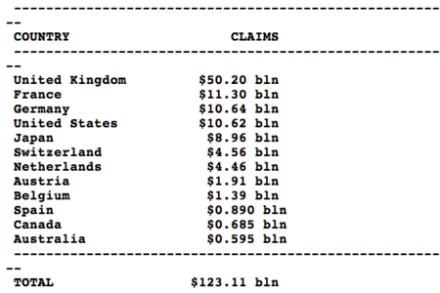
An Abu Dhabian official has briefed Reuters that Abu Dhabi will rescue Dubai on a “case-by-case basis”. The official stated: “We will look at Dubai's commitments and approach them on a case-by-case basis. It does not mean that Abu Dhabi will underwrite all of their debts. “Some of Dubai's entities are commercial, semi-government ones. Abu Dhabi will pick and choose when and where to assist." This is potentially bad news for the UK taxpayer, who faces the prospect of provided further cover for British banks, who invested $50bn in the region at the height of the boom. The reason we're in the firing line?
Outmanoeuvred Brown endangers recovery

From our UK edition

The Times’ Ian King writes that Dubai’s predicament presents an opportunity for the City to attract new business. There is no reason why, with attractive incentives, London shouldn’t capitalise on Sheik Mohammed’s momentary lapse of reason. However, the appointment of Michel Barnier, an evangelical protectionist who makes Joseph Chamberlain look like the father of Free Trade, as EU regulating supremo is a disaster for Britain. The appointment raises further questions about Gordon Brown’s acceptance of Baroness Ashton as the EU’s foreign minister. Michael Fallon is no doubt: “Brown has been completely outwitted. We now have none of the three key economic jobs in Brussels.

The coming sandstorm

From our UK edition

The FT’s Alphaville blog has published a table detailing foreign banks’ exposure in the UAE. Look away now because it’s horrific. Of course not all of this lending was to Dubai, but those sort of funds are unlikely to be required by Abu Dhabi, with its gigantic oil profits and £900bn wealth fund. If Abu Dhabi doesn’t bail out its ailing partner, you can bet your bottom dollar who will.

Commissioner Boris

From our UK edition

The Evening Standard reports that Boris Johnson is set to become the Tories’ first elected police commissioner. Chris Grayling told the paper: "We envisage the Mayor of London being the elected police commissioner. This would strengthen the role of the Mayor. However, I'm absolutely clear that no reform we introduce will allow any elected politician to interfere in operational policing and we will make absolutely certain that the independence of operational policing is protected in law." Under Tory proposals the mayor will be responsible for hiring and firing chief constables, tailoring police objectives to local requirements and budgeting. Naturally, the contrarians are gathering.

Dodgy doings in the desert

From our UK edition

Of all the lunacy engendered by this financial crisis, Dubai’s decision to call a six-month creditor standstill on its chief holding company is the most pronounced. Dubai’s successful but hideous entrepot model depends on the confidence capital markets, and as a rule markets don’t react to nasty shocks with a shake of the head and a song and dance routine. It’s as if plague has descended on every stock exchange in the world; investors are fleeing for safety. Overnight, shares in Asia collapsed between 3 and 5 percent, and the FTSE, Dax and Cac40 have opened around one percent down. Prepare for another black day. Will this blip develop into a crisis?

Smoking guns and missing memos

From our UK edition

Sir Christopher Meyer gave evidence to the Chilcot inquiry this morning. He spoke with characteristic flamboyance, awash with elegant witticisms and indiscretions calculated to amuse. Amid this tour de force, Meyer released one potential weapon of mass destruction. Hans Blix was given too little time to conduct a satisfactory inspection. Courtesy of Andrew Sparrow, here is the relevant transcript: ‘The real problem, which I did draw several times to the attention of London, was that the contingency military timetable had been decided before the UN inspectors went in under Hans Blix. So you found yourself in a situation in the autumn of 2002 where you could not synchronise the military timetable with the inspection timetable.

Missing the point | 25 November 2009

From our UK edition

The Today programme really let Paul Myners off the hook this morning. The interviewer obsessed with why the loans had remained secret for so long. It’s a fair question, and it seems bizarre that we only learn of them ten months after the borrowing was repaid in full. However, there are more important questions. As I wrote yesterday, these disclosure’s most potentially volatile revelation is that Gordon Brown was propping up HBOS whilst urging Lloyds to purchase the ailing giant. Was this issue examined in any depth? No, though it must be determined whether the Lloyds’ board understood HBOS’s predicament in its horrific entirety. The equally crucial question of how the government is addressing the banking system’s continued frailties received scant attention.

PMQs Live Blog | 25 November 2009

From our UK edition

Stay tuned for live coverage from 1200. 12:03: Here we go. Brown gets things underway with the weekly Butcher's Bill and remembrance of those killed or otherwise affected by the floods in Cumbria. 12:06: And here comes Cameron - he follows Brown's thanksgiving lead. Cameron asks how quickly temporary bridges across the Derwent in Cumbria can be constructed. Brown doesn't know as yet as he and the Secretary of State await an engineers report. Brown adds that all costs will be met by the Department of Environment. Cameron wants eveything that can be done for those affected be done. Brown rambles and says he will do everything he can and lists a host of new tractor stats about electricity and landlords.

With friends like these | 25 November 2009

From our UK edition

Bob Ainsworth has publicly criticised President Obama’s slothful deliberation on an Afghan troop surge. The Defence Secretary said: ‘We have suffered a lot of losses. We have had a period of hiatus while McChrystal's plan and his requested uplift has been looked at in the detail to which it has been looked at over a period of some months, and we have had the Afghan elections, which have been far from perfect let us say. All of those things have mitigated against our ability to show progress... put that on the other side of the scales when we are suffering the kind of losses that we are.

There are more pressing financial concerns than this

From our UK edition

The two top dogs at the Treasury Select Committee, John McFall and Michael Fallon, give remarkably different reactions to the news that ministers withheld details of emergency loans to RBS and Lloyds for over a year. McFall argues that secrecy was necessary to avoid a run on the banks; Fallon expresses outrage that Lloyds’ shareholders were not privy to all information when considering the disastrous purchase of HBOS, urged on them by the Prime Minister.   Both have their points. Blind panic is the defining recollection of those autumnal days. If the situation had been exacerbated by full disclosure of the mess RBS and Lloyds were in then God alone knows what pandemonium would have ensued.

Will Chilcot be any different?

From our UK edition

The Chilcot inquiry’s precedents don’t auger well. It's unfair to describe the Hutton and Butler inquiries as 'whitewashes', but their colour was certainly off-white. That said, the condemnatory characterisation of Sir John and his panel as ‘establishment figures’ is redolent of a lower-sixth common room circa 1968. Who else could conduct this inquiry? Mohammed al-Fayed? Pete Doherty? The Bishop of Bath and Wells? The Iraq controversy has not abated and a panel of angels would not be pure enough for some. But it’s absurd to suggest that anyone besides officials and foreign policy experts, with an intricate knowledge of the practices and issues concerned, should or can decide such matters.

Carry on Karzai

From our UK edition

The New York Times reports that 15 Afghan ministers, past and present, are under investigation on suspicion of corruption. Obama’s and Brown’s unequivocal stance on the Mk.3 Karzai government leaves the president with no choice but to sacrifice a few lambs. However, if ever there’s a bolthole Karzai will scamper through it. Corruption is Afghanistan’s chief political currency and Karzai’s authority, such as it is, rests on backhanders. Oligarchic Afghan law decrees that ministers must be prosecuted by a specially convened court, and guess who controls judicial patronage? It’s an ingenious constitutional contrivance for seeming to do something but actually doing nothing. The recent history of Afghan special courts is hardly illustrious.

Satire is dead

From our UK edition

I laughed more at the Antiques Roadshow than I did at The Thick of It. In fact, finding the louche Eric Knowles delivers more cutting gags per minute than Malcolm Tucker has become a feature of my weekends. And it’s a sad one because The Thick of It was the sharpest and most savage programme on television - a welcome focus for one’s anger at the Labour government. Truth is, Armando Iannucci’s show has dated. The outwardly crisp style of government it satirised has descended into a very public ‘omnishambles’. The reality is funnier than the fiction.

Mumsnet versus Ofsted – a prelude to the post-bureaucratic age

From our UK edition

Ofsted is bracing itself for the public lynching it roundly deserves. The Guardian reports that the Children, Schools and Families Select Committee, local authority service heads and head teachers are united in condemnation of the ‘wasteful’ bureaucratic giant in the wake of its annus horribilis. What is Ofsted doing wrong? The highly respected former Chief Inspector of Ofsted, Sir Mike Tomlinson, is clear – the scope of its remit and working practices are to blame. He tells the Guardian: ‘The question needs to be asked and answered as to whether Ofsted has the appropriate skills and experience to carry out its agenda. Inspection systems that rely too heavily on data and tick-box systems is not what we need. I worry we are heading that way.

What should be in the British Bill of Rights?

From our UK edition

The success or failure of Cameron’s EU policy rests in part on the promised British Bill of Rights. What is clear is that Tories are unclear what should be included in it. One question that is yet to be answered is whether aspects of the constitution should be entrenched? Writing on the Blue Blog today, Michael Howard writes: 'Any decision about these rights requires a balancing of competing rights. The fundamental question is who should be responsible for striking that balance: elected MP’s or unelected judges? On terrorism, Parliament twice, after great debate, reached its view. Yet twice the judges have held that Parliament got it wrong.

Where to start cutting

From our UK edition

Michael Portillo believes that a future Tory government, like those that came before it, will not succeed in cutting public spending. I agree with Pete: public finances are so parlous that cuts have to be made. Demolishing the state is not an overnight job; it will take time and cost money, and so it should because the stakes are too high for a quick fix, cowboy politics solution. But, immediate savings are to be made through efficiencies. ‘Efficiency savings’ are derided as being insubstantial. Such an analysis is simplistic. Endemic waste is perpetuated by irrational systems. The Department for Work and Pensions runs an administrative budget of £2.7bn.

There are moral absolutes: aspects of Sharia are barbaric

From our UK edition

Credit where credit’s due, Peter Tatchell wrote an article for the Guardian describing Sharia law as being “especially oppressive”. He says: ‘Its interpretations stipulate the execution of Muslims who commit adultery, renounce their faith (apostates) or have same-sex relationships. Sharia methods of execution, such as stoning, are particularly brutal and cruel – witness the stoning to death this week in Somalia of a 20-year-old woman divorcee who was accused of adultery. This is the fourth stoning of an adulterer in Somalia in the last year. Somalia is an extreme example of the Sharia oppression that exists in large parts of the Muslim world. As ever, Muslim women are often the main victims.

Nothing’s changed

From our UK edition

It’s a pity the Spectator has already run a political scandals supplement: the Telegraph’s latest scoop is a sordid classic. The Telegraph allege that Tory MP David Curry has claimed £28,078 on a second home from which his wife had banned from using after Curry used it as a rendezvous for assignations with a local school mistress. Curry is standing down at the next election and could make a packet if he sells the taxpayer funded property. There is a further complication. Until last night, Curry was the chairman of the parliamentary standards and privileges committee, the authority that decides how errant MPs will be punished. The committee was rightly criticised for its very lax disciplining of Jacqui Smith and Tony McNulty.

They think it’s all over | 19 November 2009

From our UK edition

It looks like curtains for ‘President’ Blair. Every commentator besides Adam Boulton and James MacIntyre, who is possessed of a ruinous gambling streak, have now virtually written off the former PM. Blair has an uncanny knack of winning through against the odds, so I will not call time on his chances quite yet. But with Merkel and Sarkozy united against him, the fat lady is warming up for the main event with a few scales and arpeggios. Where would failure leave Blair with regard to Labour and the election?

Hoist by his own petard

From our UK edition

The Queen’s Speech contained some worthwhile bills. Parents will face orders when a child breaches antisocial behaviour rules, and the Flood and Water Maintainence Bill, whilst unlikely to rival the 1911 Parliament Act in the annals of Westminster, is welcome, responsible legislation. I can even see that if you’re that way inclined, which I’m not, Harman’s Equality Bill has something to commend it. The remainder of the programme is a political landmine, presenting benevolences that mask incendiary conceits. Clever politics theoretically, but in the rush to prime the fuses, and with little thought for these bills’ practical application, this incomparable government has blown itself up.