Daniel Korski

Goodbye Euro?

From our UK edition

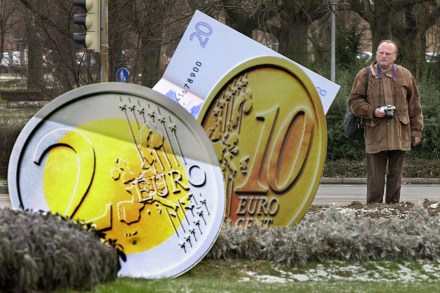
I have just visited the two countries that are making the headlines in the European newspapers – Germany and Greece. During my trip, I met officials, journalists, and key advisers to both Prime Minister Papandréou and Chancellor Merkel. Sitting on the flight back to London I have regrettably come to the conclusion that the Euro is probably done for – or that Greece will default inside the Eurozone. Until now, I have dismissed the pessimists, thinking that the Euro would be saved. But after my trip I have changed my view for a number of reasons. Nothing I saw in Greece has convinced me that the Greek government is able, ready and willing to oversee the kind of austerity programme required to restore faith in its economy.
A Human Rights Minister?

From our UK edition

Britain’s role in protecting the downtrodden and protecting the weak has significant historical pedigree. The British role in abolishing the international slave trade was one of the first liberal interventions. And as Abigail Green's biography shows, Britain’s Sir Moses Montefiore was not just a pre-eminent Jewish figure of the nineteenth century, but his pioneering approach to the problem of Jewish persecution helped transform the international response to abuses of human rights. No party, though, is going to the election with the kind of commitment to promote human rights abroad as Robin Cook did when he unveiled his ideas for an “ethical” foreign policy. This is hardly a surprise.

Coalition government may be minimal government

From our UK edition

Post-election deals are tough for those on the wings of political parties - the activists, the die-hards, the idealists. Those in the middle, by definition the pragmatists, find it easier to prioritise aims or to compromise in the short-term in order to win over the long-term. Any Con-Lib deal will be tough for the left-wing of the Lib Dems and the right-wing of the Conservative party. But both will have to accept that power is better than opposition and that being able to implement part of your party programme is better than carping on the sidelines, your manifesto languishing on never-visited websites.

The ex-factor

From our UK edition

One of the interesting features of this election campaign is the near-absence of ex-leaders in national election roles. Tony Blair has been stuck in the Middle East because of the eruption of the Eyjafjallajökull volcano and has, at any rate, been “Gored” by Gordon Brown, who is as keen to have his predecessor canvassing for Labour as Al Gore was to see ex-president Bill Clinton in the 2000 election. The former Deputy Prime Minister John Prescott has been more active. For the Tories, Michael Howard is standing down and has not been particularly visible. When I saw him recently in Portcullis House, he looked chipper and relaxed – not like a man about to electioneer for all he is worth.

Ex-Obama aide “worried” about Tory Euroscepticism

From our UK edition

One of Labour’s talking points during the election has been that even the US administration is worried about Conservative Europe policy and how a government led by David Cameron may marginalise Britain in Europe and hobble Europe in the world. Until now, there has been very little to prove the concern. US Secretary of State Hilary Clinton has said nothing, nor has anyone in the White House. But two days ago came the clearest sign that the US administration may indeed be worried.

Next time, do a Bill

From our UK edition

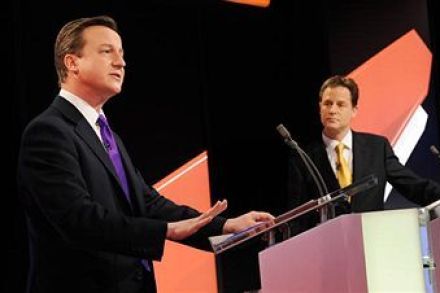
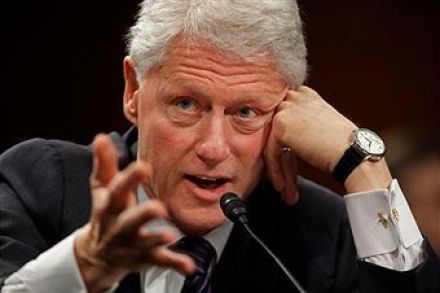
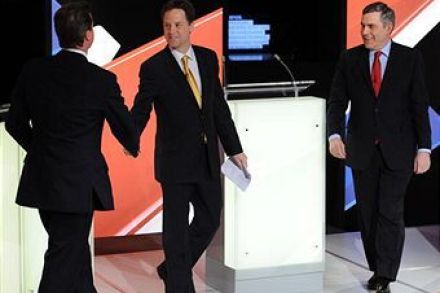
So it’s all down to the next debate. The election will probably be decided in 90 minutes, each segment of 20 seconds for every day of a new five-year mandate. In which case, what is the one thing David Cameron will need to take away from last night’s debate, his “take-home”, as a US analyst might call it, to win decisively and get into the 37, 38, 39 percent range that he needs for the Tories to win a majority? He needs to do a Bill. Clinton, that is. Last night, the Tory leader did far better than in the previous debate. He started a bit slowly, and improved as the debate went one (as opposed to Nick Clegg, who began well and deteriorated as the evening wore on). In the end, I think he won the debate.

Memo to Adam Boulton: It’s about detail

From our UK edition

Since the last thing David Cameron is likely to do is surf the web for advice for tonight’s debate, Nick Clegg needs no help and Gordon Brown deserves none, I will give my (again, unsolicited but free) advice to Adam Boulton, the moderator of tonight's Sky debate. Ask for details. The leaders have rehearsed top-level answers and can express them confidently and fluently. But we need to know if there is anything underneath the surface, beyond the well-crafted lines. Take Afghanistan. They will all say that the fight is important, that a well-resourced military effort is key but will not be enough and that a politico-economic strategy is needed.

Is Europe a Con-Lib deal-breaker?

From our UK edition

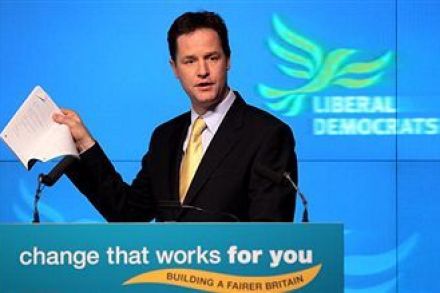
Europe is likely to play a big role in tonight’s debate. It is probably the one issue that divides the Liberal Democrats and the Tories as much as electoral reform. Nick Clegg, a former MEP and adviser to then-EU Commissioner Leon Brittan, is a euro-enthusiast who would like Britain to join the Euro, even if it takes time. David Cameron is a euro-skeptic (though not, to the chagrin of many CoffeHouse readers, obsessed about the issue).   But neither wants a confrontation with the EU and other European governments over the next four years - and the Liberal Democrats have become quieter over time about their pro-EU tendencies.

Get ready for “Clameronism”

From our UK edition

Since the Lib Dems starting surging there has been no shortage of speculation about the possible coalitions that may emerge after the election - Lab-Lib, Lib-Lab, Con-Lib. There has also been breathless speculation about what posts Nick Clegg might demand, including by yours truly.  But none have been as cleverly-written as Hugo Brady’s. A think-tanker for CER, Brady is predicting the rise of "Clameronism": 'Buoyed by a huge increase in the Liberal vote, Clegg at first opted for opposition. He bet that a swift second election was likely and that the Liberal Democrats would again double their seats. But the threat of a new financial crisis later that year spelt an end to normal politics.

Nick Clegg and the 3 am phone call

From our UK edition

Compared to many CoffeeHousers, I don’t find the Liberal Democrat’s foreign policy positions as problematic. Nick Clegg is smart, internationalist and has – unlike David Cameron and Gordon Brown (and Tony Blair) – plenty of foreign policy pre-leadership experience. But looking through the Lib Dem manifesto, I came across its pledge on Iran, which is quite problematic for a party that is keen to shed its beardie-wierdie, peacenik image and whose leader may even end up running the Foreign Office. The manifesto says that, on the one hand, the Lib Dems support “action by the international community to stop Iran obtaining nuclear weapons.” But the party also makes clear that they “oppose military action against Iran.

Where is the killer poster?

From our UK edition

Most politicos agree that a vote for Nick Clegg will likely prop up a Labour government, even if it will be led by someone else than Gordon Brown. Most voters, however, may not realise this. So what the Tories need is a poster which shows in easy-to-understand ways, the causal link. CoffeeHousers, surely the idea of the Lib Dems propping up Labour lends itself to a number of images - if you have any ideas then either mention them below, or send them in to dblackburn @ spectator.co.uk or phoskin @ spectator.co.uk and we'll post a selection of the best.

A world without planes

From our UK edition

In the book a World Without the West, the authors invite the reader to imagine the non-Western world where South-to-South grow so strong that they bypass the traditional Euro-Atlantic powers. Stuck in southern Europe because of Eyjafjallajokull's eruption, I have begun thinking about life without airplane travel.   The last 15 years have not only seen an explosion in cheap airline travel - spawning new tourist industries in once-forgotten European cities - but there has been an increase in the use of air transport for goods, mail, soldiers and much else besides. What would happen if this is ground to a halt in Europe not for a weekend or weeks but months?

Overseas aid could be a Tory winner in Con-Lib fights

From our UK edition

As the Conservatives start looking at areas where the Liberal Democrats are weak, or where differences can be drawn between the parties, they are honing in on international development. In the Independent on Sunday, David Cameron and anti-poverty star Jeffrey Sachs lay out the party's plans if they win power. It includes a commitment to spending 0.7 of GDP on overseas aid, an emphasis "on greater transparency, ensuring the money reaches the people who need it most" and "action on women" as a conduit to development. The op-ed is clearly inspired by the work of Tory aid spokesman, Andrew Mitchell, who has written a piece for ConservativeHome this evening.

Nick Clegg: the Hans-Dietrich Genscher of Britain

From our UK edition

Nick Clegg has always said that if no party can command a majority in parliament, he will support the party voters have been seen to support. It was assumed that if the Tories were the biggest party - but a few members short of an outright majority - he would back them. But if the YouGov poll comes true, on a uniform swing Labour will be the largest party and the Liberal Democrats still the third largest party in parliament but with 90-odd seats. With Labour out front, Clegg's logic would suggest he would back a Labour-led government. But Clegg's poor relationship with Gordon Brown is well known and with such a strong showing for the Lib Dems will he feel less bound by who is the largest party and feel empowered to bargain more freely?

Greece’s deferred crisis

From our UK edition

I am sitting in a busy café in Athens’s fancy Kolonaki district, watching the city’s elite stroll by in their well-fitting couture jeans, as the afternoon sun shimmers off the dusty streets. The women are weighed down by that most delightful of burdens -- shopping bags from the local FENDI shop -- and the latte I have just ordered comes at the recession-defying price of five euros.   The regular demonstrations, which block the city centre and bring the police out in force, are now greeted with resignation rather than concern. It may take a little longer to travel home when the shops close -– which they do mid-day on Mondays, Wednesdays, and Saturdays (on Sundays they are closed all day) -- but summer is on its way.

Memo to Cameron: don’t be angry

From our UK edition

There will be no shortage advice for David Cameron as he prepares for tonight’s TV debate. Wear this tie, smile a lot, be direct but not controversial and so on. The newspapers have been full of tips and lessons from the US debates. The Tory leader is also said to have hired Squier, Knapp, Dunn Communications, a DC-based political consultancy, specifically for help with the TV debates. Allow me to add my piece of (unsolicited but free) advice: don’t be Mr Angry. People want to like you; they want to feel that you can be trusted. They know they don’t like Labour. They know that the country needs change. But they are not yet sure you represent a benign form of change.

The future might be yellow

From our UK edition

The Liberal Democrats are doing well. Very well. More voters seem actively to want a hung parliament - they neither hate Labour or love the Tories enough to act decisevely either way - and a vote for Nick Clegg seems a safe, fair choice. A few years ago Paddy Ashdown was over the moon to have won far fewer MPs than the party is hoping for at this election. Then came the "Iraq Bounce" with Charles Kennedy's anti-war stance doing the party well. Many assumed that without a clear-cut issue, and having chosen a leader who looked like David Cameron's younger brother, the Lib Dems might struggle. Instead, the party seems to be fighting off Tory inroads.

Voting blues

From our UK edition

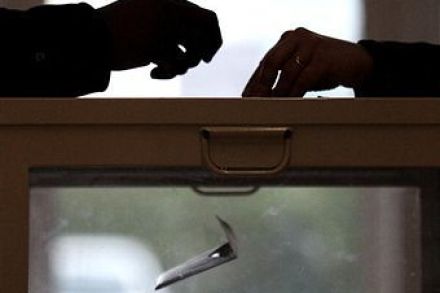
One of the key questions in any election is turnout: whose voters will turn up and whose won’t. People are clearly disappointed in the political class - on a scale from 0 to 10, trust in politicians and parties is hovering around 3 points - but does it mean that they will stay at home, spoil their ballots or opt for fringe parties and single-issue candidates? What about the talk of a hung parliament ? Will it make voters believe that their vote counts - and so bring them to the polling stations -- or make them stay at home, giving up on the idea that any change is possible? In the last three elections turnout was low, relatively speaking: 59 percent of the electorate voted in 2001 and 61 percent went to the polls in 2005.

The Big Idea Competition

From our UK edition

Whatever your political leanings, it is hard to deny that the Tories won the Big Idea Competition. The Labour Party offered a series of unconnected (if occasionally innovative) initiatives. But they lacked coherence. Their manifesto had what Peter Mandelson called “Blair Plus”, but also what could be referred to as “Prescott Squared”. “What's The Big Idea?” asked Sky’s Niall Paterson. The Tories on the other hand have a Big Idea – decentralisation. Giving power to citizens in a number of different ways. It is a concept that gives shape to the Tory manifesto, providing a ready stock of sound-bites.   But why do we need Big Ideas, as opposed to just Good Ideas?

Don’t mention ze Europe

From our UK edition

The Conservative Party’s departure from the European People's Party came down to a choice of expediency over principle. If you are inclined to accept that Britain will stay in the EU and that membership helps this country - even if it requires some compromises - you will likely find the move unfortunate. If you are more concerned about the principles at stake – and feel that Britain’s loss of sovereignty has gone too far – and do not care about the loss of influence on the legislative process, you are likely to be in favor of the Tory move.   David Cameron is keen to keep the issue of Europe away from the campaign - and he is likely to succeed.