Andrew J. Bacevich

Andrew J. Bacevich is president of the Quincy Institute for Responsible Statecraft.

Is the USA still worth fighting for?

From our UK edition

I have no personal investment in America’s Afghanistan war. My own service in Vietnam, now a half-century in the past, remains an abiding preoccupation, as does the more recent Iraq war, where my son was killed. But I feel no more emotional connection to America’s ‘longest war’ than to US efforts to pacify the Philippines at the turn of the 20th century. Even so, the abrupt collapse of the Afghan government and of the Afghan security forces over the course of a few days hit me hard. Rage, sadness, bewilderment, horror, humiliation: my emotional response cycled through all of these.
Trump hasn’t drained the swamp – he’s put the military in charge of it

From our UK edition

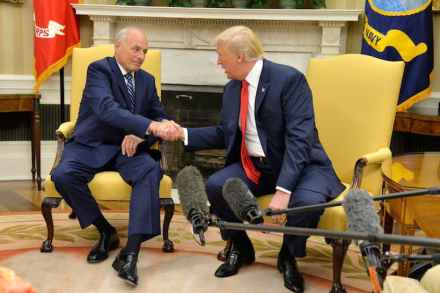
Dwight Eisenhower was right to warn Americans in 1961 of the ‘military industrial complex’, but perhaps it is now the only thing that stands between the US and chaos. The new White House chief of staff, General John F. Kelly, is the third general Donald Trump has appointed to his cabinet. Kelly is already getting a good press for introducing military discipline and order to the Trump White House. His first move was to fire the attention-grabbing billionaire Anthony Scaramucci as head of communications, and he’s said to have told even members of Trump’s family that they must book ‘face time’ with the President through him.

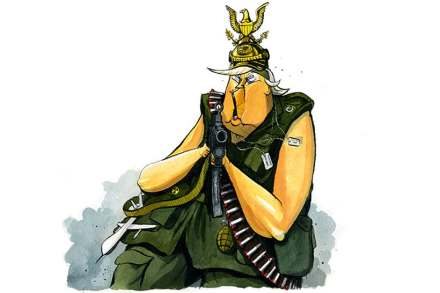
Donald Trump isn’t Hitler. Actually, he’s the new Kaiser Wilhelm II

From our UK edition

 Massachusetts All politicians wear masks. Donald Trump’s favourite is that of Maximum Leader. It was on display during this past week. ‘If China is not going to solve North Korea, we will,’ he said at the weekend, ahead of his meeting with Xi Jinping — a throwaway comment that could end up causing mayhem in the Far East. Next, his reaction to news of a chemical bombing in Syria. Trump blamed the atrocity on his predecessor’s ‘weakness and irresolution’, suggesting that he is keen to show the world what strength and resolve look like. The President, it seems, is not too dissimilar to the nightmare his political enemies warned us about: a nuclear-armed hothead itching to show the world how tough he is.

The Iran deal heralds a new era for US policy across the Middle East

From our UK edition

What is it about a nuclear deal with Iran that induces hysteria in certain quarters of the West?  In recent weeks, editors at both the New York Times and the Washington Post have seen fit to run op-eds calling for preemptively bombing Iran, apparently under the impression that preventive war has not yet received a fair shake.  Sure, Iraq didn’t work out, but why quit now?  By ensuring that the American people and their leaders do not overlook the possibility of giving war one more chance in Iran, these newspapers are presumably performing a public service.    In the Times, John Bolton, Dr. Strangelove with an unkempt moustache, describes a situation on 'the brink of catastrophe,' entirely attributable to President Obama’s folly.

Don’t listen to the hawks — the west should leave Iraq alone

From our UK edition

This is a preview from this week's Spectator, available tomorrow: Peering down from the Olympian heights of the New York Times, the columnist David Brooks writes that “We are now living in what we might as well admit is the Age of Iraq.”  There, in the Land of the Two Rivers,  he continues, a succession of American presidents has confronted the “core problem” of our era:  “the interaction between failing secular governance and radical Islam.

Time we left

From our UK edition

The journalist Michael Kinsley defines ‘gaffe’ as that which occurs when a politician accidentally tells the truth. Reacting to the latest bad news coming out of Afghanistan — an American soldier in the Panjwai district of Kandahar province went on a rampage, killing 16 civilians in cold blood — the presidential candidate Newt Gingrich committed a gaffe of the first order. Appearing on Fox News, the former House Speaker had this to say: Look at the things that are going on around the region and then ask yourself, ‘Is this, in fact, a harder, deeper problem that is not going to be susceptible to military force, at least not military force in the scale we are prepared to do?

How good a general was David Petraeus?

From our UK edition

Neoconservatives have constructed dangerous illusions around David Petraeus's strictly limited successes History has not dealt kindly with American generals of late. Remember when ‘Stormin’’ Norman Schwarzkopf ranked as one of the great captains of the ages? When members of Congress talked of promoting General Colin Powell to five-star rank, hitherto reserved for the likes of Marshall and Eisenhower? When bombing the Serbs into submission elevated General Wesley Clark to the status of a would-be presidential candidate? Or when Tommy Franks travelled the world giving speeches at $50,000 a pop to explain how he had liberated Afghanistan and Iraq?

Mission impossible

From our UK edition

The killing of Osama bin Laden settles nothing, decides nothing, and repairs nothing. Yet the passing of the al-Qa’eda leader just might serve an important purpose. We confront a moment of revelation: coming across bin Laden comfortably ensconced in a purpose-built compound in the middle of major Pakistani city down the street from the nation’s premier military academy should demolish once and for all any lingering illusions that Americans retain about their so-called global war on terror. The needle, it turns out, was not in the haystack but tucked safely away in our neighbour’s purse — the very same neighbour who professed to be searching high and low to locate that very same needle. Think we’ve been had? Bin Laden was an indubitably evil figure.

Remember Iraq?

From our UK edition

The process of forgetting ‘Bush’s war’ has already begun, says Andrew J. Bacevich. But if President Obama fails to learn from that disaster, he’ll pay the price in Afghanistan What is it about the war in Iraq that induces officials to lie, dissemble, prevaricate, and otherwise exert themselves to dodge the truth? Now even Barack Obama, who prior to becoming President accurately denounced Iraq as a ‘dumb war’, has joined the crowd. A much publicised speech on 2 August to the Disabled Veterans of America became President Obama’s own ‘mission accomplished’ moment, albeit this time without the triumphal banner and, blessedly, without America’s commander-in-chief decked out as a flyboy.

Obama is in hock to the hawks

From our UK edition

At the turn of the 20th century, an army of half a million Tommies imposed Britain’s will on the Boers, yet this nominal victory served chiefly to accelerate the downward spiral of British power. Foolishly attempting to recover its imperial holdings in Indochina after the second world war, France succeeded only in showing how weak it had become. In 1979, the seemingly mighty Red Army marched to folly in Afghanistan; within a decade the Soviet Empire disintegrated. Now comes the United States, seemingly intent on reprising the Russian experience, with Barack Obama — ironically, unexpectedly, perhaps even against his better judgment — serving as chief enabler. Once again, an inability to discriminate compounds and exacerbates the challenges of a nation in decline.

This is not World War Three — or Four

From our UK edition

In the immediate aftermath of 9/11, Norman Podhoretz, the distinguished American journalist and neoconservative godfather, penned a series of articles describing the attacks of 11 September 2001 as the opening shots of what he called ‘World War IV’. For Podhoretz, the more commonly used construct ‘global war on terror’ is too generic. Placing 9/11 in its proper context requires fitting it into the grand narrative of contemporary history which, as Podhoretz sees it, began in 1933 in Berlin. For Podhoretz and other neoconservatives — for large numbers of Americans generally — history is above all a morality tale.